
When a wet filter cake, powder, paste or particulate material needs to be converted into a dry, free-flowing product within a very short time, pneumatic flash drying and ring drying can provide an effective continuous drying route.
Unlike conventional dryers that retain material for minutes or hours, pneumatic dryers carry dispersed particles through a high-velocity drying gas stream. This creates intense heat and mass transfer with a short product residence time.
A flash dryer generally performs drying in a single pass, while a ring dryer uses a pneumatic loop and classification arrangement to selectively return particles that require additional drying.
This makes the technologies particularly relevant to:
- Starch and modified starch
- Food powders
- Chemicals
- Fine chemicals
- Minerals
- Pigments
- Pharmaceutical intermediates
- Biomass-derived powders
- Protein and gluten products
- Filter cakes and wet powders
- Selected slurries and pastes
GTI Dryers designs industrial drying systems around product characteristics, moisture requirements, throughput and process conditions rather than treating every powder as a standard flash-drying application.
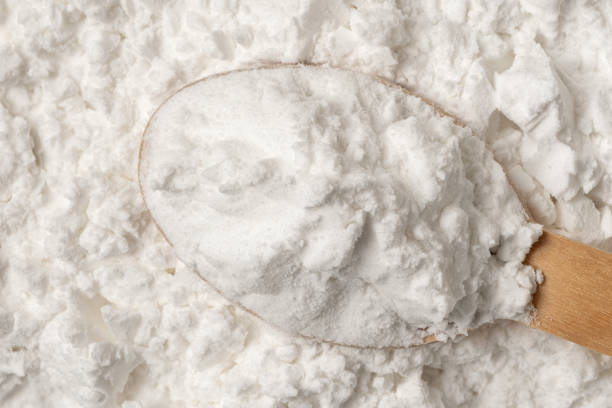
What Is a Pneumatic Flash Dryer?
A Pneumatic Flash Dryer, also called a Flash Dryer, uses a stream of heated air or another suitable drying gas to simultaneously convey and dry wet particles.
The basic process is:
Wet Feed → Disintegration → High-Velocity Drying Gas → Pneumatic Drying → Separation → Dry Product
Wet feed enters the drying stream and is dispersed into smaller particles. Because the particles are suspended and transported by the gas, moisture can evaporate rapidly while the material moves through the drying duct.
The short residence time is one of the defining characteristics of flash drying. Flash dryers are particularly suitable when free moisture is readily removed and the material can be dispersed and pneumatically conveyed.
What Is a Ring Dryer?
A Ring Dryer is an advanced pneumatic drying configuration that extends the principle of flash drying by introducing a recirculation loop and particle classification.
Instead of sending every particle directly to final collection, the system can classify particles according to their drying condition.
Simplified process:
Wet Feed
↓
Disintegration / Dispersion
↓
High-Velocity Drying Gas
↓
Ring / Loop Duct
↓
Particle Classification
↙ ↘
Drier/Finer Particles Wet/Heavier Particles
↓ ↓
Product Collection Recirculation
↓
Additional Drying Pass
This arrangement is particularly useful when the product contains moisture that cannot be removed completely in a single pass.
Industrial ring-dryer designs commonly use classifiers to selectively recycle material requiring additional drying, while sufficiently dry particles leave the drying circuit.
Flash Dryer vs Ring Dryer: The Important Difference
This is one of the most important sections for a buyer searching for the right technology.
| Feature | Pneumatic Flash Dryer | Ring Dryer |
|---|---|---|
| Drying path | Generally single pass | Multi-pass/recirculating |
| Residence time | Very short | Short, with selected recirculation |
| Classification | Usually external/simple separation | Integrated classification |
| Product recycling | Limited or application-dependent | Designed for selective recycle |
| Best suited for | Easily dried materials | Materials requiring additional drying |
| Moisture removal | Mainly free/surface moisture | Can provide additional drying passes |
| System complexity | Relatively simple | More sophisticated |
| Footprint | Compact vertical arrangement | Loop configuration |
| Typical applications | Native starch, chemicals, powders | Modified starch, gluten, minerals, selected powders |
| Process control | Airflow + feed + temperature | Airflow + feed + temperature + classification/recycle |
For example, industrial references describe native corn starch as a good flash-dryer application, while modified starch may require ring drying to provide additional residence time for bound or interstitial moisture removal.
Why Short Residence Time Matters
Flash and ring dryers can achieve very rapid moisture removal because the product is dispersed into a moving drying stream.
The main engineering benefit is not simply “high temperature.”
It is the combination of:
High heat-transfer rate + high mass-transfer rate + particle dispersion + short residence time
This can be valuable for products where prolonged exposure to heat may negatively affect:
- Colour
- Functional properties
- Texture
- Chemical characteristics
- Active components
- Product quality
However, short residence time does not automatically make every product heat-sensitive-safe.
The actual particle temperature depends on moisture evaporation, drying-gas temperature, moisture content, feed condition, particle size and residence-time distribution.
Therefore, inlet air temperature should never be used alone to judge product temperature.
How Does a Pneumatic Flash Dryer Work?
1. Feed Preparation
The wet feed may arrive as:
- Filter cake
- Wet powder
- Centrifuge cake
- Press cake
- Crumb
- Granules
- Paste
- Slurry
The feed must be suitable for dispersion into the drying stream.
2. Disintegration
Wet cakes can contain large agglomerates.
A disintegrator, mill, disperser or other feed-conditioning mechanism may be used to break the feed into smaller particles.
This step is extremely important.
Why?
If a large wet lump enters the dryer:
Large particle → low exposed surface area → slower drying
Whereas:
Fine dispersion → high surface area → rapid moisture transfer
For this reason, feed preparation can determine the performance of the entire pneumatic dryer.
The Importance of Wet-Cake Dispersion
Many flash-drying projects fail to achieve the desired performance not because the drying gas is insufficient, but because the feed is not dispersed effectively.
The dryer therefore needs to consider:
- Cake hardness
- Stickiness
- Particle size
- Feed moisture
- Feed temperature
- Bulk density
- Mechanical strength
- Cohesiveness
- Flowability
A sticky or highly cohesive cake may require mechanical conditioning before entering the pneumatic drying zone.
For difficult feeds, specialized disintegrators or agitated feeding arrangements may be considered.
Ring Dryer Classification: Why It Matters
The classifier is one of the major differences between a conventional flash dryer and a ring dryer.
Inside the ring system, particle behaviour can be influenced by factors such as:
- Particle size
- Particle density
- Moisture content
- Gas velocity
- Classification conditions
Particles that are sufficiently dry can be separated from the drying loop.
Particles that remain relatively heavy or insufficiently dry can be returned for another pass.
This creates a self-adjusting drying residence-time distribution rather than forcing every particle through exactly the same number of passes.
Ring Dryer for Starch
Starch is one of the most important applications for pneumatic drying technologies.
Potential applications include:
- Corn starch
- Maize starch
- Wheat starch
- Potato starch
- Cassava/tapioca starch
- Modified starch
- Starch derivatives
Native starch
Native starch that dries relatively easily may be suitable for a conventional flash configuration.
Modified starch
Modified starch can require a different drying strategy because the moisture may be more difficult to remove.
A ring configuration can provide additional drying passes while retaining relatively short overall exposure time.
Industrial drying references specifically distinguish flash and ring configurations for different starch products.
Ring Dryer for Food Powders
Pneumatic drying can also be evaluated for selected food and agricultural powders.
Potential applications include:
- Protein ingredients
- Gluten
- Food starches
- Cereal derivatives
- Plant-based ingredients
- Fibre products
- Agricultural powders
- Selected food-processing residues
For food applications, the system should consider:
- Hygienic design
- Material of construction
- Cleaning requirements
- Product contamination
- Temperature control
- Dust management
- Product quality
The exact configuration depends on whether the feed is already a powder, wet cake, slurry or another form.
Flash & Ring Dryers for Chemicals
Pneumatic dryers can be used for appropriately dispersible chemical products.
Potential applications include:
- Fine chemicals
- Chemical intermediates
- Pigments
- Dyes
- Crystalline materials
- Salts
- Specialty chemicals
- Selected pharmaceutical intermediates
- Agrochemical materials
Chemical drying requires particular attention to:
- Solvent content
- Flammability
- Dust explosibility
- Corrosiveness
- Product temperature
- Material compatibility
- Inert-gas requirements
- Exhaust treatment
A standard air-drying system should not be assumed suitable for solvent-bearing or combustible powders without a proper process-safety evaluation.
Ring Dryer for Minerals
Ring dryers can be considered for selected mineral products that can be dispersed and pneumatically conveyed.
Potential materials may include:
- Calcium carbonate
- Mineral powders
- Metal oxides
- Selected pigments
- Industrial mineral products
Ring drying can be advantageous when the product requires additional residence time beyond a simple one-pass flash configuration.
Industrial ring-dryer references include minerals, calcium carbonate, metal oxides and starch-based materials among application areas.
Flash Drying for Fine Powders
Fine powders have a high surface-area-to-volume ratio.
This can accelerate moisture transfer when the particles are effectively dispersed into the drying gas.
The process can therefore be useful when the target is:
Wet feed → rapidly dried free-flowing powder
Applications may include:
- Chemical powders
- Food ingredients
- Pigments
- Minerals
- Starch
- Fine industrial solids
But excessive fines can also create challenges involving:
- Dust loading
- Cyclone efficiency
- Bag-filter loading
- Product losses
- Explosion risk
- Powder handling
The separation system therefore needs to be designed as part of the complete dryer.
Can Flash Dryers Handle Wet Cakes?
Yes, but the answer depends on the nature of the cake.
A wet filter cake can be suitable when it can be broken apart and dispersed effectively.
Good candidate
Friable wet cake
→ easy disintegration
→ good particle dispersion
→ rapid moisture evaporation
Difficult candidate
Sticky/cohesive wet cake
→ poor dispersion
→ large agglomerates
→ longer internal moisture path
→ incomplete drying
In the second situation, mechanical conditioning or an alternative dryer may be required.
When Should You Choose a Flash Dryer?
A flash dryer is generally worth considering when:
- Free moisture dominates the drying load
- The feed can be dispersed effectively
- Very short residence time is desirable
- Continuous operation is required
- The final product should be a free-flowing powder
- Pneumatic conveying is practical
- The product does not require prolonged drying
Typical candidates include easily dispersed powders, starches, certain filter cakes, granules and other particulate materials.
When Should You Choose a Ring Dryer?
A ring dryer becomes more interesting when:
- One-pass flash drying is insufficient
- Additional drying time is needed
- Moisture distribution is broad
- Product classification is useful
- Internal product recycling can improve drying
- The material requires multiple short drying passes
- Final moisture control is important
The ring configuration can therefore be viewed as an extension of pneumatic flash drying rather than a completely unrelated dryer technology.
When Flash & Ring Dryers May Not Be the Right Choice
Pneumatic drying is not a universal solution.
Consider another technology when:
The product is extremely sticky
A paddle, contact or specialized dryer may provide better handling.
The material cannot be pneumatically conveyed
A belt, tray, rotary or other mechanical conveying system may be more appropriate.
Very low-temperature drying is essential
Vacuum, heat-pump or freeze drying may deserve consideration.
The feed is a liquid
Spray drying may be more appropriate if the objective is direct conversion of a liquid feed into powder.
The product requires long residence time
A ring dryer provides recirculation, but another dryer may still be more suitable.
Large amounts of bound moisture dominate
Drying kinetics should be evaluated before selecting a short-residence pneumatic system.
This “when not to use it” approach is important because the correct dryer is determined by product behaviour, not simply by production capacity.
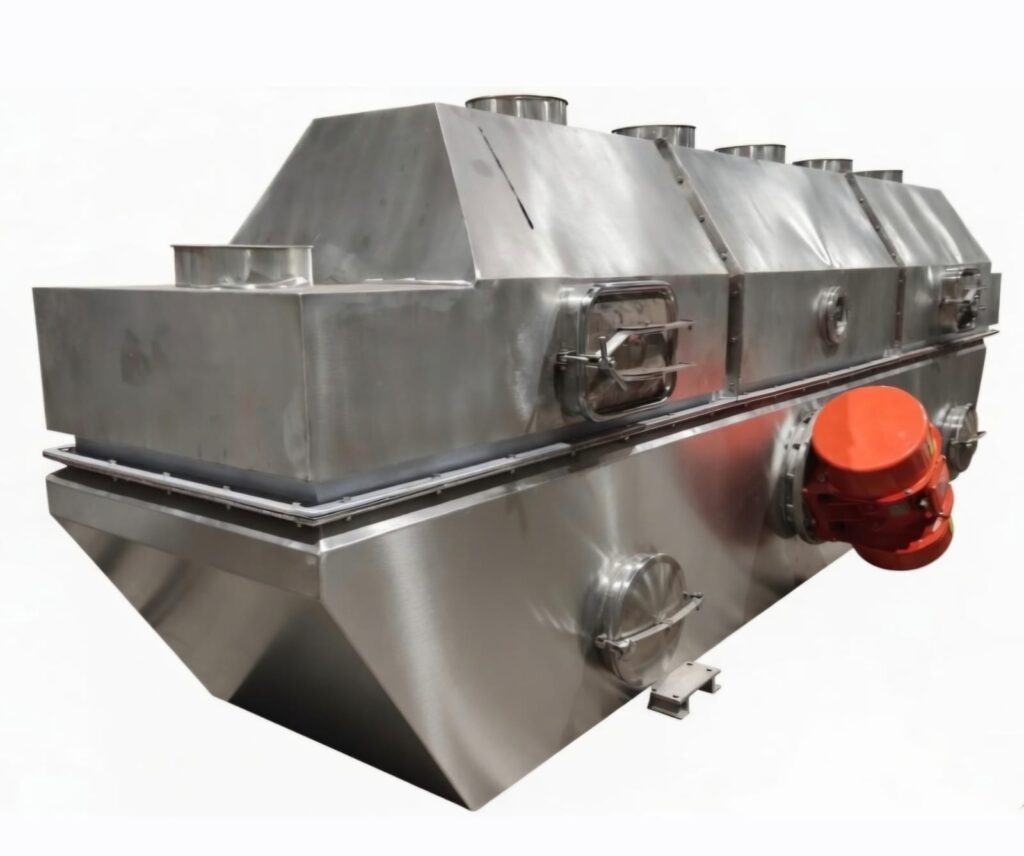
Flash Dryer vs Fluidized Bed Dryer
Both technologies can provide rapid drying, but their operating principles differ.
| Parameter | Flash Dryer | Fluidized Bed Dryer |
|---|---|---|
| Product movement | Pneumatic conveying | Fluidisation |
| Residence time | Very short | Usually longer |
| Feed | Wet cake, powder, dispersed particles | Free-flowing particles |
| Mechanical dispersion | Often important | Less central |
| Product classification | Possible | Depends on configuration |
| Typical use | Rapid surface/free-moisture removal | Final drying and moisture uniformity |
| Footprint | Compact vertical system | Larger process chamber |
| Cooling | Separate or integrated | Can be integrated |
In some applications, flash drying followed by fluid-bed finishing can be considered rather than choosing one technology exclusively.
Flash Dryer vs Spray Dryer
These dryers are often confused because both can produce powders.
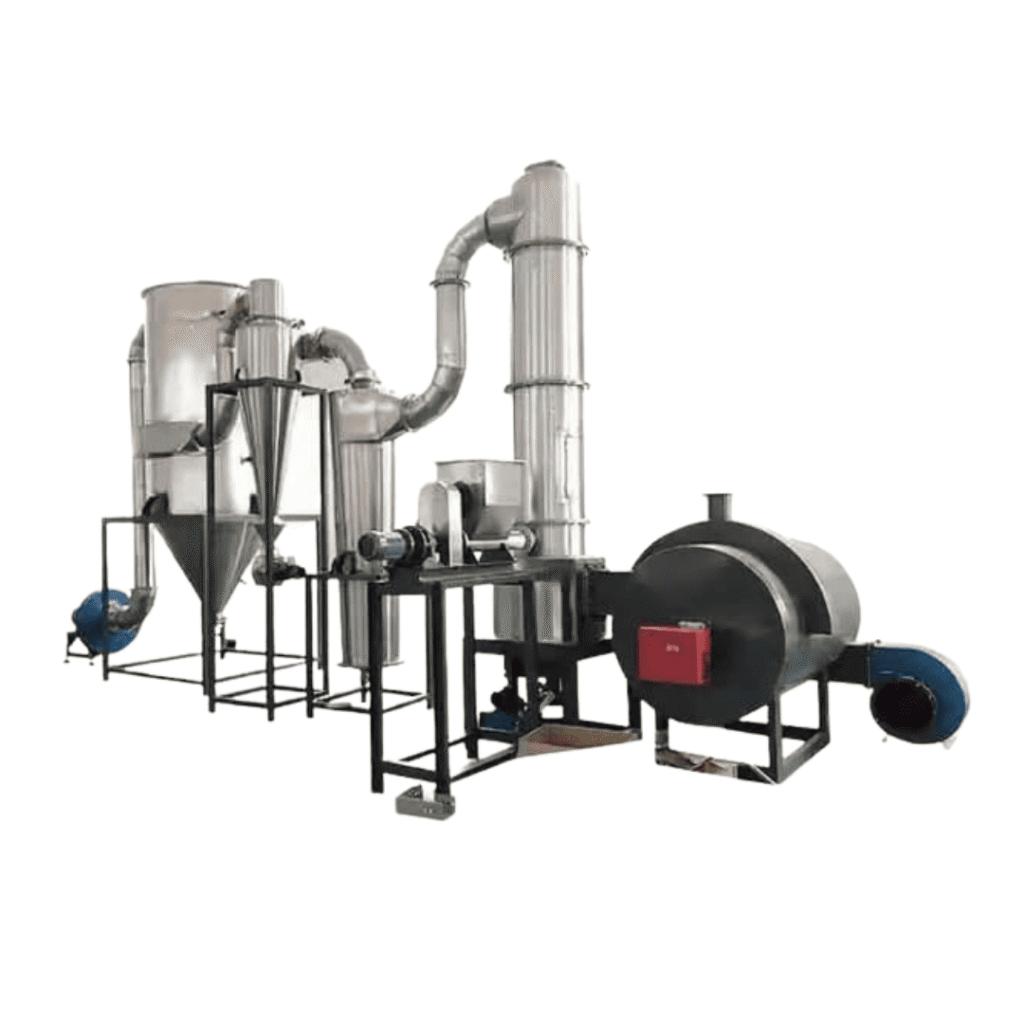
Flash Dryer
Starts with a wet solid, cake, crumb, paste or particulate feed.
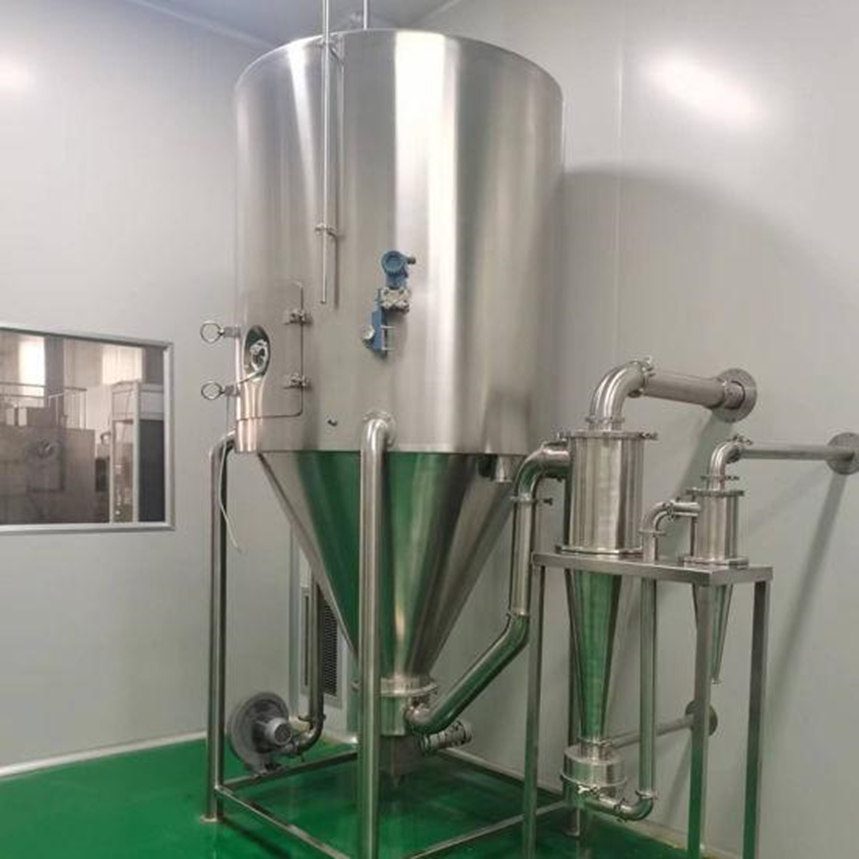
Spray Dryer
Starts with a liquid, slurry or suspension that is atomized into droplets.
If your feed is already a wet solid that needs rapid drying, a pneumatic flash system may be more relevant.
If your feed is a liquid that needs to be converted into powder, spray drying may be the appropriate technology.
Flash Dryer vs Rotary Dryer
| Feature | Flash Dryer | Rotary Dryer |
|---|---|---|
| Residence time | Very short | Longer |
| Feed | Fine/dispersible solids | Bulk solids |
| Particle conveying | Air/gas | Rotating drum |
| Heat transfer | Mainly convective | Convective/contact depending on design |
| Footprint | Compact vertical | Larger |
| Product size | Fine/particulate | Broad bulk-solids range |
| Typical applications | Starch, chemicals, fine powders | Biomass, minerals, chemicals, bulk solids |
For coarse, heavy or poorly dispersible materials, a rotary dryer may be more practical.
Flash Dryer vs Ring Dryer vs Fluid Bed: A Practical Decision
| Your Process Requirement | Technology to Evaluate |
|---|---|
| Very rapid drying of dispersed wet solids | Flash Dryer |
| Additional drying through product recycle | Ring Dryer |
| Free-flowing particles requiring controlled finishing | Fluid Bed |
| Liquid-to-powder conversion | Spray Dryer |
| Sticky wet cake requiring indirect drying | Paddle/Contact Dryer |
| Large bulk solids | Rotary Dryer |
| Low-temperature sensitive material | Vacuum/Heat Pump/Freeze Dryer |
This is not a universal selection chart. Product testing and process calculations should determine the final configuration.
Drying System Components
A complete pneumatic dryer normally involves more than the drying duct.
Depending on the application, the system may include:
Feed System
- Screw feeder
- Rotary valve
- Hopper
- Metering system
- Cake breaker
Disintegration System
- Disintegrator
- Mill
- Rotor
- Disperser
Drying System
- Drying duct
- Ring loop
- Classifier
- Air heater
- Circulation fan
Product Separation
- Cyclone
- Multi-cyclone
- Bag filter
- Product collection system
Exhaust System
- Exhaust fan
- Ducting
- Emission-control equipment
Cooling
- Product cooler
- Fluid-bed cooler
- Air cooling arrangement
The exact configuration depends on the product and environmental requirements.
Heating Options
Pneumatic dryers can potentially be integrated with different heat sources.
Depending on plant conditions, options may include:
- Steam
- Thermal oil
- Natural gas
- Biogas
- Waste heat
- Electric heating
- Other indirect or direct heating arrangements
For food, pharmaceutical and sensitive applications, indirect heating may be preferred where direct combustion-gas contact is undesirable.
The appropriate heat source should be selected according to:
Energy cost + product quality + plant utilities + emissions + safety + process temperature
Energy Efficiency in Flash & Ring Drying
Rapid drying does not automatically mean minimum energy consumption.
The thermal performance depends on:
- Initial moisture
- Final moisture
- Feed temperature
- Air temperature
- Airflow
- Solids loading
- Heat losses
- Dryer insulation
- Exhaust temperature
- Heat recovery
- Product dispersion
- Residence time
- Recirculation ratio
A poorly dispersed feed can consume more energy because the drying gas is unable to efficiently contact the product.
A correctly designed ring dryer may improve thermal utilisation by recirculating material that needs additional drying instead of unnecessarily increasing the severity of a single-pass system.
Product Quality and Temperature Control
For heat-sensitive products, the objective is not simply to reduce the inlet-air temperature.
Instead, engineers should evaluate:
- Particle temperature
- Moisture evaporation rate
- Gas temperature profile
- Residence time
- Product moisture
- Heat exposure
- Feed dispersion
Evaporative cooling can keep product temperature below the drying-gas temperature during portions of the drying process, but this should be verified for the specific product and operating conditions.
Dust Collection Is Part of the Dryer
Fine powders create a significant separation challenge.
The drying gas leaving the dryer may contain:
- Product fines
- Dust
- Condensable material
- Moisture
- Process vapours
A typical collection train may include:
Dryer → Cyclone → Bag Filter → Exhaust
The exact arrangement depends on particle size, product value, emission limits and process conditions.
For pharmaceutical, food and chemical applications, collection efficiency and cleanability can become major design considerations.
Safety for Fine Powders
Starch, food powders, biomass and many chemicals can create combustible-dust risks.
Therefore, the project should assess:
- Dust explosibility
- Minimum ignition energy
- Explosion pressure
- Dust concentration
- Static electricity
- Hot surfaces
- Spark sources
- Pressure relief
- Explosion venting
- Isolation
- Inerting requirements
Starch, for example, can present combustible-dust hazards, so dryer safety engineering must be incorporated into the equipment design rather than added later.
For pharmaceutical and chemical materials, solvent vapours may introduce additional fire and explosion considerations.
How GTI Can Evaluate Your Flash or Ring Dryer Requirement
A technically correct dryer starts with the feed—not the machine.
Step 1 — Understand the Material
GTI can evaluate:
- Product type
- Particle size
- Bulk density
- Initial moisture
- Final moisture
- Thermal sensitivity
- Stickiness
- Flowability
Step 2 — Understand the Feed Condition
Is the feed:
- Filter cake?
- Wet powder?
- Paste?
- Slurry?
- Granule?
- Crumb?
- Fine particulate?
This determines whether pre-conditioning or disintegration is required.
Step 3 — Calculate the Drying Load
The engineering assessment should establish:
- Water evaporation rate
- Dry solids throughput
- Gas requirement
- Heat requirement
- Residence time
Step 4 — Select the Pneumatic Configuration
The application may point toward:
Flash Dryer
or
Ring Dryer
or potentially:
Flash + Fluid Bed
or another hybrid arrangement.
Step 5 — Design Separation and Emission Control
Cyclones, bag filters and exhaust systems should be sized according to the actual particle and gas characteristics.
Step 6 — Validate Product Quality
For new or difficult products, pilot testing can help establish:
- Drying kinetics
- Final moisture
- Product temperature
- Particle behaviour
- Energy requirement
- Residence time
What Information Is Needed for a Flash or Ring Dryer Quote?
For a meaningful technical proposal, send:
Product:
Name and composition.
Feed form:
Wet cake, powder, paste, slurry, granule or fibre.
Capacity:
kg/h or tonnes/h.
Initial moisture:
Percentage wet basis or dry basis.
Required final moisture:
Target outlet moisture.
Particle size:
Feed and desired final particle size.
Bulk density:
If available.
Product temperature limit:
Maximum acceptable temperature.
Heat sensitivity:
Any degradation, colour or quality concerns.
Available utilities:
Steam, gas, thermal oil, electricity or waste heat.
Operating hours:
Batch or continuous.
Plant location:
Country and site conditions.
Dust/safety information:
If the material is combustible, explosive, toxic or solvent-bearing.
The more complete the process information, the more accurately the dryer can be engineered.
Why Choose GTI Dryers?
GTI Dryers designs industrial drying systems for food, chemical, pharmaceutical, biomass and mineral applications.
Its industrial dryer portfolio includes flash, belt, mesh, paddle, rotary, spray, heat-pump and fluidised-bed technologies, allowing the drying solution to be selected according to the material and process rather than forcing every application into a single machine type.
For pneumatic drying projects, the engineering focus can include:
- Feed conditioning
- Wet-cake dispersion
- Flash-dryer selection
- Ring-dryer evaluation
- Drying-load calculation
- Heat-source selection
- Cyclone and bag-filter design
- Product cooling
- Automation
- Safety engineering
- Plant integration
Engineered for the Process, Not Just the Product
A good dryer manufacturer should answer more than:
“What capacity do you need?”
The more important questions are:
What is the product?
How does its moisture behave?
Can the feed be dispersed?
How much moisture must be removed?
What happens to the product during drying?
Is one pass enough—or is recirculation required?
That is the basis for selecting between a flash dryer, ring dryer or another industrial drying technology.
Global Applications
GTI Dryers can evaluate pneumatic drying requirements for industries across:
- India
- Indonesia
- Malaysia
- Vietnam
- Thailand
- Philippines
- Bangladesh
- Sri Lanka
- Middle East
- Europe
- Germany
- United Kingdom
- United States
- Canada
- Australia
- Africa
- Latin America
Potential applications include:
Starch | Food Powders | Chemicals | Minerals | Pigments | Pharmaceuticals | Biomass | Gluten | Protein Ingredients | Industrial Solids
For international projects, dryer selection should also account for local energy costs, emissions regulations, electrical standards, safety requirements and available utilities.
Frequently Asked Questions
What is a pneumatic flash dryer?
A pneumatic flash dryer dries wet particles while transporting them through a high-velocity drying-gas stream. It is generally used where rapid moisture removal and short residence time are desirable.
What is a ring dryer?
A ring dryer is a pneumatic drying system incorporating a recirculation loop and classifier so that material requiring additional drying can return for another pass.
What is the difference between a flash dryer and a ring dryer?
A conventional flash dryer generally dries the product in one pass, while a ring dryer allows selected particles to recirculate through the drying system.
Is a ring dryer better than a flash dryer?
Neither is universally better. A flash dryer may be appropriate for products that dry readily in one pass, while a ring dryer can be advantageous when additional drying or internal recirculation is required.
Can flash dryers dry starch?
Yes. Starch is an important pneumatic-drying application. The appropriate configuration depends on the starch type, moisture characteristics, product temperature requirements and desired final moisture.
Can a ring dryer dry modified starch?
A ring dryer can be evaluated for modified starch where additional drying residence time is required. The actual configuration should be determined from the product’s drying behaviour.
Can a flash dryer handle wet filter cake?
It can handle suitable wet cakes when the material can be effectively disintegrated and dispersed into the drying gas stream.
Are flash dryers suitable for heat-sensitive products?
They can be suitable for some heat-sensitive products because of the short residence time, but product temperature and drying conditions must be established for the specific material.
Can flash dryers dry chemicals?
Yes, selected chemical powders, filter cakes and particulate materials can be dried pneumatically. Chemical compatibility, solvent content and process safety must be evaluated.
Can ring dryers dry minerals?
Yes, selected minerals and inorganic powders can be considered for ring drying when their physical properties allow pneumatic conveying and classification.
What happens after the drying duct?
The gas-solid mixture normally passes through a separation system such as a cyclone, bag filter or combination of separation equipment to recover the dried product.
How do I choose between a flash dryer and a ring dryer?
The key factors include initial and final moisture, moisture-binding behaviour, feed form, particle size, thermal sensitivity, throughput and whether one-pass drying can achieve the target moisture.
Conclusion
Pneumatic Flash and Ring Dryers are specialised high-speed drying technologies for products that can be dispersed and pneumatically conveyed.
A flash dryer focuses on rapid single-pass drying.
A ring dryer extends this concept by adding classification and selective recirculation, making it useful where certain particles require additional drying without exposing the entire product to unnecessarily long thermal residence times.
The most important design factors are:
Feed dispersion + moisture behaviour + gas velocity + drying temperature + residence time + classification + product separation
For starch, chemicals, minerals, food powders and selected industrial materials, the correct configuration can make the difference between a simple drying system and a stable production process.
If you are evaluating a new pneumatic drying line, replacing an existing dryer or trying to solve inconsistent final moisture, send GTI Dryers your product, feed condition, capacity, initial moisture and final moisture.
GTI can evaluate whether your process is better suited to a Flash Dryer, Ring Dryer, Fluidised Bed, Rotary Dryer, Paddle Dryer or another customised industrial drying system.
GTI Dryers — Engineered Drying Solutions from India for Global Industries.