
Vacuum Shelf Dryer Manufacturers in India for APIs, Chemicals & Heat-Sensitive Products
When a pharmaceutical API, chemical intermediate or specialty chemical cannot tolerate aggressive thermal processing, conventional hot-air drying may not provide the required process control.
The challenge becomes even greater when the material is supplied as a wet filter cake containing water, mother liquor or organic solvent.
In such applications, manufacturers may need:
- Low-temperature drying
- Controlled vacuum
- Batch processing
- Uniform heat transfer
- Controlled moisture removal
- Residual-solvent reduction
- Closed or contained processing
- Product protection
- Repeatable drying cycles
A Vacuum Shelf Dryer, also commonly called a Vacuum Tray Dryer, is an established batch drying technology for these requirements.
GTI Dryers designs and manufactures customized vacuum drying systems for pharmaceutical, API, chemical and specialty-material applications.
The objective is not simply to remove moisture.
It is to achieve the required final moisture or residual-solvent specification while protecting product quality.
What Is a Vacuum Shelf Dryer?
A Vacuum Shelf Dryer is a batch drying system in which wet material is placed on trays or shelves inside a sealed vacuum chamber.
The shelves are heated using a suitable thermal medium. Vacuum is then applied to reduce the pressure inside the chamber.
As pressure decreases, the boiling/evaporation temperature of the liquid can also decrease. This makes it possible to remove water or volatile solvents under controlled temperature conditions.
A simplified process is:
Wet Product → Tray Loading → Vacuum Application → Shelf Heating → Moisture/Solvent Evaporation → Vapour Condensation → Final Drying → Cooling → Discharge
Vacuum drying is particularly relevant where lower-temperature processing is desirable. GEA similarly describes vacuum drying as a method in which reducing system pressure lowers the evaporation temperature of the drying liquid, which can reduce processing temperature.
Vacuum Shelf Dryer vs Vacuum Tray Dryer: Are They the Same?
In industrial terminology, Vacuum Shelf Dryer and Vacuum Tray Dryer are often used for the same general equipment concept.
The basic principle is:
Product on trays/shelves + heated shelves + vacuum + controlled vapour removal
Different manufacturers may use terms such as:
- Vacuum Tray Dryer
- Vacuum Shelf Dryer
- Vacuum Shelf Drying System
- Vacuum Tray Drying Machine
- Pharmaceutical Vacuum Tray Dryer
- Industrial Vacuum Dryer
Why Is Vacuum Drying Useful for Heat-Sensitive Products?
At atmospheric pressure, water and many solvents require relatively high temperatures to evaporate.
Under vacuum, the pressure is reduced and the liquid can evaporate at a lower temperature.
This provides a potential advantage when the product is sensitive to:
- Excessive heat
- Thermal degradation
- Oxidation
- Colour change
- Chemical decomposition
- Solvent-related quality changes
For pharmaceutical and chemical applications, this can make vacuum drying attractive for selected products.
However, vacuum drying does not automatically guarantee product protection.
The drying cycle still has to be developed around the product’s:
- Maximum allowable temperature
- Moisture/solvent content
- Drying kinetics
- Physical properties
- Chemical stability
- Required final specification
Where Does a Vacuum Tray Dryer Fit in Pharmaceutical Manufacturing?
A typical API manufacturing process may look like:
Synthesis → Crystallization → Filtration/Centrifugation → Wet Cake → Vacuum Drying → Milling → Sieving → Packaging
The wet cake may contain:
- Water
- Mother liquor
- Organic solvent
- Solvent-water mixture
- Surface moisture
- Entrained liquid
The Vacuum Tray Dryer acts as the controlled drying stage between solid-liquid separation and downstream API processing.
GTI’s existing API drying portfolio identifies vacuum tray drying as one of the technologies that can be considered for sensitive wet cakes and batch API applications.
How Does a Vacuum Shelf / Tray Dryer Work?
Step 1: Wet Product Loading
The wet material is spread across trays.
The loading thickness is important because excessive bed depth can increase drying resistance and extend the drying cycle.
Step 2: Tray Placement
The trays are positioned on heated shelves inside the vacuum chamber.
The number of trays and usable shelf area depend on:
- Batch size
- Product bulk density
- Tray loading
- Product thickness
- Required drying time
- Available heat-transfer area
Step 3: Chamber Sealing
The chamber door is closed and sealed.
The objective is to establish a controlled vacuum environment.
Step 4: Vacuum Application
The vacuum system removes air and vapour from the chamber.
Reducing pressure lowers the evaporation temperature of the liquid.
Step 5: Shelf Heating
Thermal energy is transferred from the heated shelves through the trays into the product.
Depending on the design, the heating medium may include:
- Steam
- Hot water
- Thermal oil
- Other suitable heat-transfer media
Step 6: Moisture / Solvent Evaporation
The liquid contained in the product evaporates.
The vapour travels through the vapour outlet toward the condensation and vacuum system.
Step 7: Condensation
For condensable vapours, the system can incorporate a condenser and receiver.
For solvent-containing pharmaceutical or chemical products, this stage can also be designed around solvent recovery.
Step 8: Drying Endpoint
The process continues until the product reaches the required:
- Moisture content
- Residual solvent
- Product temperature
- Drying time
- Quality specification
Step 9: Cooling
After drying, the product can be cooled under controlled conditions before tray removal.
Step 10: Discharge
The dried material is removed from the trays and transferred to downstream processing.
Vacuum Tray Dryer Process Flow
Wet API / Chemical Filter Cake
↓
Tray Loading
↓
Vacuum Chamber Sealing
↓
Vacuum Application
↓
Heated Shelves
↓
Controlled Evaporation
↓
Vapour Removal
↓
Condenser
↓
Condensate / Solvent Recovery
↓
Vacuum System
↓
Drying Endpoint
↓
Cooling
↓
Tray Unloading
↓
Milling / Sieving / Blending / Packaging
This makes the Vacuum Tray Dryer particularly relevant to batch manufacturing operations.
Main Components of a Vacuum Shelf Dryer
A typical industrial Vacuum Shelf Dryer may include:
1. Vacuum Drying Chamber
The sealed chamber houses the trays and heated shelves.
2. Heating Shelves
Shelves provide the indirect heat-transfer surface.
3. Product Trays
The wet material is distributed over trays.
Tray design can be selected according to product, material of construction and cleaning requirements.
4. Vacuum System
Maintains the required chamber pressure.
5. Vapour Outlet
Carries evaporated water or solvent from the chamber.
6. Condenser
Condenses vapour and may facilitate solvent recovery.
7. Condensate Receiver
Collects condensed liquid.
8. Temperature Instrumentation
May monitor:
- Shelf temperature
- Product temperature
- Chamber temperature
- Condenser temperature
9. Pressure / Vacuum Instrumentation
Monitors chamber pressure and vacuum stability.
10. Heating System
Provides the thermal energy required for drying.
11. Control Panel / PLC
Controls and records relevant process parameters.
12. Door and Sealing System
Maintains chamber integrity under vacuum.
13. Cooling Arrangement
Can support controlled product cooling after drying.
What Products Can Be Dried in a Vacuum Tray Dryer?
Vacuum Shelf/Tray Dryers can be considered for a broad range of batch materials.
Pharmaceutical Products
- APIs
- Bulk drugs
- Pharmaceutical intermediates
- Crystalline pharmaceutical compounds
- Wet filter cakes
- Selected excipients
- Specialty pharmaceutical ingredients
Chemical Products
- Fine chemicals
- Specialty chemicals
- Chemical intermediates
- Pigments
- Catalysts
- Heat-sensitive chemicals
- High-value chemical products
GTI’s specialty chemical drying portfolio specifically identifies Vacuum Tray Dryers for temperature-sensitive chemicals and pharmaceutical applications.
Catalyst Applications
Selected catalysts can benefit from controlled vacuum drying where temperature sensitivity and oxidation considerations are important. GTI’s catalyst-drying portfolio identifies Vacuum Tray Dryers for heat-sensitive catalysts and specialty chemical materials.
Vacuum Tray Dryer for API Wet Cake
One of the strongest commercial applications for this technology is API wet-cake drying.
After crystallization, an API may be separated using:
- Filter press
- Nutsche filter
- Agitated Nutsche Filter Dryer
- Centrifuge
- Pressure filtration
The resulting cake can still contain significant amounts of liquid.
A Vacuum Tray Dryer can be considered when the product requires:
- Batch processing
- Low-temperature drying
- Controlled vacuum
- Gentle thermal treatment
- Simple batch handling
- Solvent removal
- Controlled final moisture
The exact suitability depends on the product’s drying behaviour.
Vacuum Tray Dryer for Pharmaceutical Intermediates
Pharmaceutical intermediates often pass through several synthesis, crystallization and filtration stages before becoming the final API.
Residual water or solvent may need to be removed before the material moves to the next process.
A Vacuum Shelf Dryer can provide a controlled batch environment for such materials.
Potential advantages include:
- Low-temperature evaporation
- Controlled heating
- Batch traceability
- Vacuum operation
- Reduced direct contact with drying air
- Solvent-handling capability when appropriately engineered
Vacuum Tray Dryer for Solvent-Containing Products
This is one of the most important areas for proper equipment engineering.
A wet pharmaceutical or chemical cake may contain:
- Ethanol
- Methanol
- Isopropyl alcohol
- Acetone
- Other organic solvents
- Solvent mixtures
- Water + organic solvent
The dryer therefore cannot be designed only around moisture removal.
The complete vapour system may need to consider:
Dryer → Vapour Filter → Condenser → Receiver → Vacuum System
Depending on the solvent and process, the engineering review may also include:
- Solvent boiling characteristics
- Vapour load
- Condensation temperature
- Solvent recovery
- Vacuum-pump selection
- Inerting
- Oxygen control
- Static electricity
- Explosion protection
- Hazardous-area requirements
- Material compatibility
For solvent-containing API applications, GTI’s existing API guidance likewise identifies condensation, solvent recovery, inerting, explosion protection, sealing and material of construction as important design considerations.
Why Use a Vacuum Tray Dryer Instead of a Hot-Air Tray Dryer?
The key difference is the operating environment.
A conventional hot-air tray dryer uses heated air as the primary drying medium.
A Vacuum Tray Dryer uses:
Heated shelves + reduced pressure + vapour removal
This can provide advantages where:
- Product temperature must be controlled
- Oxidation needs to be minimized
- Organic solvent needs to be removed
- Direct hot-air contact is undesirable
- Batch operation is preferred
The appropriate choice still depends on product characteristics and process requirements.
Vacuum Tray Dryer vs Vacuum Paddle Dryer vs Vacuum Conical Screw Dryer
This comparison should be a major part of GTI’s commercial content because buyers often have difficulty deciding between these technologies.
| Parameter | Vacuum Tray / Shelf Dryer | Vacuum Paddle Dryer | Vacuum Conical Screw Dryer |
| Operation | Batch | Batch | Batch |
| Product movement | Limited | Agitated | Screw-based circulation |
| Heating | Indirect | Indirect | Indirect |
| Vacuum | Yes | Yes | Yes |
| Low-temperature operation | Suitable | Suitable | Suitable |
| Wet filter cake | Suitable for selected cakes | Very suitable for many cohesive cakes | Suitable for many cohesive cakes |
| Sticky material | Can be challenging | Generally better suited | Can be suitable |
| Mixing | Limited | Continuous agitation | Continuous screw movement |
| Manual handling | Higher | Lower | Lower |
| Product containment | Can be designed | Strong potential | Strong potential |
| Solvent handling | Possible | Possible | Possible |
| Batch flexibility | High | High | High |
| Main advantage | Simple controlled batch drying | Agitation + heat transfer | Product circulation + conical geometry |
| Main consideration | Tray loading/unloading | Agitation and torque | Screw/geometry/product compatibility |
Simple Selection Logic
Choose Vacuum Tray/Shelf Dryer when:
- Product is suitable for static tray drying
- Batch operation is acceptable
- Manual or semi-automated tray handling is manageable
- Gentle indirect heating is required
- Product does not require intensive mixing
Consider Vacuum Paddle Dryer when:
- Product is cohesive or sticky
- Agitation is important
- Better product movement is required
- Heat transfer needs to be enhanced through mixing
Consider Vacuum Conical Screw Dryer when:
- Controlled screw circulation is desirable
- Product behaviour benefits from continuous movement
- Closed processing is important
- The material is suitable for the specific conical-screw configuration
The correct choice should be based on actual product testing and process requirements rather than machine terminology alone.
Vacuum Tray Dryer vs Conical Vacuum Dryer
The biggest difference is product movement.
In a Vacuum Tray Dryer, the product is generally distributed over trays and remains comparatively static during drying.
In a Conical Screw Dryer, the product is actively moved by the screw.
Therefore:
Static batch drying → Vacuum Tray
Mechanically circulated batch drying → Conical Screw
This distinction becomes particularly important when the product changes from wet cake to a sticky intermediate and finally to a dry powder.
Vacuum Tray Dryer vs Fluid Bed Dryer
Fluid Bed Dryers use heated gas flowing through particulate material.
They can provide efficient gas-solid heat transfer for suitable free-flowing particles and granules.
A Vacuum Tray Dryer, by contrast, uses indirect shelf heating under vacuum.
Vacuum Tray Dryer is generally considered when:
- Product is heat-sensitive
- Product is a wet cake
- Vacuum drying is desirable
- Direct air contact should be minimized
- Batch operation is preferred
Fluid Bed Dryer is generally considered when:
- Material is free-flowing
- Granules or particles can be fluidized
- Efficient gas-solid heat transfer is desired
- Air-based drying is appropriate
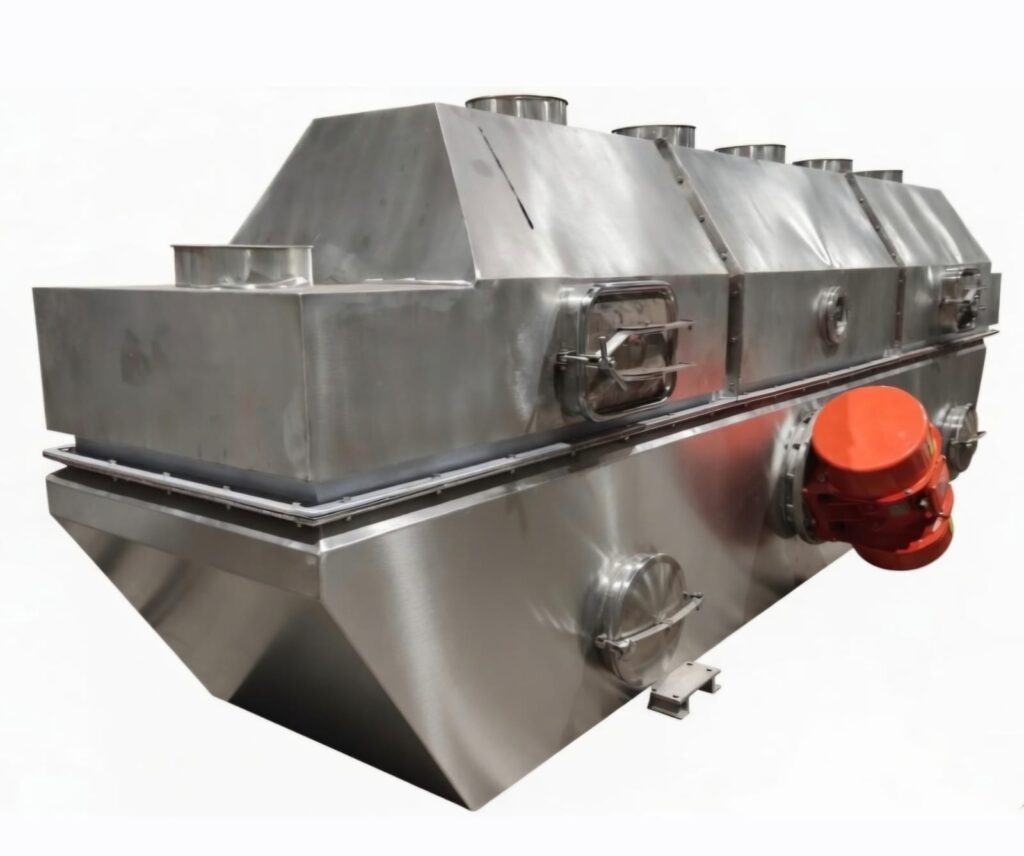
GTI’s pharmaceutical portfolio similarly distinguishes fluid-bed applications for suitable pharmaceutical particles and granules from vacuum technologies used for sensitive wet cakes and batch materials.
Key Advantages of Vacuum Shelf / Tray Dryers
1. Low-Temperature Drying
Vacuum can reduce the evaporation temperature of the liquid phase.
2. Suitable for Heat-Sensitive Products
Controlled temperature can help reduce excessive thermal exposure.
3. Batch Processing
Useful for products manufactured in campaigns or smaller batches.
4. Suitable for Wet Cakes
Can be used for selected filter cakes and centrifuge cakes.
5. Solvent Removal
Can remove water or organic solvents under suitable process conditions.
6. Reduced Direct Air Contact
Because drying relies primarily on indirect shelf heating, the process does not depend on a large continuous flow of hot drying air.
7. Controlled Drying Environment
Temperature and vacuum can be controlled throughout the batch.
8. Pharmaceutical Compatibility
The equipment can be engineered around pharmaceutical requirements such as suitable product-contact materials, cleanability and containment.
Limitations of Vacuum Tray Dryers
A technically responsible article should also explain where the technology may not be ideal.
1. Tray Handling
Large batch operations can require substantial tray loading and unloading.
2. Labour
Manual tray handling may increase labour requirements unless automated systems are incorporated.
3. Static Product
Products that require continuous agitation may not be ideal candidates.
4. Drying Uniformity
Uneven tray loading or excessive bed thickness can contribute to non-uniform drying.
5. Sticky Products
Highly cohesive materials may become difficult to remove from trays.
6. Long Drying Cycles
Some products may require extended drying times depending on moisture diffusion and heat-transfer characteristics.
7. Cleaning
Tray and chamber cleaning requirements should be considered during equipment selection.
These limitations do not make Vacuum Tray Dryers unsuitable; they help determine when another technology may provide a better process fit.
How to Improve Vacuum Tray Dryer Drying Performance
If a Vacuum Tray Dryer is taking too long to dry a product, simply increasing temperature may not be the correct solution.
Investigate:
Product Bed Thickness
A thick layer can increase the distance moisture must travel before reaching the surface.
Tray Loading
Overloading the dryer can increase cycle time.
Vacuum Stability
A fluctuating or inadequate vacuum can affect evaporation conditions.
Shelf Temperature
The heating profile should provide adequate energy without exceeding the product temperature limit.
Product Characteristics
Different products can have dramatically different drying kinetics.
Vapour Removal
The condenser and vacuum system must be capable of handling the generated vapour load.
Tray Design
Tray geometry and material can influence heat transfer.
Drying Endpoint
The endpoint should be based on the required product specification rather than an arbitrary fixed drying time.
Common Vacuum Tray Dryer Problems and Solutions
Problem 1: Uneven Drying
Possible causes
- Uneven tray loading
- Excessive product thickness
- Uneven shelf temperature
- Different product moisture levels
- Poor batch distribution
Corrective approach
Standardize tray loading and evaluate temperature uniformity, product thickness and drying kinetics.
Problem 2: Drying Time Is Too Long
Possible causes
- Excessive batch loading
- Insufficient heat-transfer area
- Poor vacuum
- High initial moisture
- Slow internal moisture diffusion
- Insufficient vapour removal
Corrective approach
Review the complete drying balance rather than increasing temperature alone.
Problem 3: Product Forms a Hard Crust
Possible causes
- Excessive surface drying
- Product migration
- Incorrect temperature profile
- Excessive bed thickness
Corrective approach
Evaluate shelf temperature, product thickness, vacuum profile and drying kinetics.
Problem 4: Product Sticks to Trays
Possible causes
- Sticky intermediate stage
- Excessive product temperature
- Product-specific adhesion
- Incorrect tray material/surface
Corrective approach
Evaluate tray surface, product temperature, loading thickness and whether an agitated vacuum dryer would be more appropriate.
Problem 5: Residual Solvent Remains High
Possible causes
- Insufficient drying time
- Inadequate vacuum
- Poor condensation
- Product diffusion limitations
- Excessive product bed thickness
- Inadequate heat transfer
Corrective approach
Evaluate the complete vapour-removal and drying system.
Vacuum Tray Dryer for Heat-Sensitive Chemicals
Specialty chemicals can have narrow temperature-processing windows.
Examples can include:
- Fine chemicals
- Specialty intermediates
- Pigments
- Catalysts
- Functional materials
- Pharmaceutical chemicals
GTI’s specialty chemical drying portfolio identifies Vacuum Tray Dryers as a technology for temperature-sensitive chemical products.
The drying process should be developed around the chemical’s:
- Thermal stability
- Solvent system
- Moisture content
- Final specification
- Particle characteristics
- Drying kinetics
Vacuum Tray Dryer for Pigments and Specialty Powders
Some specialty powders require careful drying to prevent:
- Agglomeration
- Discoloration
- Chemical degradation
- Excessive thermal exposure
- Changes in particle characteristics
A Vacuum Shelf Dryer may be considered where indirect heating and controlled pressure are beneficial.
However, product-specific testing remains important because pigment and specialty-powder behaviour can vary significantly.
Pharmaceutical GMP Considerations
For pharmaceutical applications, the dryer is part of a controlled manufacturing process.
The equipment design may need to consider:
- Product-contact materials
- Surface finish
- Cleanability
- Cleaning validation
- Containment
- Cross-contamination prevention
- Sealing
- Instrumentation
- Temperature monitoring
- Vacuum monitoring
- Batch traceability
- Product recovery
- Documentation
ICH Q7 provides GMP guidance for API manufacturing and addresses production controls and contamination-control considerations.
The exact equipment requirements should be defined by the customer’s URS, product risk profile, facility and applicable regulatory requirements.
Material of Construction
Material selection should consider:
- Product chemistry
- Solvent compatibility
- Corrosion
- Cleaning chemicals
- Temperature
- Vacuum
- Pharmaceutical requirements
Suitable stainless-steel grades are commonly considered for pharmaceutical product-contact applications, but the final material should be selected based on the actual product and process.
For pharmaceutical applications, SS 316L may be appropriate in many cases, but it should not be treated as a universal specification.
Cleaning and Containment
A pharmaceutical Vacuum Tray Dryer may process multiple products or campaigns.
Therefore, cleaning becomes an important part of the equipment lifecycle.
The design should consider:
- Accessibility
- Tray removal
- Chamber cleaning
- Product-contact surfaces
- Gaskets/seals
- Drainage where applicable
- Cleaning agents
- Cleaning validation
- Product recovery
- Cross-contamination risk
Where potent or hazardous materials are processed, containment requirements should be evaluated together with the overall facility containment strategy.
Automation and Process Control
Modern Vacuum Shelf Dryers can be equipped with automated process monitoring.
Typical monitored parameters can include:
- Shelf temperature
- Product temperature
- Chamber pressure
- Vacuum level
- Heating-medium temperature
- Condenser temperature
- Batch time
- Cooling temperature
The control system can be configured around the customer’s process recipe and documentation requirements.
For pharmaceutical applications, automation should support process repeatability and appropriate recording of critical parameters.
Energy Efficiency of Vacuum Tray Dryers
Energy efficiency should be evaluated across the complete system.
Important factors include:
- Initial moisture
- Final moisture
- Batch size
- Drying time
- Shelf temperature
- Vacuum level
- Heat-transfer area
- Heating medium
- Insulation
- Condenser efficiency
- Vacuum-pump operation
- Solvent recovery
- Heat recovery opportunities
A lower-temperature process does not automatically mean lower total energy consumption.
The most efficient configuration is the one that achieves the required drying endpoint with an appropriate combination of:
Heat Transfer + Vacuum + Drying Time + Vapour Removal + Product Loading
How to Calculate Vacuum Tray Dryer Capacity
A buyer should avoid selecting a dryer only by chamber volume.
Capacity depends on several variables.
Required inputs include:
- Wet batch weight
- Initial moisture %
- Final moisture %
- Solvent content
- Product bulk density
- Tray loading density
- Product bed thickness
- Drying time
- Product temperature limit
- Heating medium
- Vacuum level
- Heat-transfer area
For example, if a customer says:
“I need a 500 kg Vacuum Tray Dryer.”
that is not enough information for responsible equipment sizing.
A better requirement would be:
500 kg wet API cake/batch + initial moisture + residual solvent + final moisture + maximum product temperature + required drying time + available heating medium.
This allows GTI to evaluate the actual evaporation duty and equipment configuration.
What Information Should You Send GTI for a Quotation?
For a technically meaningful quotation, provide:
Product
- Product/API name
- Product type
- Product form
- Thermal sensitivity
- Hygroscopicity
- Particle size
- Bulk density
Feed
- Wet batch weight
- Initial moisture
- Solvent type
- Solvent concentration
- Feed temperature
- Feed consistency
Final Product
- Final moisture
- Residual solvent
- Maximum product temperature
- Final particle requirement
Process
- Required batch time
- Number of batches/day
- Heating medium
- Required vacuum
- Cooling requirement
Plant
- Installation country
- Available utilities
- Hazardous-area requirements
- GMP requirements
- Cleaning requirements
- Automation requirements
- Upstream filtration system
- Downstream milling/packing system
Example of a Good RFQ
Instead of:
“We need a 300 kg pharmaceutical vacuum dryer.”
Send:
Product: API
Wet cake: 300 kg/batch
Initial moisture: XX%
Solvent: IPA/water
Residual solvent target: XX
Final moisture: XX%
Maximum product temperature: XX°C
Required drying time: XX hours
Heating medium: Hot water/steam/thermal oil
Vacuum: XX mbar
Batches/day: XX
Plant location: XX
GMP requirement: Yes/No
This gives the manufacturer a meaningful engineering basis.
Why Product Testing Matters
Two products with the same moisture content may behave completely differently.
For example:
Product A: Free-flowing crystalline API
Product B: Sticky pharmaceutical filter cake
Both may contain 25% moisture.
But Product B may require:
- Different tray loading
- Longer drying time
- Different temperature profile
- Different vacuum strategy
- Different discharge method
In difficult applications, product testing can help determine:
- Drying curve
- Critical moisture point
- Product temperature
- Evaporation rate
- Drying time
- Residual solvent
- Product quality
- Tray loading
- Sticky-phase behaviour
This reduces the risk of selecting a dryer solely from theoretical capacity.
When Should You NOT Choose a Vacuum Tray Dryer?
This is an important question for buyers.
A Vacuum Tray Dryer may not be the first technology to consider when:
Very high continuous throughput is required
A continuous belt, rotary or other continuous technology may be more appropriate.
Product requires intensive mixing
A Vacuum Paddle or Conical Screw Dryer may provide better product movement.
Material must be fluidized
A Fluid Bed Dryer may be more appropriate for suitable free-flowing particles.
Feed is a liquid/slurry requiring direct powder formation
A Spray Dryer may be more appropriate.
Manual tray handling is unacceptable
An automated agitated or continuous system may be worth evaluating.
Product is highly sticky
A static tray arrangement may create handling difficulties.
This is why GTI’s philosophy should remain:
Select the dryer according to the product and process — not according to the machine name.
GTI Dryers: Vacuum Drying Systems for Global Pharmaceutical & Chemical Applications
GTI Dryers designs and manufactures industrial drying systems for pharmaceutical, API, chemical and specialty-material applications.
Its existing pharmaceutical drying portfolio includes:
- Vacuum Tray Dryers
- Vacuum Paddle Dryers
- Conical Vacuum Dryers
- Fluid Bed Dryers
- Spray Dryers
- Other application-specific drying systems
This multi-technology approach allows GTI to evaluate the actual process before recommending a drying configuration.
GTI’s broader industrial-dryer portfolio also emphasizes product-specific design based on product characteristics, moisture content and process requirements, rather than treating dryer selection as a standard capacity exercise.
GTI’s engineering approach
Product
↓
Feed Characteristics
↓
Moisture / Solvent Load
↓
Temperature Sensitivity
↓
Drying Kinetics
↓
Technology Selection
↓
Dryer Sizing
↓
Vacuum / Condensation System
↓
Automation
↓
Testing / Validation Requirements
↓
Manufacturing
↓
Installation & Commissioning
Why Choose an Indian Vacuum Tray Dryer Manufacturer?
For global pharmaceutical and chemical buyers, equipment origin is only one part of supplier selection.
The more important questions are:
- Can the manufacturer understand the process?
- Can the dryer be customized?
- Can the manufacturer supply suitable materials?
- Can it engineer vacuum and condensation systems?
- Can it support automation?
- Can it provide technical documentation?
- Can it support export projects?
- Can it provide commissioning assistance?
- Can it supply spares and technical support?
GTI Dryers positions its manufacturing and engineering capabilities for Indian and international industrial drying projects.
Engineered in India. Designed for Global Industries.
Global Opportunities for Vacuum Tray Dryers
Core keywords
- Vacuum Shelf Dryer Manufacturer
- Vacuum Tray Dryer Manufacturer
- Vacuum Tray Dryer Manufacturer India
- Industrial Vacuum Tray Dryer
- Pharmaceutical Vacuum Tray Dryer
- API Vacuum Tray Dryer
- Vacuum Dryer for Wet Cake
- Vacuum Dryer for Pharmaceutical Intermediates
- Chemical Vacuum Tray Dryer
- Low Temperature Vacuum Dryer
- Heat Sensitive Product Dryer
- Batch Vacuum Dryer
- Industrial Vacuum Drying Equipment
- Vacuum Shelf Drying System
- Pharmaceutical Shelf Dryer
- Vacuum Tray Drying Machine
High-intent application keywords
- API wet cake vacuum dryer
- pharmaceutical filter cake dryer
- solvent-containing API dryer
- pharmaceutical intermediate vacuum dryer
- low-temperature chemical dryer
- heat-sensitive chemical vacuum dryer
- pharmaceutical solvent drying system
- vacuum dryer for fine chemicals
- vacuum dryer for specialty chemicals
Global country-intent keywords
Supporting country pages can target:
- Vacuum Tray Dryer Manufacturer USA
- Vacuum Tray Dryer Manufacturer Germany
- Vacuum Tray Dryer Manufacturer UK
- Vacuum Tray Dryer Manufacturer France
- Vacuum Tray Dryer Manufacturer Italy
- Vacuum Tray Dryer Manufacturer Spain
- Vacuum Tray Dryer Manufacturer Netherlands
- Vacuum Tray Dryer Manufacturer Switzerland
- Vacuum Tray Dryer Manufacturer Japan
- Vacuum Tray Dryer Manufacturer South Korea
- Vacuum Tray Dryer Manufacturer Singapore
- Vacuum Tray Dryer Manufacturer Indonesia
- Vacuum Tray Dryer Manufacturer Malaysia
- Vacuum Tray Dryer Manufacturer Vietnam
- Vacuum Tray Dryer Manufacturer Thailand
- Vacuum Tray Dryer Manufacturer UAE
- Vacuum Tray Dryer Manufacturer Saudi Arabia
- Vacuum Tray Dryer Manufacturer Brazil
- Vacuum Tray Dryer Manufacturer Mexico
Local-Language GEO Keywords
Germany
- Vakuumtrockenschrank
- Vakuum-Etagentrockner
- Vakuumregaltrockner
- Vakuumtrockner für pharmazeutische Produkte
- Vakuumtrockner für Feinchemikalien
France
- sécheur sous vide à plateaux
- sécheur à étagères sous vide
- sécheur sous vide pharmaceutique
- sécheur sous vide pour produits chimiques
Spain
- secador de bandejas al vacío
- secador de estantes al vacío
- secador de vacío farmacéutico
- secador de vacío para productos químicos
Italy
- essiccatore a vassoi sottovuoto
- essiccatore a ripiani sottovuoto
- essiccatore sottovuoto farmaceutico
Indonesia
- mesin pengering vakum tray
- mesin pengering vakum farmasi
- vacuum tray dryer Indonesia
- mesin pengering vakum bahan kimia
Japan
- 真空トレイ乾燥機
- 真空棚乾燥機
- 医薬品用真空乾燥機
- 化学品用真空乾燥機
Localized terms should be validated against actual search behaviour before creating large numbers of localized pages.
Frequently Asked Questions
What is a Vacuum Shelf Dryer?
A Vacuum Shelf Dryer is a batch dryer in which material is placed on heated shelves or trays inside a sealed chamber and dried under reduced pressure.
Is a Vacuum Shelf Dryer the same as a Vacuum Tray Dryer?
They commonly refer to the same general batch drying principle: product is placed on trays/shelves and dried using indirect heat under vacuum.
What is a Vacuum Tray Dryer used for?
It is commonly considered for batch drying of pharmaceutical, chemical and specialty products, including selected APIs, intermediates, wet cakes and heat-sensitive materials.
Can a Vacuum Tray Dryer dry API wet cake?
Yes, it can be suitable for selected API wet cakes, particularly where batch drying, controlled temperature and vacuum operation are required.
Can it remove organic solvents?
Yes, a suitably engineered system can remove organic solvents. The condenser, receiver, vacuum system and safety configuration must be designed around the actual solvent.
Is a Vacuum Tray Dryer suitable for heat-sensitive products?
It can be suitable because vacuum can lower the evaporation temperature. The actual drying cycle must still respect the product’s temperature and quality limits.
What is the difference between a Vacuum Tray Dryer and Vacuum Paddle Dryer?
A Vacuum Tray Dryer generally keeps the product distributed over trays with limited movement. A Vacuum Paddle Dryer actively agitates the material during drying, which can be advantageous for cohesive or sticky products.
What is the difference between a Vacuum Tray Dryer and Conical Screw Dryer?
A Vacuum Tray Dryer uses static trays/shelves, while a Conical Screw Dryer uses a screw mechanism to actively circulate the product.
Can a Vacuum Tray Dryer be used for GMP pharmaceutical production?
It can be engineered for pharmaceutical applications with appropriate product-contact materials, cleanability, containment, instrumentation and documentation according to the project requirements.
How do I calculate the required Vacuum Tray Dryer size?
The calculation should consider wet batch weight, moisture/solvent content, final specification, tray loading, bed thickness, drying time, heat-transfer area, product temperature and vacuum conditions.
What information should I provide to a Vacuum Tray Dryer manufacturer?
Provide product type, wet batch weight, initial moisture, solvent, final moisture/residual solvent, maximum product temperature, drying time, heating medium, vacuum requirement and plant location.
Is the Vacuum Tray Dryer always the best vacuum drying technology?
No. Vacuum Tray, Vacuum Paddle and Vacuum Conical Screw Dryers have different product-movement characteristics. The appropriate technology depends on the actual material and process.
Get a Vacuum Tray Dryer Designed Around Your Process
A pharmaceutical or chemical manufacturer should not begin with:
“What size Vacuum Tray Dryer do you sell?”
The better starting point is:
“What product are we drying, how wet is it, what solvent does it contain, what temperature can it tolerate, and what final specification must we achieve?”
GTI Dryers can evaluate the application around:
Product → Wet Cake → Moisture/Solvent → Temperature Limit → Drying Time → Vacuum → Heat Transfer → Condensation → Final Specification
Send GTI these details:
Product:
Wet batch size:
Initial moisture:
Solvent:
Final moisture:
Residual solvent:
Maximum product temperature:
Required drying time:
Heating medium:
Vacuum requirement:
Batches/day:
Plant location:
GMP requirement:
GTI Dryers can then evaluate whether a Vacuum Shelf/Tray Dryer, Vacuum Paddle Dryer, Vacuum Conical Screw Dryer or another drying technology is appropriate for your application.
GTI Dryers — Engineered in India. Designed for Global Pharmaceutical, Chemical & Process Industries.