
Nigeria’s Agricultural Transition: Industrializing the Spices & Agro-Export Economy
Nigeria stands as one of Africa’s leading agricultural powerhouses and ranks among the top global producers of high-pungency ginger, turmeric, chilli peppers, garlic, and onions. Driven by the Federal Ministry of Agriculture and Food Security (FMAFS), the Nigerian Export Promotion Council (NEPC), and non-oil export diversification mandates, Nigerian agribusinesses are transitioning from raw farm-gate commodities toward standardized, export-grade dehydrated food ingredients, powders, and essential oil extracts.
Nigeria’s major agricultural belts produce substantial annual yields:
- North-West Zone (Kaduna, Kano, Katsina): Global hub for split-dried and sliced ginger (citta), garlic, and onions.
- North-Central Zone (Nasarawa, Niger, Plateau, Benue): Core belt for high-curcumin turmeric (kurkum), chilli peppers (barkono), and ginger.
- South-West Zone (Oyo, Ogun, Lagos logistics corridor): Primary regional hub for value-added agro-processing, pulverizing, packaging, and maritime export execution.
However, tropical weather during rainy seasons—combined with relative humidity exceeding 80%—presents severe post-harvest risks. Open sun-drying leads to mold infestation, aflatoxin contamination (violating EU, US FDA, and NAFDAC safety thresholds), darkening of product colors, and loss of volatile aromatic oils.
To secure international buyers and satisfy Nigeria’s domestic seasoning and food manufacturing industries, commercial processing plants are replacing manual drying with enclosed, multi-zone industrial thermal dehydration plants.
Technical Transformation: Converting Fresh Crops into Export-Grade Ingredients
Fresh Nigerian ginger, turmeric, chilli, garlic, and onions arrive at processing facilities with initial moisture levels between 75% and 85%. Uncontrolled open drying degrades bio-active compounds like gingerol, curcumin, capsaicin, and allicin.
Precision thermal dehydration converts raw harvests into shelf-stable, high-value product streams:
Fresh Kaduna Citta (Ginger) → Hydro-Washing & Slicing → Multi-Zone Belt Dryer → Dry Ginger Slices → High-Oil Extract / Powder
Fresh Nasarawa Turmeric → Boiling & Slicing → Controlled Airflow → Dried Roots → High-Curcumin Powder
Fresh Kano Barkono (Chilli) → Pod De-stemming → Hot-Air Recirculation → Whole Dried Pods → Crushed Flakes / Chili Powder
Fresh Northern Garlic → Clove Separation → Low-Temp Dehydration → Garlic Flakes → Industrial Seasoning Powder
Fresh Kano/Katsina Onion → Precision Dicing → Controlled Velocity → Kibbled Onion → Seasoning Granules / Flakes
Operational Advantages for Nigerian Processing Plants
- Continuous Year-Round Uptime: Fully sealed drying chambers allow processors to operate 24/7 through heavy rainy seasons without weather disruptions.
- Aflatoxin & Contamination Prevention: Closed stainless steel drying channels eliminate exposure to rain, dust, bird drop contamination, and fungal toxins.
- Essential Oil & Oleoresin Retention: Low-to-medium temperature drying cycles retain natural volatile oils and vibrant natural pigments.
- NAFDAC & Export Compliance: Reaches precise target moisture levels ($\le 8\%-10\%$) required for downstream pulverizing and long-distance container shipping.
Application Engineering: Five Core Nigerian Spice Pillars
GTI Dryers engineers dehydration systems tailored to the physical characteristics and thermal parameters of Nigeria’s primary spice crops.
| Crop Application | Primary Nigerian Processing Hubs | Dehydration & Quality Standard |
| Ginger (Citta) | Kaduna (Kafanchan, Kachia), Nasarawa, Niger | Continuous moisture removal preserving high oleoresin/oil content ($\ge 2.0\text{ ml}/100\text{g}$) and pale yellow finish. |
| Turmeric (Kurkum) | Nasarawa, Benue, Plateau | Precision heat distribution to retain curcumin content ($\ge 5\%$) and vibrant orange pigmentation. |
| Chilli (Barkono) | Kano, Katsina, Jigawa | Managed humidity exhaustion to prevent pod collapse, maintaining sharp capsaicin potency and deep red color. |
| Garlic (Tafarnuwa) | Kano, Sokoto, Kebbi | Low-temperature drying ($\le 55^\circ\text{C}$) to prevent slice browning and preserve active allicin flavor compounds. |
| Onion (Albasa) | Kano, Katsina, Sokoto | Specialized non-stick mesh belts and airflow control to process high-sugar sliced onions without scorching. |
1. Ginger Dryer Machine Manufacturer in Nigeria
Nigeria is one of the world’s top producers of ginger, famous for its intense aroma and high oil content. Designed for commercial processing centers in Kaduna and Nasarawa, our continuous ginger dehydrators convert fresh ginger rhizomes into export-grade ginger slices, flakes, and ground powders.
- Processing Line Flow:
Fresh Ginger Washing $\rightarrow$ Peeling / Mechanical Slicing ($3\text{–}5\text{mm}$) $\rightarrow$ Continuous Belt Dehydrator $\rightarrow$ Counter-Flow Cooling $\rightarrow$ Flaking / Powder Grinding
- Local Search Terms:
Ginger dryer machine in Kaduna | Industrial ginger dehydration plant Nigeria | Ginger powder processing machinery
2. Turmeric Dryer Machine Manufacturer in Nigeria
Nigerian turmeric is valued for its rich organic purity and high curcumin levels. Controlled indirect hot-air circulation dries sliced turmeric roots evenly without thermal degradation, satisfying international extraction and food powder standards.
- Primary Advantage: Indirect clean hot-air circulation guarantees zero soot or fuel combustion residue on the product, meeting strict international export purity requirements.
- Local Search Terms:
Turmeric dryer machine Nigeria | Turmeric dehydration plant Nasarawa | Curcumin extraction dryer equipment
3. Chilli Dryer Machine Manufacturer in Nigeria
Northern Nigeria produces vast quantities of hot chillies used in domestic culinary blends and global exports. Industrial chilli dryers allow processors to produce whole dried chillies, flakes, and chilli powder with consistent heat and uniform color retention.
- Quality Assurance: Locks in natural capsaicin levels while drying whole pods or crushed chillies down to stable moisture levels ($\le 9\%$) for high-speed grinding mills.
- Local Search Terms:
Chilli dryer machine Kano | Industrial pepper drying plant Nigeria | Commercial chilli dehydrator
4. Garlic Dryer Machine Manufacturer in Nigeria
Grown extensively across Northern Nigeria, fresh garlic cloves are processed into shelf-stable dehydrated garlic flakes and granules used in ready-to-eat seasoning packs, sauces, and instant food products.
- Key Feature: Multi-stage temperature zones prevent sugar blistering, ensuring a clean off-white finish and intense garlic aroma.
- Local Search Terms:
Garlic dryer machine Nigeria | Garlic dehydration plant Kano | Commercial garlic flake dryer
5. Onion Dryer Machine Manufacturer in Nigeria
Onions are a staple agricultural crop across Kano, Sokoto, and Katsina. Dehydrating seasonal onion surpluses into dried flakes, granules, and powders helps stabilize factory ingredient supplies, reduces seasonal post-harvest losses, and supports commercial food seasoning manufacturing.
- Engineering Requirement: Features specialized food-grade mesh belts and adjustable air velocity control to handle high-sugar sliced onions smoothly.
- Local Search Terms:
Onion dryer machine Nigeria | Onion dehydration plant Kano | Dehydrated onion flake equipment
Dehydration Equipment Selection for Nigerian Facilities
Selecting the proper dehydration machinery depends on daily raw input tonnage, heating utility availability, and plant floor layout:
Fresh Agricultural Input (Northern & Central Harvests)
│
├── High-Volume Continuous Output (Agro-Industrial Parks) ──► Multi-Layer Continuous Belt Dryers
│
└── Specialized Batch / Multi-Crop Operations (Agro-SMEs) ──► Diesel / Biomass Multi-Trolley Cabinet Dryers
- Continuous Multi-Layer Belt Dryers (5-Layer / 7-Layer)
- Best For: Commercial food processing plants handling high daily tonnage ($5\text{ to }50+\text{ tons/day}$) of sliced ginger, turmeric, garlic, or chillies.
- Features: Automated spreading feed, adjustable belt speed controls, multi-zone thermal management, high energy efficiency.
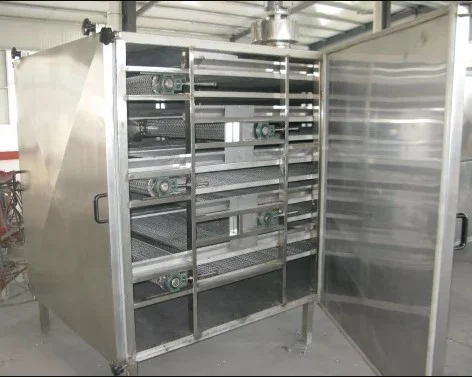
- Industrial Multi-Tray / Cabinet Dryers
- Best For: Agricultural cooperatives, regional processors, or facilities managing smaller multi-product batches.
- Features: Stainless steel food-contact areas (SS304/SS316), heavy-duty insulation, precise digital temperature control ($\pm 1^\circ\text{C}$).
Continuous Multi-Layer Belt Dryers vs. Batch Tray Dryers
For spice processors in Nigeria—particularly across major production corridors like Kaduna (citta / ginger), Kano (barkono / chilli, albasa / onion), and Nasarawa (kurkum / turmeric)—choosing between a continuous belt dryer and a multi-tray cabinet dryer directly dictates operational profitability, labor costs, and thermal efficiency.
1. High-Level Comparison Matrix
| Operational Metric | Continuous Multi-Layer Belt Dryer | Industrial Batch Tray Dryer |
| Primary Suitability | High-volume industrial plants ($5\text{–}50+\text{ tons/day}$) | Agro-SMEs, multi-crop hubs ($500\text{kg}\text{–}3\text{ tons/day}$) |
| Thermal & Fuel Efficiency | High ($1.2\text{–}1.5\text{ kWh/kg}$ water evaporated) | Moderate to Low ($1.8\text{–}2.5\text{ kWh/kg}$ water evaporated) |
| Throughput & Capacity | Continuous 24/7 loading ($200\text{–}2,000+\text{ kg/hour}$) | Batch loading ($50\text{–}300\text{ kg/batch}$) |
| Factory Footprint | Linear Horizontal Layout ($12\text{–}25\text{m}$ length $\times 2.5\text{–}4\text{m}$ width) | Vertical Compact Footprint ($2\text{–}4\text{m}$ length $\times 1.5\text{–}2.5\text{m}$ width) |
| Product Color & Quality | Highly uniform (automated flip/turn across layers) | Requires manual tray rotation to prevent hot spots |
| Labor Dependency | Low (1–2 operators per shift) | High (3–5 workers for loading, unloading, tray washing) |
| CAPEX (Initial Investment) | High ($\$35,000\text{–}\$150,000+$ depending on layers) | Low to Medium ($\$5,000\text{–}\$22,000$) |
2. Fuel Efficiency & Operating Costs in Nigeria
Energy is the largest recurring cost for Nigerian agro-processors due to grid instability and fluctuating diesel and gas costs.
Continuous Multi-Layer Belt Dryer
- Recirculation System: Uses internal exhaust heat recovery loops, retaining up to $60\%$ of thermal energy inside the chamber.
- Thermal Mass Stability: Operates continuously at thermal equilibrium without opening doors, preventing heat loss.
- Biomass / Waste Integration: Easily configured to burn local agricultural waste (e.g., spent ginger fiber, palm kernel shells, rice husks), reducing diesel dependence by $70\%\text{–}80\%$.
Batch Tray Dryer
- Thermal Shock & Loss: Every batch cycle requires opening cabinet doors to reload trays, cooling the chamber completely and burning excess fuel to reheat.
- Uneven Hot Spots: Static air channels lead to dead zones; operators often increase thermal output to force air through dense lower trays, leading to fuel wastage.
3. Footprint & Civil Installation Requirements
[Continuous Multi-Layer Belt Layout]
┌──────────────┐ ┌──────────────────────────────────────────────┐ ┌──────────────┐
│ Feed Hopper │►│ 5-Layer Chamber (15m – 20m Length x 3m Width)│►│ Cooler / Out │
└──────────────┘ └──────────────────────────────────────────────┘ └──────────────┘
[Batch Tray Dryer Layout]
┌───────────────────────┐
│ Multi-Trolley Cabinet │ ◄ Compact: 3m x 2m (Requires 5m x 5m room
└───────────────────────┘ for tray washing and staging trolleys)
- Continuous Belt Dryers: Require a extended floor length ($12\text{ to }25\text{ meters}$) with high ceilings ($\ge 4\text{ meters}$) to accommodate multi-layer incline feeds, fans, and exhaust ducts. Best suited for purpose-built industrial sheds in zones like Kakuri Industrial Area (Kaduna) or Challenger/Kano industrial hubs.
- Batch Tray Dryers: Require minimal structural modifications. A standard $50\text{ m}^2$ processing room can accommodate multiple cabinet units. However, extra floor space must be allocated for tray washing, sanitization, and manual staging carts.
4. Product Quality, Color, and Active Compound Retention
- Ginger (Citta): Continuous belt dryers automatically turn slices as they drop from upper to lower mesh layers, ensuring uniform drying down to $8\%\text{–}10\%$ moisture while preserving essential volatile oils ($\ge 2.0\text{ ml/100g}$). Tray dryers risk scorching bottom layers, darkening the pale yellow export finish.
- Turmeric (Kurkum): Continuous systems maintain tight temperature controls ($\le 60^\circ\text{C}$), protecting heat-sensitive curcumin compounds.
- Chilli & Garlic: Managed relative humidity exhaust in continuous belt systems prevents pod collapse in chillies and sugar blistering in garlic flakes.
Which System Fits Your Facility?
- Choose a Batch Tray Dryer if: You are processing less than 2 tons of raw harvest per day, handle multiple seasonal crops in small batches, or are operating with constrained initial capital ($\le \$25,000$).
- Choose a Continuous Multi-Layer Belt Dryer if: You are targeting export markets (EU, US FDA, Middle East), need continuous NAFDAC-compliant operations during rainy seasons, process over 5 tons per day, or wish to utilize biomass waste to eliminate diesel costs.
Targeting Nigeria’s Agricultural & Commercial Zones
Equipment design, energy integration, and customer support are aligned with Nigeria’s main regional processing corridors:
North-West Agro-Industrial Belt (Kaduna, Kano, Katsina, Sokoto)
- Primary Focus: Massive processing centers for ginger (citta), garlic, onion, and chilli.
- Target Keywords: Ginger Dryer Kaduna, Garlic Dehydrator Kano, Onion Drying Plant Katsina, Chilli Processing Sokoto
North-Central Agricultural Corridor (Nasarawa, Niger, Benue, Plateau)
- Primary Focus: High-yield production centers for turmeric, ginger, sesame, and chillies.
- Target Keywords: Turmeric Dryer Nasarawa, Agro Processing Niger State, Spice Dryer Plateau, Ginger Processing Benue
South-West Export & Industrial Hub (Lagos, Ogun, Oyo)
- Primary Focus: Export packaging centers, industrial seasoning manufacturers, and maritime export logistics hubs.
- Target Keywords: Industrial Spice Dryer Lagos, Food Processing Equipment Ogun, Spice Dehydration Plant Oyo
Technical Project Sizing Parameters
To receive a custom heat load calculation, factory layout drawing, and commercial proposal for your facility in Nigeria, please provide:
- Target Agricultural Crop: (e.g., Ginger, Turmeric, Chilli, Garlic, Onion, or Multi-Crop)
- Material Preparation State: (Whole pods, sliced $3\text{–}5\text{mm}$, diced, or crushed)
- Daily Processing Input: (kg/hour OR tons/day of fresh raw harvest)
- Initial Moisture Content: (Approximate % upon loading, typically $80\%$)
- Target Final Moisture Content: (Typically $6\%$ to $10\%$ for grinding/packaging)
- Preferred Heating Energy Source: (Diesel, Biomass/Wood Waste, Dual-Fuel Burner, Steam Boiler, or Electric)
- Facility Location: (State / Industrial Zone in Nigeria)
Why Partner with GTI Dryers?
GTI Dryers manufactures heavy-duty industrial thermal systems built for high performance in tropical environments across Africa.
- Precision Airflow Distribution: Custom air duct layouts eliminate cold spots and ensure uniform drying across all product layers.
- Sanitary Stainless Construction: Complete SS304/SS316 food-grade contact surfaces that conform to international FDA, NAFDAC, and export standards.
- Energy-Efficient Recirculation: Advanced heat recovery designs lower operating fuel costs per kilogram of evaporated moisture.
- Turnkey Engineering Service: End-to-end guidance covering capacity planning, thermal calculations, CAD installation layout, commissioning, and operator training.
Request an Engineering Proposal for Your Plant
Are you setting up a new spice processing line or upgrading existing drying equipment in Nigeria?
Contact the GTI Dryers engineering team today with your crop type, daily throughput target, slice thickness, and fuel choice to receive a detailed process flow layout, thermal calculation, and commercial quotation.