
Peru’s Agro-Export Revolution: Scaling Organic & High-Value Spice Processing
Peru has positioned itself as a global powerhouse for high-value organic agro-exports. Sourced from the high-altitude Amazonian valleys and coastal agro-industrial corridors, Peruvian spices—particularly organic kión (ginger), cúrcuma (turmeric), páprika, ajo (garlic), and cebolla (onion)—are prized across North America, Europe, and Asia for their high active compound density, vibrant natural pigment, and chemical-free cultivation.
Driven by national agricultural development mandates, the Ministry of Agricultural Development and Irrigation (MIDAGRI), and export promotion programs via PROMPERÚ, Peruvian processors are shifting from exporting raw fresh roots to manufacturing value-added dehydrated slices, flakes, and standardized fine powders.
Peru’s key spice-producing zones operate under distinct climatic conditions:
- Central Jungle Zone (Junín – Chanchamayo, Satipo): Global hub for certified organic kión (jengibre) and high-curcumin cúrcuma.
- Southern Coastal Belt (Arequipa – Majes, Tacna): Dominant region for premier export páprika, white garlic (ajo blanco), and purple garlic (ajo morado).
- Northern Coastal Belt (Ica, La Libertad, Piura): Commercial production centers for processed red and yellow onions (cebolla), alongside hot peppers.
However, processing in high-humidity rainforest environments like Satipo and Chanchamayo presents severe operational challenges. Open-air drying leads to rapid humidity absorption, mold development, mycotoxin/aflatoxin contamination (violating EU, US FDA, and SENASA phytosanitary regulations), and severe loss of essential volatile oils.
To preserve organic certification, satisfy international buyers, and maintain strict HACCP compliance, commercial processors across Peru are upgrading to enclosed, multi-tier continuous thermal dehydration plants.
Technical Transformation: Converting Fresh Peruvian Harvests into Export Ingredients
Fresh Peruvian kión, cúrcuma, páprika, garlic, and onions arrive at wash-and-cut facilities with initial moisture levels between 72% and 86%. Uncontrolled drying damages heat-sensitive bioactive compounds like 6-gingerol, curcumin, capsanthin, and allicin.
Precision thermal dehydration converts raw Amazonian and coastal harvests into shelf-stable, high-value ingredients:
Fresh Junín Organic Kión → Hydro-Washing & Slicing → Multi-Zone Belt Dryer → Dry Kión Flakes → High-Oil Extract / Powder
Fresh Satipo Cúrcuma → Boiling & Slicing → Controlled Airflow → Dried Roots → High-Curcumin Powder
Fresh Arequipa Páprika → De-stemming & Dicing → Hot-Air Recirculation → Dried Pod Strips → ASTA-Graded Red Powder
Fresh Arequipa / Tacna Ajo → Clove Separation → Low-Temp Dehydration → Garlic Flakes → Granulated Industrial Seasoning
Fresh Coastal Onion → Precision Dicing → Controlled Air Velocity → Kibbled Onion → Powdered Food Seasoning
Operational Advantages for Peruvian Processing Facilities
- Continuous Operation in High-Humidity Zones: Completely sealed thermal chambers allow 24/7 continuous output during intense rainforest precipitation in the Junín jungle.
- SENASA & HACCP Compliance: Full food-grade SS304/SS316 stainless steel contact areas eliminate dust, insect, and fungal pathogen risks.
- Bioactive & Pigment Preservation: Multi-zone temperature controls safeguard volatile gingerols, high ASTA color values in páprika, and natural curcumin content.
- Precision Export Moisture Targets: Reaches strict export moisture levels ($\le 7\%\text{–}9\%$) required for long-distance maritime container transport to European and North American ports.
Application Engineering: Five Core Peruvian Spice Pillars
GTI Dryers engineers continuous belt and industrial batch dehydration systems configured for the specific physical properties and thermal constraints of Peruvian crops.
| Crop Application | Primary Peruvian Processing Hubs | Dehydration & Quality Standard |
| Kión / Jengibre (Ginger) | Junín (Chanchamayo, Satipo), Pichanaqui | Moisture reduction preserving high gingerol content, rich aroma, and pale gold export appearance. |
| Cúrcuma (Turmeric) | Junín, San Martín, Ucayali | Uniform thermal treatment retaining curcumin concentration ($\ge 5.5\%$) and deep orange pigmentation. |
| Páprika | Arequipa (Majes), Ica, Tacna | Managed humidity exhaustion to prevent pod collapse, preserving high ASTA color values ($120\text{–}200\text{ ASTA}$). |
| Ajo (Garlic) | Arequipa, Tacna | Low-temperature dehydration ($\le 52^\circ\text{C}$) to avoid sugar scorching and preserve bioactive allicin. |
| Cebolla (Onion) | Arequipa, Ica, La Libertad | Specialized non-stick mesh belting and air velocity management to process high-sugar diced onions smoothly. |
1. Kión Dryer Machine Manufacturer in Peru (Secadoras de Kión)
Peru is globally renowned for its high-grade organic kión. Tailored for commercial processing facilities in Satipo and Pichanaqui, our continuous kión dehydrators convert fresh rhizomes into export-grade slices, flakes, and fine ground powders.
- Processing Line Flow:
Fresh Kión Washing $\rightarrow$ Peeling / Slicing ($3\text{–}5\text{mm}$) $\rightarrow$ Continuous Belt Dehydrator $\rightarrow$ Counter-Flow Cooling $\rightarrow$ Flaking / Fine Powder Pulverizing
- Local Search Terms:
Secadora industrial de kión Junín | Deshidratador de jengibre Perú | Planta de procesamiento de kión en polvo
2. Cúrcuma Dryer Machine Manufacturer in Peru (Secadoras de Cúrcuma)
Peruvian Amazonian cúrcuma is celebrated for its purity and vibrant natural pigmentation. Controlled indirect hot-air circulation dries sliced turmeric roots evenly without thermal degradation or surface browning.
- Primary Advantage: Indirect clean hot-air circulation guarantees zero soot or fuel combustion residue on the product, meeting strict organic export purity requirements.
- Local Search Terms:
Secadora de cúrcuma en Perú | Deshidratador continuo de cúrcuma Satipo | Equipos para deshidratar cúrcuma orgánica
3. Páprika Dehydration Plant Manufacturer in Peru (Secadoras de Páprika)
Southern Peru produces some of the world’s finest sweet páprika. Industrial páprika dehydrators allow processors to handle de-stemmed pods and diced strips while locking in natural extractable color (ASTA) and moisture stability for high-speed pulverizing.
- Quality Assurance: Maintains continuous low-to-medium heat profiles to avoid darkening the pods, delivering high-value ASTA-graded ground páprika.
- Local Search Terms:
Secadora industrial de páprika Arequipa | Planta deshidratadora de páprika en Perú | Deshidratador de páprika Majes
4. Garlic Dryer Machine Manufacturer in Peru (Secadoras de Ajo)
Grown across Arequipa and Tacna, fresh garlic cloves are processed into dehydrated garlic flakes, granules, and powders used in international food seasonings, sauces, and dry mixes.
- Key Feature: Multi-stage temperature zoning prevents caramelization, ensuring a clean off-white finish and high pungent flavor retention.
- Local Search Terms:
Secadora de ajo en Perú | Deshidratador de ajo Arequipa | Planta para deshidratado de ajo y cebolla
5. Onion Dryer Machine Manufacturer in Peru (Secadoras de Cebolla)
Red and yellow onions harvested in coastal Peru are converted into dehydrated flakes, minced granules, and fine powders to reduce post-harvest losses and supply international commercial food manufacturing chains.
- Engineering Requirement: Features specialized food-grade mesh belts and adjustable air velocity control to handle high-sugar sliced onions smoothly without belt scorching.
- Local Search Terms:
Secadora de cebolla Perú | Planta deshidratadora de cebolla Ica | Deshidratador industrial de cebolla en hojuelas
Dehydration Equipment Selection for Peruvian Facilities
Selecting the ideal dehydration system depends on daily raw harvest tonnage, available fuel utilities, and factory footprint:
Fresh Peruvian Agricultural Input (Jungle & Coastal Valleys)
│
├── High-Volume Continuous Output (Agro-Export Parks) ──► Multi-Layer Continuous Belt Dryers
│
└── Specialized Batch / Organic Multi-Crop Operations ──► Gas / Diesel / Biomass Multi-Trolley Cabinet Dryers
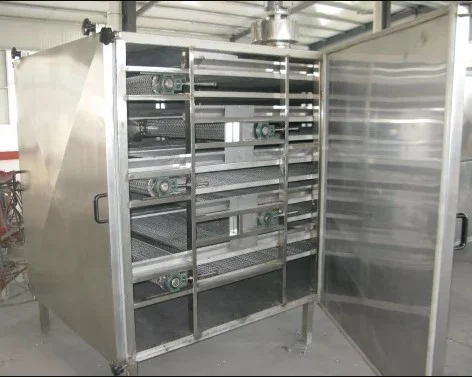
- Continuous Multi-Layer Belt Dryers (5-Layer / 7-Layer)
- Best For: Commercial agro-exporters handling high daily tonnage ($5\text{ to }50+\text{ tons/day}$) of sliced kión, cúrcuma, páprika, garlic, or onions.
- Features: Automated spreading feeds, variable belt speed inverter controls, multi-zone thermal management, high energy efficiency.
- Industrial Multi-Tray / Cabinet Dryers
- Best For: Agricultural cooperatives (cooperativas agracias), regional processors, or facilities managing small certified-organic batches.
- Features: Complete SS304/SS316 food-grade contact surfaces, heavy insulation panels, digital PID temperature controllers ($\pm 1^\circ\text{C}$).
Continuous Multi-Layer Belt Dryers vs. Batch Tray Dryers
For agro-industrial processors in Peru—particularly across organic corridors like Junín (Satipo, Pichanaqui for kión / ginger and cúrcuma / turmeric) and Arequipa (Majes for páprika and garlic)—the choice between a continuous belt dryer and a multi-tray batch dryer impacts operational profitability, regulatory compliance, and thermal costs.
1. High-Level Performance Comparison
| Evaluation Metric | Continuous Multi-Layer Belt Dryer | Industrial Batch Tray Dryer |
| Primary Suitability | Commercial exporters ($5\text{–}50+\text{ MT/day}$) | Cooperatives & micro-batch plants ($500\text{kg}\text{–}3\text{ MT/day}$) |
| Thermal Efficiency | High ($1.1\text{–}1.4\text{ kWh/kg}$ $H_2O$ evaporated) | Moderate to Low ($1.8\text{–}2.6\text{ kWh/kg}$ $H_2O$ evaporated) |
| Footprint Configuration | Linear Horizontal ($12\text{–}24\text{m}$ L $\times 2.5\text{–}3.5\text{m}$ W) | Vertical Compact ($2\text{–}4\text{m}$ L $\times 1.5\text{–}2.5\text{m}$ W) |
| SENASA / HACCP Traceability | High (Integrated continuous physical separation) | Moderate (Higher cross-contamination risk) |
| Product Uniformity | Automated layer tumbling ensures even moisture | Requires manual tray flipping/rotation |
| Labor Requirement | Low (1–2 operators/shift) | High (3–6 workers for loading, unloading, tray washing) |
| Estimated CAPEX | High ($\$38,000\text{–}\$160,000+$) | Low to Medium ($\$6,000\text{–}\$24,000$) |
2. Thermal Efficiency & Fuel Dynamics in Peru
Energy management directly affects processing margins in Peru, where energy sources range from LPG and Liquefied Natural Gas (LNG/GNV) along the coast to diesel or agricultural biomass in the Amazon jungle regions.
Continuous Multi-Layer Belt Dryer
- Recirculation Efficiency: Uses internal heat-recovery loops, retaining up to $65\%$ of thermal energy inside the chamber rather than exhausting it into the high-humidity jungle air of Junín.
- Thermal Equilibrium: Operates as a sealed system 24/7 without opening doors, maintaining stable interior temperatures ($\pm 1^\circ\text{C}$).
- Fuel Adaptability: Easily integrated with indirect LPG/LNG burners or clean indirect biomass furnaces (using wood waste or coffee husks) to cut fuel costs by up to $70\%$.
Batch Tray Dryer
- Thermal Loss via Batching: Every reloading cycle requires opening cabinet doors, causing heat loss that consumes additional fuel to reheat the chamber.
- Hot Spot Inefficiencies: Air resistance across dense static trays creates heat channels, risking localized scorching on lower trays while upper layers remain damp.
3. Footprint & Civil Layout Considerations
[Continuous Multi-Layer Belt Layout]
┌──────────────┐ ┌──────────────────────────────────────────────┐ ┌──────────────┐
│ Infeed Hopper│►│ 5-Layer Chamber (15m – 20m Length x 3m Width)│►│ Cooling Belt │
└──────────────┘ └──────────────────────────────────────────────┘ └──────────────┘
[Batch Tray Dryer Layout]
┌───────────────────────┐
│ Multi-Trolley Cabinet │ ◄ Compact Footprint: 3m x 2m (Requires 6m x 6m room
└───────────────────────┘ for tray washing, staging, and sanitation)
- Continuous Belt Dryers: Require a long floor plan ($12\text{ to }24\text{ meters}$) and ceiling heights of $\ge 4\text{ meters}$. This setup fits purpose-built industrial facilities in logistics centers like Lurín, Callao, or Arequipa’s industrial zones.
- Batch Tray Dryers: Offer a smaller primary footprint, making them suitable for retrofitting existing rural sheds. However, adequate staging areas are required for tray washing, sanitization, and manual trolley handling.
4. SENASA, HACCP & Export Compliance Standards
Peru’s National Agricultural Health Service (SENASA) enforces strict phytosanitary guidelines for agro-exports. Maintaining certified HACCP protocols and organic traceability requires strict operational standards:
Organic Crop Infeed ──► Enclosed SS304 Tunnel ──► Automated Cooling ──► SENASA-Compliant Packaging
(Zero Human Contact)
- Preventing Contamination & Cross-Contact: Multi-layer belt dryers feature fully enclosed food-grade SS304/SS316 drying channels. Products move continuously from wet to dry zones without manual handling, avoiding cross-contamination between organic certified loads and conventional batches.
- Mycotoxin & Aflatoxin Risk Mitigation: Rapid, controlled moisture reduction prevents mold growth on organic kión slices and cúrcuma roots during humid rainforest conditions in Pichanaqui.
- ASTA Color & Bioactive Preservation: Continuous temperature control ($\le 55\text{–}60^\circ\text{C}$) protects color units ($120\text{–}200\text{ ASTA}$) in páprika and retains volatile gingerol and curcumin content.
Strategic Selection Guidelines for Peruvian Facilities
- Select a Batch Tray Dryer if: Your facility processes under 2.5 metric tons per day of raw harvest, handles varied seasonal specialty crops in small organic lots, or operates with limited initial investment capital ($\le \$25,000$).
- Select a Continuous Multi-Layer Belt Dryer if: You export bulk shipments to North American or European markets under SENASA certification, process over 5 metric tons per day of kión, cúrcuma, or páprika, and need continuous year-round production with low labor requirements.
Targeting Peru’s Agro-Industrial Corridors
Equipment specifications, heat sourcing, and technical servicing are aligned with Peru’s major processing centers:
Central Jungle Agro-Export Belt (Junín: Chanchamayo, Satipo, Pichanaqui)
- Primary Focus: High-capacity processing centers for organic kión (jengibre) and Amazonian cúrcuma.
- Target Keywords: Secadora de kión Pichanaqui, Deshidratador de jengibre Satipo, Planta de cúrcuma Chanchamayo, Procesamiento de kión Junín
Southern Coastal Agro-Industrial Hub (Arequipa, Tacna, Moquegua)
- Primary Focus: High-yield industrial processing for páprika, garlic (ajo), and onions (cebolla).
- Target Keywords: Secadora de páprika Arequipa, Deshidratador de ajo Tacna, Planta deshidratadora Majes, Secador de cebolla Moquegua
Northern Coastal & Lima Logistics Corridor (Ica, Lima, Callao, La Libertad)
- Primary Focus: Export packaging facilities, commercial food spice blenders, and maritime shipping hubs.
- Target Keywords: Secadora industrial de especias Lima, Planta deshidratadora Ica, Equipos agroindustriales Callao
Technical Project Sizing Parameters
To receive a tailored heat-balance calculation, CAD factory layout, and commercial quotation for your facility in Peru, please provide:
- Target Crop Application: (e.g., Organic Kión, Cúrcuma, Páprika, Garlic, Onion, or Multi-Crop)
- Material Preparation State: (Whole pods, sliced $3\text{–}5\text{mm}$, diced, or crushed)
- Daily Processing Input: (kg/hour OR metric tons/day of fresh raw harvest)
- Initial Moisture Content: (Approximate % upon loading, typically $75\%\text{–}85\%$)
- Target Final Moisture Content: (Typically $6\%$ to $9\%$ for pulverizing/export packaging)
- Preferred Heating Energy Source: (LPG/Natural Gas, Diesel, Biomass/Wood Waste, Steam Coil, or Electric)
- Facility Location: (Department / Industrial District in Peru)
Why Partner with GTI Dryers?
GTI Dryers builds heavy-duty industrial thermal dehydration equipment engineered to perform reliably under demanding tropical rainforest and coastal agro-industrial conditions.
- Precision Airflow Distribution: Custom air duct geometry eliminates cold spots and guarantees uniform moisture removal across all product beds.
- Sanitary Stainless Construction: Complete SS304/SS316 food-grade contact areas that meet international FDA, EU, SENASA, and HACCP standards.
- Energy-Efficient Recirculation: Advanced heat recovery designs reduce fuel consumption per kilogram of evaporated moisture by up to $40\%$.
- Turnkey Engineering Service: End-to-end support including thermal calculations, CAD plant design, installation supervision, and operator training.
Request an Engineering Proposal for Your Plant
Are you launching a new spice processing line or upgrading existing drying machinery in Peru?
Contact the GTI Dryers engineering team today with your crop type, daily throughput goal, slice thickness, and fuel preference to receive a comprehensive process flow layout, thermal calculation, and commercial quotation.
Consultas Técnicas para Proyectos en Perú:
Si está planeando implementar una nueva planta deshidratadora de kión, cúrcuma, páprika, ajo o cebolla en Perú, contacte a nuestro equipo de ingeniería para recibir asesoría personalizada, planos CAD de distribución y cálculos de eficiencia energética.