
Democratic Republic of Congo: A Tea Industry with an Industrial Restart Opportunity
The tea story of the Democratic Republic of Congo (DRC) is different from that of large African tea-exporting markets such as Kenya, Uganda or Rwanda.
The country has a long tea-growing history, but years of instability, underinvestment and obsolete processing infrastructure disrupted production.
Today, the opportunity is not simply about adding another tea dryer to an already mature industrial network.
It is about rehabilitating, modernizing and expanding tea-processing capacity.
The tea industry in Congo dates back to the 1940s, and the country became an important producer of black CTC tea during the following decades. Later political and economic instability severely affected plantations and processing facilities.
Recent production data illustrates the scale of the challenge.
FAOSTAT-derived data reports DRC tea production at approximately 2,014 tonnes in 2024, down from 2,365 tonnes in 2023. Production has remained far below the historical peak of approximately 10,000 tonnes recorded in 1966.
But low current production should not automatically be interpreted as lack of industrial opportunity.
In fact, the DRC tea sector contains a different type of opportunity:
existing plantations + tea-processing heritage + underutilized infrastructure + modernization requirements + potential value addition.
This is where industrial drying technology can become commercially relevant.
The DRC Tea Dryer Opportunity: Modernization Before Expansion
For a country rebuilding parts of its tea-processing industry, the most important question is not:
“Which tea dryer is cheapest?”
It is:
“Which drying technology can help us build a more reliable, controllable and commercially viable tea-processing operation?”
This changes the equipment conversation.
A modern tea-processing project may need to address:
- Obsolete drying machinery
- Unstable production capacity
- Moisture inconsistency
- Energy consumption
- Product-quality variation
- Limited automation
- Equipment maintenance
- Process integration
- Export-quality requirements
- Future production expansion
A documented example comes from the M’bayo Tea Estate in South Kivu, where modernization included new CTC manufacturing lines and VFBD dryers. Great Lake Plantations reports that its M’bayo operation subsequently became a modernized tea-producing unit and later introduced premium Orthodox tea production.
This provides an important DRC-specific insight:
CTC and Orthodox processing are not theoretical opportunities in the DRC—they have already formed part of actual tea-industry modernization activity.
Three Drying Pathways for the DRC Tea Industry
Rather than presenting all tea dryers as interchangeable, the DRC market can be approached through three application pathways:
CTC Tea
CTC Tea → Vibratory Fluid Bed Dryer (VFBD)
Orthodox Tea
Orthodox Tea → Combination Fluid Bed Dryer
Green Tea
Green Tea → Combination Fluid Bed Dryer
The first two pathways have particularly strong relevance to DRC’s existing tea-processing history.
Green tea should be positioned as a product-diversification opportunity, rather than being presented as the country’s dominant tea category.
1. CTC Tea Dryer Machine Manufacturer in DRC – VFBD
The DRC has a historical connection with CTC black tea.
Great Lake Plantations notes that Congo became a significant exporter of black CTC teas during the industry’s earlier period. Its later modernization of M’bayo included CTC manufacturing lines and VFBD dryers.
This makes VFBD technology particularly relevant when discussing the modernization of CTC tea processing in the DRC.
How Does a VFBD Tea Dryer Work?
A Vibratory Fluid Bed Dryer combines:
Controlled vibration + hot-air fluidization + continuous product movement
The tea enters the vibrating drying bed.
Hot air passes through the perforated bed and comes into contact with the tea particles.
At the same time, controlled vibration transports the product through the dryer.
Moisture is progressively removed before the dried tea is discharged.
A simplified process is:
Wet CTC Tea
↓
Controlled Feeding
↓
Vibrating Fluidized Bed
↓
Hot-Air Distribution
↓
Moisture Evaporation
↓
Controlled Residence Time
↓
Final Moisture Adjustment
↓
Dried Tea Discharge
For appropriate granular products, this arrangement can support:
- Continuous drying
- Uniform moisture removal
- Controlled residence time
- Efficient heat and mass transfer
- Product movement
- Adjustable airflow
- Automated process control
- Consistent final moisture
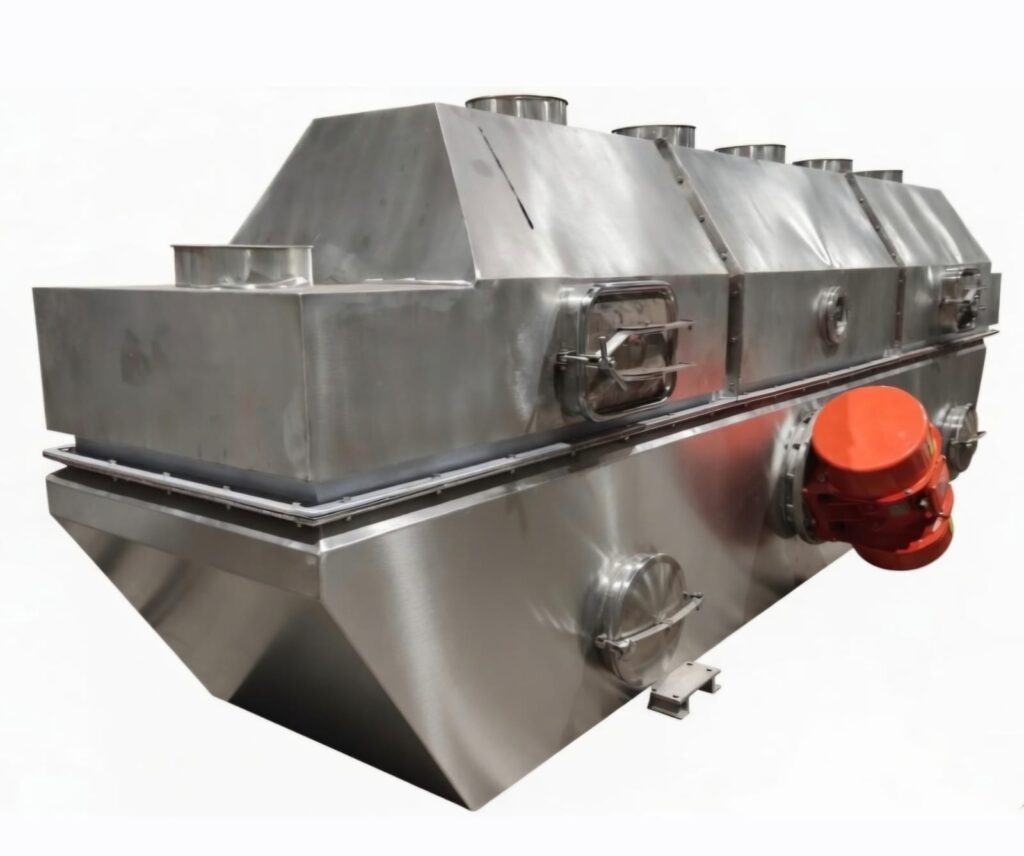
GTI’s VFBD technology is designed for continuous drying of suitable particulate materials, with options for automation and process control.
Why VFBD Can Be Relevant for CTC Tea Modernization in DRC
The DRC’s tea-processing challenge is partly an infrastructure challenge.
A 2024 Radio Okapi report on North Kivu described the need to revive tea cultivation, production and processing and noted that the former JTN tea complex, once producing around 240 tonnes of tea annually, was no longer operating because of prolonged insecurity.
A previous study of the Butuhe Tea Complex in North Kivu also identified obsolete machinery and electricity interruptions among constraints affecting dry-tea production.
Therefore, a new CTC drying system should be considered as part of a wider modernization project.
The equipment specification should consider:
- Existing CTC line
- Withering system
- Fermentation/oxidation process
- Dryer capacity
- Heating system
- Electrical infrastructure
- Exhaust system
- Dust collection
- Product handling
- Automation
- Future expansion
French Terminology for CTC & VFBD SEO
French is the official language of the DRC and is widely used for government, administration and business.
Useful French terminology includes:
Séchoir à thé CTC
CTC Tea Dryer
Machine de séchage du thé CTC
CTC Tea Drying Machine
Séchoir à lit fluidisé vibrant
Vibratory Fluid Bed Dryer
Séchoir à lit fluidisé
Fluid Bed Dryer
Équipement de séchage du thé
Tea Drying Equipment
Équipement de transformation du thé
Tea Processing Equipment
Machine de transformation du thé
Tea Processing Machine
These should be used naturally across French-language landing pages rather than simply inserting translated keywords into the English page.
2. Orthodox Tea Dryer Machine Manufacturer in DRC – Combination Fluid Bed Dryer
The DRC’s Orthodox tea opportunity is particularly interesting because there is already documented evidence of premium Orthodox tea production.
Great Lake Plantations reports that its M’bayo operation became the first company in the region to manufacture premium-quality Orthodox tea in 2017, following earlier modernization of the estate and factory.
This means Orthodox tea can be positioned as part of the DRC’s value-addition and product-diversification pathway.
Instead of selling only bulk black CTC tea, a modern tea processor can potentially develop additional product categories.
Combination Fluid Bed Dryer for Orthodox Tea
Orthodox tea generally requires careful handling because the leaf structure and desired finished characteristics differ from granular CTC tea.
A Combination Fluid Bed Dryer can be engineered with multiple drying stages to provide controlled:
- Airflow
- Temperature
- Residence time
- Moisture reduction
- Product movement
Potential benefits include:
- Multi-stage drying
- Uniform heat transfer
- Controlled moisture
- Continuous operation
- Process flexibility
- Energy optimization
- Automated control
- Improved production consistency
The final configuration must be established through product and process data rather than assuming one standard operating condition for all Orthodox teas.
Orthodox Tea as a Value-Addition Route for DRC
This is where the DRC page should differ from a generic African tea article.
The opportunity is not simply:
“DRC needs Orthodox tea dryers.”
The more useful industrial proposition is:
Existing tea-growing resources → Modern processing → Product diversification → Higher-value tea categories → Better market positioning
The M’bayo example demonstrates that Orthodox production has already been introduced into the DRC tea industry.
For future projects, the drying system can therefore be considered as part of a broader value-added processing line.
3. Green Tea Dryer in DRC – Combination Fluid Bed Dryer
Green tea is a smaller and more specialized opportunity for the DRC compared with its historical black-tea/CTC profile.
It should therefore be marketed as a diversification opportunity.
A tea processor considering green tea production may be targeting:
- Specialty tea
- Premium tea
- New domestic products
- Regional markets
- Export diversification
- Value-added tea products
Green tea processing requires controlled drying after the appropriate upstream processing stage.
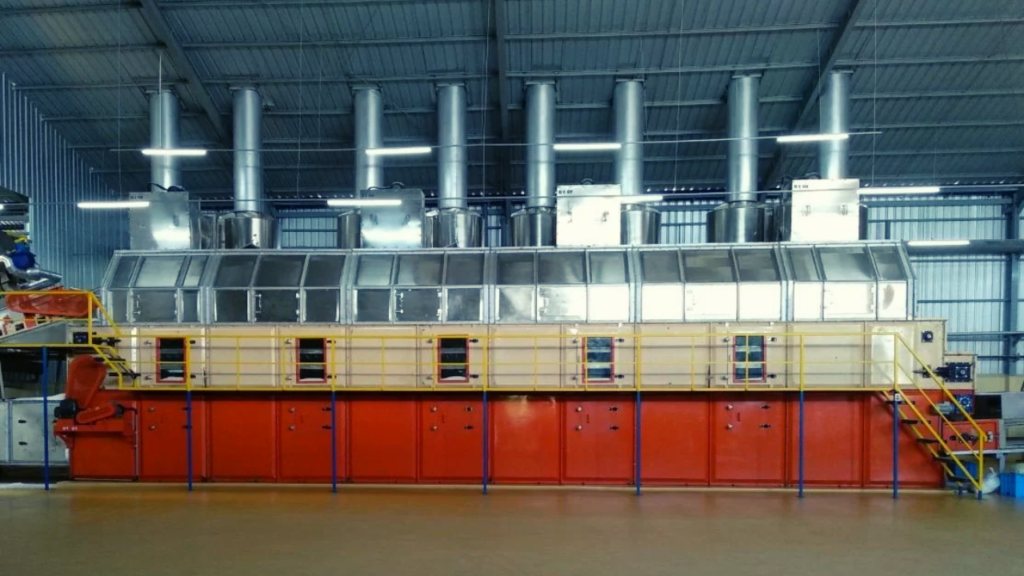
GTI’s green-tea drying technology includes combination drying and fluidized-bed approaches depending on the product and production requirements.
Why Green Tea Could Be an Opportunity for DRC Tea Processors
A modern tea factory does not necessarily need to rely on one finished product.
A flexible drying system can help manufacturers evaluate additional product categories.
For green tea, a Combination Fluid Bed Dryer can be considered where the process requires:
- Controlled moisture reduction
- Multi-stage drying
- Uniform airflow
- Product-quality consistency
- Continuous operation
- Temperature monitoring
- Automated control
The actual design should be based on:
Tea variety + initial moisture + production capacity + target moisture + leaf characteristics + drying profile
DRC Tea Processing: The Kivu Region Is the Main Opportunity
For this pillar page, Kivu should be the central geographic SEO strategy, rather than treating Kinshasa as the primary tea-production location.
The DRC’s documented tea activity is strongly connected to North Kivu and South Kivu.
South Kivu
Important target:
Bukavu
Great Lake Plantations is based in Bukavu and operates M’bayo and Magada tea estates in the region.
Potential GEO searches:
- Tea Dryer Bukavu
- Tea Processing Equipment Bukavu
- Tea Dryer South Kivu
- Tea Processing Machinery South Kivu
- Tea Drying Machine Bukavu
- Séchoir à thé Bukavu
- Équipement de transformation du thé Sud-Kivu
North Kivu
Potential target areas include:
- Beni
- Butuhe
- Goma
- Rutshuru
- Masisi
Radio Okapi’s 2024 reporting specifically highlighted the need to revive tea production and processing in North Kivu.
Potential searches:
- Tea Dryer North Kivu
- Tea Processing Equipment North Kivu
- Tea Dryer Beni
- Tea Processing Equipment Butuhe
- Tea Dryer Goma
- Tea Processing Machinery Rutshuru
- Tea Processing Equipment Masisi
- Séchoir à thé Nord-Kivu
- Machine de séchage du thé Nord-Kivu
Swahili Eastern DRC
The U.S. Commercial Service notes that Swahili is widely spoken in eastern DRC, including areas such as Goma and Bukavu.
Potential Swahili search terminology:
| English | Swahili |
|---|---|
| Tea | Chai |
| Tea Dryer | Mashine ya kukaushia chai |
| Tea Drying | Kukausha chai |
| Tea Processing | Usindikaji wa chai |
| Tea Processing Equipment | Vifaa vya usindikaji wa chai |
| Tea Factory | Kiwanda cha chai |
| Tea Processing Machine | Mashine ya usindikaji wa chai |
| Tea Drying Machine | Mashine ya kukaushia chai |
| Green Tea | Chai ya kijani |
| Black Tea | Chai nyeusi |
High-Intent Swahili Queries
mashine ya kukaushia chai DRC
vifaa vya usindikaji wa chai
mashine ya chai Kivu
kiwanda cha chai DRC
mashine ya kukaushia chai Bukavu
mashine ya kukaushia chai Goma
This creates an additional search layer for buyers and technical personnel in eastern DRC.
DRC Tea Industry: The Demand Story Is About Rehabilitation and Value Addition
The DRC should not be marketed using inflated claims about tea demand.
Current production remains relatively small.
FAOSTAT-derived 2024 data puts national tea production at approximately 2,014 tonnes, considerably below the country’s historical production levels.
The more defensible market opportunity is therefore:
1. Rehabilitation
Restoring previously productive tea-processing facilities.
2. Modernization
Replacing obsolete dryers and other processing equipment.
3. Capacity Recovery
Increasing usable factory capacity.
4. Product Diversification
Moving beyond traditional black CTC tea where commercially viable.
5. Quality Improvement
Improving moisture and process consistency.
6. Export Development
Creating processing capabilities capable of serving higher-value domestic, regional and international markets.
This is a much stronger industrial narrative than claiming that DRC currently has a massive tea-dryer market.
Existing DRC Experience with CTC + VFBD Modernization
One of the strongest country-specific points for this page is that the technology combination has already appeared in the DRC tea industry.
Great Lake Plantations reports that when M’bayo and Magada were acquired in 2014, the factory modernization included:
CTC manufacturing lines + VFBD dryers + upgraded factory infrastructure.
The company subsequently reports expansion into premium Orthodox tea.
This creates a useful technology progression for the DRC:
Traditional Tea Estate
↓
Factory Rehabilitation
↓
CTC Processing
↓
VFBD Drying
↓
Orthodox Tea Diversification
↓
Premium Tea Development
That is a more compelling DRC-specific story than simply listing three dryers.
What Should a DRC Tea Factory Consider Before Buying a Dryer?
A dryer should be sized from actual process requirements.
Important information includes:
Tea Type
- CTC
- Orthodox
- Black tea
- Green tea
- Specialty tea
Production Capacity
Provide:
- kg/hour
- tonnes/day
- seasonal capacity
- operating hours
Moisture
Provide:
- Initial moisture
- Required final moisture
Product Characteristics
Include:
- Leaf size
- Particle size
- Bulk density
- Flowability
- Heat sensitivity
- Product fragility
Existing Plant
For modernization projects, provide information about:
- Existing dryer
- CTC line
- Withering system
- Fermentation/oxidation equipment
- Conveyors
- Heating system
- Exhaust
- Dust collection
- Electrical supply
Energy Availability
This is especially important for DRC projects.
Potential heating options may include:
- Steam
- Thermal oil
- Gas
- LPG
- Biomass
- Electricity
- Waste-heat recovery
The availability and reliability of utilities should be assessed during project design.
Tea Dryer Engineering for DRC: Design Around the Local Plant
A major difference between a new-build tea factory and a rehabilitation project is the existing infrastructure.
In the DRC, a dryer project may need to work around:
- Existing buildings
- Existing tea machinery
- Limited electrical infrastructure
- Heating-system limitations
- Spare-parts requirements
- Local maintenance capabilities
- Transport and installation conditions
- Future capacity expansion
This makes custom engineering more important than a standard catalogue machine.
GTI Dryers can evaluate the drying system according to:
Product → Capacity → Moisture → Heating Source → Airflow → Residence Time → Plant Layout → Automation
Why Choose a Customized Industrial Tea Dryer?
A customized dryer can be engineered according to the actual tea-processing line.
Possible engineering considerations include:
Controlled Airflow
Helps achieve more uniform drying.
Controlled Residence Time
Allows the process to be matched to the product.
Temperature Monitoring
Provides visibility into the drying process.
Automated Operation
PLC/HMI/SCADA options can be considered depending on project requirements.
Continuous Processing
VFBD technology can support continuous drying for suitable free-flowing products.
Modular Design
Equipment can be designed around available factory space and future expansion.
Energy Optimization
Thermal efficiency, insulation and heat-recovery opportunities can be evaluated during engineering.
French Content Strategy for DRC
Because French is the official language of DRC and the principal language of business and administration, a dedicated French landing-page cluster can be particularly valuable.
Recommended French pages:
Main Page
Fabricant de Séchoirs à Thé en RDC
/fabricant-sechoir-the-rdc/
CTC
Séchoir à Thé CTC en RDC | Séchoir à Lit Fluidisé Vibrant
/sechoir-the-ctc-rdc/
Orthodox
Séchoir à Thé Orthodoxe en RDC | Séchoir à Lit Fluidisé Combiné
/sechoir-the-orthodoxe-rdc/
Green Tea
Séchoir à Thé Vert en RDC | Séchoir à Lit Fluidisé Combiné
/sechoir-the-vert-rdc/
Regional
Équipement de Transformation du Thé au Nord-Kivu
Équipement de Transformation du Thé au Sud-Kivu
Séchoir à Thé à Bukavu
Séchoir à Thé à Goma
These pages should have genuinely localized content rather than simple machine translation.
Recommended DRC Cluster
The pillar page should become the central page for the entire DRC tea-dryer topic.
National Cluster
/tea-dryer-machine-manufacturer-drc/
Targets:
Tea Dryer Manufacturer DRC
Tea Processing Equipment DRC
Industrial Tea Dryer Democratic Republic of Congo
Technology Cluster
/ctc-tea-dryer-drc/
/vfbd-tea-dryer-drc/
/orthodox-tea-dryer-drc/
/green-tea-dryer-drc/
/combination-fluid-bed-dryer-drc/
Regional Cluster
/tea-processing-equipment-north-kivu/
/tea-processing-equipment-south-kivu/
/tea-dryer-bukavu/
/tea-dryer-goma/
/tea-processing-equipment-beni/
/tea-dryer-butuhe/
French Cluster
/sechoir-the-rdc/
/sechoir-the-ctc-rdc/
/sechoir-the-vert-rdc/
/sechoir-the-orthodoxe-rdc/
/equipement-transformation-the-rdc/
Suggested Internal Linking Structure
The site architecture can be organized as:
DRC Tea Dryer Pillar
↓
CTC Tea Dryer
↓
VFBD Tea Dryer
↓
Orthodox Tea Dryer
↓
Green Tea Dryer
↓
Combination Fluid Bed Dryer
↓
Tea Processing Equipment
↓
North Kivu Tea Equipment
↓
South Kivu Tea Equipment
↓
Bukavu / Goma / Beni GEO Pages
↓
French & Swahili Content
This creates a clear relationship between:
Country → Region → Tea Type → Technology → Application → Buyer Intent
Frequently Asked Questions
Is tea produced in the Democratic Republic of Congo?
Yes. The DRC has a long history of tea cultivation and processing, particularly in the Kivu region. However, current production is substantially below its historical levels. FAOSTAT-derived data reports approximately 2,014 tonnes in 2024.
What type of tea has historically been important in DRC?
The DRC has a documented history of black CTC tea production and export. More recently, Orthodox tea production has also been developed at M’bayo in South Kivu.
What dryer is suitable for CTC tea in DRC?
For suitable granular CTC tea, a Vibratory Fluid Bed Dryer (VFBD) can be evaluated for continuous drying, controlled residence time and moisture management.
What dryer is suitable for Orthodox tea?
A Combination Fluid Bed Dryer can be considered for Orthodox tea where multi-stage controlled drying is appropriate. Final equipment selection depends on the tea and process characteristics.
Can green tea be produced in DRC?
Green tea can be considered as a product-diversification opportunity, although the DRC’s established tea history is more strongly associated with black tea and CTC production.
What is “tea dryer” in French?
Common terminology includes “séchoir à thé,” “machine de séchage du thé” and “équipement de séchage du thé.”
What is “Vibratory Fluid Bed Dryer” in French?
A commonly used technical translation is “séchoir à lit fluidisé vibrant.”
What is the Swahili term for tea dryer?
A useful term is “mashine ya kukaushia chai.”
Where should tea-processing equipment suppliers focus their DRC GEO strategy?
The strongest tea-specific geographic targets are North Kivu and South Kivu, including locations such as Bukavu, Goma and Beni. Current reporting specifically identifies tea-processing activity and rehabilitation needs in these regions.
Can an industrial dryer be integrated into an existing DRC tea factory?
Yes. A modernization project can be engineered around existing processing equipment, building constraints, heating systems, electrical infrastructure and future capacity requirements.
Request a Tea Dryer Proposal for the Democratic Republic of Congo
The DRC’s tea industry presents a different kind of industrial opportunity.
It is not primarily a story of massive current production.
It is a story of:
Tea-growing potential + existing processing infrastructure + modernization + rehabilitation + product diversification.
For suitable CTC applications, VFBD technology can provide continuous fluidized drying and controlled moisture management.
For Orthodox tea, Combination Fluid Bed Dryers can support controlled multi-stage drying.
For green tea, Combination Fluid Bed Drying can provide a potential route toward product diversification.
GTI Dryers can evaluate tea-drying projects around:
- Tea type
- Production capacity
- Initial moisture
- Final moisture
- Product characteristics
- Heating source
- Existing factory equipment
- Plant layout
- Automation requirements
Planning a Tea Dryer Project in DRC?
Share:
Tea type + production capacity + initial moisture + final moisture + existing machinery + heating source + plant location
The GTI engineering team can use these details to evaluate the appropriate drying technology and develop a project-specific solution.
French Enquiry CTA
Vous planifiez une nouvelle usine de transformation du thé ou souhaitez moderniser votre système de séchage en RDC ?
Envoyez-nous :
Type de thé + capacité de production + humidité initiale + humidité finale + équipements existants + source d’énergie + emplacement de l’usine
Notre équipe d’ingénierie peut étudier vos besoins et proposer une solution industrielle de séchage adaptée à votre procédé.
GTI Dryers — Solutions de séchage industriel conçues pour les industries du thé en République Démocratique du Congo.
Swahili CTA
Unapanga kuanzisha au kuboresha kiwanda cha usindikaji wa chai nchini DRC?
Tuma:
Aina ya chai + uwezo wa uzalishaji + unyevu wa awali + unyevu wa mwisho + mashine zilizopo + chanzo cha nishati + eneo la kiwanda.
Timu ya GTI inaweza kutathmini mahitaji ya mchakato na kupendekeza mfumo unaofaa wa kukaushia chai.
GTI Dryers — Suluhisho za kisasa za kukausha kwa viwanda vya chai.