
Argentina’s Tea Industry Needs More Than a Dryer
Argentina occupies a distinctive position in the international tea industry.
Unlike markets where tea is primarily produced for domestic consumption, Argentina’s tea industry has a strong export-oriented manufacturing model, with production concentrated particularly in the province of Misiones.
In 2024, tea represented 17.3% of Misiones’ total export value, generating approximately US$76.2 million, with tea export volume also increasing year over year.
More recent data from the provincial government shows that tea remained a major export category in 2025, accounting for 12.3% of Misiones’ total exports and approximately US$65.5 million.
At the national level, World Bank WITS/UN Comtrade data records Argentina exporting approximately 56.96 million kg of black fermented and partly fermented tea in 2024, valued at approximately US$64.53 million. The United States accounted for the overwhelming majority of that export volume.
This export dependence changes the role of industrial tea drying.
For an Argentine tea processor, drying is not simply about removing moisture.
It is about achieving repeatable moisture control, consistent processing, efficient production and the product quality required by export markets.
That creates an opportunity for application-specific industrial drying technologies such as:
CTC Tea → Vibratory Fluid Bed Dryer (VFBD)
Orthodox Tea → Combination Fluid Bed Dryer
Green Tea → Combination Fluid Bed Dryer
Argentina Tea Market: Why Drying Technology Is a Strategic Process Step
Argentina’s tea industry has developed around an export-oriented production chain.
Approximately 95% of Argentine tea production has historically been directed toward international markets, with the United States identified as the principal destination.
This means tea factories must consider more than production volume.
They also need to consider:
- Consistent final moisture
- Product uniformity
- Storage stability
- Export specifications
- Energy consumption
- Drying capacity
- Process automation
- Product handling
- Batch-to-batch consistency
- Production economics
The latest 2025–26 tea-season reporting indicates that the sector experienced pressure from adverse climatic conditions, higher production and logistics costs, and weaker international demand, with reported declines in production and exports.
For equipment manufacturers, this makes process efficiency and controlled drying particularly relevant.
A modern dryer can therefore be positioned not merely as a replacement machine, but as part of a broader tea-processing modernization strategy.
The Argentina Opportunity: From Export-Volume Tea to Controlled Processing
Argentina’s tea industry is strongly associated with black tea.
Therefore, the most commercially relevant equipment pathway is not to claim that Argentina has the same green-tea market structure as China.
Instead, the opportunity can be divided into three industrial applications:
Established Black Tea Processing
Orthodox / black tea → Combination Fluid Bed Dryer
Granular Tea and CTC Applications
CTC tea → VFBD
Product Diversification
Green tea → Combination Fluid Bed Dryer
This creates a more realistic Argentina-specific equipment proposition:
Modernize the core black-tea drying process while creating flexible drying capability for CTC, specialty and green-tea products.
1. CTC Tea Dryer Machine Manufacturer in Argentina – VFBD
CTC, or Crush-Tear-Curl, processing produces relatively small, granular tea particles.
Because of their physical characteristics, these materials can be suitable for fluidized drying systems when the process and product properties support fluidization.
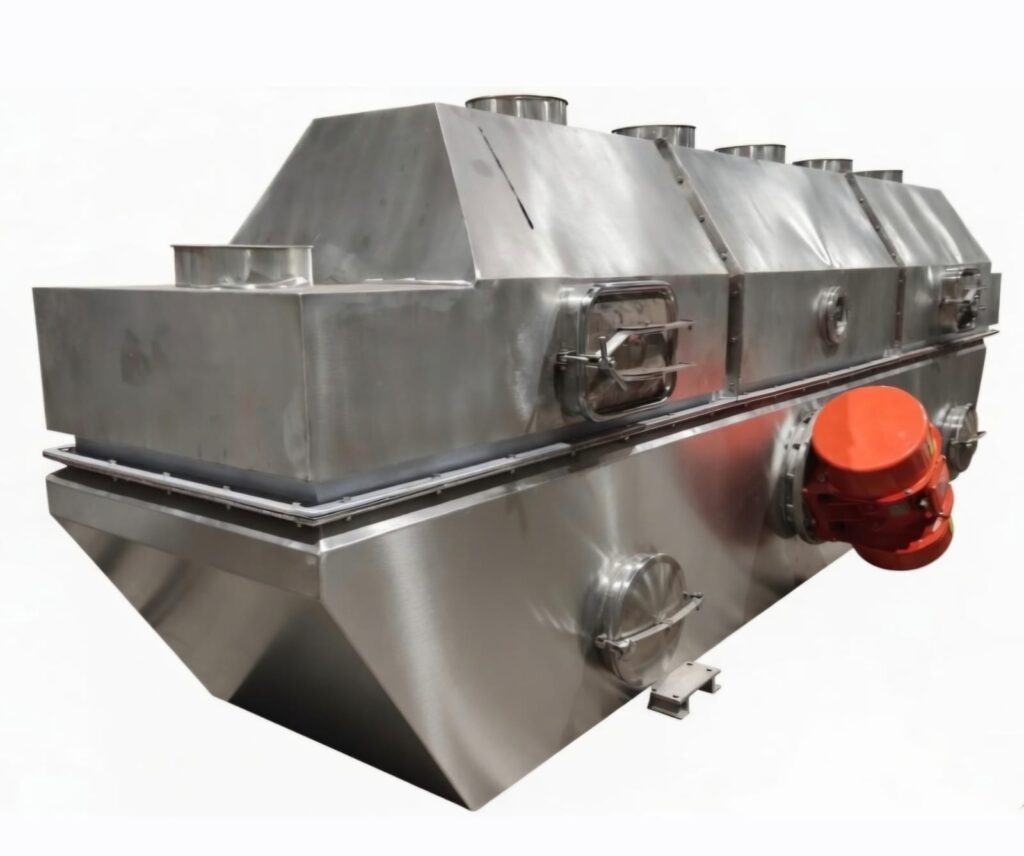
A Vibratory Fluid Bed Dryer (VFBD) combines controlled vibration with upward-flowing heated air.
The vibration helps move the product continuously while the air creates the fluidized drying environment.
GTI’s VFBD systems are designed for uniform drying, controlled final moisture, continuous operation and efficient heat transfer.
Why Consider VFBD for CTC Tea?
A properly engineered VFBD can provide:
- Continuous drying
- Controlled residence time
- Uniform product movement
- Efficient heat and mass transfer
- Controlled final moisture
- Adjustable airflow
- Gentle product handling
- Automation capability
- Consistent production
The basic process can be represented as:
Wet CTC Tea
↓
Controlled Feeding
↓
Vibratory Fluidized Bed
↓
Hot Air Distribution
↓
Moisture Evaporation
↓
Progressive Moisture Reduction
↓
Final Moisture Control
↓
Continuous Discharge
The exact drying conditions must be established from the tea characteristics, initial moisture, target moisture, capacity and process requirements.
CTC Tea Dryer – Spanish Terminology for Argentina SEO
Because Spanish is the language used throughout Argentina, the Argentina SEO strategy should include Spanish industrial terminology rather than relying exclusively on English keywords.
Useful terminology includes:
| English | Spanish |
| Tea Dryer | Secadora de té / Secador de té |
| Tea Drying Machine | Máquina secadora de té |
| Tea Drying Equipment | Equipo de secado de té |
| Tea Processing Equipment | Equipos para procesamiento de té |
| CTC Tea Dryer | Secadora de té CTC |
| CTC Tea Drying Machine | Máquina secadora de té CTC |
| Fluid Bed Dryer | Secador de lecho fluidizado |
| Vibratory Fluid Bed Dryer | Secador de lecho fluidizado vibratorio |
| Combination Fluid Bed Dryer | Secador de lecho fluidizado combinado |
| Green Tea Dryer | Secadora de té verde |
| Black Tea Dryer | Secadora de té negro |
| Tea Factory | Fábrica de té |
| Tea Processing Plant | Planta de procesamiento de té |
| Tea Processing Machinery | Maquinaria para procesamiento de té |
High-Intent Spanish Searches
Potential high-intent search phrases include:
secadora de té industrial Argentina
máquina secadora de té Argentina
secador de té industrial
secadora de té CTC
secador de lecho fluidizado vibratorio
equipos para procesamiento de té Argentina
maquinaria para fábrica de té
equipos para industria tealera
secadora de té Misiones
These terms should be distributed naturally across dedicated Spanish landing pages, metadata, FAQs, image alt text and supporting articles.
2. Orthodox Tea Dryer Machine Manufacturer in Argentina – Combination Fluid Bed Dryer
Orthodox tea processing generally involves more intact leaf structures than CTC production.
Consequently, drying needs to be engineered around:
- Leaf characteristics
- Moisture distribution
- Product temperature
- Residence time
- Airflow
- Aroma
- Colour
- Final moisture
A Combination Fluid Bed Dryer can be configured as a multi-stage drying system, allowing the process engineer to control different drying zones according to the product requirements.
Why Combination Fluid Bed Drying?
A customized combination system can provide:
- Multi-stage drying
- Controlled airflow
- Uniform heat transfer
- Better moisture management
- Flexible residence time
- Continuous operation
- Energy optimization
- Automated process control
This can be relevant for Argentine processors producing:
- Orthodox black tea
- Specialty black tea
- Premium tea
- Export-oriented tea
- Specialty blends
- Diversified tea products
The final equipment selection should always be based on actual product and process data.
Black Tea Drying for Argentina’s Export-Oriented Tea Industry
Black tea represents the most commercially significant tea export pathway for Argentina.
World Bank WITS/UN Comtrade data shows that Argentina exported nearly 57 million kg of black fermented and partly fermented tea in 2024, with the United States taking approximately 48.9 million kg.
That makes consistency especially important.
For export-oriented factories, drying performance can influence:
Moisture Uniformity
Consistent moisture supports predictable product quality and storage performance.
Product Temperature
Controlled temperature helps avoid unnecessary thermal stress.
Residence Time
Proper residence time allows moisture to be removed progressively rather than relying on uncontrolled drying.
Airflow Distribution
Uniform airflow helps reduce variation across the product bed.
Energy Consumption
For large production volumes, thermal efficiency becomes an important operating consideration.
Automation
Automated control can reduce process variation and improve repeatability.
GTI’s industrial tea-drying systems are designed around parameters such as temperature, airflow, moisture content, drying time and residence time.
3. Green Tea Dryer in Argentina – Combination Fluid Bed Dryer
Green tea is not the dominant tea category in Argentina’s export profile, so it should be positioned differently from the black-tea market.
For Argentine tea processors looking to diversify into:
- Green tea
- Specialty tea
- Premium tea
- Functional tea products
- New export categories
- Blended tea products
a controlled drying system can become part of the production strategy.
Green tea requires careful control because the drying stage follows enzyme deactivation and is important for maintaining the desired colour, aroma and product characteristics.
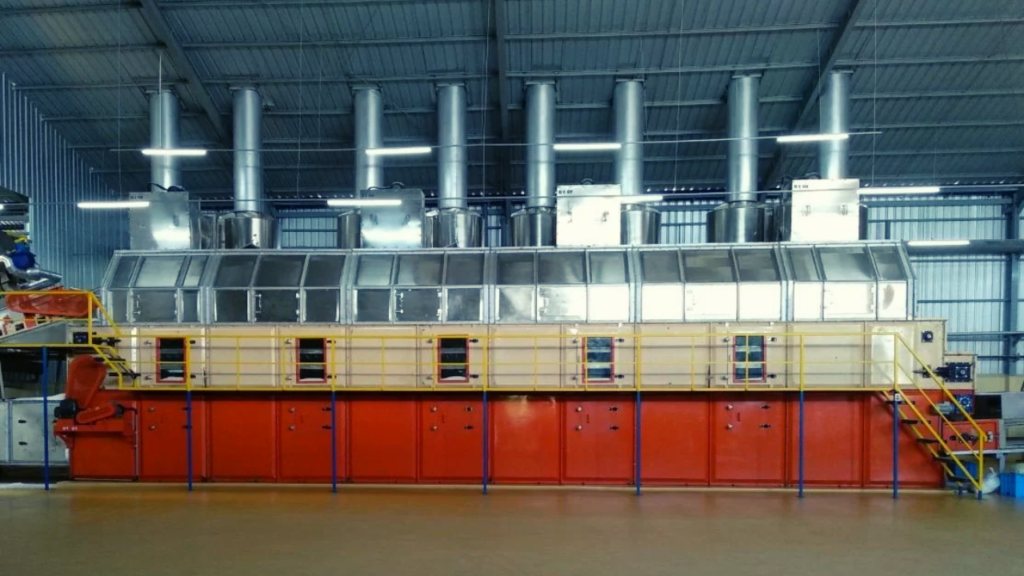
GTI’s green-tea drying systems include Combination Dryers and Vibro Fluid Bed Dryers, with the system selected according to production scale and product requirements.
Combination Fluid Bed Dryer for Green Tea
A combination drying system can be designed with multiple stages to progressively reduce moisture.
Potential advantages include:
- Controlled moisture reduction
- Multi-stage drying
- Uniform airflow
- Improved process consistency
- Energy optimization
- Continuous processing
- Automated temperature control
- Flexible process configuration
The system should be designed around:
Initial moisture → Tea characteristics → Production capacity → Target moisture → Airflow → Residence time → Heating source
Why Misiones Is the Main Target for Tea Dryer Equipment
The strongest geographic opportunity is Misiones, where the tea industry has a major production and export presence.
The provincial government describes Misiones as a national and international reference point for tea production and highlighted the importance of innovation, business development and strengthening the tea value chain during Expo Té Argentina 2025.
This means the website should create location-specific landing pages around the actual tea-processing ecosystem.
Recommended GEO Keywords
Tea Dryer Manufacturer in Misiones
Tea Processing Equipment Misiones
Tea Dryer Oberá
Tea Processing Machinery Oberá
Tea Dryer Apóstoles
Tea Processing Equipment Apóstoles
Tea Dryer Campo Viera
Tea Processing Equipment Campo Viera
Tea Dryer Leandro N. Alem
Tea Processing Equipment Aristóbulo del Valle
Spanish GEO Keywords
secadora de té Misiones
secadora industrial de té Oberá
equipos para procesamiento de té Misiones
maquinaria para industria tealera Misiones
secador de té industrial Oberá
equipos para fábrica de té Misiones
This creates a much stronger local-search footprint than repeatedly using only:
“Tea Dryer Manufacturer in Argentina.”
Tea Processing Equipment for Misiones: A Regional Industrial Opportunity
Misiones’ export data demonstrates why the province should be the primary GEO focus for this pillar page.
In 2024, tea generated approximately US$76.2 million in Misiones exports, representing 17.3% of the province’s export value.
In 2025, tea exports from Misiones were approximately US$65.5 million, representing 12.3% of provincial exports.
The figures also demonstrate an important point for equipment manufacturers:
A high-value tea-processing market does not necessarily mean uninterrupted growth.
The sector has faced cost, logistics, climate and international-demand pressures.
Therefore, a dryer supplier should communicate measurable engineering benefits such as:
- Controlled drying
- Energy optimization
- Production consistency
- Automation
- Reduced process variation
- Flexible capacity
- Product-quality protection
rather than relying on generic claims such as “best dryer” or “cheapest dryer.”
Argentina’s Tea Industry and Export Quality: Why Drying Consistency Matters
Argentina’s tea industry is strongly connected to international markets.
The 2024 export data illustrates the concentration: approximately 85.9% of Argentina’s black-tea export volume went to the United States based on the WITS figures.
For a processor serving export markets, a drying system therefore needs to support repeatability.
The objective is not simply:
Wet Tea → Dry Tea
The industrial objective is:
Controlled Feed → Controlled Airflow → Controlled Heat Transfer → Controlled Residence Time → Uniform Moisture → Stable Product
This is where process engineering becomes important.
What Should an Argentine Tea Factory Consider Before Selecting a Dryer?
There is no single dryer that is automatically suitable for every tea factory.
Before selecting a system, the manufacturer should evaluate:
1. Tea Type
- CTC
- Orthodox
- Black tea
- Green tea
- Specialty tea
2. Production Capacity
Specify:
- kg/hour
- tonnes/day
- seasonal production
- operating hours/day
3. Initial Moisture
The moisture entering the dryer directly affects the drying load.
4. Target Final Moisture
The required final specification determines the drying duty and residence time.
5. Product Characteristics
Important parameters include:
- Leaf size
- Particle size
- Bulk density
- Fragility
- Flowability
- Heat sensitivity
6. Heating Source
Potential heating systems can include:
- Steam
- Thermal oil
- Gas
- LPG
- Biomass
- Electricity
- Waste-heat integration
7. Plant Conditions
The project should also consider:
- Available floor space
- Existing processing equipment
- Utilities
- Exhaust requirements
- Dust collection
- Product transfer
- Future capacity expansion
8. Automation Requirements
Options can include:
- Manual controls
- PLC
- HMI
- SCADA
- Automatic temperature control
- Airflow control
- Data logging
How a Modern Tea Dryer Can Support Argentine Tea Manufacturers
The objective of modern drying equipment is to make the process more controllable.
A properly engineered system can help manufacturers work toward:
Consistent Moisture
Uniform drying can reduce variation between production batches.
Improved Production Control
Automated monitoring provides greater visibility into important process conditions.
Continuous Processing
VFBD and other continuous systems can support industrial production where the feed characteristics are appropriate.
Energy Management
Optimized airflow, insulation and heat recovery can be considered during system design.
Product Handling
Vibration and controlled airflow can provide gentle movement for suitable particulate products.
Export-Oriented Quality
Repeatable processing can help manufacturers maintain consistent product specifications.
GTI’s tea drying systems are designed with process engineering, equipment manufacturing, installation and commissioning, automation integration, operator training and after-sales support as part of the potential project scope.
GTI Dryers for Argentina: From Equipment Supply to Drying Engineering
For an Argentine tea factory, importing a dryer should not simply be an equipment-purchase decision.
The more important question is:
How should the drying system be engineered around our tea, capacity and production process?
GTI Dryers approaches industrial drying through application-specific engineering.
The system can be evaluated around:
- Tea variety
- Initial moisture
- Final moisture
- Production capacity
- Product characteristics
- Residence time
- Airflow
- Heating source
- Plant layout
- Automation requirements
GTI manufactures industrial drying technologies including fluidized-bed and vibratory fluidized-bed systems for different process applications.
For tea applications, GTI’s technology portfolio covers drying solutions for black tea, green tea, CTC tea and specialty tea processing.
Argentina Tea Dryer SEO Strategy: Build a Country + Province Cluster
This pillar page should become the main Argentina authority page and should internally link to more specific commercial pages.
Core Technology Pages
CTC Tea Dryer Argentina
/ctc-tea-dryer-argentina/
Target:
CTC Tea Dryer Machine Manufacturer Argentina
CTC Tea VFBD Argentina
Secadora de té CTC Argentina
VFBD Tea Dryer Argentina
/vfbd-tea-dryer-argentina/
Target:
Vibratory Fluid Bed Dryer Argentina
VFBD Tea Dryer Argentina
Secador de lecho fluidizado vibratorio Argentina
Orthodox Tea Dryer Argentina
/orthodox-tea-dryer-argentina/
Target:
Orthodox Tea Dryer Argentina
Orthodox Tea Drying Machine Argentina
Secadora de té negro Argentina
Green Tea Dryer Argentina
/green-tea-dryer-argentina/
Target:
Green Tea Dryer Argentina
Green Tea Drying Machine Argentina
Secadora de té verde Argentina
Combination Fluid Bed Dryer Argentina
/combination-fluid-bed-dryer-argentina/
Target:
Combination Fluid Bed Dryer Argentina
Secador de lecho fluidizado combinado
Province-Level GEO Pages
The next layer should focus specifically on Misiones.
Recommended pages include:
/tea-dryer-misiones/
/tea-processing-equipment-misiones/
/tea-dryer-obera/
/tea-processing-equipment-apostoles/
/tea-dryer-campo-viera/
/tea-processing-machinery-leandro-n-alem/
These pages should not simply copy the pillar page.
Each should discuss the relevant local tea-processing ecosystem, application, logistics, project requirements and buyer intent.
Spanish-Language SEO Cluster
A dedicated Spanish-language section can capture searches that English-only content may miss.
Recommended pages:
/secadora-de-te-argentina/
/equipos-procesamiento-te-argentina/
/secadora-te-misiones/
/secador-lecho-fluidizado-vibratorio/
/secadora-te-verde/
/secadora-te-ctc/
Potential Spanish page titles:
Secadora Industrial de Té en Argentina | Equipos de Secado para Plantas Tealeras
Secador de Lecho Fluidizado Vibratorio para Té | VFBD Industrial
Secadora de Té CTC en Argentina | Sistema VFBD Continuo
Secadora de Té Verde | Sistema de Lecho Fluidizado Combinado
Internal Linking Architecture
The pillar page should connect the Argentina topic cluster like this:
Argentina Tea Dryer Pillar
↓
CTC Tea Dryer
↓
VFBD Tea Dryer
↓
Orthodox Tea Dryer
↓
Green Tea Dryer
↓
Combination Fluid Bed Dryer
↓
Tea Processing Equipment
↓
Misiones Tea Dryer
↓
Spanish Tea Dryer Pages
This creates a topical relationship between:
Country → Region → Tea Type → Dryer Technology → Industrial Application
which is more useful for both users and search engines than creating isolated keyword pages.
Frequently Asked Questions About Tea Dryers in Argentina
What type of tea dryer is suitable for Argentine tea factories?
The appropriate technology depends on the tea type, production capacity, moisture requirements and physical characteristics of the product. VFBD can be evaluated for suitable CTC/granular tea applications, while combination fluid-bed systems can be considered for Orthodox and green-tea applications.
Is CTC tea produced in Argentina?
Argentina’s tea industry is strongly associated with black tea and export production. CTC can be considered an application-specific processing route rather than the country’s dominant tea category.
What is a VFBD tea dryer?
A Vibratory Fluid Bed Dryer combines vibration with fluidized hot air. The vibration moves the product through the dryer while airflow provides heat and mass transfer for moisture removal.
What is a combination fluid bed dryer?
A combination fluid bed drying system integrates multiple drying stages or drying mechanisms to provide greater control over moisture reduction and process conditions.
What is the Spanish term for tea dryer?
Common terms include “secadora de té,” “secador de té” and “máquina secadora de té.”
What is the Spanish term for VFBD?
A commonly used technical translation is “secador de lecho fluidizado vibratorio.”
Where is Argentina’s tea industry mainly concentrated?
Misiones is the principal tea-producing and tea-exporting region of Argentina and is therefore a major geographic target for tea-processing equipment suppliers.
Can GTI Dryers supply a tea dryer for Argentina?
GTI Dryers designs and manufactures customized industrial drying systems and can evaluate tea-drying projects according to product characteristics, production capacity, moisture requirements, heating source and automation needs.
Can the dryer be integrated into an existing tea-processing plant?
Yes. Dryer selection and design can consider integration with existing feeding, processing, conveying, exhaust, dust-collection and packaging systems.
What information is needed for a tea dryer quotation?
A preliminary technical assessment should include tea type, capacity, initial moisture, required final moisture, product characteristics, operating hours, available heating source, plant location and automation requirements.
Request a Customized Tea Drying System for Argentina
Argentina’s tea industry is fundamentally different from markets where domestic tea consumption drives production.
Its strength lies heavily in export-oriented tea manufacturing, particularly in Misiones.
That means industrial drying needs to support more than moisture removal.
It needs to support:
Consistency + Process Control + Energy Management + Product Quality + Export Requirements
For suitable granular CTC applications, Vibratory Fluid Bed Dryers (VFBD) can provide continuous movement, fluidization and controlled moisture removal.
For Orthodox and specialty black tea, Combination Fluid Bed Dryers can provide multi-stage drying and controlled process conditions.
For manufacturers diversifying into green tea and specialty products, Combination Fluid Bed Drying can provide an additional technology pathway.
Planning a Tea Dryer Project in Argentina?
Send the following information to the GTI engineering team:
Tea type + production capacity + initial moisture + final moisture + product characteristics + heating source + plant location
GTI can then evaluate the process requirements and recommend an appropriate industrial drying configuration.
GTI Dryers — Engineered Drying Solutions from India for Argentina’s Tea Processing Industry.
Spanish Enquiry CTA
¿Está planificando una nueva planta de procesamiento de té o desea modernizar su sistema de secado?
Comparta con nuestro equipo:
Tipo de té + capacidad de producción + humedad inicial + humedad final + fuente de energía + ubicación de la planta
Nuestro equipo de ingeniería puede evaluar sus requisitos y desarrollar una solución de secado industrial personalizada.GTI Dryers — Soluciones de secado industrial diseñadas para la industria tealera argentina.