
Tea Dryer Machine Manufacturer in Sri Lanka for Modern Ceylon Tea Processing
Sri Lanka’s tea industry is not simply another tea-producing market.
It is the home of Ceylon Tea, a globally recognized tea origin with a production system divided across distinctive high-grown, medium-grown and low-grown regions.
The Sri Lanka Tea Board identifies seven principal tea-growing regions:
- Nuwara Eliya
- Uda Pussellawa
- Uva
- Dimbula
- Kandy
- Sabaragamuwa
- Ruhuna
These regions have different elevations, climates and tea characteristics, making process control and consistent manufacturing conditions particularly important.
Sri Lanka’s tea industry also has a distinctive production structure.
Unlike countries where CTC dominates the industrial tea sector, Sri Lanka’s production is heavily oriented toward Orthodox tea.
In 2025, Sri Lanka produced:
- 237,079 MT Orthodox Tea
- 24,709 MT CTC Tea
- 2,333 MT Green Tea
- 264,122 MT total tea
The same industry statistics show that Sri Lanka exported approximately 257,440 MT of tea in 2025 across bulk tea, packets, tea bags, instant tea and green tea.
This creates three distinct industrial drying opportunities:
Orthodox Tea → Combination Fluid Bed Dryer
CTC Tea → Vibratory Fluid Bed Dryer (VFBD)
Green Tea → Combination Fluid Bed Dryer
GTI Dryers designs customized industrial drying systems according to the tea type, capacity, moisture load, product characteristics and required process conditions.
Why Sri Lanka Requires a Different Tea Dryer Strategy
A generic “Tea Dryer for Sri Lanka” approach does not fully reflect the country’s tea industry.
Sri Lanka’s tea-processing requirements are influenced by:
Origin → Elevation → Tea Type → Processing Method → Drying → Grading → Value Addition → Export
The country’s tea is commercially differentiated according to geographical origin.
For example:
- Nuwara Eliya – high-grown tea
- Dimbula – high-grown tea
- Uva – high-grown tea
- Uda Pussellawa – high-grown tea
- Kandy – mid-country tea
- Ruhuna – low-grown tea
- Sabaragamuwa – low-grown tea
The Sri Lanka Tea Board and Tea Exporters Association recognize these regional appellations as part of the identity and quality framework of Ceylon Tea.
Therefore, industrial drying equipment should be designed around the actual tea-processing application, rather than using one standard dryer configuration for every factory.
Sri Lanka Tea Industry at a Glance
Sri Lanka remains a major international tea-exporting country.
World Bank WITS data records approximately 243.16 million kg of tea exports from Sri Lanka in 2024, valued at approximately US$1.393 billion. Major destinations included Iraq, Russia, the UAE, Türkiye and Saudi Arabia.
Sri Lankan industry statistics show that production recovered to 264.12 million kg in 2025, compared with 262.16 million kg in 2024.
This scale creates an ongoing requirement for:
- tea-processing equipment
- industrial drying systems
- dryer modernization
- production-capacity upgrades
- energy-efficient drying
- moisture control
- automation
- product diversification
- export-oriented processing
The opportunity is therefore not simply about installing new dryers.
It also includes upgrading and modernizing existing tea-processing infrastructure.
The Three Tea Dryer Technologies for Sri Lanka
For Sri Lankan tea processors, the most relevant GTI drying technologies can be mapped as follows:
| Tea Type | Recommended GTI Technology | Main Drying Objective |
| Orthodox Tea | Combination Fluid Bed Dryer | Controlled multi-stage drying |
| CTC Tea | Vibratory Fluid Bed Dryer | Continuous and uniform granular tea drying |
| Green Tea | Combination Fluid Bed Dryer | Controlled drying and moisture management |
This technology structure also reflects the actual scale of Sri Lanka’s production.
Orthodox should be treated as the core application, while CTC and Green Tea represent additional processing requirements and diversification opportunities.
1. Orthodox Tea Dryer Machine Manufacturer in Sri Lanka – Combination Fluid Bed Dryer
The Core Drying Opportunity for Ceylon Tea
Because Orthodox tea accounts for the overwhelming majority of Sri Lanka’s recorded tea production, Orthodox tea drying should be central to a Sri Lankan tea-dryer strategy.
The 2025 production statistics show approximately 237,079 tonnes of Orthodox tea, compared with 24,709 tonnes of CTC tea.
This makes controlled Orthodox tea drying a particularly important industrial application.
A Combination Fluid Bed Dryer can be engineered for staged drying and controlled moisture removal.
Rather than applying identical drying conditions throughout the complete process, different sections can be designed around different stages of moisture removal.
Typical Orthodox Tea Drying Flow
Fresh Tea Leaf
↓
Withering
↓
Rolling / Leaf Processing
↓
Oxidation
↓
Controlled Feeding
↓
Initial Drying
↓
Intermediate Drying
↓
Final Moisture Control
↓
Cooling
↓
Grading
↓
Blending / Packaging
The actual drying conditions must be established according to the tea characteristics and process requirements.
Why Combination Fluid Bed Drying Can Be Valuable for Orthodox Tea
A properly engineered combination system can provide:
- controlled airflow
- staged drying
- uniform moisture removal
- adjustable residence time
- improved process repeatability
- controlled product movement
- continuous operation
- automation possibilities
- opportunities for energy optimization
For a Sri Lankan factory producing teas from different elevations or estates, process flexibility can be particularly valuable.
The dryer should therefore be engineered according to:
- tea origin
- leaf characteristics
- feed moisture
- production rate
- desired final moisture
- particle/leaf size
- heating system
- plant layout
Orthodox Tea and Sri Lanka’s Regional Identity
The drying system becomes even more important when tea is marketed according to geographical origin.
Sri Lanka’s recognized tea regions include:
Nuwara Eliya
High-grown tea associated with a lighter, delicate character.
Dimbula
High-grown tea from the central highlands.
Uva
Known for distinctive seasonal characteristics and aromatic qualities.
Uda Pussellawa
A high-grown region between Nuwara Eliya and Uva.
Kandy
A mid-country tea-growing region producing distinctive teas.
Sabaragamuwa
A major low-grown tea region.
Ruhuna
A low-grown region associated with strong, full-flavoured black tea.
The Tea Board identifies these seven regions as distinct Ceylon Tea growing areas.
For this reason, “Orthodox Tea Dryer Sri Lanka” can be supported by highly localized content such as:
- Orthodox Tea Dryer Nuwara Eliya
- Tea Dryer Kandy
- Tea Processing Equipment Dimbula
- Tea Dryer Uva
- Tea Dryer Sabaragamuwa
- Tea Dryer Ruhuna
- Tea Dryer Uda Pussellawa
2. CTC Tea Dryer Machine Manufacturer in Sri Lanka – VFBD
Vibratory Fluid Bed Dryer for CTC Tea
CTC tea represents a smaller but still established part of Sri Lanka’s tea production.
Sri Lanka produced approximately 24,709 tonnes of CTC tea in 2025.
CTC stands for:
Crush – Tear – Curl
The process produces smaller granular tea particles that require efficient and controlled drying following oxidation.
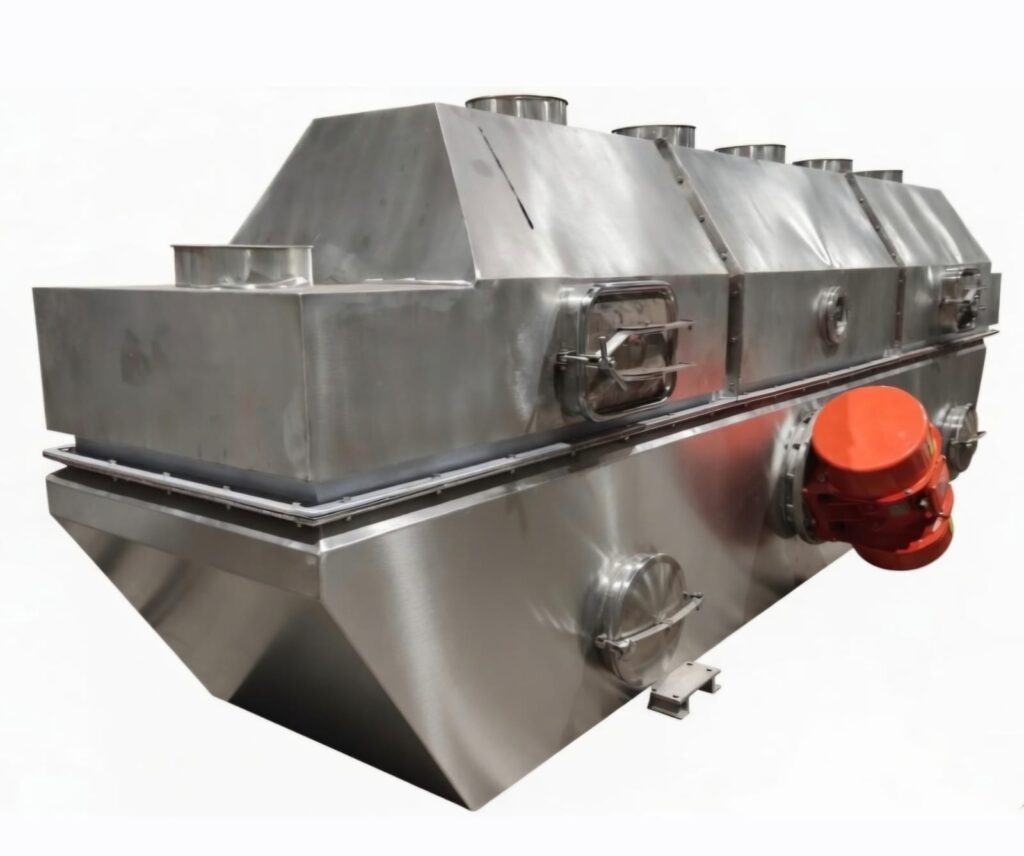
A Vibratory Fluid Bed Dryer (VFBD) combines:
fluidized hot air + controlled vibration + continuous product movement.
This makes the technology suitable for applications requiring continuous drying, controlled residence time and uniform moisture reduction.
How a CTC Tea VFBD Works
The wet CTC tea is introduced through a controlled feeding system.
Inside the VFBD:
- Tea is distributed over the vibrating bed.
- Heated air passes through the perforated distribution surface.
- The air fluidizes the tea particles.
- Controlled vibration transports the product through the dryer.
- Moisture transfers from the tea to the drying air.
- Moisture-laden air is removed through the exhaust system.
- Dried tea exits for cooling, grading or further processing.
GTI’s VFBD technology combines vibration and fluidization and is designed around parameters including airflow, residence time, bed depth, vibration and moisture conditions.
Why VFBD Is Relevant for CTC Tea Processing
A properly designed VFBD can provide:
Uniform Drying
Fluidized air provides strong contact between drying air and the tea particles.
Controlled Residence Time
Vibration helps transport the product through the dryer.
Continuous Operation
The system can operate continuously with controlled feeding and discharge.
Moisture Control
Drying conditions can be adjusted according to the product and required final moisture.
Automation
Temperature, airflow and other operating parameters can be integrated into an automated control system.
For Sri Lankan factories producing CTC tea, VFBD can therefore serve as a dedicated industrial drying solution rather than forcing CTC tea through an Orthodox-oriented drying configuration.
3. Green Tea Dryer in Sri Lanka – Combination Fluid Bed Dryer
Controlled Drying for Green Tea Processing
Green tea is a much smaller production category in Sri Lanka than Orthodox tea, but it represents an established product category.
Sri Lanka produced 2,333 tonnes of Green Tea in 2025, while Green Tea exports reached 4,922 tonnes in 2025 according to Tea Exporters Association statistics.
This makes Green Tea relevant to processors looking at:
- product diversification
- specialty tea
- premium products
- value-added tea
- export opportunities
Green tea requires a different drying strategy because the processing objective is to limit oxidation and preserve desirable characteristics.
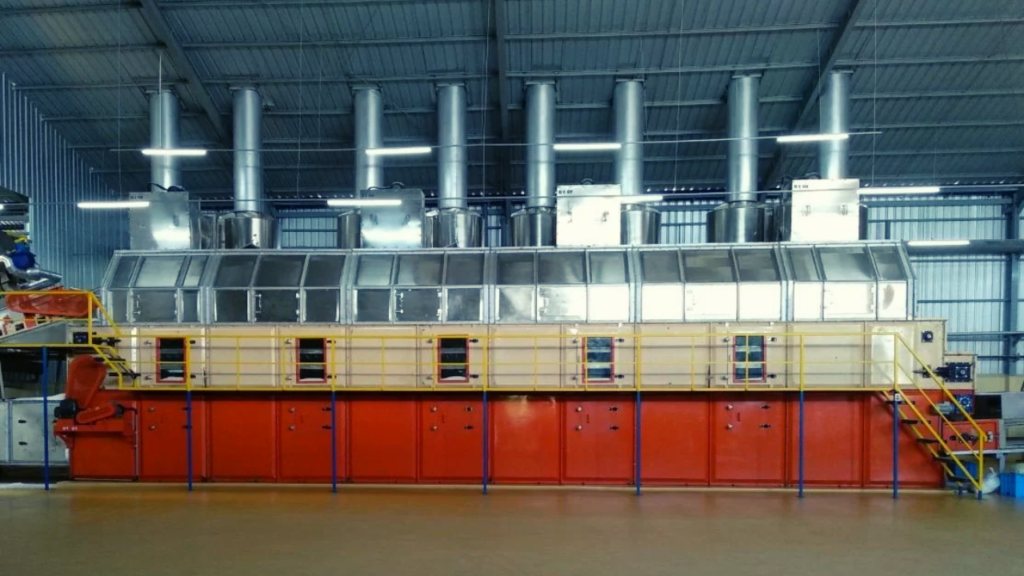
GTI’s Green Tea Drying System describes controlled drying after enzyme deactivation and identifies Combination Dryers for multi-stage drying, moisture control and large-scale production.
Green Tea Drying Process
A simplified industrial process can be represented as:
Fresh Tea Leaves
↓
Enzyme Deactivation
↓
Rolling / Shaping
↓
Controlled Drying
↓
Cooling
↓
Sorting
↓
Grading
↓
Packaging
The drying system should be designed according to:
- leaf condition
- feed moisture
- product temperature
- final moisture
- production capacity
- desired colour
- particle/leaf size
- heating source
The objective is not simply to remove water.
It is to achieve controlled moisture reduction while protecting the desired characteristics of the finished green tea.
Why Green Tea Can Be a Value-Addition Opportunity in Sri Lanka
Sri Lanka’s tea economy has historically been strongly associated with black tea, while the current export structure also includes tea packets, tea bags, instant tea and Green Tea.
The Tea Exporters Association reported 4,687 tonnes of Green Tea exports in 2024 and 4,922 tonnes in 2025.
This indicates that Green Tea is not merely a theoretical product category.
For processors, the opportunity is to evaluate whether controlled Green Tea production fits their:
- market
- available leaf
- processing capabilities
- product strategy
- export customers
- plant capacity
Sri Lanka Tea Drying: One Country, Different Processing Requirements
The biggest mistake in choosing a tea dryer is assuming that one machine configuration is automatically suitable for every tea type.
Sri Lanka demonstrates why this approach is problematic.
Orthodox Tea
237,079 MT in 2025
Dryer: Combination Fluid Bed Dryer
Application: Controlled multi-stage drying.
CTC Tea
24,709 MT in 2025
Dryer: VFBD
Application: Continuous drying of granular CTC tea.
Green Tea
2,333 MT in 2025
Dryer: Combination Fluid Bed Dryer
Application: Controlled drying after enzyme deactivation.
Production figures are based on Tea Exporters Association/Sri Lanka Tea Board statistics.
Sri Lanka’s Seven Tea Regions:
A country-specific industrial page can become considerably stronger by connecting technology with actual tea-producing regions.
Nuwara Eliya Tea Dryer
Potential searches:
- Tea Dryer Nuwara Eliya
- Orthodox Tea Dryer Nuwara Eliya
- Tea Processing Equipment Nuwara Eliya
- Ceylon Tea Dryer Nuwara Eliya
Dimbula Tea Dryer
Potential searches:
- Dimbula Tea Processing Equipment
- Dimbula Tea Dryer
- Orthodox Tea Dryer Dimbula
- Industrial Tea Dryer Dimbula
Uva Tea Dryer
Potential searches:
- Uva Tea Dryer
- Tea Processing Equipment Uva
- Orthodox Tea Processing Equipment Uva
Uda Pussellawa Tea Dryer
Potential searches:
- Uda Pussellawa Tea Dryer
- Tea Factory Equipment Uda Pussellawa
- Orthodox Tea Dryer Sri Lanka
Kandy Tea Dryer
Potential searches:
- Kandy Tea Dryer
- Tea Processing Equipment Kandy
- Industrial Tea Dryer Kandy
Sabaragamuwa Tea Dryer
Potential searches:
- Sabaragamuwa Tea Dryer
- Low-Grown Tea Processing Equipment
- Tea Dryer Sabaragamuwa
Ruhuna Tea Dryer
Potential searches:
- Ruhuna Tea Dryer
- Ruhuna Tea Processing Equipment
- Low-Grown Tea Dryer Sri Lanka
This provides a natural country → region → product → technology SEO architecture.
Ceylon Tea + Industrial Drying: Why Process Control Matters
Ceylon Tea has a strong geographical identity.
The Tea Board regulates regional appellations and standards for tea carrying district names.
Therefore, industrial drying equipment should not be viewed only as a commodity machine.
The drying stage can influence:
- final moisture
- consistency
- storage stability
- processing repeatability
- product appearance
- handling characteristics
- energy use
- production capacity
For factories producing teas from different regions, the ability to establish repeatable drying conditions can become an important part of process management.
Tea Dryer Modernization in Sri Lanka
Sri Lanka’s tea industry has a large installed processing base.
Therefore, the potential market is not limited to greenfield factories.
Tea dryer projects can include:
Dryer Replacement
Replacing an older or inefficient drying system.
Capacity Expansion
Increasing drying throughput to match higher green-leaf intake.
Process Modernization
Improving temperature, airflow and moisture control.
Automation Upgrade
Introducing PLC/HMI-based monitoring and control.
Energy Optimization
Improving thermal management and airflow.
Product Diversification
Adding CTC or Green Tea capability to an existing production operation.
Export-Oriented Upgrading
Improving process consistency for international customers.
This creates several commercial search intents beyond “new tea dryer machine.”
How to Select an Industrial Tea Dryer for a Sri Lankan Factory
A tea factory should provide the dryer manufacturer with actual process data before selecting equipment.
1. Tea Type
- Orthodox
- CTC
- Green Tea
- Specialty Tea
2. Production Capacity
Specify:
- kg/hour
- tonnes/hour
- tonnes/day
3. Feed Moisture
The initial moisture content determines the required moisture-removal load.
4. Final Moisture
The desired final moisture determines the drying requirement.
5. Tea Characteristics
Provide:
- leaf size
- particle size
- bulk density
- flowability
- product sensitivity
6. Heating Source
Possible systems include:
- steam
- thermic fluid
- gas
- biomass
- electric
- hybrid heating
7. Factory Location
For example:
- Nuwara Eliya
- Kandy
- Hatton/Dimbula
- Uva
- Sabaragamuwa
- Ruhuna
8. Existing Equipment
Indicate whether the project is:
New Plant / Expansion / Replacement / Modernization
Industrial Tea Dryer Configuration for Sri Lanka
A complete tea drying system may include:
Controlled Tea Feeding
↓
Drying Chamber
↓
Hot Air Generation
↓
Air Distribution System
↓
Moisture Removal / Exhaust
↓
Dust Collection
↓
Cooling
↓
Product Discharge
↓
Grading / Blending / Packaging
The exact arrangement depends on the tea type and factory requirements.
For example:
Orthodox Tea → Combination Fluid Bed Dryer
while:
CTC Tea → VFBD
and:
Green Tea → Combination Fluid Bed Dryer
This application-specific approach prevents the common mistake of selecting equipment based only on nominal capacity.
Key Parameters Used to Engineer a Tea Dryer
There is no universal “Sri Lanka tea dryer temperature” or single machine size that applies to every factory.
The system must be engineered around the actual material.
Important parameters include:
Feed Rate
How much wet tea enters the dryer per hour.
Moisture Load
How much water must be removed.
Final Moisture
The required moisture specification.
Airflow
Required quantity and velocity of drying air.
Residence Time
Time required for controlled moisture removal.
Bed Depth
Important for fluidized systems.
Heating Load
Determined from the moisture-removal requirement and operating conditions.
Product Temperature
Must be controlled according to tea type and product objectives.
Exhaust
Moisture-laden air must be efficiently removed.
GTI’s VFBD technology specifically incorporates factors such as airflow, bed depth, residence time, vibration and moisture conditions into system design.
Sinhala Terminology for Tea Dryer Searches
Sri Lanka’s official languages include Sinhala and Tamil, while English functions as the link language.
For local SEO, selected Sinhala terminology can be incorporated naturally into supporting content.
Useful Sinhala Terms
| English | Sinhala |
| Tea | තේ |
| Tea Dryer | තේ වියළන යන්ත්රය |
| Tea Drying | තේ වියළීම |
| Tea Processing | තේ සැකසුම් |
| Tea Processing Machine | තේ සැකසුම් යන්ත්රය |
| Tea Factory | තේ කර්මාන්ත ශාලාව |
| Tea Processing Equipment | තේ සැකසුම් උපකරණ |
| Green Tea | හරිත තේ |
| Black Tea | කළු තේ |
| Tea Production | තේ නිෂ්පාදනය |
| Tea Drying Machine | තේ වියළන යන්ත්රය |
| Industrial Tea Dryer | කාර්මික තේ වියළන යන්ත්රය |
Sinhala SEO Phrases
ශ්රී ලංකාවේ තේ වියළන යන්ත්ර
තේ සැකසුම් යන්ත්ර
කාර්මික තේ වියළන යන්ත්රය
තේ වියළීමේ උපකරණ
These can be used in image alt text, FAQs, supporting pages and selected internal-link anchors.
Tamil Terminology for Sri Lankan Tea Processing
Tamil is also an official language of Sri Lanka.
Useful Tamil terms include:
| English | Tamil |
| Tea | தேயிலை |
| Tea Dryer | தேயிலை உலர்த்தும் இயந்திரம் |
| Tea Drying | தேயிலை உலர்த்துதல் |
| Tea Processing | தேயிலை பதப்படுத்துதல் |
| Tea Processing Machine | தேயிலை பதப்படுத்தும் இயந்திரம் |
| Tea Factory | தேயிலை தொழிற்சாலை |
| Tea Processing Equipment | தேயிலை பதப்படுத்தும் உபகரணங்கள் |
| Green Tea | பச்சை தேநீர் |
| Tea Production | தேயிலை உற்பத்தி |
Tamil Search Examples
இலங்கையில் தேயிலை உலர்த்தும் இயந்திரம்
தேயிலை பதப்படுத்தும் இயந்திரங்கள்
தொழில்துறை தேயிலை உலர்த்தும் இயந்திரம்
தேயிலை பதப்படுத்தும் உபகரணங்கள்
For SEO, these should be used naturally rather than repeating translated keywords throughout the English article.
Sri Lanka Tea Dryer: Building a Country-Level Topic Cluster
The main pillar should target:
Tea Dryer Machine Manufacturer in Sri Lanka
Supporting pages can target specific commercial intents.
Product Cluster
- CTC Tea Dryer Machine Sri Lanka
- Orthodox Tea Dryer Sri Lanka
- Green Tea Dryer Sri Lanka
Technology Cluster
- VFBD Tea Dryer Sri Lanka
- Vibratory Fluid Bed Dryer Sri Lanka
- Combination Fluid Bed Dryer Sri Lanka
Regional Cluster
- Tea Dryer Nuwara Eliya
- Tea Dryer Kandy
- Tea Dryer Dimbula
- Tea Dryer Uva
- Tea Dryer Sabaragamuwa
- Tea Dryer Ruhuna
- Tea Dryer Uda Pussellawa
Application Cluster
- Tea Factory Equipment Sri Lanka
- Tea Processing Equipment Sri Lanka
- Ceylon Tea Processing Equipment
- Industrial Tea Drying System Sri Lanka
Language Cluster
- තේ වියළන යන්ත්රය
- තේ සැකසුම් යන්ත්ර
- தேயிலை உலர்த்தும் இயந்திரம்
- தேயிலை பதப்படுத்தும் இயந்திரம்
Export-Oriented Tea Drying in Sri Lanka
Sri Lanka’s tea industry is highly export-oriented.
In 2024, World Bank WITS recorded 243.16 million kg of tea exports worth approximately US$1.393 billion.
The 2025 Tea Exporters Association statistics recorded approximately 257.44 million kg of exports, with tea in packets, bulk tea, tea bags, instant tea and Green Tea all contributing to the export mix.
For an export-oriented processor, drying consistency can support:
- repeatable product specifications
- moisture control
- improved storage stability
- consistent grading
- predictable downstream packaging
- production efficiency
The dryer therefore becomes part of the larger export-quality processing chain.
Value Addition: Beyond Bulk Tea
Sri Lanka’s tea export structure includes more than bulk tea.
The Tea Exporters Association recorded in 2025:
- 111,074 MT bulk tea
- 101,818 MT tea in packets
- 25,584 MT tea bags
- 2,623 MT instant tea
- 4,687 MT Green Tea
for the reported 2024 statistics, with the 2025 total exports reaching 257,440 MT.
This demonstrates why tea processing in Sri Lanka increasingly needs to be considered beyond simply producing dried bulk tea.
Potential processing strategies include:
Tea Production → Controlled Drying → Grading → Blending → Packaging → Value Addition → Export
Modern drying equipment can become one component in this broader manufacturing strategy.
Why Choose GTI Dryers for a Sri Lankan Tea-Drying Project?
GTI Dryers designs and manufactures industrial drying systems for different tea applications.
For Sri Lankan projects, the system can be evaluated according to:
- tea type
- production capacity
- feed moisture
- final moisture
- leaf/particle characteristics
- heating source
- residence time
- plant layout
- automation requirements
- future expansion
The technology portfolio can be mapped as:
Orthodox Tea
Combination Fluid Bed Dryer
CTC Tea
Vibratory Fluid Bed Dryer
Green Tea
Combination Fluid Bed Dryer
GTI’s published green-tea drying systems identify Combination Dryers and Vibro Fluid Bed Dryers as industrial options depending on production requirements.
What Makes a Good Tea Dryer Project?
A successful tea dryer project should begin with the product rather than the machine.
The engineering sequence should be:
Tea Type
↓
Feed Characteristics
↓
Moisture Removal Requirement
↓
Production Capacity
↓
Drying Technology
↓
Heating System
↓
Airflow Design
↓
Automation
↓
Factory Integration
↓
Commissioning
This approach allows the manufacturer to develop a dryer around the actual process rather than selling a generic machine.
Tea Dryer Project Checklist for Sri Lankan Buyers
Before requesting a quotation, prepare:
Tea Type: Orthodox / CTC / Green
Capacity: ___ kg/hr or TPH
Initial Moisture: ___ %
Final Moisture: ___ %
Tea Grade/Product Form: ___
Heating Source: ___
Factory Location: Nuwara Eliya / Kandy / Uva / Dimbula / Sabaragamuwa / Ruhuna / Other
Existing Dryer: Yes / No
Project Type: New Plant / Expansion / Replacement / Modernization
Automation: Manual / PLC / HMI / SCADA
Available Installation Area: ___
Future Capacity: ___
Providing these details enables the manufacturer to evaluate the process accurately and prepare a more relevant technical proposal.
Frequently Asked Questions – Tea Dryer Machine in Sri Lanka
Which tea dryer is suitable for Orthodox tea in Sri Lanka?
A Combination Fluid Bed Dryer can be engineered for controlled, multi-stage drying of Orthodox tea. The actual configuration should be based on feed characteristics, capacity and required final moisture.
Which dryer is suitable for CTC tea?
A Vibratory Fluid Bed Dryer (VFBD) can be used for continuous drying of granular CTC tea, combining fluidized hot air with controlled vibration and product movement.
Can GTI supply a Green Tea Dryer in Sri Lanka?
Yes. GTI designs Green Tea Drying Systems, including Combination Dryer configurations, for controlled moisture removal and industrial green-tea processing.
Is Orthodox tea important in Sri Lanka?
Yes. Orthodox tea is by far the largest production category in Sri Lanka’s Tea Exporters Association statistics. In 2025, Orthodox production was approximately 237,079 MT compared with 24,709 MT CTC and 2,333 MT Green Tea.
What are the major tea-growing regions of Sri Lanka?
The seven recognized regions are Nuwara Eliya, Uda Pussellawa, Uva, Dimbula, Kandy, Sabaragamuwa and Ruhuna.
What is “tea dryer” in Sinhala?
A useful Sinhala term is තේ වියළන යන්ත්රය, meaning tea-drying machine.
What is “tea dryer” in Tamil?
A useful Tamil term is தேயிலை உலர்த்தும் இயந்திரம், meaning tea-drying machine.
Can one dryer process Orthodox, CTC and Green Tea?
It should not be assumed that one standard configuration will be optimal for all three. Each tea type has different processing requirements, so the dryer should be selected according to the actual product and process.
Can GTI customize a tea dryer for an existing Sri Lankan factory?
Yes. A dryer can be evaluated around the factory’s existing capacity, layout, heating source, product characteristics, moisture requirement and automation level.
Request a Customized Tea Dryer Proposal for Sri Lanka
Planning a new Ceylon Tea processing plant, tea factory expansion, dryer replacement, modernization project or product-diversification line in Sri Lanka?
GTI Dryers can evaluate your application based on actual tea-processing data.
Send Your Project Details
Tea Type: Orthodox / CTC / Green Tea
Capacity: ___ kg/hr or TPH
Feed Moisture: ___ %
Final Moisture: ___ %
Factory Location: Nuwara Eliya / Kandy / Dimbula / Uva / Sabaragamuwa / Ruhuna / Uda Pussellawa / Other
Heating Source: ___
Project Type: New Plant / Expansion / Replacement / Modernization
Automation Requirement: ___
GTI Tea Drying Technology for Sri Lanka
Orthodox Tea → Combination Fluid Bed Dryer
CTC Tea → Vibratory Fluid Bed Dryer (VFBD)
Green Tea → Combination Fluid Bed Dryer
From Ceylon Tea Processing to Controlled Industrial Drying
Engineered in India. Designed for Sri Lankan Tea Processing.
Request a Tea Dryer Quotation for Sri Lanka
Get Technical Consultation | Discuss Your Tea Factory Project | Request a Customized Dryer Proposal