Coconut Clusters Dryer: Turning Coconut Ingredients into Consistent, Export-Ready Products
The global coconut industry is moving beyond traditional products such as copra, coconut oil and desiccated coconut.
Today, processors are increasingly developing value-added coconut products for snack foods, bakery products, confectionery, breakfast foods, health foods and private-label export markets.
Coconut clusters are one such value-added format.
A coconut cluster may combine coconut pieces, flakes, shreds or other ingredients into a defined cluster or bite-sized structure. The drying stage becomes important because the product must reach the required moisture level while maintaining its shape, texture, colour, flavour and structural integrity.
For manufacturers producing coconut clusters at commercial scale, conventional batch drying can become a production bottleneck.
This is where an industrial Band Dryer / Continuous Belt Dryer can become an important part of the processing line.
GTI Dryers designs and manufactures customized industrial drying systems for coconut processing, including continuous band drying solutions developed around product characteristics, moisture requirements, throughput and process conditions.
The objective is not simply to remove water.
It is to create a repeatable drying process that supports consistent production and commercial scalability.
Why Coconut Clusters Need Controlled Industrial Drying
Coconut-based cluster products can be sensitive to variations in moisture and drying conditions.
If the product is under-dried, manufacturers may face:
- Shorter shelf life
- Moisture migration
- Texture instability
- Microbial-quality concerns
- Packaging problems
- Product sticking
- Reduced export stability
If the product is overdried, other problems may occur:
- Excessive hardness
- Loss of desirable texture
- Colour changes
- Excessive weight loss
- Reduced sensory quality
- Product breakage
Therefore, the dryer needs to provide controlled and gradual moisture removal.
For a commercial coconut cluster producer, the real requirement is:
Uniform product → controlled drying → consistent final moisture → stable quality → scalable production.
India and Indonesia: Important Coconut Processing Hubs
The opportunity for industrial coconut processing is closely connected with the availability of coconut raw materials and established export networks.
According to World Bank WITS/UN Comtrade data for 2024, Indonesia was the largest exporter under HS 080110, exporting approximately 1.18 billion kg of fresh or dried coconuts valued at US$471.8 million.
The Philippines exported about 176.4 million kg valued at US$302.1 million, Sri Lanka about 69.3 million kg valued at US$116.8 million, while India exported approximately 118.6 million kg valued at US$83.9 million.
This creates opportunities not only for raw coconut exports but also for higher-value processed coconut products.
India’s 2024 export destinations for fresh or dried coconut included the UAE, USA, UK, Nepal, Bangladesh, Qatar, Canada, Spain and Saudi Arabia.
For equipment manufacturers, this means the opportunity extends beyond the coconut-growing region.
It exists across the complete value chain:
Coconut Processing → Value Addition → Drying → Packaging → Export
Where Does a Coconut Clusters Dryer Fit into the Production Line?
A typical industrial coconut cluster processing line can be designed around the following stages:
Raw Coconut / Coconut Ingredients
↓
Cleaning & Preparation
↓
Cutting / Shredding / Flaking
↓
Ingredient Mixing / Formulation
↓
Cluster Formation / Shaping
↓
Controlled Feeding
↓
Continuous Band Drying
↓
Cooling
↓
Inspection / Screening
↓
Packaging
↓
Finished Coconut Clusters
The exact process depends on the formulation and whether the cluster contains only coconut or additional ingredients such as nuts, cereals, seeds, sweeteners or other food components.
The dryer should therefore be engineered after understanding the complete product formulation, rather than selecting a dryer only from the product name.
How Does a Coconut Clusters Band Dryer Work?
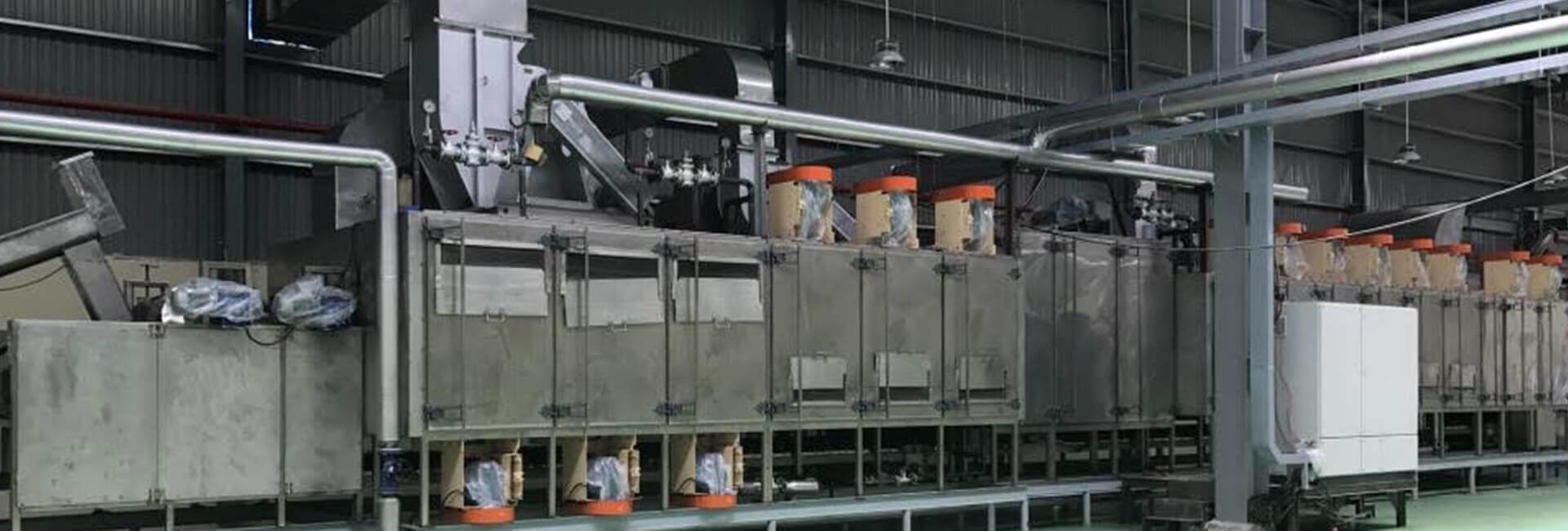
A Band Dryer is a continuous drying system in which the product travels through a controlled drying chamber on a moving conveyor or perforated belt.
The basic process is:
1. Controlled Feeding
Coconut clusters are distributed evenly onto the moving belt.
Uniform product loading is important because variations in bed depth can result in variations in drying.
2. Multi-Zone Drying
The clusters travel through multiple controlled drying zones.
Each zone can be designed around specific process conditions.
3. Controlled Hot-Air Circulation
Heated air transfers thermal energy to the product and removes moisture.
4. Moisture-Laden Air Removal
Exhaust systems remove humid air from the drying chamber.
5. Residence-Time Control
Belt speed controls the time the product spends inside the drying system.
6. Continuous Discharge
The dried clusters are discharged continuously for cooling, inspection and packaging.
GTI’s Band Dryer technology uses controlled temperature, airflow, belt speed and multiple drying zones to provide continuous moisture removal for industrial production.
Why Band Dryer Technology for Coconut Clusters?
The major advantage of a Band Dryer is that it transforms drying from a batch operation into a continuous production process.
For large coconut processing facilities, this can provide several operational benefits.
Continuous Production
Raw material can continuously enter the dryer while finished product exits from the other side.
This is particularly useful for export-oriented plants operating at high throughput.
Uniform Moisture Reduction
Multiple drying zones allow the drying profile to be controlled throughout the process.
This helps reduce variations between batches.
Gentle Product Handling
Coconut clusters can be vulnerable to breakage or deformation.
A properly designed conveyor drying system can minimize unnecessary mechanical handling.
Adjustable Residence Time
Belt speed can be adjusted according to the required drying profile.
Scalable Production
Band Dryers can be engineered according to required production capacity and product characteristics.
Hygienic Construction
For food applications, the dryer can be configured with suitable food-processing materials and hygienic design considerations.
The Real Challenge: Maintaining Cluster Integrity
This is where Coconut Clusters Dryer design differs from a standard coconut drying application.
A cluster is not simply a loose coconut flake.
The finished product may need to retain a particular:
- Shape
- Size
- Density
- Surface appearance
- Bite texture
- Structural integrity
During drying, moisture moves from inside the product toward its surface before evaporating.
If drying is too aggressive, the external surface can dry faster than the internal structure.
This can affect the final texture and physical integrity of the cluster.
Therefore, industrial dryer design should consider:
Product size + formulation + moisture + loading density + airflow + temperature + residence time + final moisture target.
This is why GTI approaches coconut drying as a process-engineering requirement, rather than simply supplying a standard machine.
Key Drying Parameters GTI Considers
There is no single drying temperature or residence time that is correct for every coconut cluster.
The final design should be based on actual product and process data.
Important parameters include:
Initial Moisture Content
How much moisture enters the dryer?
Target Final Moisture
What moisture level is required for the finished product?
Cluster Dimensions
Thickness and diameter affect drying behaviour.
Product Density
Different formulations can have different internal structures.
Feed Rate
The amount of product entering the dryer determines belt loading.
Drying Temperature
The thermal profile must match the product’s quality requirements.
Airflow
Air velocity and distribution influence heat and mass transfer.
Residence Time
The product must remain inside the dryer long enough to achieve the required moisture reduction.
Product Sensitivity
Some formulations may be more sensitive to thermal exposure than others.
Coconut Clusters Dryer for High-Capacity Production
For a small producer, tray or batch drying may appear sufficient.
But when production reaches commercial or export scale, the requirements change.
A large manufacturing plant may need:
- Continuous operation
- Automated feeding
- Consistent belt loading
- Multiple drying zones
- Automatic temperature control
- Controlled exhaust
- Product cooling
- PLC/HMI monitoring
- Reduced manual handling
- Consistent final moisture
- Easy cleaning and maintenance
A properly engineered Band Dryer can integrate these requirements into a continuous production system.
GTI’s industrial Band Dryer systems are designed for continuous processing, controlled airflow and temperature, adjustable residence time and high-throughput applications.
Which Countries Should Coconut Cluster Manufacturers Target?
Coconut cluster demand is difficult to isolate through international trade statistics because “coconut clusters” does not generally have a single dedicated HS trade classification.
Therefore, market targeting should be based on a combination of:
- Coconut exports
- Desiccated coconut imports
- Processed food markets
- Snack and bakery industries
- Existing coconut-product trade
- Export infrastructure
Current trade indicators provide a useful direction.
1. United States
The USA should be an important target market for Indian and Asian coconut-product manufacturers.
The International Coconut Community reported that U.S. desiccated coconut imports reached 14,698 MT during January–April 2026, up 5.8% year-on-year.
The USA was also India’s second-largest destination for fresh or dried coconut exports in 2024 by reported value.
Target: Premium coconut snacks, bakery ingredients, clusters, granola-style products and private-label products.
2. Netherlands & European Union
The Netherlands is particularly relevant because it functions both as a consumer market and an important European trading/distribution hub.
The EU27 imported 30,387 MT of desiccated coconut during January–April 2026, making it the world’s largest regional market for that product category.
The Netherlands was also one of the largest destination markets in Philippine coconut trade and is repeatedly identified as a major market for desiccated coconut.
Target: Organic/natural-positioned snacks, bakery ingredients, cereal products, confectionery and specialty coconut ingredients.
3. Germany
Germany is another important European market to target for value-added coconut products.
Philippine coconut exports to Germany were approximately US$13.4 million in 2024 under the fresh/dried coconut category.
Germany can be targeted for:
- Coconut snacks
- Bakery applications
- Health-food products
- Breakfast products
- Coconut ingredients
- Private-label food manufacturing
4. United Kingdom
The UK has established demand for imported coconut products and is already an important destination for Indian coconut exports.
India exported approximately US$6.53 million of fresh or dried coconut to the UK in 2024.
For coconut clusters, manufacturers can target:
Snack brands + bakery manufacturers + cereal producers + private-label food companies.
5. China
China is another major Asian market.
Philippine coconut exports to China reached approximately US$20.9 million in 2024 under HS 080110.
Indonesia also recorded China among its major coconut export destinations in recent trade data.
This makes China relevant for manufacturers developing larger Asian export networks.
6. Australia
Australia is another market worth targeting for value-added coconut snacks and food ingredients.
Australia appeared among the leading import destinations for Philippine desiccated coconut in 2025.
Potential applications include:
- Health snacks
- Breakfast foods
- Bakery products
- Coconut clusters
- Natural ingredient products
7. UAE & Middle East
For Indian manufacturers, the UAE is especially relevant.
India exported approximately US$23.47 million of fresh or dried coconut to the UAE in 2024, the largest destination by value in the WITS dataset for this Indian product category.
The wider Gulf market can therefore be considered for:
- Coconut snacks
- Premium food products
- Bakery ingredients
- Retail products
- Foodservice applications
Potential markets include:
UAE | Saudi Arabia | Qatar | Oman | Kuwait | Bahrain
Priority Export Markets for Coconut Cluster Manufacturers
| Market | Why Target It | Potential Coconut Cluster Opportunity |
|---|---|---|
| USA | Strong coconut-product imports and growing 2026 desiccated coconut imports | Snacks, bakery, private label |
| Netherlands | Major European coconut import/distribution hub | Ingredients, snacks, bakery |
| Germany | Established European coconut trade | Health foods, bakery, confectionery |
| UK | Established Indian coconut export destination | Retail snacks, bakery |
| China | Large Asian coconut market | Food ingredients, snacks |
| Australia | Established coconut-product imports | Premium snacks, breakfast foods |
| UAE | Major Indian coconut export destination | Retail & foodservice |
| Saudi Arabia | Strong GCC food market | Snacks and ingredients |
| Canada | North American coconut market | Retail and specialty foods |
| Indonesia | Major coconut producer/exporter | Processing and value addition |
These markets should be treated as target markets rather than guaranteed demand for coconut clusters specifically, because international trade databases generally do not separately classify coconut clusters. The market selection above uses broader coconut and desiccated-coconut trade indicators.
India vs Indonesia: Opportunity for Coconut Processing Equipment
India and Indonesia represent two different but complementary opportunities.
India
India combines:
- Large domestic coconut-processing activity
- Growing value-added food manufacturing
- Existing export relationships
- Strong engineering and equipment manufacturing capability
India’s coconut export destinations already include the UAE, USA, UK, Nepal, Bangladesh, Qatar and Canada.
Indonesia
Indonesia has an exceptionally large coconut export base.
In 2024, Indonesia exported around 1.18 billion kg of fresh or dried coconut worth approximately US$471.8 million.
Indonesia’s recent export destinations have included Malaysia, China, the USA, the Philippines and the Netherlands.
This creates opportunities for industrial equipment suppliers serving:
Coconut processors → snack manufacturers → ingredient producers → exporters.
Why Choose GTI Dryers for Coconut Cluster Drying?
At GTI Dryers, the objective is not to sell a standard Band Dryer and leave the processor to determine how to operate it.
The approach is based on product-specific dryer engineering.
GTI designs and manufactures industrial coconut drying systems for different coconut products and processing requirements, including Band Dryer solutions for continuous coconut drying.
For a Coconut Clusters Dryer project, GTI can work around:
Product Evaluation
Understanding the physical characteristics and formulation of the cluster.
Drying Requirement
Determining the moisture-removal requirement from initial to final condition.
Capacity Engineering
Designing the system around the required production rate.
Drying Profile
Developing a suitable multi-zone drying approach.
Airflow Engineering
Optimizing air circulation and distribution across the product bed.
Continuous Operation
Designing the dryer for industrial production requirements.
Automation
Temperature, airflow, belt speed and other process parameters can be integrated into the control system.
Plant Integration
The dryer can be engineered as part of a larger coconut processing line rather than treated as an isolated machine.
What Makes GTI’s Approach Different?
Product first. Dryer second.
That is the key principle.
A Coconut Clusters Dryer should not be selected only by saying:
“We need a 1-ton-per-hour coconut dryer.”
The important questions are:
- What is the product formulation?
- What is the initial moisture?
- What is the required final moisture?
- What is the cluster size?
- What is the product density?
- How fragile is the cluster?
- What is the required production capacity?
- What heating source is available?
- What food-grade construction is required?
- What is the desired automation level?
- What are the packaging and storage requirements?
Once these parameters are understood, the drying system can be engineered accordingly.
Data Required for Coconut Cluster Dryer Design
For an accurate technical proposal, manufacturers should provide:
Product Information
- Product name
- Product formulation
- Cluster dimensions
- Bulk density
- Initial moisture
- Target moisture
- Product sensitivity
Production Information
- Required capacity in kg/hr or TPH
- Operating hours/day
- Batch or continuous production
- Future capacity expansion
Utility Information
- Steam availability
- Gas/fuel availability
- Electricity
- Hot-air requirements
- Available installation space
Quality Requirements
- Final moisture
- Colour requirements
- Texture requirements
- Shelf-life objective
- Food-grade requirements
This information enables GTI engineers to develop a dryer configuration suited to the actual process.
From Coconut Processor to Global Coconut Snack Supplier
The future of coconut processing is not limited to selling raw coconut.
Value-added products can create additional opportunities across the food industry.
A coconut cluster manufacturer can potentially serve:
Snack Industry
Bakery Industry
Confectionery Industry
Breakfast & Cereal Industry
Health Food Industry
Private-Label Food Brands
Food Ingredient Manufacturers
Export Markets
The dryer becomes an important link between product formulation and commercial-scale production.
Frequently Asked Questions
1. What is a Coconut Clusters Dryer?
A Coconut Clusters Dryer is an industrial drying system designed to reduce moisture from formed coconut cluster products under controlled thermal and airflow conditions. For large-scale production, a continuous Band Dryer can provide controlled residence time and continuous processing.
2. Why is a Band Dryer suitable for coconut clusters?
Band Dryers provide continuous processing, controlled airflow, adjustable residence time and multi-zone drying. These characteristics make them suitable for large-scale coconut processing when the product can be conveyed effectively through the dryer.
3. Can GTI customize a Coconut Clusters Dryer?
Yes. GTI designs industrial dryers according to product characteristics, required capacity, moisture reduction, heating system and process requirements.
4. Can the Band Dryer maintain coconut cluster shape?
The dryer can be designed to minimize unnecessary mechanical handling and provide controlled drying conditions. However, actual cluster integrity depends on formulation, binding characteristics, product dimensions and drying behaviour, so product trials may be required.
5. What capacity can a Coconut Band Dryer handle?
Capacity is not determined only by the dryer name. It depends on product moisture, feed rate, drying duty, product loading, residence time and final moisture requirement. GTI’s Band Dryer systems are engineered according to the required process capacity.
6. Is a Coconut Clusters Dryer suitable for export-oriented production?
Yes. Continuous drying can help manufacturers achieve more consistent production conditions, which is important when supplying standardized products to export markets.
7. Which countries should coconut cluster manufacturers target?
Potential target markets include the USA, Netherlands, Germany, UK, China, Australia, UAE, Saudi Arabia and Canada, based on broader coconut and desiccated-coconut trade indicators. Product-specific market validation should be conducted before committing to a particular export market.
Build a High-Capacity Coconut Cluster Drying Line with GTI
For a coconut processor, the objective is not simply to purchase a dryer.
The objective is to build a reliable production system capable of producing consistent coconut products at commercial scale.
GTI Dryers provides customized industrial drying solutions for coconut processors, food manufacturers and export-oriented production facilities.
From product evaluation and drying trials to dryer engineering, capacity calculation and plant integration, GTI can develop a Coconut Clusters Drying System around your actual production requirements.
Looking for a Coconut Clusters Dryer Manufacturer in India?
Talk to GTI Dryers about your Coconut Clusters Drying Project.
Share your:
Product | Initial Moisture | Final Moisture | Capacity | Cluster Size | Heating Source
and our engineering team can evaluate the appropriate Band Dryer configuration for your application.
GTI Dryers — Engineered Drying Solutions from India for Global Coconut Industries.