
Coconut Cubes Are Turning Coconut Into a Higher-Value Food Product
Coconut is no longer limited to traditional products such as copra, coconut oil and desiccated coconut.
Modern food processors are creating increasingly diverse value-added coconut products, including:
- Coconut cubes
- Coconut chunks
- Coconut pieces
- Coconut chips
- Coconut flakes
- Coconut threads
- Dried coconut snacks
- Flavoured coconut products
- Bakery ingredients
- Cereal and granola ingredients
Among these products, coconut cubes offer an interesting format for food manufacturers because their larger, defined geometry can be used in snacks, breakfast products, bakery applications, confectionery, trail mixes and ingredient formulations.
But producing consistent dried coconut cubes at industrial scale requires much more than simply heating the product.
The processor needs to control:
Cube size + moisture + drying rate + colour + texture + product integrity + shelf stability.
This is where an industrial Band Dryer becomes an important part of the coconut processing line.
GTI Dryers designs and manufactures customized coconut drying systems engineered around the product, capacity and final quality requirements. GTI’s existing coconut portfolio includes drying systems for coconut chips, flakes, desiccated coconut and other coconut products.
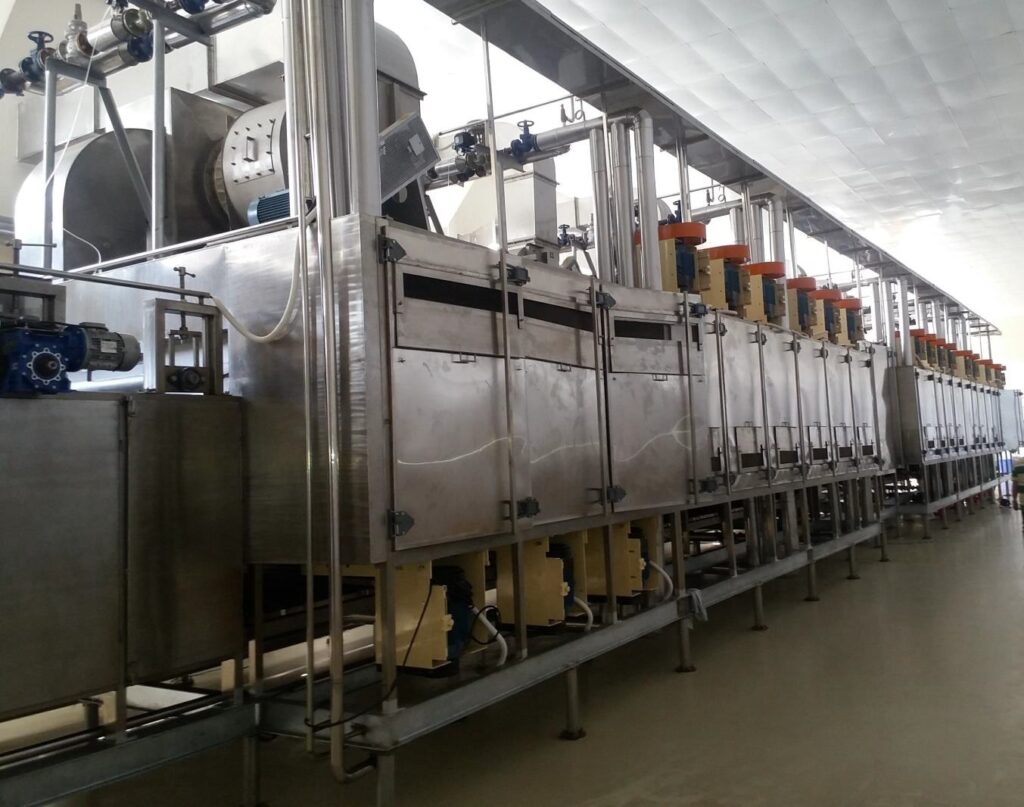
What Is a Coconut Cubes Dryer?
A coconut cubes dryer is an industrial drying system designed to reduce moisture from cut or diced coconut pieces under controlled drying conditions.
Fresh coconut cubes contain substantial moisture. If this moisture is not reduced sufficiently and uniformly, the product can experience:
- Reduced shelf life
- Texture changes
- Microbial deterioration
- Packaging problems
- Moisture migration
- Quality inconsistency
- Product spoilage
An industrial dryer provides controlled:
- Air temperature
- Airflow
- Residence time
- Product loading
- Drying-zone conditions
- Exhaust conditions
The objective is to achieve the required final moisture while maintaining the desired appearance, texture and structure of the coconut cubes.
Why Coconut Cubes Need a Different Drying Approach
A coconut cube is not the same as shredded coconut.
A shredded particle has a much larger exposed surface relative to its mass.
A cube, on the other hand, has a defined three-dimensional geometry.
This affects the way moisture moves from the interior of the product toward the surface.
Therefore, the drying process needs to consider:
Cube Dimensions
Larger cubes generally require a different drying profile from small diced pieces.
Product Loading
The depth and distribution of cubes on the drying belt influence air-product contact.
Feed Moisture
The initial moisture determines the total evaporation requirement.
Final Moisture
The required final moisture depends on the product specification and intended application.
Product Temperature
The product should be dried under conditions appropriate to the desired quality characteristics.
Residence Time
The product needs sufficient time in the dryer to achieve the target moisture without unnecessary thermal exposure.
This is why industrial coconut cube drying is a process-engineering application rather than simply a heating operation.
Why Use a Band Dryer for Coconut Cubes?
For continuous coconut cube production, a Band Dryer can provide an effective platform for controlled drying.
A Band Dryer, also known as a belt dryer or conveyor dryer, transports the product through a controlled drying chamber on a moving belt.
The drying chamber can contain multiple zones, allowing the drying conditions to be adjusted progressively.
GTI’s industrial Band Dryer is designed for continuous drying with controlled temperature, airflow and residence time across multiple drying zones.
Key advantages for coconut cubes include:
- Continuous operation
- Controlled drying profile
- High production capacity
- Gentle product conveying
- Adjustable residence time
- Multi-zone drying
- Uniform airflow
- Controlled moisture reduction
- Easy integration with processing lines
- Suitable for export-oriented production
How a Coconut Cube Band Dryer Works
A typical process can be visualized as:
Fresh Coconut
↓
Dehusking & Shell Removal
↓
Peeling / Washing
↓
Cutting / Dicing
↓
Dewatering
↓
Controlled Feeding
↓
Band Dryer
↓
Cooling
↓
Screening / Grading
↓
Quality Inspection
↓
Packaging
↓
Finished Coconut Cubes
The exact upstream and downstream equipment depends on the customer’s production line.
Inside the Coconut Cubes Band Dryer
The dryer can be divided into multiple drying zones.
Zone 1 — Initial Moisture Removal
The freshly prepared coconut cubes enter the dryer and begin releasing surface moisture.
The initial stage can be designed to avoid unnecessarily aggressive thermal conditions.
Zone 2 — Progressive Drying
As surface moisture decreases, the drying conditions can be adjusted to continue moisture removal.
Airflow and temperature can be controlled according to the process design.
Zone 3 — Final Drying
The final section can be used to approach the required moisture specification.
Zone 4 — Cooling
Depending on the process arrangement, controlled cooling can be incorporated before the product moves to packaging or further processing.
This staged approach is particularly useful when the processor wants greater control over the drying curve.
The Most Important Parameter: Uniform Moisture
For coconut cubes, uniform moisture can be more important than simply achieving an average moisture value.
Imagine a batch where:
- Some cubes are properly dried
- Some cubes remain wetter
- Some cubes become excessively dry
The average laboratory moisture may appear acceptable, but the product itself may not be consistent.
This can create problems during:
- Packaging
- Storage
- Transportation
- Further processing
- Retail preparation
A properly engineered Band Dryer therefore aims for controlled and consistent moisture removal throughout the product bed.
GTI’s coconut drying systems emphasize uniform moisture reduction and controlled drying conditions for coconut-based products.
Coconut Cube Size Matters
There is no single dryer setting for every coconut cube.
For example, a processor may produce:
- Small diced coconut
- Medium coconut cubes
- Large coconut chunks
- Snack-size coconut pieces
Different dimensions change the drying behaviour.
A larger piece generally has a greater distance for internal moisture to migrate before evaporation is complete.
Therefore, the dryer design should consider:
Cube dimensions → feed moisture → loading → airflow → temperature → residence time → final moisture
This is one reason GTI approaches coconut dryer design on a product-specific basis.
Maintaining Coconut Colour
For food manufacturers and exporters, colour is an important quality characteristic.
Fresh coconut has a naturally light appearance. Poorly controlled processing can contribute to undesirable colour changes.
Drying conditions should therefore be developed with consideration for:
- Product temperature
- Drying time
- Air temperature
- Airflow
- Moisture profile
- Product loading
The objective is not simply maximum drying speed.
The objective is:
Efficient moisture removal without unnecessarily compromising product quality.
GTI’s coconut drying systems are designed around controlled temperature, airflow and drying time to help maintain flavour, aroma and product quality.
Texture: The Difference Between a Commodity and a Premium Product
Coconut cubes can be sold for different applications.
A snack manufacturer may want:
Dry + crisp + stable
A bakery ingredient manufacturer may want:
Dry + firm + structurally intact
A food ingredient processor may want:
Controlled moisture + consistent size + predictable downstream performance
Therefore, the final drying target must be connected to the end application.
The dryer should be engineered around the final product—not just around the quantity of water that needs to be removed.
Coconut Cubes for Snack Manufacturing
One of the most attractive applications is the premium snack segment.
Coconut cubes can be used in:
- Ready-to-eat snacks
- Trail mixes
- Granola
- Breakfast products
- Roasted coconut snacks
- Flavoured coconut snacks
- Healthy snack blends
- Chocolate-coated products
For these applications, appearance and texture can be particularly important.
A continuous Band Dryer can help manufacturers produce a consistent intermediate or finished dried coconut product at industrial scale.
Coconut Cubes for Bakery & Confectionery
Coconut is widely used in bakery and confectionery applications.
Dried coconut pieces can be incorporated into:
- Cakes
- Cookies
- Muffins
- Energy bars
- Chocolate products
- Dessert products
- Bakery fillings
- Confectionery mixes
GTI’s broader coconut drying portfolio already covers coconut products used in bakery, confectionery, snacks and food-ingredient industries.
Coconut Cubes for Cereals & Granola
Breakfast cereals and granola products provide another potential application.
Coconut pieces can be combined with:
- Oats
- Nuts
- Seeds
- Dried fruits
- Chocolate
- Other plant-based ingredients
For these applications, the coconut needs to be sufficiently stable to withstand:
- Storage
- Handling
- Transportation
- Mixing
- Packaging
Controlled drying is therefore an important part of the manufacturing process.
Coconut Cubes for Food Ingredients
Not every coconut cube is sold directly to consumers.
Many can be supplied as ingredients to other food manufacturers.
This creates a B2B opportunity for processors producing coconut cubes for:
- Bakery manufacturers
- Snack manufacturers
- Cereal companies
- Confectionery companies
- Foodservice suppliers
- Ingredient distributors
- Private-label food manufacturers
For these customers, batch-to-batch consistency can become a major purchasing consideration.
Band Dryer Configuration for Coconut Cubes
A coconut cube Band Dryer can be customized according to:
Product
- Coconut cubes
- Coconut chunks
- Diced coconut
- Coconut pieces
Production Capacity
For example:
- 250 kg/h
- 500 kg/h
- 1 TPH
- 2 TPH
- 5 TPH
- Higher capacities based on process requirements
Product Parameters
- Cube size
- Feed moisture
- Final moisture
- Bulk density
- Fat content
- Product loading
Plant Requirements
- Available floor space
- Heating source
- Exhaust system
- Electrical supply
- Automation requirements
- Packaging integration
Actual dryer dimensions, heating load and operating conditions must be established from the customer’s process data.
Multi-Zone Drying: Why It Matters
One of the major advantages of a Band Dryer is the ability to create different drying conditions across the dryer.
Instead of applying exactly the same condition from inlet to outlet, the drying profile can be engineered progressively.
For example:
High Moisture
↓
Initial Drying
↓
Controlled Moisture Reduction
↓
Final Drying
↓
Moisture Equalization
↓
Cooling
This can provide greater process control than a simple single-zone drying arrangement.
GTI’s Band Dryer technology uses multiple drying zones with controlled temperature and airflow for staged drying.
Why Gentle Product Handling Matters
Coconut cubes are physically larger and more structured than shredded coconut.
Excessive mechanical handling can potentially lead to:
- Broken pieces
- Fines
- Uneven product geometry
- Increased losses
A Band Dryer provides a relatively straightforward conveying mechanism in which the product travels through the drying chamber on a belt.
This makes it attractive for applications where controlled, continuous product movement is required.
Coconut Cubes Dryer: Energy Efficiency
For industrial food processors, dryer energy consumption can have a direct effect on operating cost.
An efficient system considers:
- Air circulation
- Air distribution
- Exhaust management
- Insulation
- Heat recovery opportunities
- Product loading
- Residence time
- Drying-zone control
GTI’s coconut drying systems are designed with optimized airflow and energy-efficiency considerations, with actual energy consumption depending on product and plant conditions.
India: An Important Market for Coconut Drying Equipment
India should be one of GTI’s primary markets for coconut drying equipment.
World Bank WITS trade data shows India exported approximately US$83.9 million / 118.6 million kg of fresh or dried coconuts in 2024. The major destinations included the UAE, USA, UK, Nepal and Bangladesh.
This provides a useful market signal for GTI because India’s coconut-processing ecosystem supports opportunities across:
- Coconut processors
- Food manufacturers
- Snack producers
- Ingredient manufacturers
- Exporters
- Bakery suppliers
- Desiccated coconut manufacturers
- Value-added coconut product companies
Recommended India keywords
Coconut Cubes Dryer Manufacturer India
Coconut Cube Drying Machine India
Coconut Band Dryer Manufacturer India
Industrial Coconut Dryer India
Coconut Processing Dryer Manufacturer
Indonesia: Major Coconut Processing & Export Market
Indonesia should be another important GTI target.
In 2024, Indonesia was the largest exporter of fresh or dried coconuts in the World Bank WITS dataset, with approximately US$471.8 million in exports under HS 080110.
For a dryer manufacturer, this represents an important concentration of coconut-processing activity.
Potential applications include:
- Coconut cubes
- Coconut chips
- Desiccated coconut
- Coconut flakes
- Coconut snacks
- Coconut ingredients
Indonesian keywords
Coconut Cube Dryer Indonesia
Coconut Band Dryer Indonesia
Mesin Pengering Kelapa
Mesin Pengering Kelapa Industri
Coconut Drying Machine Indonesia
GTI already targets Indonesian industrial drying applications, including belt/band drying for coconut and other food products.
Philippines: A Major Coconut Processing Hub
The Philippines is another strategically important market.
In 2024, the Philippines exported approximately US$302.1 million of fresh or dried coconuts under HS 080110, according to World Bank WITS.
The country’s established coconut-processing sector creates opportunities for industrial drying equipment.
Potential applications include:
- Coconut cubes
- Coconut chips
- Desiccated coconut
- Coconut flakes
- Coconut ingredients
- Snack products
For GTI, the Philippines can be developed as a dedicated coconut-processing GEO cluster.
Sri Lanka: Coconut Processing & Export Opportunity
Sri Lanka is another important coconut industry market.
In 2024, Sri Lanka exported approximately US$116.8 million of fresh or dried coconuts under HS 080110. Major destinations included India, UAE, USA, Germany and Pakistan.
This creates potential opportunities for:
- Coconut dryers
- Band dryers
- Desiccated coconut systems
- Coconut snack drying
- Coconut ingredient processing
Where Is the Demand for Coconut-Based Products?
For GTI, the opportunity should not be viewed only from the perspective of coconut-producing countries.
There are two separate markets:
Production Markets
Countries where coconut is processed:
- India
- Indonesia
- Philippines
- Sri Lanka
- Vietnam
- Thailand
- Malaysia
Consumption / Import Markets
Countries where coconut ingredients are consumed by food manufacturers:
- USA
- EU countries
- Netherlands
- Germany
- UK
- Australia
- Canada
- China
- Japan
This distinction is important for GTI’s international SEO strategy.
Production markets are potential dryer buyers.
Consumption markets can contain food manufacturers establishing or expanding local processing and ingredient operations.
USA: Important Downstream Market
The United States is a particularly important destination market for coconut products.
The International Coconut Community reported that during January–April 2026, US desiccated-coconut imports increased 5.8% year-on-year to 14,698 MT.
The US should therefore be included in GTI’s coconut-processing GEO strategy.
Target sectors include:
- Snack manufacturing
- Bakery
- Confectionery
- Cereals
- Granola
- Food ingredients
- Coconut-based consumer products
European Union: Major Coconut Ingredient Market
The EU27 is particularly relevant.
The International Coconut Community reported EU27 desiccated-coconut imports of approximately 30,387 MT during January–April 2026, making the EU27 the largest desiccated-coconut import market during that period.
For GTI’s strategy, this supports dedicated content targeting:
- Germany
- Netherlands
- France
- Belgium
- Italy
- Spain
- Poland
The Netherlands deserves special attention because it also appears prominently in destination data for Philippine desiccated coconut. UCAP reported the USA, Netherlands and China as the top three destinations in one 2025 Philippine desiccated-coconut trade report.
China, Australia, Canada & UK
These markets can form GTI’s secondary international GEO cluster.
Philippine desiccated coconut trade data reported by UCAP identified China, Turkey, Australia, Germany and the UK among significant destinations in the referenced period.
For GTI, these markets can be approached through application-specific content rather than generic “coconut dryer” pages.
For example:
Coconut Cubes Dryer for Snack Manufacturing in Australia
Industrial Coconut Dryer for Food Processing in Germany
Coconut Band Dryer for Ingredient Processing in the Netherlands
Coconut Drying Equipment for Food Manufacturers in the USA
This creates much stronger search intent than simply repeating “coconut dryer manufacturer.”
GTI’s Recommended Coconut Dryer Strategy
| Market | Market Role | Content Opportunity |
| India | Coconut processing + export | Coconut Cube Dryer India |
| Indonesia | Major coconut producer/exporter | Coconut Band Dryer Indonesia |
| Philippines | Major coconut processing/export | Coconut Dryer Philippines |
| Sri Lanka | Coconut processing/export | Coconut Drying System Sri Lanka |
| USA | Major downstream/import market | Coconut Food Processing Dryer USA |
| EU27 | Major import market | Coconut Dryer Europe |
| Netherlands | Important European destination | Coconut Processing Dryer Netherlands |
| Germany | Food manufacturing market | Coconut Dryer Germany |
| UK | Food & ingredient market | Coconut Drying Equipment UK |
| Australia | Coconut food/snack market | Coconut Cube Dryer Australia |
| Canada | Food ingredient market | Coconut Dryer Canada |
| China | Major Asian market | Coconut Processing Dryer China |
Note: Trade classifications do not isolate “coconut cubes” cleanly in all datasets. Therefore, these markets should be treated as business-development targets based on broader coconut/desiccated-coconut trade indicators, rather than as a definitive ranking of coconut-cube demand.
What Makes GTI’s Coconut Cube Dryer Different?
GTI’s approach is not simply to select a standard Band Dryer and put coconut cubes inside it.
The system should be engineered around:
Product Geometry
Cube dimensions affect drying behaviour.
Moisture Profile
Feed and final moisture determine the drying load.
Production Capacity
Capacity determines belt width, loading and dryer length.
Drying Curve
The product may require progressive drying rather than a single thermal condition.
Product Quality
Colour, texture and structure need to be considered.
Plant Integration
The dryer should connect efficiently with upstream cutting/dewatering and downstream cooling/packaging.
GTI’s coconut drying portfolio emphasizes customized engineering based on product characteristics, moisture requirements and production capacity.
From Coconut Cutting to Final Packaging
A complete coconut cube processing line can be designed around:
1. Coconut Preparation
Dehusking, shell removal and peeling.
2. Washing
Cleaning the coconut kernel.
3. Cutting / Cubing
Producing the required cube dimensions.
4. Dewatering
Removing excess surface water before thermal drying.
5. Controlled Feeding
Distributing the cubes evenly across the Band Dryer.
6. Multi-Zone Drying
Progressive moisture reduction.
7. Cooling
Reducing product temperature before packaging.
8. Screening / Grading
Separating broken pieces and controlling product size where required.
9. Packaging
Packing the finished coconut cubes according to the application.
GTI can focus specifically on the industrial drying section or work with the project requirements for broader process integration.
What Information Does GTI Need to Design a Coconut Cube Dryer?
For a technical proposal, provide:
Product: Coconut Cubes
Cube Size: ___ mm
Feed Moisture: ___ %
Final Moisture: ___ %
Capacity: ___ kg/h or TPH
Product Temperature Requirement: ___
Heating Source: Steam / Gas / Thermic Fluid / Electric / Other
Operating Hours: ___ h/day
Country: ___
Application: Snack / Bakery / Confectionery / Ingredient / Export
This information allows the engineering team to evaluate:
- Dryer configuration
- Belt area
- Drying-zone arrangement
- Airflow
- Heating requirement
- Residence time
- Exhaust requirement
- Energy requirement
New Coconut Plant or Dryer Upgrade?
GTI’s Band Dryer can be considered for both new and expansion projects.
New Plant
For a new coconut cube plant, the dryer can be designed as part of the overall processing layout.
Existing Plant
For an existing processor, the dryer can be evaluated as a replacement or capacity-expansion solution.
Possible objectives include:
- Increase production capacity
- Improve moisture consistency
- Reduce manual drying
- Improve product quality
- Reduce drying variation
- Automate drying
- Improve process control
- Integrate cooling and packaging
Why GTI Dryers for Coconut Cube Drying?
GTI Dryers combines industrial drying engineering with application-specific process design.
The company develops customized coconut drying systems for food processors and export-oriented manufacturers.
GTI’s current coconut portfolio includes:
- Coconut chips drying
- Coconut flakes drying
- Desiccated coconut drying
- Coconut powder drying
- Coconut milk powder drying
- Coconut snack products
- Coconut by-product drying
Its coconut drying technologies include Band Dryers, Fluidized Bed Dryers, Rotary Dryers, Spray Dryers and other customized configurations.
For coconut cubes specifically, the Band Dryer provides a continuous platform that can be engineered around cube size, capacity, moisture requirements and desired product quality.
The GTI Advantage: Engineer the Drying Process, Not Just the Machine
For a coconut processor, buying a dryer should not be about choosing:
“5 TPH Band Dryer.”
The more important question is:
“What drying system will consistently produce our required coconut cube specification at our target capacity?”
That requires understanding:
- Raw material
- Product geometry
- Moisture
- Drying behaviour
- Capacity
- Quality specification
- Heating source
- Factory conditions
This is the approach GTI brings to coconut drying projects.
Engineered in India. Designed for Global Coconut Processing.
Frequently Asked Questions
What dryer is used for coconut cubes?
A Band Dryer can be used for continuous industrial drying of coconut cubes. The final configuration depends on cube size, feed moisture, final moisture, production capacity and product-quality requirements.
Why is a Band Dryer suitable for coconut cubes?
A Band Dryer provides continuous conveying through controlled drying zones. This allows the drying profile, airflow and residence time to be adjusted according to the product.
Can GTI manufacture a customized coconut cube dryer?
Yes. GTI designs customized industrial drying systems according to product characteristics, capacity and process requirements.
Can coconut cubes be dried together with other coconut products?
Potentially, but different products may have different drying behaviour. Cube size, thickness, moisture and required final quality should be evaluated before designing a common drying system.
What capacity can a coconut Band Dryer handle?
Capacity is project-specific. Dryer dimensions and configuration should be calculated from feed moisture, final moisture, evaporation load, product loading and required throughput rather than selecting a nominal capacity alone.
Can the dryer maintain uniform moisture in coconut cubes?
A properly engineered multi-zone Band Dryer can be designed for controlled and uniform moisture removal. Actual performance depends on product characteristics, loading and operating conditions.
Which countries should GTI target for coconut drying equipment?
Important GEO markets include India, Indonesia, Philippines, Sri Lanka, USA, EU countries, Netherlands, Germany, UK, Australia, Canada and China, based on broader coconut and desiccated-coconut trade indicators. Product-specific demand for coconut cubes should be validated separately.
Is India an important market for coconut dryers?
Yes. India has a significant coconut-processing ecosystem and exported approximately 118.6 million kg of fresh/dried coconuts in 2024 under HS 080110, with major destinations including UAE, USA, UK, Nepal and Bangladesh.
Get a Coconut Cube Drying System Designed for Your Production
If you are planning a:
Coconut Cube Processing Plant
Coconut Snack Manufacturing Plant
Dried Coconut Production Line
Coconut Ingredient Plant
Coconut Export Processing Facility
or simply want to upgrade an existing coconut dryer, GTI Dryers can develop a customized Band Dryer solution around your process.
Send GTI your:
Product → Cube Size → Feed Moisture → Final Moisture → Capacity → Heating Source → Application → Country
and the drying system can be evaluated accordingly.
GTI Dryers
Industrial Coconut Drying Solutions
Band Dryers | Fluid Bed Dryers | Combination Dryers | Customized Drying Systems
Engineered in India. Designed for the World.