
Coconut Paring Skin: From Processing By-Product to a Valuable Resource
Coconut processing generates much more than the final white kernel.
During peeling and paring operations, the thin brown outer layer attached to the coconut kernel is removed. This material is commonly referred to as coconut paring skin, coconut skin or coconut testa.
For a large coconut-processing plant, the volume of this material can become significant.
The traditional approach may treat it simply as a processing residue.
But modern processors are increasingly looking at the complete coconut value chain:
Coconut → Kernel → Oil / Milk / Desiccated Coconut / Snacks → Paring Skin → Drying → Value-Added Utilization
This creates an opportunity to convert a wet, difficult-to-store by-product into a stable dried material suitable for further handling, storage or downstream utilization, depending on the customer’s application and product specification.
This is where industrial drying technology becomes important.
At GTI Dryers, customized drying systems can be engineered for coconut processing applications using technologies such as:
- Band Dryer
- Fluid Bed Dryer
- Combination Fluid Bed + Band Dryer
- Multi-stage continuous drying systems
The objective is not simply to remove moisture.
The objective is to create a controlled, continuous and commercially practical drying process for coconut paring skin.
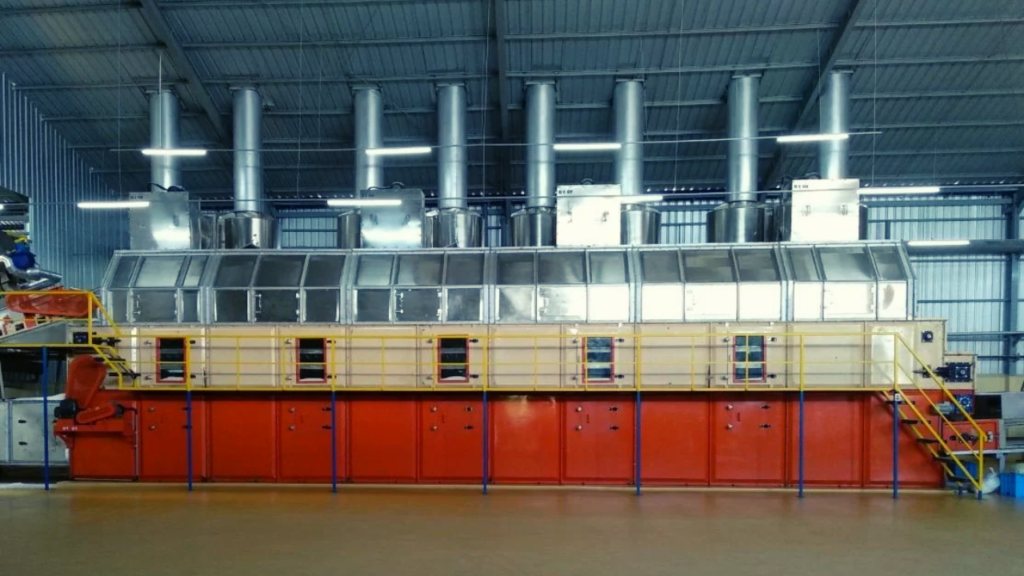
What Is Coconut Paring Skin?
Coconut paring skin is the thin brown layer removed from the coconut kernel during processing.
Depending on the processing line, it may be generated during:
- Coconut peeling
- Kernel preparation
- Desiccated coconut production
- Coconut milk processing
- Coconut oil processing
- Coconut snack manufacturing
- Coconut ingredient production
The material can contain considerable moisture when it leaves the processing operation.
Its physical characteristics can also vary depending on:
- Coconut maturity
- Peeling method
- Thickness
- Surface moisture
- Particle size
- Upstream washing
- Processing conditions
Therefore, drying requirements can vary considerably from one plant to another.
Why Dry Coconut Paring Skin?
The main reason is stability and handling.
Fresh or wet paring skin can be:
- Difficult to store
- Difficult to transport economically
- Susceptible to deterioration
- Bulky because of its moisture content
- Challenging to handle continuously
Drying can reduce moisture and transform the material into a more stable form.
Potential benefits include:
Better Storage
Lower moisture can improve storage stability when the resulting specification is appropriate for the intended application.
Lower Transportation Load
Removing water reduces the amount of non-value-added moisture transported.
Easier Handling
Dried material can be easier to convey, screen and package.
Better Resource Utilization
A processing by-product can potentially become a useful secondary material rather than simply being discarded.
Improved Plant Housekeeping
Controlled collection and drying can help integrate by-product handling into the overall production system.
The GTI Approach: Dry the By-Product as a Process Stream
A common mistake is to think:
“It is only coconut skin, so any dryer should work.”
Industrial processing is more complicated.
The dryer needs to consider:
- Feed moisture
- Particle size
- Skin thickness
- Bulk density
- Surface moisture
- Required final moisture
- Throughput
- Downstream application
- Heating source
- Product temperature
- Residence time
This is why GTI approaches coconut paring skin drying as a process-engineering application.
The appropriate dryer configuration is selected based on the actual material and required final specification.
Why Combination Fluid Bed + Band Drying?
For coconut paring skin, a combination drying concept can provide flexibility when the material’s behaviour changes during moisture removal.
A Band Dryer and Fluid Bed Dryer perform different functions.
Band Dryer
Provides controlled conveying and staged drying.
Fluid Bed Dryer
Provides intensive air-product contact for suitable particle sizes and free-flowing material.
Combining the technologies can create a staged drying process.
A possible process concept is:
Wet Paring Skin
↓
Controlled Band Drying
↓
Progressive Moisture Reduction
↓
Fluid Bed Finishing / Equalization
↓
Cooling
↓
Screening
↓
Storage / Further Processing
The actual sequence should be established from product testing and process calculations.
Why Use a Band Dryer for Coconut Paring Skin?
A Band Dryer can be useful when the feed is relatively moist, irregular or not immediately suitable for fluidization.
The material can be distributed onto a moving belt and transported through multiple drying zones.
The system can be engineered for controlled:
- Air temperature
- Airflow
- Residence time
- Product loading
- Drying-zone conditions
Advantages can include:
- Continuous operation
- Controlled residence time
- Multi-zone drying
- Gentle product conveying
- High-throughput capability
- Integration with upstream peeling
- Integration with downstream cooling
- Suitable for large processing plants
GTI’s Band Dryer technology is designed around continuous drying with controlled airflow, temperature and residence time across drying zones.
Why Add Fluid Bed Drying?
Fluid Bed Drying can provide highly effective air-product contact when the coconut paring material has suitable particle characteristics.
Air passes through the material bed, creating intensive contact between drying air and particles.
This can help with:
- Moisture equalization
- Efficient heat transfer
- Finishing drying
- Controlled final moisture
- Continuous processing
However, fluidization behaviour must be verified for the actual paring-skin particle size and physical characteristics.
Not every coconut paring material will behave identically in a fluidized bed.
This is why GTI’s combination concept is based on process suitability rather than simply combining two machines.
A Typical Coconut Paring Skin Drying Process
A commercial drying line can be organized as:
1. Coconut Processing
The coconut kernel is prepared for the primary product.
2. Paring
The brown outer layer is mechanically removed.
3. Collection
The paring skin is collected separately rather than mixed with other waste streams.
4. Dewatering
Excess surface water can be removed before thermal drying.
5. Controlled Feeding
The material is fed uniformly into the drying system.
6. Band Drying
Bulk moisture is progressively removed.
7. Fluid Bed Finishing
Where suitable, fluidized-air drying can provide further moisture reduction or equalization.
8. Cooling
The dried material is cooled before storage or further processing.
9. Screening
The material can be classified according to downstream requirements.
10. Storage / Further Utilization
The dried material can then move to its intended application.
What Makes Coconut Paring Skin Difficult to Dry?
Coconut paring skin can be an irregular feed material.
Unlike uniform pellets or granules, it may contain pieces with different:
- Sizes
- Shapes
- Thicknesses
- Moisture levels
This creates a challenge for achieving uniform drying.
If airflow is too low, wetter particles may remain.
If thermal conditions are unnecessarily aggressive, the material may experience unwanted quality changes.
Therefore, the drying process needs to balance:
Moisture Removal + Uniformity + Energy Efficiency + Product Quality
Moisture Uniformity Is Critical
A dryer should not be evaluated only by its average final moisture.
Consider a material stream containing:
- Some very dry pieces
- Some medium-moisture pieces
- Some wetter pieces
Even if the average laboratory result appears acceptable, the material may not perform consistently during storage or downstream processing.
For this reason, a properly engineered drying system focuses on:
- Uniform feed distribution
- Controlled airflow
- Residence time
- Drying-zone management
- Moisture equalization
This becomes particularly important when dried coconut paring skin is being prepared for a defined downstream application.
Coconut Paring Skin Dryer for Large Processing Plants
The business case becomes particularly interesting when the coconut processor is operating at significant scale.
A large coconut plant can generate substantial quantities of paring skin every day.
Instead of managing this material only as waste, the processor can establish a dedicated:
Collection → Drying → Cooling → Storage
system.
This can transform by-product handling from a disposal problem into a more controlled resource-management operation.
Potential Applications of Dried Coconut Paring Skin
The final application depends on the composition, hygiene status, processing method and customer specification.
Potential utilization pathways can include:
Biomass / Fuel Applications
Where appropriate and permitted, dried coconut processing residues may be evaluated as biomass feedstock.
Animal Feed / Feed Ingredient Applications
Where composition, safety and regulatory requirements are met, dried coconut-derived materials may be evaluated for feed-related applications.
Organic / Agricultural Applications
Depending on composition and local regulations, dried coconut residues may have potential for agricultural or soil-related utilization.
Ingredient / Extract Applications
Where the material meets appropriate food-grade requirements, further processing or extraction may be considered.
Industrial By-Product Applications
Certain processors may use dried coconut residues in other industrial processes.
The final use must be established according to product composition, applicable regulations and the customer’s specification.
GTI’s role is the drying technology, while the downstream utilization determines the required final product specification.
Why Drying Can Improve Coconut By-Product Economics
Consider the difference between:
Wet Paring Skin
and
Controlled Dried Paring Skin
The wet material contains a substantial quantity of water.
The processor therefore has to:
- Handle more mass
- Store more volume
- Transport more water
- Manage faster deterioration
- Deal with more difficult handling
After drying, the material can become:
- More stable
- Easier to handle
- Easier to store
- Easier to transport
- More suitable for downstream processing
The economics ultimately depend on the intended application, energy cost and recovered value.
But the fundamental principle is straightforward:
Remove unwanted water before paying to store, transport or process it further.
Band Dryer vs Combination Dryer
Not every coconut processor requires a combination system.
A Band Dryer may be appropriate when:
- The material has high initial moisture
- Continuous conveying is preferred
- Large throughput is required
- The material is not readily fluidizable
- Multi-zone drying is sufficient
A Fluid Bed Dryer may be considered when:
- Particle characteristics allow effective fluidization
- Intensive air-product contact is beneficial
- Efficient finishing drying is required
A Combination System may be considered when:
- The drying behaviour changes significantly during the process
- Initial bulk drying and final finishing require different conditions
- Moisture equalization is important
- Greater process flexibility is required
- The plant needs a staged drying approach
This is where GTI can evaluate the actual paring skin and determine the appropriate configuration.
Combination Fluid Bed + Band Dryer: A Process Example
A conceptual GTI system could be:
Wet Coconut Paring Skin
↓
Stage 1 — Dewatering
Remove excess surface water.
↓
Stage 2 — Band Dryer
Controlled bulk moisture removal.
↓
Stage 3 — Fluid Bed Section
Efficient finishing and moisture equalization where suitable.
↓
Stage 4 — Cooling
Bring the material to a suitable handling temperature.
↓
Stage 5 — Screening
Separate according to customer requirements.
↓
Stage 6 — Storage
Store the dried material for downstream utilization.
This staged approach can provide more process flexibility than relying on a single drying mechanism.
Temperature Is Not a One-Number Specification
One common mistake in dryer purchasing is asking:
“What temperature does the coconut skin dryer operate at?”
There is no universal answer.
The appropriate drying conditions depend on:
- Feed moisture
- Particle size
- Product temperature sensitivity
- Final moisture
- Airflow
- Residence time
- Dryer configuration
- Downstream application
The air temperature and actual product temperature are not necessarily the same.
GTI therefore recommends developing the operating profile from the actual product and process data.
Energy Efficiency in Coconut Paring Skin Drying
For a high-volume coconut processing plant, energy efficiency can strongly influence operating economics.
The dryer design can consider:
- Air recirculation
- Exhaust management
- Heat recovery
- Insulation
- Air distribution
- Product loading
- Residence time
- Drying-zone control
- Heater efficiency
The exact energy requirement depends on the moisture evaporation load and operating conditions.
Therefore, GTI can calculate the system based on actual:
Feed Rate + Feed Moisture + Final Moisture + Operating Hours
rather than using a generic energy estimate.
India: A Major Target Market for Coconut Processing Equipment
India is an important market for GTI’s coconut drying systems.
According to World Bank WITS data, India exported approximately 118.6 million kg of fresh or dried coconut worth US$83.9 million in 2024. Its reported destinations included the UAE, USA, UK, Nepal, Bangladesh, Qatar, Canada, Spain and Saudi Arabia.
For GTI, the opportunity extends beyond raw coconut exports.
India has processors involved in:
- Desiccated coconut
- Coconut milk
- Coconut oil
- Coconut snacks
- Coconut flour
- Coconut ingredients
- Coconut by-product utilization
This makes India an important market for coconut paring skin drying equipment.
Target Indian keywords
Coconut Paring Skin Dryer Manufacturer India
Coconut Skin Dryer India
Coconut Paring Dryer Machine
Coconut By Product Dryer India
Coconut Band Dryer Manufacturer India
Combination Fluid Bed Dryer India
Indonesia: A High-Priority Coconut Processing Market
Indonesia should be another major target.
In 2024, Indonesia was the largest exporter of fresh or dried coconut in the World Bank WITS dataset, at approximately US$471.8 million and 1.176 billion kg.
This represents a substantial coconut-processing ecosystem.
For GTI, Indonesia can therefore be targeted for:
- Coconut processing plants
- Desiccated coconut
- Coconut oil plants
- Coconut milk plants
- Coconut snack production
- Coconut by-product drying
- Industrial coconut drying
Indonesian SEO targets
Coconut Paring Skin Dryer Indonesia
Coconut Skin Drying Machine Indonesia
Coconut Band Dryer Indonesia
Mesin Pengering Kulit Kelapa
Mesin Pengering Produk Samping Kelapa
Philippines: Major Coconut Processing Ecosystem
The Philippines is another strategically important market.
In 2024, the country exported approximately 176.4 million kg of fresh or dried coconut worth US$302.1 million under HS 080110.
Philippine coconut processors can potentially generate significant quantities of processing by-products.
This creates an opportunity for:
- Coconut paring skin dryers
- Band drying systems
- Fluid bed finishing systems
- Combination drying systems
- Coconut by-product recovery projects
The Philippines should therefore be a dedicated GTI coconut-processing GEO market.
Sri Lanka: Coconut Processing and By-Product Opportunity
Sri Lanka is another established coconut-processing market.
In 2024, Sri Lanka exported approximately 69.3 million kg of fresh or dried coconut worth US$116.8 million. Its reported destinations included India, UAE, USA, Germany and Pakistan.
The combination of coconut processing and international food markets creates potential demand for:
- Coconut drying equipment
- Desiccated coconut systems
- Coconut by-product dryers
- Band Dryers
- Combination drying systems
USA: Important Downstream Market
The USA is an important destination for coconut products and a significant food-manufacturing market.
The International Coconut Community reported that US desiccated-coconut imports increased 5.8% year-on-year to 14,698 MT during January–April 2026.
For GTI, the US opportunity is therefore relevant not only for coconut exporters but also for:
- Food ingredient companies
- Snack manufacturers
- Bakery manufacturers
- Confectionery producers
- Coconut processors
- Companies developing local value-added processing
Europe: A Major Coconut Ingredient Market
The EU27 was the world’s largest desiccated-coconut import market during January–April 2026, with approximately 30,387 MT of imports during the period.
This makes Europe an important GEO region for GTI.
Priority countries can include:
- Netherlands
- Germany
- France
- Belgium
- Italy
- Spain
- UK
These markets should be targeted through application-focused content rather than only generic coconut dryer keywords.
For example:
Coconut By-Product Dryer for Food Processing Europe
Coconut Paring Skin Dryer Germany
Industrial Coconut Dryer Netherlands
Coconut Processing Equipment UK
UAE & Middle East: A Strong India-Linked Opportunity
The UAE is particularly relevant to GTI because it is one of India’s major reported coconut export destinations.
India exported approximately 42.2 million kg of fresh/dried coconut worth US$23.5 million to the UAE in 2024, according to WITS data.
Other Middle Eastern markets worth targeting include:
- Saudi Arabia
- Qatar
- Oman
- Kuwait
- Bahrain
The opportunity is driven by food manufacturing, ingredient distribution and regional trade.
Recommended GEO Markets for GTI
| Market | Why It Matters | GTI Target |
| India | Large coconut processing ecosystem | Paring skin + coconut dryers |
| Indonesia | Major global coconut exporter | Industrial by-product drying |
| Philippines | Major coconut processing market | Combination drying |
| Sri Lanka | Established coconut industry | Band & fluid bed systems |
| USA | Major coconut ingredient market | Food & ingredient processing |
| EU27 | Largest desiccated-coconut import market | European processing projects |
| Netherlands | Important European food hub | Coconut processing |
| Germany | Food manufacturing | By-product utilization |
| UK | Food ingredient market | Coconut processing |
| UAE | Major India-linked coconut destination | Food processing |
| Saudi Arabia | Regional food market | Coconut ingredients |
| Australia | Coconut food applications | Processing equipment |
| Canada | Food ingredient market | Coconut processing |
How GTI Can Position Coconut Paring Skin Drying
The strongest commercial message is not:
“We sell a coconut skin dryer.”
Instead:
“Turn coconut processing by-products into a controlled, stable and potentially valuable secondary material.”
This changes the conversation from machine purchasing to process economics.
The customer is not simply buying a dryer.
They are potentially solving:
Wet By-Product
→
Handling Problem
→
Drying
→
Stable Material
→
Storage / Transport
→
Potential Value Addition
That is a much stronger B2B sales proposition.
GTI Coconut Paring Skin Dryer Configuration
A customized GTI system may include:
Feed System
Uniform feeding of collected paring skin.
Dewatering Section
Removal of excess surface water where required.
Band Dryer
Controlled continuous bulk drying.
Fluid Bed Section
Finishing drying or moisture equalization where the product permits effective fluidization.
Cyclone / Filtration
Handling of exhaust air and entrained fines according to system requirements.
Cooling
Controlled product cooling.
Screening
Particle classification where required.
Discharge
Transfer to storage or downstream processing.
Automation
Temperature, airflow and process monitoring can be incorporated according to project requirements.
What Data Does GTI Need Before Designing the Dryer?
For a technically accurate proposal, the customer should provide:
Product
Coconut Paring Skin / Coconut Testa
Feed Rate
___ kg/h or TPH
Feed Moisture
___ %
Required Final Moisture
___ %
Particle Size
___ mm
Bulk Density
___ kg/m³, if available
Downstream Application
Biomass / Feed / Agricultural / Industrial / Other
Heating Source
Steam / Gas / Thermic Fluid / Electric / Other
Operating Hours
___ hours/day
Location
Country / City
This information allows GTI to estimate:
- Evaporation load
- Dryer area
- Heating requirement
- Airflow
- Residence time
- Equipment configuration
- Exhaust requirement
- Energy consumption
New Plant or Existing Coconut Factory?
GTI’s coconut paring skin drying technology can be considered in two situations.
New Coconut Processing Plant
The by-product handling and drying system can be incorporated into the plant layout from the beginning.
This can help avoid future problems associated with:
- Wet residue accumulation
- Manual handling
- Storage
- Disposal
- Uncontrolled deterioration
Existing Coconut Processing Plant
An existing processor may add a dedicated drying system to:
- Recover more value from by-products
- Reduce wet waste
- Improve plant housekeeping
- Automate material handling
- Create a stable dried secondary material
This can turn an existing processing challenge into a potential value-addition project.
Why GTI Dryers for Coconut Paring Skin?
GTI Dryers approaches coconut processing through application-specific drying engineering.
The company already develops drying solutions for coconut products including:
- Coconut chips
- Coconut flakes
- Desiccated coconut
- Coconut milk powder
- Coconut-based ingredients
- Other coconut processing streams
GTI’s coconut drying portfolio includes Band Dryers, Fluidized Bed Dryers and combination drying systems.
For coconut paring skin, GTI can evaluate whether a:
or
Combination Fluid Bed + Band Dryer
is appropriate for the actual material.
More Than a Dryer: A Coconut By-Product Recovery Strategy
A modern coconut processing plant should look at the entire raw material.
Instead of:
Coconut → Main Product + Waste
the objective can become:
Coconut → Main Product + Recoverable By-Products
For example:
Coconut Kernel
→ Coconut Milk
→ Coconut Oil
→ Desiccated Coconut
→ Coconut Chips
→ Coconut Flakes
→ Coconut Flour
Coconut Paring
→ Collection
→ Drying
→ Storage
→ Potential Downstream Utilization
This creates a more integrated approach to coconut processing.
Frequently Asked Questions
What is a coconut paring skin dryer?
A coconut paring skin dryer is an industrial drying system designed to reduce moisture from the brown outer layer removed from coconut kernel during processing.
Which dryer is suitable for coconut paring skin?
A Band Dryer can be considered for continuous bulk drying, while a Fluid Bed Dryer may be suitable for appropriately sized and free-flowing material. A combination system can be considered when staged drying provides process advantages.
What is a Combination Fluid Bed + Band Dryer?
It is a drying system that uses both band-conveying and fluidized-air drying principles in different stages of the process.
Why dry coconut paring skin?
Drying can reduce moisture, improve handling and storage characteristics and prepare the material for potential downstream utilization.
Can coconut paring skin be used as biomass?
It may be evaluated for biomass applications depending on its composition, moisture, contamination level, local regulations and the intended combustion or conversion system.
Can dried coconut paring skin be used as animal feed?
Potentially, but this depends on nutritional composition, contamination controls, applicable feed regulations and the customer’s intended formulation. Drying equipment alone does not make a material feed-grade.
Can coconut paring skin be used for food applications?
Only where the collected material, processing conditions, hygiene controls and final specifications meet the requirements of the intended food application. The appropriate product specification must be established before selecting the drying system.
Can GTI customize a coconut paring skin dryer?
Yes. GTI can engineer the drying system according to feed rate, moisture, particle size, final moisture, heating source and downstream application.
Which countries should GTI target for coconut paring skin dryer SEO?
The priority GEO markets should include India, Indonesia, Philippines, Sri Lanka, USA, EU countries, UAE, Saudi Arabia, Australia and Canada, based on broader coconut production, processing and trade indicators.
Turn Coconut Paring Into a Controlled By-Product Stream
If your coconut processing plant generates significant quantities of wet paring skin, the next question is not simply:
“How do we dispose of it?”
It can be:
“Can we dry it, stabilize it and create a useful secondary material?”
GTI Dryers can evaluate the process and develop a suitable industrial drying configuration using:
Band Dryer
Fluid Bed Dryer
Combination Fluid Bed + Band Dryer
Customized Coconut Drying System
From wet coconut paring collection to controlled drying and final discharge, GTI can engineer the drying section around your actual process requirements.
Discuss Your Coconut Paring Skin Drying Project With GTI
Provide:
Product: Coconut Paring Skin
Feed Capacity: ___ kg/h or TPH
Feed Moisture: ___ %
Final Moisture: ___ %
Particle Size: ___ mm
Application: ___
Heating Source: ___
Country: ___
GTI Dryers — Engineered Drying Solutions from India for Global Coconut Processing Industries.