
From Coconut Kernel to Export-Ready Chips, Flakes & Threads
Coconut processing is no longer limited to producing copra, coconut oil or traditional desiccated coconut.
Modern food processors are increasingly converting coconut into chips, flakes, threads, shredded coconut and other value-added formats for bakery, confectionery, breakfast cereals, snacks, granola, desserts, foodservice and ingredient applications.
For an exporter, however, producing these products is only part of the challenge.
The bigger question is:
How do you dry coconut products continuously while maintaining the required moisture, colour, texture, flavour, particle structure and shelf stability?
This is where industrial drying technology becomes a critical part of the coconut processing line.
At GTI Dryers, we engineer customized drying systems for coconut processors based on the product form, feed moisture, final moisture requirement, production capacity, particle size and desired product quality.
Depending on the application, the drying solution can be configured around:
- Band Dryer
- Fluid Bed Dryer
- Combination Band + Fluid Bed Dryer
- Multi-stage continuous drying systems
- Customized coconut drying systems
The objective is not simply to remove water.
The objective is to produce a consistent, export-ready coconut product.
Why Coconut Chips, Flakes & Threads Are Important Value-Added Products
Coconut chips, flakes and threads offer processors a way to move beyond commodity-oriented coconut products.
Instead of selling only raw or minimally processed coconut, processors can create products designed for specific downstream applications.
Coconut Chips
Coconut chips are larger pieces or slices of coconut kernel, commonly positioned for:
- Healthy snacks
- Granola
- Trail mixes
- Breakfast products
- Bakery products
- Confectionery
- Dessert toppings
- Foodservice
- Retail snack packs
Coconut Flakes
Coconut flakes are commonly used as an ingredient or topping in:
- Bakery
- Cakes
- Cookies
- Cereals
- Granola
- Confectionery
- Desserts
- Snack products
- Food ingredient manufacturing
Coconut Threads
Coconut threads are finer shredded or elongated coconut particles used in:
- Bakery fillings
- Cakes
- Confectionery
- Dessert products
- Toppings
- Sweet preparations
- Food ingredient blends
Each product has a different physical structure.
Therefore, one drying configuration does not necessarily produce the same result for every coconut product.
The Drying Challenge: Coconut Is Not Just Another Food Product
Coconut contains moisture, fat and organic solids. Once the kernel is sliced, shredded or cut, the exposed surface area increases significantly.
This creates several processing considerations:
- Moisture removal
- Product thickness
- Particle size
- Fat content
- Product stickiness
- Heat sensitivity
- Colour retention
- Texture
- Aroma retention
- Final moisture uniformity
- Product handling
- Hygienic processing
- Powder/fines generation
GTI’s coconut drying systems are designed around these characteristics rather than applying a generic drying approach. GTI specifically identifies coconut flakes and coconut chips among products handled by its industrial desiccated-coconut drying systems.
Band Dryer vs Fluid Bed Dryer vs Combination Dryer
The right dryer depends on the physical characteristics of the coconut product and the production objective.
| Dryer Technology | Suitable Application | Major Advantage |
| Band Dryer | Coconut chips, flakes, threads, shredded coconut | Continuous, high-capacity drying |
| Fluid Bed Dryer | Smaller/granular/free-flowing coconut particles | Efficient heat and mass transfer |
| Combination Dryer | Products requiring staged drying | Combines advantages of different drying zones |
| Multi-stage system | Large export-oriented plants | Better control of drying profile |
The important point is that the dryer should be selected after understanding the product, rather than selecting a machine first and attempting to adapt the product to it.
1. Band Dryer for Coconut Chips, Flakes & Threads
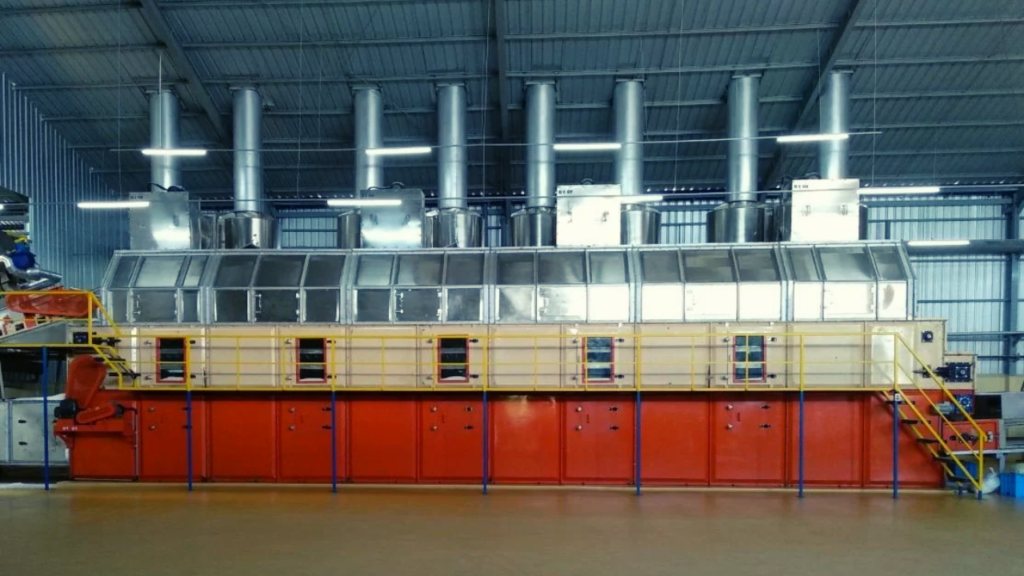
For large-scale coconut processing, the Band Dryer can provide a practical continuous drying platform.
The product is distributed onto a moving perforated belt or conveyor and passes through controlled drying zones.
Hot air is circulated through the product layer while moisture is progressively removed.
Why Band Dryers are attractive for coconut processing
- Continuous operation
- High production capacity
- Controlled drying zones
- Gentle product conveying
- Adjustable residence time
- Uniform airflow
- Multi-stage temperature control
- Suitable for export-oriented production
- Integration with upstream and downstream equipment
GTI’s coconut chips drying information specifically identifies Band Dryers for large-scale coconut chip drying, while its desiccated coconut system describes band drying as a continuous system with controlled airflow and multiple drying zones.
Typical Band Dryer process
Fresh Coconut → Cutting/Slicing/Shredding → Washing → Dewatering → Feeding → Band Dryer → Cooling → Screening/Grading → Packaging
The drying profile can be engineered according to:
- Product thickness
- Feed moisture
- Final moisture
- Belt loading
- Airflow
- Residence time
- Production capacity
- Product sensitivity
2. Fluid Bed Dryer for Coconut Products
A Fluid Bed Dryer works differently.
Instead of simply conveying the product through drying zones, controlled air passes through the product bed to create effective contact between the drying air and particles.
This can provide efficient heat transfer and rapid moisture removal for appropriate coconut products.
GTI’s desiccated coconut systems describe fluidized-bed drying as suitable for granular coconut products, with advantages including uniform moisture removal, efficient heat transfer, improved product consistency and shorter drying time.
Fluid Bed Dryer advantages
- Efficient heat transfer
- Good air-product contact
- Uniform drying
- Shorter drying time for suitable products
- Continuous processing possibilities
- Improved moisture consistency
- Suitable for appropriately sized free-flowing particles
However, not every coconut chip or flake behaves like a free-flowing granular product.
That is why product testing and process evaluation are important before selecting a pure fluid-bed configuration.
3. Combination Band + Fluid Bed Dryer for Coconut
This is where a customized Combination Dryer can become particularly interesting for export-oriented coconut processors.
A combination system integrates different drying mechanisms into a single process line.
For example:
Stage 1 — Controlled Band Drying
The product enters a band drying section where bulk moisture is progressively reduced.
Stage 2 — Fluid Bed Finishing
The partially dried coconut can then enter a fluid-bed section for further moisture equalization and finishing, depending on product characteristics.
Stage 3 — Cooling
Controlled cooling stabilizes the product before further handling and packaging.
This approach can provide greater process flexibility than relying on a single drying technology.
GTI describes its combination dryer concept as integrating technologies such as fluid-bed and band drying to achieve optimized drying results.
Why Combination Drying Can Be Valuable for Export Plants
Imagine a coconut processor producing several product formats:
- Coconut chips
- Coconut flakes
- Coconut threads
- Shredded coconut
- Fine desiccated coconut
The products may have different:
- Particle sizes
- Surface areas
- Bulk densities
- Moisture levels
- Fat contents
- Drying rates
A combination system can therefore be engineered to provide different drying environments within one continuous production concept.
This can be particularly useful when the plant needs flexibility rather than a single-product dryer.
What Determines the Right Coconut Dryer?
At GTI, dryer selection should begin with product and process data.
The key parameters include:
Feed Product
Is the product:
- Sliced?
- Flaked?
- Threaded?
- Shredded?
- Granulated?
Particle Dimensions
Thickness and particle size affect:
- Drying rate
- Air penetration
- Residence time
- Heat transfer
Feed Moisture
The starting moisture level determines the overall evaporation load.
Final Moisture
The target should be established according to the intended product specification and storage requirements.
Fat Content
Coconut products can contain significant fat, which can influence product behaviour during drying and handling.
Production Capacity
For example:
500 kg/h, 1 TPH, 2 TPH, 5 TPH or higher
The actual dryer configuration should be calculated from the process load rather than selected only from nominal machine capacity.
Export Quality Starts with Moisture Uniformity
One of the most important reasons for investing in an industrial coconut dryer is moisture consistency.
If different portions of the product leave the dryer at significantly different moisture levels, the processor can face problems during:
- Packaging
- Storage
- Transportation
- Shelf-life management
- Further processing
Over-dried product can also affect texture and appearance.
Under-dried product can compromise stability.
Therefore, industrial coconut drying needs to balance:
Moisture Removal + Product Quality + Energy Consumption + Throughput
Protecting Coconut Colour, Aroma & Texture
For premium coconut chips and flakes, drying is not simply a moisture-removal operation.
The final product may be judged on:
- Colour
- Aroma
- Crispness
- Texture
- Taste
- Particle integrity
- Moisture
- Appearance
An excessively aggressive drying profile can negatively affect product quality.
GTI therefore approaches coconut drying as a controlled thermal process, where air temperature, product temperature, residence time, airflow and product loading are considered together.
Actual operating temperatures and residence times should always be established through product-specific trials and engineering calculations.
Coconut Chips Dryer for Snack Manufacturers
The global snack industry creates an important application for coconut chips.
Coconut chips can be marketed as:
- Standalone snacks
- Roasted snack ingredients
- Granola ingredients
- Trail mix components
- Healthy snack products
- Toppings
- Bakery ingredients
For snack manufacturers, the dryer needs to produce a product with consistent:
Texture + Moisture + Colour + Particle Integrity
A continuous Band Dryer can be engineered for high-throughput production where consistent product handling and drying are required.
Coconut Flakes Dryer for Bakery & Confectionery
Coconut flakes are widely applicable in food manufacturing.
They can be used in:
- Cakes
- Cookies
- Pastries
- Chocolates
- Dessert toppings
- Cereal products
- Granola
- Bakery fillings
- Confectionery
The drying system therefore needs to preserve the physical characteristics of the flakes while achieving the required moisture level.
GTI’s existing coconut drying systems cover applications including coconut flakes, chips and different grades of desiccated coconut.
Coconut Threads Dryer for Ingredient Manufacturers
Coconut threads have a different geometry from chips or flakes.
Their high surface-area-to-volume ratio can change:
- Moisture evaporation rate
- Airflow requirements
- Product loading
- Residence time
- Fines formation
This makes process-specific dryer design particularly important.
A Band Dryer or appropriately configured combination drying system can be engineered depending on capacity and product characteristics.
Where Is the Global Market Opportunity?
Coconut-producing countries are also becoming increasingly important processing and export hubs.
In 2024, the Philippines, Indonesia and Sri Lanka together exported approximately 446,811 MT of desiccated coconut, according to data compiled by the United Coconut Association of the Philippines. The Philippines accounted for 52.1%, Indonesia 35.8%, and Sri Lanka 12.1%.
This provides an important indicator for companies supplying industrial coconut processing and drying equipment.
But the opportunity is not limited to coconut-producing countries.
The major opportunity also exists in the importing and food-manufacturing markets.
1: India
India should be one of the primary targets for GTI’s coconut drying solutions.
India has a large coconut-processing ecosystem and a growing food-processing sector.
The opportunity exists across:
- Coconut processing plants
- Desiccated coconut manufacturers
- Snack manufacturers
- Bakery ingredient producers
- Food exporters
- Confectionery manufacturers
- Private-label food manufacturers
India should therefore be targeted around keywords such as:
Coconut Dryer Manufacturer India
Coconut Chips Dryer India
Coconut Flakes Drying Machine India
Coconut Band Dryer Manufacturer India
Coconut Processing Plant Dryer
2: Indonesia
Indonesia is one of the world’s major coconut-producing and processing countries.
World Bank WITS data for 2024 shows Indonesia as the largest exporter among the listed countries for fresh or dried coconuts by trade value, at approximately US$471.8 million, ahead of Thailand, the Philippines, Sri Lanka and India.
For GTI, Indonesia is therefore an important market for:
- Coconut drying plants
- Desiccated coconut
- Coconut chips
- Coconut flakes
- Coconut threads
- Food ingredient processing
- Export-oriented coconut factories
opportunity:
Coconut Dryer Manufacturer in Indonesia
Coconut Chips Dryer Indonesia
Coconut Flakes Dryer Indonesia
Coconut Band Dryer Indonesia
3: Philippines
The Philippines is one of the most significant global coconut-processing and desiccated-coconut exporting countries.
In 2024, the Philippines exported approximately 173,171 MT of desiccated coconut, representing 52.1% of the combined exports of the Philippines, Indonesia and Sri Lanka tracked by UCAP.
The country’s coconut processing ecosystem makes it a strong target for:
- Band Dryers
- Fluid Bed Dryers
- Combination Dryers
- Desiccated coconut drying systems
- Coconut chips drying systems
- Coconut flakes drying systems
The Philippines should be an important GEO cluster for GTI.
4: Sri Lanka
Sri Lanka is another established coconut-processing and exporting market.
In the same 2024 UCAP comparison, Sri Lanka exported approximately 40,250 MT of desiccated coconut.
Potential applications include:
- Desiccated coconut
- Coconut flakes
- Coconut chips
- Coconut threads
- Bakery ingredients
- Export-oriented coconut processing
5: USA
The United States is particularly important as a destination market.
UCAP data shows the USA as the leading destination for Philippine desiccated coconut in several reported periods. In July 2025, the USA accounted for 27.7% of the reported Philippine desiccated-coconut market, followed by the Netherlands and China.
For GTI, the US opportunity is therefore not only about selling dryers to coconut-producing countries.
It is also about supplying equipment to:
- Coconut ingredient processors
- Snack manufacturers
- Food manufacturers
- Private-label producers
- Ingredient importers establishing local processing
- Specialty food manufacturers
6: Netherlands & Europe
The Netherlands is an important European entry point for coconut products.
Philippine fresh/dried coconut exports to the Netherlands were approximately US$49.4 million in 2024, according to World Bank WITS data.
UCAP’s 2025 desiccated-coconut data also placed the Netherlands second among the reported destination markets at 14.3%.
This makes the Netherlands particularly relevant for GTI’s European GEO strategy.
Potential expansion markets include:
- Germany
- UK
- France
- Belgium
- Italy
- Spain
- Poland
- Turkey
7: China
China is another important coconut-product destination.
In one 2025 UCAP desiccated-coconut report, China represented 8.6% of the reported destination market, behind the USA and Netherlands.
For GTI, China can be targeted through:
- Coconut ingredient processing
- Food manufacturing
- Snack production
- Bakery ingredients
- Coconut flakes
- Coconut chips
- Desiccated coconut
8: Australia
Australia is another relevant downstream food market.
Demand can be targeted through applications rather than only the commodity:
- Coconut snacks
- Bakery
- Cereals
- Granola
- Confectionery
- Food ingredients
- Natural/plant-based food products
Australia appeared among the significant destination markets in UCAP’s 2025 desiccated-coconut data.
9: Germany, Canada, UK & Turkey
These markets should form a secondary European and North American GEO cluster.
Recent UCAP destination data identifies countries including Germany, Canada, Australia, the UK and Turkey among notable desiccated-coconut markets.
For SEO purposes, GTI can create supporting location pages around:
- Coconut Dryer Manufacturer Germany
- Coconut Dryer Manufacturer Canada
- Coconut Dryer Manufacturer UK
- Coconut Dryer Manufacturer Turkey
- Coconut Drying System Europe
Recommended GEO Market Cluster for GTI
| Market | Why Target It | GTI Opportunity |
| India | Large coconut processing ecosystem | Dryer manufacturing & domestic/export plants |
| Indonesia | Major coconut producer/exporter | Industrial coconut drying |
| Philippines | Major desiccated coconut exporter | Band & combination dryers |
| Sri Lanka | Established coconut industry | Coconut drying systems |
| USA | Major downstream market | Food & ingredient processing |
| Netherlands | Important European coconut destination | European processing market |
| China | Significant coconut-product market | Industrial food processing |
| Germany | European food manufacturing | Ingredient processing |
| UK | Food & bakery applications | Coconut ingredient processing |
| Australia | Coconut food/snack applications | Export-oriented processing |
| Canada | Food ingredient demand | Coconut processing |
| Turkey | Growing destination market | Food manufacturing |
Important: These are targeting priorities based on coconut/desiccated-coconut trade indicators, not a definitive ranking of demand for the specific products “chips, flakes and threads.” Product-level trade classifications can combine several coconut products, so country targeting should be refined using GTI’s lead data and customer inquiries.
Why GTI Uses Different Drying Technologies
There is no universal “best coconut dryer.”
The appropriate technology depends on the product.
For high-capacity continuous production
Band Dryer
For suitable free-flowing particles requiring efficient air-product contact
Fluid Bed Dryer
For staged drying and more process flexibility
Combination Band + Fluid Bed Dryer
This product-first approach allows GTI to engineer systems around actual process requirements.
GTI Coconut Drying System — Typical Process Flow
A typical industrial coconut processing line can be structured as:
Fresh Coconut
↓
Dehusking & Shell Removal
↓
Peeling / Washing
↓
Cutting / Slicing / Shredding
↓
Dewatering
↓
Controlled Feeding
↓
Band / Fluid Bed / Combination Dryer
↓
Cooling
↓
Screening / Grading
↓
Metal Detection / Quality Control
↓
Packaging
↓
Finished Coconut Chips / Flakes / Threads
The exact configuration depends on the customer’s process and product specification.
What GTI Can Engineer
GTI Dryers can develop customized drying solutions based on:
- Product type
- Feed moisture
- Final moisture
- Production capacity
- Particle size
- Product thickness
- Fat content
- Drying time
- Heat sensitivity
- Required product temperature
- Available utilities
- Factory layout
- Energy source
- Automation requirement
- Downstream packaging requirements
Possible configurations include:
Coconut Chips Drying System
For sliced/chunk coconut products.
Coconut Flakes Drying System
For larger flake formats used in food manufacturing.
Coconut Threads Drying System
For fine shredded/elongated coconut products.
Desiccated Coconut Drying System
For fine, medium and coarse grades.
Combination Coconut Dryer
For processors requiring staged drying and greater process flexibility.
Energy Efficiency: More Than Just Heating Air
For large coconut processing plants, energy consumption can have a significant effect on operating cost.
A well-engineered drying system considers:
- Air circulation
- Exhaust management
- Heat recovery opportunities
- Insulation
- Air distribution
- Product loading
- Residence time
- Drying-zone control
- Heater efficiency
GTI’s coconut drying systems are positioned around continuous operation and energy-efficient processing, with the final energy performance depending on product and plant conditions.
Designing the Dryer Around the Export Product
An exporter may have a specification such as:
“Coconut chips with controlled final moisture, uniform colour and consistent crispness.”
A food ingredient manufacturer may instead require:
“Coconut flakes with uniform moisture and particle integrity for bakery applications.”
A confectionery producer may need:
“Fine coconut threads with consistent drying and minimal variation between batches.”
These are different process requirements.
Therefore, GTI does not treat a coconut dryer as a one-size-fits-all machine.
The dryer configuration should be developed around the final product specification.
What a Coconut Dryer Buyer Should Share with GTI
For a technically meaningful proposal, buyers should provide:
Product Information
- Coconut chips/flakes/threads
- Product dimensions
- Feed condition
- Fat content, if available
Process Information
- Feed moisture
- Desired final moisture
- Feed temperature
- Production capacity
- Operating hours
Quality Requirements
- Colour
- Texture
- Crispness
- Particle integrity
- Bulk density, where applicable
Plant Information
- Available floor space
- Heating source
- Electrical availability
- Steam availability
- Exhaust requirements
- Automation requirements
The more accurate the process data, the more accurately the drying system can be engineered.
Why Coconut Processors Choose Continuous Drying
For export-oriented manufacturing, continuous drying can provide advantages over highly manual or batch-dependent processing.
Continuous Production
Suitable for large-scale manufacturing.
Better Process Control
Drying conditions can be controlled by zones.
Consistent Product Handling
Automated conveying reduces unnecessary manual handling.
Production Scalability
Systems can be engineered according to required capacity.
Integration
The dryer can be integrated with upstream preparation and downstream cooling, grading and packaging.
Band Dryer or Combination Dryer: Which One Should You Choose?
The answer depends on your product.
Choose a Band Dryer when:
- Production capacity is high
- Continuous operation is required
- Product can be conveyed on a belt
- Controlled multi-zone drying is preferred
- Product handling needs to be gentle
Consider Fluid Bed Drying when:
- Product is suitably free-flowing
- Efficient air-product contact is required
- Rapid moisture transfer is desirable
Consider Combination Drying when:
- Product behaviour changes during drying
- Different drying mechanisms are beneficial at different stages
- Greater process flexibility is required
- Final moisture equalization is important
- The plant produces multiple coconut formats
GTI can evaluate the product and recommend the appropriate configuration rather than forcing every application into one dryer type.
Why GTI Dryers for Coconut Processing?
GTI Dryers approaches coconut drying from a process-engineering perspective.
The objective is not simply:
“Supply a dryer.”
The objective is:
“Develop a drying system that fits the customer’s coconut processing line and product specification.”
GTI’s existing coconut portfolio covers systems for high-fat and low-fat desiccated coconut, coconut flakes and coconut chips, using technologies including fluidized-bed, band and combination drying.
GTI’s approach includes:
- Product-specific dryer selection
- Customized capacity
- Continuous drying solutions
- Band drying
- Fluid bed drying
- Combination drying
- Controlled drying zones
- Hygienic food-processing design
- Energy-efficiency considerations
- Integration with processing lines
- Export-oriented engineering support
Engineered in India. Designed for the World.
Beyond Coconut: Building a Complete Coconut Value-Addition Plant
A modern coconut processor can potentially create multiple revenue streams from the same raw material.
Coconut Kernel
↓
Coconut Milk
↓
Coconut Milk Powder
Coconut Cream
Coconut Oil
Desiccated Coconut
Coconut Chips
Coconut Flakes
Coconut Threads
Coconut Flour
This creates an important opportunity for coconut-processing companies to move from commodity sales toward higher-value processed ingredients and consumer products.
GTI can be positioned within this value chain as the industrial drying technology partner.
Build Your Coconut Drying Plant Around Your Product
Whether you are planning:
- A new coconut processing plant
- A desiccated coconut production line
- A coconut chips factory
- A coconut flakes production line
- A coconut threads processing line
- An export-oriented coconut plant
- A capacity expansion
- A dryer replacement
- A drying-system modernization project
GTI Dryers can evaluate the product and process requirements and develop a suitable drying configuration.
The solution may be a:
or a customized multi-stage drying system.
Frequently Asked Questions
1. Which dryer is used for coconut chips?
Band Dryers are commonly considered for large-scale coconut chip drying because they provide continuous conveying and controlled drying zones. The final configuration depends on chip size, feed moisture, capacity and product specifications.
2. Which dryer is suitable for coconut flakes?
A Band Dryer can be suitable for continuous coconut flake drying. Fluid-bed or combination systems may also be considered depending on particle characteristics, capacity and moisture requirements.
3. Can a Fluid Bed Dryer dry coconut?
Yes, fluidized-bed drying can be used for suitable coconut products, particularly appropriately sized free-flowing particles. GTI lists fluidized-bed drying for granular coconut products.
4. What is a Combination Coconut Dryer?
A combination dryer integrates more than one drying technology, such as band and fluid-bed drying, to provide staged or optimized drying.
5. Can GTI manufacture a customized coconut dryer?
Yes. GTI Dryers designs and manufactures customized industrial drying systems based on product characteristics, capacity and process requirements.
6. Can the same dryer produce coconut chips and flakes?
Potentially, but the configuration and operating conditions must be evaluated for each product. Different particle sizes and geometries can require different feeding, loading and drying conditions.
7. Is Band Dryer suitable for large coconut processing plants?
Band Dryers are particularly suitable for continuous, large-scale applications where controlled multi-zone drying is required. GTI specifically identifies band drying for large-scale coconut chip and desiccated-coconut applications.
8. Which countries should coconut dryer manufacturers target?
For GTI’s GEO strategy, important markets include India, Indonesia, Philippines, Sri Lanka, USA, Netherlands, China, Germany, UK, Australia, Canada and Turkey, based on coconut production, processing and downstream trade indicators. The exact opportunity varies by product and market.
Looking for a Coconut Chips, Flakes or Threads Dryer?
If your objective is to manufacture export-quality coconut chips, flakes, threads or desiccated coconut, the drying system should be designed around the product—not simply around machine capacity.
GTI Dryers provides customized industrial coconut drying solutions using Band Dryers, Fluid Bed Dryers and Combination Dryers for food processors and coconut exporters.
From product evaluation to dryer configuration and process engineering, GTI can support the development of a suitable industrial drying system.
Talk to GTI Dryers About Your Coconut Processing Project
Share:
Product: Chips / Flakes / Threads / Shredded Coconut
Capacity: kg/h or TPH
Feed Moisture: %
Final Moisture: %
Product Dimensions: mm
Heating Source: Steam / Thermic Fluid / Gas / Electric / Other
Country:
Application: Food / Snack / Bakery / Export / Ingredient
GTI Dryers — Engineered Drying Solutions from India for Global Coconut Industries.