
From Fresh Coconut Milk to a Global Food Ingredient
Fresh coconut milk has a major commercial limitation:
It is highly perishable.
But the same coconut milk can be transformed into a much more convenient ingredient through controlled spray drying:
Fresh Coconut
↓
Coconut Meat
↓
Coconut Milk / Coconut Cream
↓
Filtration & Formulation
↓
Spray Drying
↓
Coconut Milk Powder
↓
Packaging
↓
Global Distribution
This transformation changes the commercial possibilities of the product.
Instead of transporting a high-moisture, perishable liquid, manufacturers can produce a stable, concentrated powder ingredient that can be stored, transported and incorporated into a wide range of food formulations.
That is where industrial spray drying becomes one of the most important technologies in coconut milk powder production.
GTI Dryers designs and manufactures industrial coconut milk powder drying systems for full-fat and low-fat coconut milk, coconut cream and other coconut-based liquid formulations.
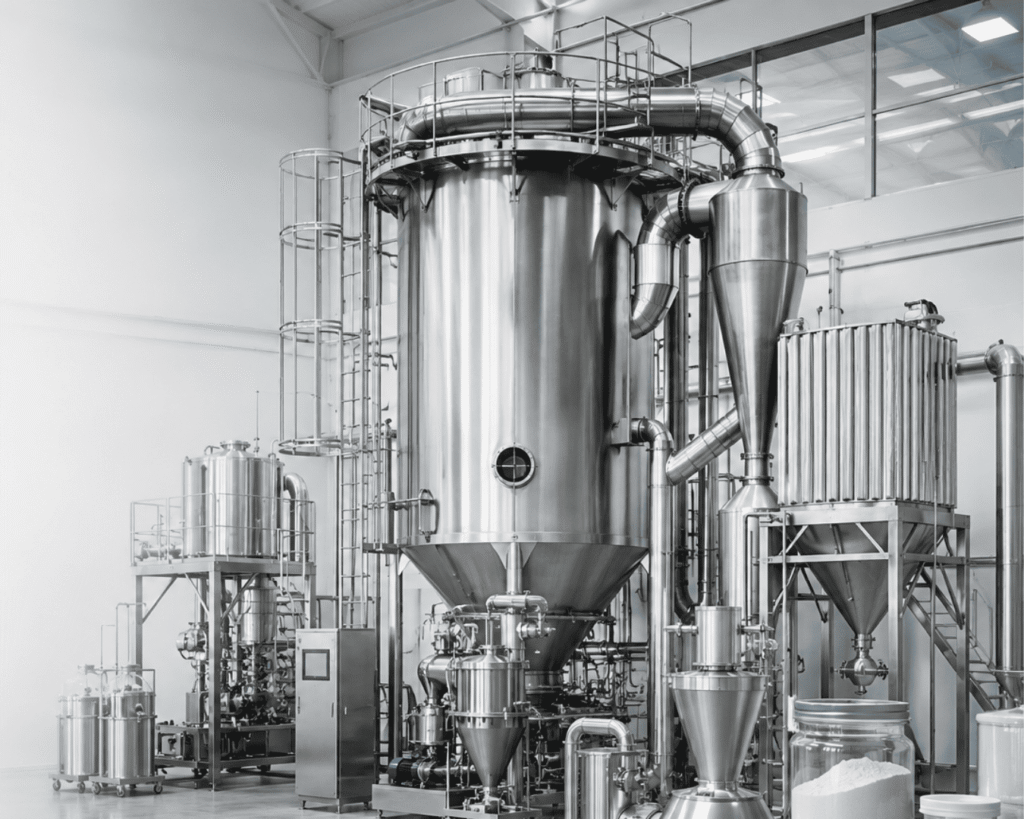
What Is Coconut Milk Powder?
Coconut milk powder is a dried form of coconut milk or coconut-based liquid formulation produced by removing water under controlled drying conditions.
Depending on the formulation and production process, the powder may be used in:
- Beverages
- Instant drink mixes
- Bakery products
- Biscuits
- Cakes
- Confectionery
- Chocolate
- Soups
- Sauces
- Curry mixes
- Ready-to-eat foods
- Ready-to-cook foods
- Plant-based dairy alternatives
- Nutritional products
- Seasonings
- Food premixes
- Instant coconut beverages
GTI’s coconut milk powder systems are designed for both full-fat and low-fat coconut milk powder, as well as coconut cream and emulsified coconut formulations.
Why Turn Coconut Milk Into Powder?
The business case is bigger than simply removing water.
Liquid Coconut Milk
- High moisture
- Perishable
- Requires controlled storage
- Higher transportation weight
- Limited shelf stability
- More difficult long-distance distribution
Coconut Milk Powder
- Lower moisture
- Easier storage
- Easier transportation
- Longer commercial usability when properly formulated and packaged
- Convenient for food manufacturers
- Easier incorporation into dry mixes
- Suitable for export-oriented ingredient businesses
This creates a major opportunity for coconut processors:
Convert a perishable liquid into a higher-value, globally transportable ingredient.
Why Spray Drying Is the Preferred Technology
Coconut milk is a liquid feed.
That immediately makes spray drying particularly attractive.
In a spray dryer:
Liquid coconut milk → Atomization → Fine droplets → Rapid moisture evaporation → Dry particles → Powder collection
The process is continuous and can produce a powder directly from a pumpable liquid.
GTI’s spray dryer technology is designed to convert pumpable liquids, slurries, emulsions and solutions into free-flowing powders in a continuous operation. Its published applications specifically include coconut milk powder and plant-based powders.
The GTI Way: Don’t Just Dry Coconut Milk — Engineer the Powder
This is where GTI’s approach becomes different.
The customer does not simply need:
“A machine that removes water.”
The customer needs:
A powder with the right commercial characteristics.
Depending on the formulation, important targets may include:
- Moisture
- Solubility
- Dispersibility
- Particle size
- Bulk density
- Flowability
- Powder recovery
- Fat content
- Aroma retention
- Colour
- Reconstitution behaviour
- Storage stability
GTI therefore designs the spray drying system around the feed formulation and final powder specification.
The Coconut Milk Powder Production Journey
A typical industrial process may include:
1. Coconut Selection
Mature coconut is selected according to the required product specification.
2. Dehusking and Shelling
The coconut is prepared for meat extraction.
3. Paring and Cleaning
The coconut meat is cleaned and prepared for processing.
4. Grating / Size Reduction
The coconut meat is reduced to a suitable form.
5. Milk Extraction
Water is added where required and coconut milk is extracted through mechanical processing.
6. Filtration
The liquid is filtered to remove unwanted solids.
7. Formulation
Depending on the product, the feed may be standardized or combined with suitable food ingredients.
8. Homogenization / Emulsification
Where required, the feed is processed to improve consistency and emulsion stability.
9. Spray Drying
The liquid feed is atomized into the drying chamber.
10. Powder Recovery
The dried particles are separated from the drying air through cyclone and/or filtration systems.
11. Cooling / Conditioning
The powder may be cooled or conditioned before packaging.
12. Packaging
The final powder is packed under appropriate food-processing conditions.
How a Coconut Milk Powder Spray Dryer Works
The core process is simple to understand.
Step 1 — Feed Preparation
Coconut milk is prepared to the required concentration, viscosity and formulation.
Step 2 — Atomization
The liquid is converted into fine droplets through a suitable atomization system.
Step 3 — Contact with Hot Drying Air
The droplets enter the spray-drying chamber and contact controlled hot drying air.
Step 4 — Rapid Water Evaporation
Because the droplets have a very high surface-area-to-volume ratio, water evaporates rapidly.
Step 5 — Particle Formation
The remaining solids form individual powder particles.
Step 6 — Powder Separation
The powder is separated from the drying air through a cyclone, bag filter or combination collection system.
Step 7 — Final Product Handling
The powder can then be cooled, screened, conveyed and packed.
GTI’s spray-dryer configuration includes feed tanks/pumps, atomization, drying chamber, heating system and powder-separation equipment, with the exact configuration customized to the application.
Full-Fat vs Low-Fat Coconut Milk Powder
This distinction is commercially important.
Full-Fat Coconut Milk Powder
Contains a higher proportion of coconut-derived fat and is typically selected where the final product needs:
- Rich coconut flavour
- Creamier mouthfeel
- Higher coconut-fat content
- Strong coconut character
Applications can include:
- Curry mixes
- Sauces
- Bakery
- Confectionery
- Beverages
- Instant coconut products
Low-Fat Coconut Milk Powder
Lower-fat formulations may be developed for products where the manufacturer requires a different nutritional or formulation profile.
Potential applications include:
- Beverage mixes
- Food premixes
- Low-fat formulations
- Nutritional products
- Ingredient blends
The dryer should not be designed from the words “full-fat” or “low-fat” alone.
Feed viscosity, solids concentration, emulsification, fat content and final powder requirements all affect the spray-dryer design.
GTI explicitly offers coconut milk powder drying systems for both full-fat and low-fat coconut milk.
The Real Challenge: Coconut Milk Is Not an Ordinary Liquid
Coconut milk is an emulsion containing water, fat, proteins, carbohydrates and other coconut-derived components.
This creates several process-engineering considerations.
Feed viscosity
The feed must be pumpable and suitable for atomization.
Fat content
Fat influences powder formation, stickiness and handling.
Solids concentration
Higher solids affect evaporation duty and feed properties.
Emulsion stability
Feed preparation can influence final powder quality.
Powder stickiness
Certain formulations may create wall-deposition or powder-recovery challenges.
Aroma
Excessive thermal exposure can affect desirable sensory characteristics.
Reconstitution
The powder should be engineered for the required end-use behaviour.
Therefore, spray-dryer design should begin with feed characterization.
What Should a Good Coconut Milk Powder Dryer Deliver?
A commercial system should be engineered to achieve the customer’s specific product requirements.
Potential objectives include:
Controlled moisture
→
Good powder recovery
→
Consistent particle size
→
Suitable bulk density
→
Good dispersibility
→
Stable fat distribution
→
Controlled thermal exposure
→
Good aroma retention
→
Reliable continuous production
The exact targets must be established through product development and process trials.
Particle Size Matters
Spray drying creates particles rather than simply producing a “dried liquid.”
Particle size can influence:
- Flowability
- Bulk density
- Dispersibility
- Solubility behaviour
- Packaging
- Powder handling
- Reconstitution
Atomization therefore becomes one of the most important parts of the dryer.
GTI can configure spray dryers with appropriate atomization systems according to feed properties and target powder characteristics.
What Happens Inside the Spray-Drying Chamber?
The drying chamber is where the liquid becomes powder.
The process involves:
Droplet formation
↓
Heat transfer
↓
Water evaporation
↓
Particle formation
↓
Powder-air separation
The objective is to dry the droplets rapidly enough to produce the desired particle structure while controlling product exposure and wall deposition.
For coconut milk, chamber geometry, airflow pattern, atomization, inlet conditions, outlet conditions and feed rate must be evaluated together.
This is why simply increasing the inlet temperature is not a complete drying strategy.
Product Temperature vs Air Temperature
This is an important point for coconut milk powder projects.
The drying-air temperature and the actual product temperature are not necessarily the same.
During spray drying, evaporation consumes heat.
As long as moisture is actively evaporating, the product can remain considerably cooler than the incoming drying air.
Therefore, the engineering focus should be on:
- Drying-air conditions
- Outlet conditions
- Feed properties
- Evaporation rate
- Residence time
- Product sensitivity
rather than judging product quality solely from the heater temperature.
Powder Recovery: Where Plant Economics Begin
Producing powder is only half of the problem.
The other half is recovering it efficiently.
A commercial spray dryer may use:
- Cyclone separator
- Bag filter
- Cartridge filter
- Secondary powder recovery
- Multi-stage collection
The appropriate arrangement depends on:
- Particle size
- Powder density
- Production capacity
- Recovery target
- Product properties
- Emission requirements
GTI’s spray drying systems can incorporate cyclone and filtration-based powder collection depending on the process requirement.
Energy Efficiency Is a Commercial Requirement
Spray drying is an energy-intensive process because large quantities of water are evaporated.
For a commercial coconut milk powder plant, energy cost can directly influence the production economics.
GTI’s coconut milk powder drying systems focus on:
- Airflow optimization
- Drying-chamber design
- Heat utilization
- Heat recovery opportunities
- Powder recovery
- Continuous operation
GTI states that its coconut milk powder systems are engineered with airflow management, optimized drying chambers and heat-recovery approaches to reduce energy losses.
The actual energy consumption should always be established from the customer’s feed rate, solids concentration, moisture load, ambient conditions and process design.
Where Is Coconut Milk Powder Used?
Coconut milk powder can serve as a versatile ingredient across several industries.
Food & Beverage
- Instant coconut beverages
- Curry mixes
- Soups
- Sauces
- Ready-to-cook products
- Ready-to-eat foods
- Bakery mixes
Bakery
- Biscuits
- Cookies
- Cakes
- Pastries
- Bakery premixes
Confectionery
- Chocolate
- Coconut fillings
- Dessert formulations
- Coatings
Plant-Based Food
- Dairy alternatives
- Vegan beverages
- Coconut-based creamers
- Plant-based formulations
Nutraceuticals
- Nutritional powders
- Functional food blends
- Specialty formulations
Foodservice
- Instant coconut preparations
- Restaurant mixes
- Industrial kitchen formulations
This broad application base is one reason coconut milk powder can be positioned as a value-added coconut ingredient rather than simply a dried coconut product.
The Global Coconut Milk Powder Opportunity
The market needs to be viewed from two sides:
Where is coconut milk powder produced?
and
Where is coconut milk powder consumed/imported?
These are not necessarily the same countries.
Current trade data shows strong export activity from Vietnam, Malaysia and Indonesia, while Sri Lanka, Thailand and other Asian countries also participate in international trade.
Coconut-producing countries → equipment buyers
Food-importing countries → processors and ingredient manufacturers
1 — INDIA 🇮🇳
India should be a core market for GTI’s coconut milk powder equipment.
India has:
- Large coconut production
- Growing food processing
- Existing coconut-product manufacturers
- Export-oriented food businesses
- Growing interest in value-added ingredients
The opportunity is not limited to companies already making coconut milk powder.
Potential customers include:
- Coconut processors
- Coconut oil manufacturers diversifying into food ingredients
- Desiccated coconut producers
- Food ingredient manufacturers
- Plant-based food manufacturers
- Nutraceutical companies
- Exporters
- Contract food manufacturers
Target Keywords
Coconut Milk Powder Machine India
Coconut Milk Powder Spray Dryer India
Coconut Milk Powder Plant Manufacturer India
Coconut Spray Dryer Manufacturer India
Industrial Coconut Milk Dryer India
Coconut Milk Powder Processing Equipment India
2 — INDONESIA 🇮🇩
Indonesia is one of the most important countries for GTI’s coconut-processing equipment strategy.
It is already a major exporter of desiccated coconut, with 119,229 MT exported in 2024 in data compiled by the United Coconut Association of the Philippines.
Indonesia also ranks among the leading global exporters of coconut milk powder in recent shipment data.
This means Indonesia represents both:
Raw-material advantage
and
Value-added processing capability.
GTI Target Keywords
- Coconut Milk Powder Machine Indonesia
- Coconut Milk Spray Dryer Indonesia
- Coconut Powder Spray Dryer Indonesia
- Coconut Milk Powder Plant Indonesia
- Mesin Spray Dryer Santan
- Mesin Pengering Santan
- Mesin Bubuk Santan
- Mesin Spray Dryer Kelapa
3 — VIETNAM 🇻🇳
Vietnam deserves particularly strong GEO attention.
Recent shipment data identifies Vietnam as the leading exporter of coconut milk powder in the cited dataset, with Malaysia and Indonesia also ranking strongly.
Vietnam also has a growing coconut-processing industry.
Potential buyers include:
- Coconut milk manufacturers
- Food ingredient manufacturers
- Beverage manufacturers
- Coconut-product exporters
- Plant-based food manufacturers
Target Keywords
- Coconut Milk Powder Spray Dryer Vietnam
- Coconut Milk Powder Machine Vietnam
- Coconut Spray Dryer Vietnam
- Coconut Milk Powder Plant Vietnam
- Máy sấy phun sữa dừa
- Máy sấy phun nước cốt dừa
- Máy sản xuất bột nước cốt dừa
4 — MALAYSIA 🇲🇾
Malaysia is another important coconut milk powder production market.
Recent shipment data places Malaysia among the leading exporters of coconut milk powder.
Potential applications include:
- Coconut milk powder
- Food ingredients
- Instant beverage mixes
- Curry products
- Bakery ingredients
- Plant-based food
Target Keywords
- Coconut Milk Powder Dryer Malaysia
- Coconut Spray Dryer Malaysia
- Coconut Milk Powder Machine Malaysia
- Industrial Coconut Dryer Malaysia
- Coconut Processing Equipment Malaysia
5 — PHILIPPINES 🇵🇭
The Philippines is one of the world’s most important coconut-producing and coconut-processing countries.
Its strong desiccated-coconut export industry demonstrates the scale of its value-added coconut sector. In 2024, the Philippines exported approximately 173,171 MT of desiccated coconut, according to UCAP data.
For GTI, this creates potential opportunities beyond desiccated coconut:
- Coconut milk
- Coconut cream
- Coconut powder
- Coconut flour
- Coconut-based ingredients
Target Keywords
- Coconut Milk Powder Dryer Philippines
- Coconut Milk Spray Dryer Philippines
- Coconut Powder Machine Philippines
- Coconut Processing Equipment Philippines
- Coconut Milk Powder Plant Philippines
6 — SRI LANKA 🇱🇰
Sri Lanka is an established coconut-processing and export market.
It is also significant in coconut milk powder trade. Current product-specific shipment data identifies Sri Lanka as an important coconut milk powder importing market, while Sri Lanka is also a major coconut-product exporter.
Potential applications:
- Coconut milk powder
- Coconut cream powder
- Desiccated coconut
- Coconut flour
- Coconut-based food ingredients
Target Keywords
- Coconut Milk Powder Machine Sri Lanka
- Coconut Milk Spray Dryer Sri Lanka
- Coconut Powder Dryer Sri Lanka
- Coconut Processing Plant Sri Lanka
7 — THAILAND 🇹🇭
Thailand has a highly developed food-processing industry and is relevant for coconut-based products.
GTI should target:
- Coconut milk powder
- Coconut cream powder
- Instant coconut products
- Food ingredients
- Beverage powders
Keywords
- Coconut Milk Powder Dryer Thailand
- Coconut Spray Dryer Thailand
- Coconut Powder Machine Thailand
- Coconut Processing Equipment Thailand
8 — USA 🇺🇸
The USA is important from the consumption and food-processing side.
Product-specific trade datasets identify the United States among important coconut milk powder importing markets, although rankings vary by product classification and reporting period.
The broader coconut ingredient market includes:
- Bakery
- Plant-based foods
- Beverages
- Confectionery
- Health foods
- Foodservice
- Ingredient manufacturing
GTI should therefore target not only coconut processors but also:
Food ingredient manufacturers + contract manufacturers + plant-based food producers.
Keywords
- Coconut Milk Powder Spray Dryer USA
- Coconut Milk Powder Machine USA
- Industrial Coconut Spray Dryer
- Coconut Powder Processing Equipment USA
9 — UAE & MIDDLE EAST 🇦🇪
The UAE is particularly interesting from an import, food-processing and distribution perspective.
Current trade data for a coconut milk powder product classification identifies the UAE as a leading importing market.
Potential applications include:
- Instant beverage mixes
- Bakery ingredients
- Curry mixes
- Foodservice
- Plant-based foods
- Food ingredient distribution
Target Keywords
- Coconut Milk Powder Machine UAE
- Coconut Spray Dryer UAE
- Coconut Milk Powder Plant UAE
- Coconut Processing Equipment Dubai
- Coconut Milk Powder Dryer Saudi Arabia
10 — CHINA 🇨🇳
China is an important food-processing and coconut-product market.
Recent coconut-product shipment data identifies China as a significant participant in global coconut-product trade, while product-specific coconut milk powder data also shows China as a major market under some classifications.
Potential applications include:
- Coconut beverages
- Bakery
- Confectionery
- Plant-based products
- Instant foods
- Functional ingredients
11 — BANGLADESH 🇧🇩
Bangladesh is worth targeting as a developing South Asian food-processing market.
Recent broader coconut-product shipment data identifies Bangladesh among major importing markets.
Potential customers include:
- Food manufacturers
- Bakery manufacturers
- Beverage manufacturers
- Ingredient processors
- Instant-food producers
GTI’s Priority GEO Markets
For this particular product page, I would structure the international targeting into three levels.
| Priority | Market | Why Target |
| Tier 1 | India | Coconut raw material + food-processing + machinery market |
| Tier 1 | Indonesia | Major coconut-processing/export country |
| Tier 1 | Vietnam | Major coconut milk powder exporter |
| Tier 1 | Malaysia | Major coconut milk powder exporter |
| Tier 1 | Philippines | Major coconut-processing/export industry |
| Tier 1 | Sri Lanka | Strong coconut processing + powder trade |
| Tier 2 | Thailand | Large food-processing ecosystem |
| Tier 2 | USA | Major consumption/import market |
| Tier 2 | UAE | Import + food manufacturing/distribution |
| Tier 2 | China | Large food-processing market |
| Tier 2 | Bangladesh | Growing food-processing demand |
| Tier 3 | Germany | European food-processing market |
| Tier 3 | UK | Food ingredient/retail market |
| Tier 3 | Australia | Coconut-product consumption/import |
| Tier 3 | Canada | Food ingredient market |
Important: trade rankings vary significantly depending on the HS code, product definition and reporting period, so these should be treated as GEO targeting priorities rather than a universal ranking of coconut milk powder demand.
What Makes GTI’s Coconut Milk Powder Spray Dryer Different?
1. Designed Around the Feed
GTI evaluates:
- Solids
- Fat
- Viscosity
- Feed temperature
- Feed rate
- Emulsion characteristics
2. Designed Around the Powder
The target powder can determine:
- Atomization
- Chamber design
- Airflow
- Collection
- Cooling
- Powder handling
3. Full-Fat and Low-Fat Capability
GTI’s coconut milk powder systems are designed for both full-fat and low-fat formulations.
4. Food-Grade Engineering
The system can be designed around applicable food-processing and hygiene requirements.
5. Continuous Production
Spray drying is suitable for continuous industrial powder production.
6. Powder Recovery
Cyclone and filtration arrangements can be engineered around the required recovery and particle characteristics.
7. Energy Optimization
Airflow and heat utilization can be engineered around the plant’s evaporation duty.
GTI Coconut Spray Dryer Configuration
A typical system can include:
Feed Preparation
↓
Feed Tank
↓
Feed Pump
↓
Filter
↓
Atomization System
↓
Spray Drying Chamber
↓
Cyclone / Primary Powder Recovery
↓
Bag Filter / Secondary Recovery
↓
Powder Cooling
↓
Conveying
↓
Packaging
Additional systems may include:
- Air heater
- Air filtration
- Exhaust fan
- Heat recovery
- CIP-oriented arrangements where applicable
- Automation
- Moisture control
- Powder conveying
- Dust collection
The final configuration depends on product properties and plant requirements.
How GTI Can Help an Export-Oriented Coconut Processor
A coconut processor planning international expansion may need more than a spray dryer.
The project may require:
Process Design
Understanding the complete coconut milk-to-powder process.
Dryer Selection
Determining appropriate spray-drying configuration.
Capacity Calculation
Matching evaporation capacity to production targets.
Utility Calculation
Estimating:
- Thermal energy
- Electricity
- Air
- Water
- Cooling requirements
Powder Collection
Designing an efficient powder recovery system.
Automation
Controlling:
- Feed rate
- Temperature
- Airflow
- Pressure
- Product conditions
Installation & Commissioning
Supporting the transition from equipment delivery to production.
GTI states that its coconut drying solutions can include process design, equipment manufacturing, plant layout, installation/commissioning and automation depending on project scope.
What Data Should You Send GTI for a Coconut Milk Powder Dryer Quote?
To prepare a meaningful technical proposal, provide:
Feed
- Coconut milk / coconut cream
- Initial moisture
- Solids content
- Fat content
- Feed temperature
- Feed viscosity
- Feed rate
Powder
- Desired moisture
- Target particle size
- Bulk density
- Solubility/dispersibility requirement
- Full-fat or low-fat
- Packaging method
Production
- kg/hour
- MT/day
- Operating hours/day
- Batch or continuous requirement
Plant
- Factory location
- Available heat source
- Steam/gas/biomass/electricity
- Electrical supply
- Available floor space
Project
- New plant or expansion
- Target market
- Existing equipment
- Automation requirement
- Installation location
- Expected commissioning timeline
This information allows GTI to move from a generic machine quotation toward a process-specific spray-drying proposal.
Coconut Milk Powder Machine: New Plant or Existing Plant Upgrade?
GTI can approach both project types.
New Plant
For a new facility, the dryer can be considered together with:
- Feed preparation
- Extraction
- Filtration
- Homogenization
- Spray drying
- Powder recovery
- Cooling
- Packaging
Existing Plant
For an existing coconut processor, the project may focus on:
- Replacing an inefficient dryer
- Increasing capacity
- Improving powder recovery
- Improving moisture consistency
- Reducing energy consumption
- Automating production
- Adding low-fat powder production
- Expanding export capacity
From Coconut Processor to Coconut Ingredient Manufacturer
This is where the larger commercial opportunity lies.
A company that currently sells:
Fresh Coconut
can move toward:
Coconut Milk
then:
Coconut Cream
then:
Coconut Milk Powder
then potentially:
Specialty Coconut Ingredients
Each additional processing stage can create a different customer base and potentially a higher-value product.
For GTI, this means the dryer is not simply a machine sale.
It can become part of a customer’s value-addition strategy.
Coconut Milk Powder vs Desiccated Coconut: Different Dryer, Different Process
These two products should not be treated as the same drying application.
| Parameter | Desiccated Coconut | Coconut Milk Powder |
| Feed | Solid/grated coconut | Liquid coconut milk |
| Main technology | Band/VFBD etc. | Spray dryer |
| Feed handling | Mechanical conveying | Pumping |
| Particle formation | Existing solid particles | Created during atomization |
| Drying mechanism | Air-solid contact | Droplet drying |
| Powder formation | Already particulate | Formed inside dryer |
| Key control | Residence time/airflow | Atomization + drying |
| Powder recovery | Product-dependent | Cyclone/filter system |
| Main challenge | Moisture uniformity | Powder formation/recovery |
This distinction is important for SEO as well.
A customer searching for:
“coconut milk powder spray dryer“
has a very different purchase intent from someone searching:
“desiccated coconut band dryer.”
GTI should therefore maintain separate, strongly interlinked pillar pages for both.
Why GTI Dryers?
Process Engineering
The dryer is designed around the actual feed and final powder.
Coconut Application Experience
GTI’s published portfolio includes dedicated coconut drying solutions for coconut milk powder and other coconut products.
Spray Drying Expertise
GTI manufactures spray drying systems for food, dairy, nutraceutical, pharmaceutical and specialty applications.
Customization
Systems can be adapted for:
- Full-fat
- Low-fat
- Coconut milk
- Coconut cream
- Emulsified formulations
- Different capacities
- Different powder specifications
International Orientation
GTI can position the equipment for coconut processors in India and international markets.
Engineered in India. Designed for Global Coconut Processing.
Frequently Asked Questions
What machine is used to make coconut milk powder?
A spray dryer is the primary industrial drying technology used to convert liquid coconut milk or coconut-based liquid formulations into powder.
Which dryer is best for coconut milk powder?
Spray drying is generally the most appropriate technology for continuous conversion of pumpable coconut milk into powder, but the exact configuration depends on feed properties, fat content, solids concentration and final powder requirements.
Can a spray dryer produce full-fat coconut milk powder?
Yes. GTI designs coconut milk powder systems for both full-fat and low-fat formulations.
Can a spray dryer produce low-fat coconut milk powder?
Yes. Low-fat coconut milk formulations can be spray dried when the feed formulation and process conditions are suitable.
Can coconut cream be spray dried?
Yes. Coconut cream is a potential spray-drying feed, subject to formulation, viscosity, fat content and atomization requirements.
Which countries should GTI target for coconut milk powder dryer sales?
GTI should target coconut-processing countries such as India, Indonesia, Vietnam, Malaysia, Philippines, Sri Lanka and Thailand, while also targeting food-processing/import markets such as the USA, UAE, China, Bangladesh and selected European markets. Trade data varies by product classification and period, so country-specific landing pages should use the relevant local trade context.
Is India a good market for coconut milk powder equipment?
Yes. India’s coconut-processing base and expanding value-added food sector make it a relevant market for coconut milk powder production equipment. The opportunity should be viewed as part of India’s broader shift toward processed and exportable coconut ingredients.
Can GTI design a complete coconut milk powder plant?
GTI can support the drying section and, depending on project scope, process design, plant layout, automation, installation and commissioning for coconut drying projects.
What capacity spray dryer does a coconut milk powder plant need?
There is no universal capacity. The dryer should be sized from feed rate, solids concentration, initial/final moisture, evaporation duty and required production output.
How do I get a quotation from GTI?
Provide the coconut milk feed rate, solids, fat content, initial moisture, target powder moisture, required production capacity, available heat source and plant location. GTI can then evaluate the appropriate spray-drying configuration.
Build Your Coconut Milk Powder Plant with GTI Dryers
The coconut industry is moving beyond raw-material trading.
The next opportunity is value-added coconut processing.
Coconut
↓
Coconut Milk
↓
Coconut Cream
↓
Coconut Milk Powder
↓
Specialty Coconut Ingredients
And spray drying is the bridge between the liquid product and a globally transportable powder ingredient.
For processors in India, Indonesia, Vietnam, Malaysia, Philippines, Sri Lanka, Thailand and other coconut-processing markets, a well-engineered spray dryer can become the core of an industrial coconut milk powder line.
GTI Dryers can engineer customized systems for:
Full-Fat Coconut Milk Powder
Low-Fat Coconut Milk Powder
Coconut Cream Powder
Coconut-Based Liquid Ingredients
Plant-Based Coconut Powders
Planning a Coconut Milk Powder Plant?
Send GTI:
Feed Rate + Solids + Fat Content + Initial Moisture + Target Moisture + Production Capacity + Powder Specification + Heat Source + Plant Location
and discuss your spray-drying requirement with the GTI engineering team.
GTI Dryers — Engineered in India. Designed for the Global Coconut Industry.
Coconut Milk Powder Machine | Coconut Milk Spray Dryer | Coconut Powder Dryer | Coconut Processing Plant | Industrial Spray Dryer Manufacturer