
Low-Fat Desiccated Coconut Needs More Than Moisture Removal
Low-fat desiccated coconut is not simply coconut with moisture removed.
Once coconut moves through processing and part of its oil is removed or reduced, the resulting material can behave differently during drying, conveying, cooling and packaging.
For an industrial producer, the challenge becomes:
How do you remove moisture quickly and uniformly without compromising the physical characteristics required by the final customer?
This is where a Vibratory Fluid Bed Dryer (VFBD) can become an important part of a low-fat desiccated coconut processing line.
GTI Dryers designs industrial Vibratory Fluid Bed Dryers and coconut drying systems for controlled, continuous drying of suitable particulate food products. Its VFBD technology combines fluidization with controlled vibration to improve air-product contact, movement and moisture uniformity.
For low-fat desiccated coconut processors targeting domestic and export markets, the dryer is therefore not just a utility.
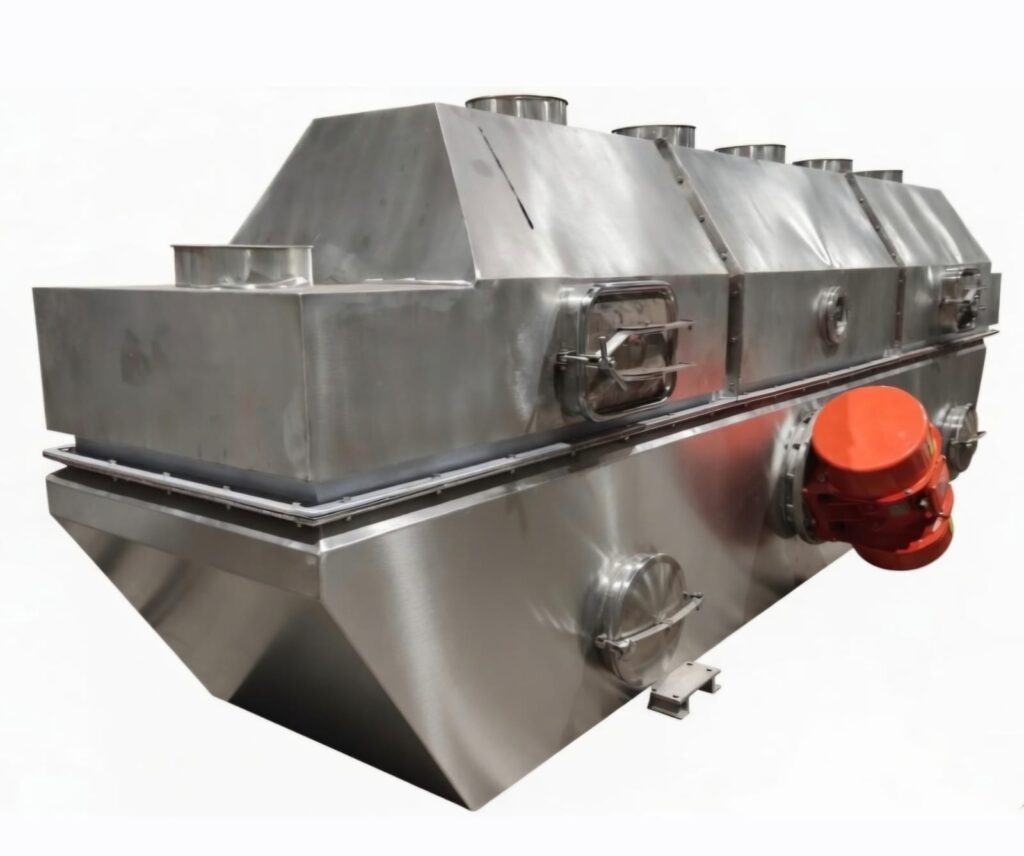
It is a product-quality and production-capacity decision.
India’s Desiccated Coconut Opportunity Is Expanding
India is becoming increasingly important in value-added coconut processing.
According to the Coconut Development Board’s 2024-25 annual report, India’s desiccated coconut exports increased from 2,415 MT in 2023-24 to 8,195 MT in 2024-25. Export value increased from approximately ₹36 crore to ₹163 crore over the same period.
That is a significant change in the market landscape.
Indian coconut processors are increasingly looking beyond:
Fresh Coconut → Copra → Coconut Oil
towards higher-value products such as:
Desiccated Coconut → Low-Fat Desiccated Coconut → Coconut Flour → Coconut Powder → Coconut Ingredients
For manufacturers moving into these products, industrial drying becomes a critical process step.
What Is Low-Fat Desiccated Coconut?
Low-fat desiccated coconut is a processed coconut ingredient with reduced fat/oil content compared with conventional full-fat desiccated coconut.
It can be used in applications where manufacturers require a coconut ingredient with a different nutritional profile, functional behaviour or formulation requirement.
Potential applications include:
- Bakery products
- Biscuits
- Cakes
- Cookies
- Confectionery
- Cereals
- Snack products
- Nutritional foods
- Health-food formulations
- Coconut flour and ingredient production
- Food premixes
The exact fat specification depends on the customer’s product definition and processing route.
Therefore, a dryer should be designed from the actual feed characteristics, rather than simply from the description “low-fat coconut.”
Why Drying Low-Fat Coconut Requires Process Control
A commercial coconut dryer must deal with several variables simultaneously.
Feed moisture
Determines the total evaporation duty.
Particle size
Fine coconut, medium coconut and coarse coconut do not dry in exactly the same way.
Fat content
Changes product handling and drying behaviour.
Bulk density
Influences fluidization and airflow requirements.
Final moisture
Must meet the customer’s product specification.
Product temperature
Must remain within an appropriate process window.
Residence time
Controls how long the material remains under drying conditions.
Airflow
Determines the heat and mass transfer environment.
This is why a successful industrial dryer cannot be selected only by saying:
“We need a coconut dryer for X tonnes per day.”
The dryer needs to be engineered around the complete material balance and product specification.
Why Use a Vibratory Fluid Bed Dryer?
A Vibratory Fluid Bed Dryer combines two mechanisms:
Fluidization + Vibration
Heated air passes upward through a perforated bed while mechanical vibration moves the product through the dryer.
This creates:
- Strong air-product contact
- Uniform heat transfer
- Controlled product movement
- Improved moisture distribution
- Adjustable residence time
- Reduced channeling
- Continuous operation
GTI’s VFBD systems are designed for uniform drying, controlled final moisture, efficient heat transfer, gentle handling and continuous industrial operation.
For suitable low-fat coconut particles, these characteristics can make VFBD technology particularly attractive for continuous production.
How a VFBD Dries Low-Fat Desiccated Coconut
The process can be visualized as:
Wet Low-Fat Coconut
↓
Controlled Feeding
↓
Vibratory Fluidized Bed
↓
Hot Air Distribution
↓
Moisture Evaporation
↓
Progressive Moisture Reduction
↓
Final Moisture Equalization
↓
Cooling
↓
Screening / Grading
↓
Packaging
The coconut enters the perforated vibrating bed.
As conditioned hot air passes through the product layer, particles become partially or fully fluidized depending on their physical properties.
The vibration continuously moves the product forward.
At the same time:
Heat transfers to the particles → moisture migrates to the surface → moisture evaporates → exhaust air carries moisture away.
The process continues until the required moisture level is achieved.
Why Vibration Matters
A conventional fluid bed relies primarily on airflow to suspend and move particles.
A vibratory fluid bed adds controlled mechanical movement.
This can help with:
Product transportation
The product can move progressively through the dryer without requiring excessive air velocity.
Residence-time control
Vibration parameters can be adjusted according to the desired residence time.
Reduced channeling
Mechanical movement can help maintain more consistent product distribution.
Gentle handling
The product can be transported through the dryer under controlled conditions.
Moisture uniformity
Continuous movement combined with fluidization promotes repeated contact between product particles and drying air.
GTI specifically identifies controlled residence time, reduced agglomeration, uniform moisture levels and gentle product handling as benefits of its VFBD systems.
Where Does VFBD Fit in a Low-Fat Coconut Plant?
A typical processing concept may look like:
Coconut
→ Dehusking
→ Shelling
→ Paring
→ Washing
→ Shredding
→ Oil/Fat Reduction Process
→ Low-Fat Coconut Feed
→ VFBD Drying
→ Cooling
→ Screening
→ Grading
→ Packaging
→ Export
The actual process sequence varies depending on how the low-fat coconut is produced.
GTI therefore approaches the dryer as part of the overall process line, rather than as an isolated machine.
VFBD vs Band Dryer for Low-Fat Coconut
Both technologies can be relevant, but their operating principles are different.
| Parameter | VFBD | Band Dryer |
| Drying mechanism | Fluidization + vibration | Conveyed hot-air drying |
| Product movement | Vibratory | Belt movement |
| Air-product contact | Very high | Controlled through bed |
| Continuous operation | Yes | Yes |
| Moisture control | High | High |
| Suitable for particulate materials | Excellent where fluidization is suitable | Excellent |
| Residence-time control | Vibration + airflow | Belt speed + zones |
| Large-capacity processing | Yes | Yes |
| Fine particulate products | Product-dependent | Product-dependent |
| Best selection | Based on feed behaviour | Based on feed behaviour |
The important point is that VFBD should not automatically be considered superior to a band dryer for every coconut product.
Technology selection should be based on:
- Particle size
- Bulk density
- Moisture
- Fat content
- Feed behaviour
- Required capacity
- Final moisture
- Product quality
- Residence time
GTI manufactures both fluidized-bed and band-drying systems for coconut applications.
When Should a Processor Consider VFBD?
VFBD becomes particularly interesting when the coconut product:
- Can be effectively fluidized
- Requires continuous drying
- Requires controlled residence time
- Needs uniform moisture removal
- Is supplied as particulate material
- Requires efficient heat transfer
- Needs automated movement through the dryer
- Requires scalable production
The final decision should be confirmed through process evaluation and, where appropriate, trials.
Low-Fat Coconut: What Should the Dryer Control?
A commercial VFBD system should provide control over several parameters.
1. Air Temperature
The drying-air temperature should be matched to the product and process requirement.
2. Airflow
Airflow must be sufficient for effective fluidization without creating unnecessary product carryover.
3. Vibration
Vibration influences product movement and residence time.
4. Bed Depth
Bed depth influences pressure drop, air distribution and drying performance.
5. Feed Rate
An inconsistent feed rate can produce inconsistent moisture.
6. Residence Time
Residence time determines the exposure period.
7. Exhaust Conditions
Exhaust temperature and humidity provide valuable information about drying progress.
8. Final Moisture
The final moisture target should be based on the customer’s product specification rather than a generic number.
Why Final Moisture Uniformity Matters
Imagine a production batch where:
Part A = adequately dried
but
Part B = still carrying excess moisture.
The average laboratory result may appear acceptable, but the product may still have quality variation.
Uneven drying can contribute to:
- Shelf-life problems
- Clumping
- Packaging issues
- Microbial-risk concerns
- Product rejection
- Inconsistent downstream processing
This is why moisture uniformity, not simply average moisture, is an important dryer-design consideration.
GTI’s VFBD design focuses on uniform airflow and controlled movement to support consistent moisture removal.
The GTI Approach: Dry the Product, Not Just the Moisture
GTI Dryers’ engineering approach begins with the material.
Before selecting a VFBD, the key questions include:
What is the incoming moisture?
What is the target final moisture?
What is the fat content?
What is the particle-size distribution?
What is the bulk density?
What is the required production rate?
How does the product behave under fluidization?
Is the product prone to sticking or agglomeration?
What is the required residence time?
What heat source is available?
Is cooling required before packaging?
These parameters determine whether VFBD alone is appropriate or whether another configuration should be considered.
GTI’s VFBD Engineering for Coconut Applications
GTI Dryers manufactures Vibratory Fluidised Bed Dryers for powders, granules and particulate materials across food and other process industries. The technology uses a perforated vibrating bed, controlled hot-air flow and adjustable vibration to achieve continuous moisture removal.
For coconut processing, the system can be engineered around:
- Food-grade construction
- Controlled airflow
- Multiple drying zones where required
- Adjustable vibration
- Controlled residence time
- Efficient air distribution
- Product cooling
- Powder/fines collection
- Exhaust-air handling
- Automated temperature control
- Moisture monitoring options
- Continuous operation
The final equipment configuration depends on the product and project specification.
Food Hygiene Is Part of Dryer Design
A coconut dryer operates in a food-processing environment.
Therefore, the equipment design should consider:
- Appropriate product-contact materials
- Hygienic surfaces
- Cleaning accessibility
- Air filtration
- Product contamination prevention
- Inspection access
- Maintenance access
- Condensation prevention
- Dust management
- Food-safety requirements
For export-oriented plants, these considerations become even more important because customers may have specific supplier and food-safety requirements.
GTI’s coconut drying systems are positioned for hygienic processing and export-oriented production.
India’s Low-Fat Coconut Opportunity
India is an important market for this technology for two reasons.
First, India has a large coconut-processing ecosystem.
Second, the country is increasingly moving toward value-added coconut products.
The increase in India’s desiccated coconut exports—from 2,415 MT to 8,195 MT between FY2023-24 and FY2024-25—shows the scale of recent growth in this specific product category.
For GTI, potential Indian customers include:
- Desiccated coconut manufacturers
- Coconut oil processors
- Food ingredient manufacturers
- Coconut exporters
- Coconut flour manufacturers
- Bakery ingredient suppliers
- Nutraceutical ingredient manufacturers
- Integrated coconut-processing plants
Indian GEO Keywords
English
- Low Fat Desiccated Coconut Dryer India
- VFBD Dryer for Coconut India
- Coconut Dryer Manufacturer India
- Fluid Bed Dryer for Coconut
- Desiccated Coconut Drying Machine India
Regional opportunity clusters
- Kerala
- Tamil Nadu
- Karnataka
- Andhra Pradesh
- Odisha
- Maharashtra
- Other coconut-processing and food-manufacturing regions
Indonesia: A Major Target Market for GTI
Indonesia should be one of GTI’s priority international GEO markets.
The country is one of the world’s major coconut exporters, and 2024 data from the United Coconut Association of the Philippines shows Indonesia exported approximately 119,229 MT of desiccated coconut, representing about 35.8% of the combined exports of the Philippines, Indonesia and Sri Lanka in that dataset.
GTI also lists a substantial group of Indonesian food and coconut-processing companies among its clients, including companies such as Mayora Group, Indofood, PT Royal Coconut and others.
Indonesian Search Intent
Target:
- Low Fat Desiccated Coconut Dryer Indonesia
- VFBD Dryer Indonesia
- Coconut Dryer Machine Indonesia
- Fluid Bed Dryer for Coconut Indonesia
- Mesin Pengering Kelapa
- Mesin Pengering Kelapa Parut
- Mesin Fluid Bed Dryer
- Mesin Pengering Kelapa Industri
This is an important GEO market because the searcher can be both:
coconut processor + equipment buyer.
Philippines: One of the World’s Major Desiccated Coconut Exporters
The Philippines is an especially important market for coconut-processing equipment.
In 2024, the Philippines exported approximately 173,171 MT of desiccated coconut, accounting for 52.1% of the combined exports reported for the Philippines, Indonesia and Sri Lanka.
GTI’s client portfolio also includes multiple Philippine coconut processors, including Franklin Baker, Primex Coco Products, Celebes Coconut Corporation, Superstar Coconut Products and Century Agriculture Corporation.
Target Keywords
- Low Fat Desiccated Coconut Dryer Philippines
- VFBD Coconut Dryer Philippines
- Fluid Bed Dryer Philippines
- Coconut Processing Equipment Philippines
- Industrial Coconut Dryer Philippines
- Desiccated Coconut Drying Machine Philippines
This market is particularly valuable for large-scale coconut processors and exporters.
Sri Lanka: Another Strong Coconut-Processing Market
Sri Lanka exported approximately 40,250 MT of desiccated coconut in 2024, according to the United Coconut Association of the Philippines’ compilation of major producer-exporter data.
GTI also lists numerous Sri Lankan coconut-related companies among its clients.
Target Keywords
- Low Fat Coconut Dryer Sri Lanka
- Desiccated Coconut Dryer Sri Lanka
- VFBD Dryer Sri Lanka
- Coconut Processing Machinery Sri Lanka
- Industrial Coconut Dryer Sri Lanka
Vietnam: A Strong Southeast Asian Processing Market
Vietnam is relevant both as a coconut-producing country and as a food-processing market.
GTI’s client portfolio includes several Vietnamese coconut and food-processing companies, including Asia Coconut Processing, Trabac Corporation, Hungphu and other processors.
Target Keywords
- Coconut Dryer Vietnam
- Low Fat Desiccated Coconut Dryer Vietnam
- VFBD Dryer Vietnam
- Coconut Processing Equipment Vietnam
- Máy sấy cơm dừa
- Máy sấy dừa công nghiệp
- Máy sấy tầng sôi rung
Thailand and Malaysia
Thailand and Malaysia are also relevant target markets for coconut-processing equipment because of their established food-processing industries and coconut-related manufacturing.
GTI lists customers in Thailand, including C & A Products and Merit Food Products.
Target Keywords
- Coconut Dryer Thailand
- VFBD Dryer Thailand
- Desiccated Coconut Dryer Thailand
- Coconut Dryer Malaysia
- Industrial Coconut Drying System Malaysia
Where Is the Demand for Desiccated Coconut?
The production countries are not necessarily the same as the biggest consuming markets.
This distinction is important for GTI’s international SEO strategy.
Recent trade data for desiccated coconut identified the USA, Netherlands and China as leading buyers in August 2024, followed by markets including Germany, Canada, Australia, the UK and Russia.
A July 2025 trade update again identified the USA, Netherlands and China as the top three markets in that particular month’s trade data, followed by Turkey, Australia, Germany, Russia and the UK.
Therefore GTI should target two different buyer groups:
Production / Equipment Markets
- India
- Indonesia
- Philippines
- Sri Lanka
- Vietnam
- Thailand
- Malaysia
Consumption / Import / Food-Processing Markets
- USA
- Netherlands
- China
- Germany
- Turkey
- Australia
- UK
- Canada
- Russia
- Brazil
This distinction is important because a country can be a major buyer of desiccated coconut without being a major coconut producer.
USA: A Major End-Market to Target
The United States should be an important GEO target for GTI’s coconut-processing equipment content.
The USA was the largest buyer in the cited monthly desiccated-coconut trade data, taking 4,797 MT in August 2024, or 28.5% of the month’s reported purchases.
For GTI, the opportunity is not necessarily only US coconut growers.
Target:
- Food ingredient manufacturers
- Coconut importers
- Bakery ingredient manufacturers
- Confectionery manufacturers
- Coconut processors
- Contract food manufacturers
- Nutritional food manufacturers
SEO Keywords
- Low Fat Desiccated Coconut Dryer USA
- Coconut Dryer Machine USA
- Industrial Coconut Dryer
- Desiccated Coconut Processing Equipment
- Coconut Drying System Manufacturer
Netherlands: An Important European Target
The Netherlands was the second-largest buyer in the August 2024 trade data cited above, with 3,083 MT or 18.3% of purchases in that month.
The Netherlands is also an important European trading and distribution location.
For GTI, target:
- Coconut importers
- Food ingredient companies
- Industrial food processors
- Private-label food manufacturers
- Ingredient distributors
Keywords
- Coconut Dryer Netherlands
- Desiccated Coconut Dryer Europe
- Low Fat Coconut Drying System
- Industrial Coconut Processing Equipment Europe
- VFBD Dryer Europe
Germany, UK, Australia, Canada and Turkey
These markets should form a second layer of international SEO targeting.
The cited 2024 trade data identifies Germany, Canada, Australia, the UK and Turkey among important desiccated-coconut buyers.
GTI can build country-specific supporting pages around:
Germany
Low Fat Desiccated Coconut Dryer Germany
UK
Coconut Dryer Machine UK
Australia
Desiccated Coconut Dryer Australia
Canada
Coconut Processing Equipment Canada
Turkey
Industrial Coconut Dryer Turkey
The country pages should not simply duplicate this pillar page.
Each should include:
- Local industry context
- Import/processing opportunity
- Applicable coconut products
- Local terminology
- Equipment requirements
- GTI export capability
- Project enquiry CTA
GTI’s Existing Coconut Industry Experience
GTI’s coconut client portfolio is particularly useful for commercial positioning.
The company’s published client list includes coconut and food-processing companies in:
- India
- Indonesia
- Philippines
- Sri Lanka
- Vietnam
- Thailand
- USA
- Mexico
- Mozambique
- Côte d’Ivoire
and other markets.
This provides a stronger sales story than simply saying:
“We manufacture coconut dryers.”
The message becomes:
GTI Dryers has experience serving coconut-processing businesses across multiple international markets.
That is particularly relevant to buyers evaluating an overseas equipment supplier.
Why Choose GTI for Low-Fat Coconut Drying?
1. Product-Specific Engineering
GTI does not size the dryer only from production capacity.
The design considers:
- Moisture
- Particle size
- Fat content
- Bulk density
- Feed rate
- Final moisture
- Drying characteristics
2. VFBD Expertise
GTI manufactures Vibratory Fluidised Bed Dryers for particulate products requiring controlled continuous drying.
3. Coconut-Specific Experience
GTI’s coconut portfolio covers:
- Desiccated coconut
- Coconut flakes
- Coconut chips
- Coconut powder
- Coconut flour
- Coconut milk powder
- Coconut cake
- Coir and coconut by-products
4. International Customer Base
GTI’s published client portfolio includes coconut processors across Asia, Africa, North America and other markets.
5. Complete Drying Engineering
Depending on project scope, GTI can support:
- Process engineering
- Dryer manufacturing
- Plant layout
- Automation
- Air-handling systems
- Product conveying
- Installation
- Commissioning
- Process optimization
GTI describes its coconut systems as available with process design, equipment manufacturing, plant layout, installation/commissioning and automation support.
VFBD for Low-Fat Coconut: The Commercial Advantage
For a growing coconut processor, the objective is not simply to buy a dryer.
The objective is to build a production system that can consistently produce:
The Right Moisture
The Right Texture
The Right Colour
The Right Capacity
The Right Energy Consumption
The Right Export Quality
That is why dryer selection should be treated as a process-engineering decision.
When a Combination Dryer May Be Better
Although VFBD can be highly suitable for particulate low-fat coconut, some plants may benefit from combining drying technologies.
For example:
Band Dryer → VFBD Finishing
or
VFBD → Cooling → Packaging
The correct arrangement depends on:
- Initial moisture
- Product form
- Production capacity
- Required residence time
- Final moisture
- Particle characteristics
- Energy integration
GTI manufactures both band and fluidized-bed systems and can evaluate combination configurations for suitable coconut applications.
What Information Does GTI Need for a VFBD Proposal?
A buyer should provide:
Product Information
- Low-fat desiccated coconut
- Particle size
- Bulk density
- Fat content
- Product temperature
Moisture Information
- Initial moisture
- Final moisture
- Moisture removal requirement
Production Information
- kg/hour
- MT/day
- Operating hours
- Continuous/batch requirement
Plant Information
- Available heat source
- Steam/gas/biomass/electric heating
- Electricity availability
- Factory location
- Ambient conditions
Quality Information
- Colour requirement
- Texture
- Final moisture specification
- Food-grade requirements
- Packaging requirement
Commercial Information
- New plant or expansion
- Existing dryer, if any
- Target market
- Required delivery schedule
- Desired automation level
Common Questions About VFBD for Low-Fat Desiccated Coconut
What is a Vibratory Fluid Bed Dryer?
A Vibratory Fluid Bed Dryer uses controlled vibration together with upward-flowing heated air to move and dry particulate materials continuously. The combination promotes air-particle contact, controlled residence time and uniform moisture removal.
Can VFBD be used for low-fat desiccated coconut?
It can be considered where the low-fat coconut feed has suitable particle and bulk properties for fluidization. Final suitability should be confirmed from actual product characteristics and process trials.
What is the advantage of VFBD over conventional drying?
VFBD can provide efficient heat and mass transfer, continuous product movement, controlled residence time and uniform drying for suitable particulate products.
Is VFBD better than a band dryer for coconut?
Neither technology is universally better. VFBD is attractive for suitable particulate products requiring efficient fluidization, while band dryers are highly suitable for continuous staged drying of coconut gratings and other products. GTI manufactures both technologies.
Can GTI supply a low-fat coconut dryer in India?
Yes. GTI designs and manufactures industrial coconut drying systems in India and supports customized solutions based on product and plant requirements.
Does GTI export coconut dryers?
GTI’s published customer portfolio includes coconut and food-processing companies across Indonesia, Philippines, Sri Lanka, Vietnam, Thailand, USA, India and other countries.
Can the VFBD be integrated with cooling?
Yes. A cooling section can be integrated or designed downstream depending on the product, packaging temperature and process requirements.
Can GTI design a complete coconut drying plant?
GTI provides process design, dryer manufacturing, plant layout, automation and installation/commissioning support depending on project scope.
The Future of Coconut Processing Is Moving Toward Value Addition
The coconut industry is changing.
Instead of exporting only raw or minimally processed coconut, processors can create higher-value ingredients:
Coconut
→
Desiccated Coconut
→
Low-Fat Desiccated Coconut
→
Coconut Flour
→
Coconut Powder
→
Coconut Protein / Functional Ingredients
→
Specialty Coconut Products
Drying sits at the centre of many of these value-added processes.
And for low-fat desiccated coconut, uniform and controlled drying can become a key part of commercial production.
Build Your Low-Fat Coconut Drying Plant with GTI Dryers
If you are planning:
- A new low-fat desiccated coconut plant
- A coconut processing expansion
- A capacity increase
- A replacement for batch drying
- A continuous coconut drying line
- An export-oriented coconut processing facility
- A VFBD-based coconut drying system
- A combination band + VFBD system
GTI Dryers can evaluate the process and recommend an appropriate drying configuration.
Send GTI Your Process Data
Product: Low-Fat Desiccated Coconut
Initial Moisture: ______
Final Moisture: ______
Fat Content: ______
Particle Size: ______
Production Capacity: ______
Operating Hours: ______
Heat Source: ______
Plant Location: ______
From these parameters, GTI’s engineering team can evaluate the appropriate VFBD, Band Dryer or Combination Drying System.
GTI Dryers
Industrial Coconut Drying Systems | Vibratory Fluid Bed Dryers | Band Dryers | Combination Dryers
Engineered in India. Designed for Global Coconut Processing.
Talk to GTI Dryers about your Low-Fat Desiccated Coconut Drying Project.