
Build Consistent, Export-Grade Desiccated Coconut with the Right Drying Technology
Global demand for desiccated coconut is creating new opportunities for coconut processors in India, Indonesia, the Philippines, Sri Lanka, Vietnam, and other producing regions. But entering demanding export markets takes more than access to coconuts. Buyers expect consistent moisture, clean colour, natural aroma, controlled particle quality, hygienic processing, and dependable supply from batch to batch.
The dryer is at the centre of achieving these outcomes.
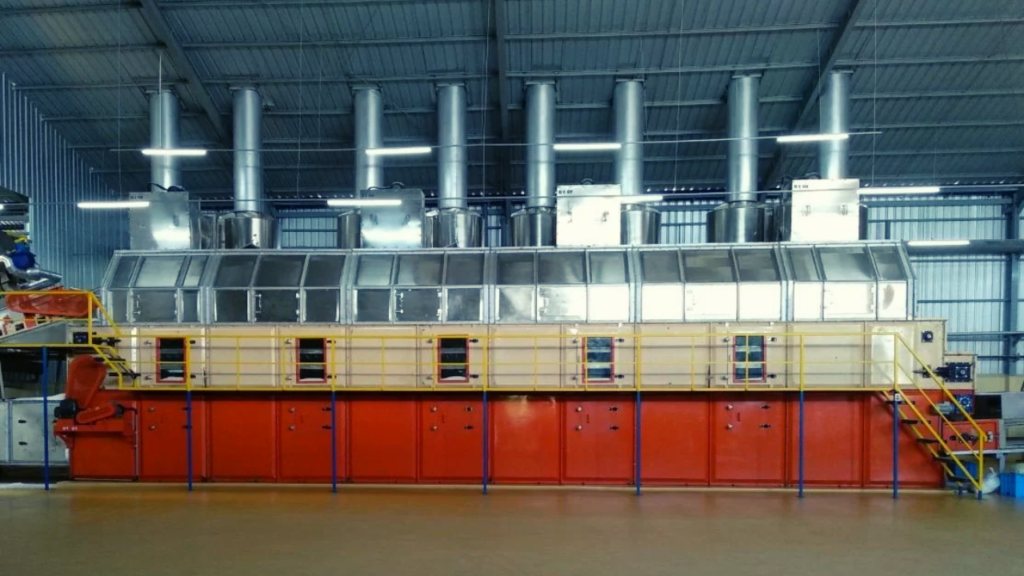
At Genex Tech Industries LLP (GTI), we design and manufacture industrial drying systems and turnkey processing solutions for coconut and other food products. Our Combination Fluid Bed Dryers and Band Dryers can be engineered around the processor’s raw material, product grade, required output, available heat source, plant layout, and destination-market requirements.
Whether you are planning a new desiccated coconut factory, increasing the capacity of an existing line, or improving product consistency for export, GTI can help you select a drying system based on the actual process requirement rather than a one-size-fits-all machine.
Planning a coconut drying project? Share your wet feed rate, incoming and required final moisture, product size, heat source, operating hours, and destination market with the GTI engineering team for an application-specific recommendation.
Why Global Demand Makes Desiccated Coconut Processing an Attractive Opportunity
Desiccated coconut is widely used in:
- Biscuits, cakes, bakery fillings, and toppings
- Chocolate, confectionery, and snack products
- Breakfast cereals and granola
- Ice cream and dairy applications
- Plant-based, vegan, gluten-free, and keto-positioned foods
- Ready mixes, sauces, curries, and Asian cuisine
- Food-service and retail ingredient packs
According to the Observatory of Economic Complexity (OEC), international trade in desiccated coconuts under HS 080111 reached approximately US$798 million in 2024, up 13.6% from 2023. The United States was the largest importer by value, followed by the Netherlands and Germany. The Philippines, Indonesia, and Sri Lanka were the three leading exporters reported by OEC for that year.
Europe is especially important. The Centre for the Promotion of Imports from developing countries (CBI) identifies the Netherlands, Germany, the United Kingdom, Poland, France, and Belgium as leading European import markets. It also notes demand drivers including bakery and confectionery use, Asian cuisine, plant-based foods, and gluten-free and keto diets.
For machinery investors, this creates a two-sided opportunity:
- Consumer-market demand is concentrated in the United States and major European and Asian food markets.
- Dryer and processing-equipment demand is strongest in coconut-producing countries that need to convert fresh kernels into stable, higher-value export ingredients.
This distinction matters. GTI’s best machinery prospects are processors located near coconut production, while those processors ultimately sell into high-demand importing markets.
Which Countries Should Coconut Dryer Manufacturers Target?
Established Coconut-Processing and Export Hubs
Indonesia
Indonesia is one of the world’s leading desiccated coconut exporters. Its large coconut base and established ingredient-export sector make it an important market for:
- New continuous processing lines
- Replacement of inefficient or ageing dryers
- Capacity expansion
- Energy optimisation
- Flexible plants producing multiple grades
- Export-quality and hygiene upgrades
A Combination Fluid Bed Dryer can be attractive to processors seeking staged drying and final moisture equalisation, while a Band Dryer can suit gentle, continuous drying of oil-rich gratings, threads, flakes, and chips.
Philippines
The Philippines was the largest desiccated coconut exporter by value in the OEC’s 2024 data. Its mature processing industry creates demand for high-throughput systems, modern controls, heat recovery, dependable spare support, and retrofit engineering.
GTI can address greenfield plants as well as processors seeking to improve line availability, moisture consistency, and operating cost per kilogram.
Sri Lanka
Sri Lanka has a strong reputation in value-added coconut products and was among the top global exporters in 2024. Opportunities include premium product lines, high-fat desiccated coconut, coconut chips, organic production, and plants serving buyers with strict quality specifications.
Gentle temperature control, hygienic contact parts, careful airflow design, and repeatable residence time are particularly valuable for premium applications.
India
India is a major coconut-producing nation with growing capacity in value-added coconut products. It offers GTI a strong domestic base for:
- First-time industrial processors
- Regional brands moving into B2B ingredients
- Export-oriented greenfield plants
- Cooperatives and integrated coconut projects
- Existing factories upgrading from batch to continuous drying
India should be positioned as a growth market with significant processing potential, rather than described as the world’s largest desiccated coconut exporter. That claim is not supported by the 2024 HS 080111 trade ranking.
Vietnam
Vietnam’s growing food-processing and agricultural-export capabilities make it a promising market for modular and scalable coconut processing equipment. Buyers may value compact layouts, automation, flexible heating options, and machinery that can support more than one coconut format.
Emerging Coconut-Processing Markets
GTI should also prospect in coconut-growing regions where more raw material can be converted locally into exportable products:
- Côte d’Ivoire, Ghana, Nigeria, Tanzania, Mozambique, and Kenya
- Papua New Guinea and other Pacific producing regions
- Brazil and selected Latin American coconut regions
- Malaysia and Thailand
The sales message for these markets should focus on local value addition, reduction of post-harvest losses, employment, export diversification, phased capacity growth, training, and turnkey project execution.
End Markets That Support the Investment Case
Processors evaluating a new dryer should study buyer demand in:
- United States: the largest importer by value in OEC’s 2024 data
- Netherlands: a major European entry and re-export hub
- Germany: a large food-manufacturing and ingredient market
- United Kingdom, Poland, France, and Belgium: important European markets identified by CBI
- China and Russia: large net-import markets in OEC’s 2024 trade-balance data
A machinery proposal becomes more persuasive when it links dryer performance to the requirements of these destination markets: consistency, food safety, traceability, shelf stability, and predictable supply.
Why Drying Is the Critical Control Point in Desiccated Coconut Production
Fresh coconut gratings contain substantial moisture and natural oil. Poorly controlled drying may cause:
- Uneven final moisture or wet pockets
- Yellowing, scorching, or loss of natural appearance
- Oil migration and clumping
- Reduced aroma and flavour quality
- Inconsistent bulk density
- Shorter shelf life
- Higher microbial and storage risk
- Buyer complaints or rejected shipments
- Excess fuel consumption and low plant profitability
A properly engineered industrial coconut dryer must coordinate feed distribution, bed depth, air temperature, airflow, humidity removal, residence time, product movement, and cooling.
Drying parameters should never be copied blindly from another plant. Coconut variety, maturity, particle size, fat level, blanching conditions, wet feed moisture, ambient humidity, and desired product specification can all change the drying behaviour.
GTI therefore recommends product-based engineering and, where appropriate, drying trials before final equipment sizing.
Combination Fluid Bed Dryer for Desiccated Coconut
A Combination Fluid Bed Dryer is a hybrid system that integrates controlled tray-based drying with a fluidised-bed finishing zone. The objective is to combine gentle staged moisture removal with rapid final equalisation.
How the Combination Dryer Works
- Uniform feeding: Wet coconut is spread across the full working width.
- Controlled pre-drying: Moving trays carry the product through initial drying zones, helping remove moisture without exposing the material to uncontrolled heat.
- Intermediate staged drying: Temperature, airflow, and residence time are managed as moisture falls.
- Fluid-bed finishing: The product enters a fluidised zone for more uniform particle contact with the drying air and final moisture equalisation.
- Controlled discharge: Dried product moves to downstream cooling, grading, and packing as required by the line design.
Advantages for Coconut Processors
- Staged drying for better process control
- Improved final-moisture uniformity
- Reduced risk of localised wet material
- Better control of colour, texture, and bulk density
- Lower tendency toward clumping when correctly engineered
- Continuous or semi-continuous production options
- Adjustable residence time with variable-speed drives
- Insulated chambers and optimised air distribution
- Optional dust collection, automation, and heat recovery
- Flexibility for processors producing different coconut grades
When to Consider a Combination Fluid Bed Dryer
A Combination Dryer may be a strong option when:
- The factory needs tighter final-moisture consistency
- The product benefits from gentle initial drying and faster finishing
- One plant must handle more than one coconut format or fat profile
- The processor wants staged control within a single integrated system
- Export customers require repeatable product quality
Final suitability depends on the product’s fluidisation behaviour. Very light, sticky, irregular, or oil-rich materials require careful testing and airflow design.
Explore GTI Combination Fluid Bed Dryers
Band Dryer for Desiccated Coconut
A Band Dryer, also called a Belt Dryer or Apron Dryer, continuously transports wet material through controlled drying zones on a perforated belt or apron.
How the Band Dryer Works
- A feeder distributes coconut gratings at a controlled and uniform bed depth.
- The moving band carries the product through multiple drying zones.
- Conditioned hot air passes through the product bed.
- Zone temperatures, airflow, and exhaust can be adjusted as moisture decreases.
- Belt speed controls residence time.
- The product is discharged continuously for cooling, grading, metal detection, or packing.
Advantages for Coconut Processors
- Gentle handling with limited product agitation
- Continuous operation for industrial production
- Multi-zone temperature and airflow control
- Adjustable bed depth and belt speed
- Suitability for gratings, threads, flakes, and chips
- Scalable design for different production capacities
- Food-grade SS304 or SS316 contact-part options
- PLC or SCADA automation options
- Multiple heating-source possibilities
- Heat recovery and air-recirculation options
When to Consider a Band Dryer
A Band Dryer is often attractive when:
- The product is delicate, oil-rich, or sensitive to aggressive movement
- The desired format includes threads, flakes, chips, or larger particles
- A longer, controlled residence time is useful
- The plant requires high-capacity continuous production
- Product integrity and gentle handling are important
Explore GTI Band and Apron Dryers
Combination Fluid Bed Dryer vs. Band Dryer
| Selection factor | Combination Fluid Bed Dryer | Band Dryer |
|---|---|---|
| Drying approach | Tray-based staged drying plus fluid-bed finishing | Product moves continuously on a perforated band through controlled zones |
| Product movement | Controlled tray transport with active finishing | Relatively gentle transport with limited agitation |
| Key strength | Final moisture equalisation and process flexibility | Gentle, continuous, multi-zone drying |
| Typical fit | Granules, powders, and products that fluidise reliably; flexible plants | Oil-rich gratings, threads, flakes, chips, and delicate formats |
| Residence-time control | Tray movement and fluid-bed parameters | Belt speed, bed depth, and dryer length |
| Capacity | Custom engineered | Custom engineered and readily scalable for continuous output |
| Dust considerations | Requires application-specific fluidisation and dust control | Generally lower particle entrainment, depending on air velocity and product |
| Best choice | Determined by trials, feed data, product grade, and quality target | Determined by trials, feed data, product grade, and quality target |
The correct decision is not simply “Fluid Bed or Band Dryer?” It is:
Which airflow, temperature profile, residence time, handling method, construction standard, and control strategy will deliver the required product at the lowest sustainable processing cost?
GTI engineers the answer around the application.
High-Fat and Low-Fat Desiccated Coconut Require Different Thinking
High-Fat Desiccated Coconut
High-fat coconut retains more natural oil and needs gentle thermal treatment. Uncontrolled temperature or rough handling can contribute to oil migration, clumping, discolouration, and flavour deterioration.
A carefully configured Band Dryer is often well suited to this duty because it can provide gentle product movement and staged temperature control. However, the final choice should be validated with actual feed material and the buyer’s product specification.
Low-Fat Desiccated Coconut
Low-fat coconut is produced after part of the oil is mechanically removed. Its lighter and more porous structure can dry differently and may be more suitable for rapid, uniform air contact.
A fluidised-bed or Combination Dryer may offer advantages where the particle characteristics support stable fluidisation. Dust capture and air velocity become important design considerations.
Flexible Multi-Product Plants
Processors planning to produce high-fat and low-fat grades, as well as flakes, chips, or granules, should discuss:
- Product-change requirements
- Cleaning time
- Airflow operating range
- Residence-time flexibility
- Dust recovery
- Feed-system changes
- Cooling requirements
- Automation recipes
A hybrid or multi-stage solution can sometimes provide better flexibility than forcing every product through one fixed drying profile.
What an Export-Oriented Coconut Dryer Should Include
1. Hygienic Construction
Product-contact areas may be offered in SS304 or SS316, depending on the application. The design should support access for inspection and cleaning, minimise product traps, and fit the plant’s sanitation programme.
2. Uniform Product Feeding
Even the best dryer cannot compensate for uncontrolled loading. A properly selected feeder and spreader help maintain consistent bed depth across the dryer width.
3. Multi-Zone Process Control
The wettest product and nearly dry product should not necessarily receive the same thermal treatment. Independent zone control can improve quality and energy performance.
4. Suitable Heating System
GTI can engineer systems around available utilities, including steam, thermic fluid, electric heating, or a hot-air generator. Fuel availability, food-safety policy, energy price, and maintenance capability should guide the choice.
5. Air Recirculation and Heat Recovery
Dryer efficiency depends on more than burner efficiency. Insulation, recirculated air, exhaust control, fan selection, duct design, and optional heat recovery can all influence energy consumed per kilogram of water removed.
6. Automation and Data Visibility
PLC and SCADA options can help operators control temperatures, airflow, pressure, feed rate, belt or tray speed, and alarms. Recipe-based control can improve repeatability across product grades.
7. Dust and Fine-Particle Management
Fine low-fat coconut can become airborne if velocity and separation equipment are not designed correctly. Cyclones, filters, or other collection systems may be incorporated based on the product and local emission requirements.
8. Cooling Before Packing
Hot product should not be packed without considering condensation and moisture migration. An integrated cooling stage can help stabilise the product before grading and packing.
9. Export-Ready Electrical and Documentation Package
International projects may require adaptation for site voltage and frequency, local conditions, documentation, shipping, installation, commissioning, and operator training.
From Coconut Kernel to Finished Product: A Typical Processing Line
A complete desiccated coconut line may include:
- Coconut reception and inspection
- Dehusking and deshelling
- Paring and washing
- Cutting, grinding, or shredding
- Blanching or another validated microbial-control step
- Dewatering or oil extraction, where applicable
- Uniform feeding and spreading
- Controlled drying
- Cooling
- Sieving and size grading
- Metal detection and quality checks
- Hygienic packing
GTI can support the dryer as a standalone machine or engineer it as part of a broader turnkey processing solution. The final line must be configured around the processor’s product range, food-safety plan, capacity, utilities, labour model, and intended market.
Why Coconut Processors Choose Genex Tech Industries
GTI brings process engineering and manufacturing capability together for food, agro, pharmaceutical, and chemical applications.
Based on GTI’s published company information, customers can benefit from:
- Engineering and manufacturing experience dating from 1985
- ISO 9001:2015 certification stated on the company website
- CE-marked machinery options and engineering for global requirements
- In-house manufacturing and fabrication capability
- Custom-built dryers instead of catalogue-only selection
- Experience with food-grade materials and hygienic design
- Multiple heating and automation options
- Turnkey project capability from concept to commissioning
- Overseas project and installation experience across multiple regions
- After-sales service and spare-parts support
Every project should be evaluated individually. Capacity, energy consumption, finished-product quality, and compliance should be confirmed in the final technical proposal and agreed performance terms.
Information Needed for an Accurate Dryer Proposal
To receive a meaningful technical recommendation and quotation, provide:
- Product type: high-fat or low-fat desiccated coconut
- Format: fine, medium, thread, flake, chip, or granule
- Wet feed capacity in kg/hour
- Incoming moisture percentage and measurement basis
- Required final moisture and buyer specification
- Operating hours per day and days per year
- Available heat source and local energy cost
- Ambient temperature and humidity
- Preferred construction material
- Available floor space and building height
- Electrical supply, voltage, and frequency
- Required automation level
- Target country and applicable standards
- Need for upstream or downstream processing machinery
This information helps GTI estimate the drying load, residence time, airflow, heat requirement, dryer size, controls, and supporting equipment.
Frequently Asked Questions
Which dryer is best for desiccated coconut?
There is no universal best dryer. A Band Dryer is often preferred for gentle, continuous treatment of high-fat gratings, threads, flakes, or chips. A Combination Fluid Bed Dryer may be advantageous for staged drying and final moisture equalisation where the product fluidises reliably. Trials and feed data should determine the selection.
Can one machine dry both high-fat and low-fat coconut?
A flexible system may be designed for multiple products, but operating windows can differ significantly. GTI should review particle size, fat level, moisture, required capacity, dust behaviour, and cleaning requirements before confirming suitability.
What final moisture is required for desiccated coconut?
Many commercial desiccated coconut products target a low final moisture, often around 2–3%, but the exact requirement depends on the grade, process, analytical method, customer specification, and applicable standard. The buyer-approved specification should govern dryer design and operation.
Can GTI customise capacity and heating method?
Yes. GTI’s published dryer configurations include custom capacities, materials of construction, and heating options such as steam, thermic fluid, electric systems, and hot-air generation. Final availability and scope should be confirmed in the project proposal.
Does GTI supply turnkey coconut processing plants?
GTI states that it designs, manufactures, installs, and commissions processing machinery and turnkey plants. The precise project boundary can include the dryer alone or a wider process line, depending on the customer’s requirement.
How can a processor reduce drying cost?
The main levers include correct dryer sizing, uniform feeding, optimised zone temperatures, effective insulation, balanced air recirculation and exhaust, appropriate fan selection, heat recovery where viable, clean heat-transfer surfaces, and disciplined operating control.
What should be tested before ordering a dryer?
Where possible, test the actual coconut grade under representative conditions. Review throughput, incoming and final moisture, colour, aroma, clumping, bulk density, fines loss, residence time, energy demand, and cleanability.
Can GTI supply dryers outside India?
GTI’s website reports installations and exports across Asia, Africa, Europe, the Americas, and Oceania. International scope can include export packing, documentation, site-specific electrical design, installation support, commissioning, and training as agreed.
Invest in a Dryer Designed Around Your Coconut Product
The growth of global desiccated coconut trade is an opportunity for processors, but export success depends on consistency. Buyers do not purchase installed capacity; they purchase reliable product quality delivered on time.
A properly selected Combination Fluid Bed Dryer or Band Dryer can help a processor:
- Improve moisture consistency
- Protect colour, aroma, and texture
- Reduce clumping and wet pockets
- Move from batch production to continuous operation
- Improve energy performance
- Produce multiple value-added grades
- Build confidence with international buyers
At Genex Tech Industries LLP, we combine dryer manufacturing, application engineering, and turnkey project experience to build systems around the product and business objective.
Request a Technical Consultation and Quotation
Send GTI your product details and production target to begin dryer selection.
- Email: paul@foodtechprojects.com / mktg@coconutprojects.com
- Phone / WhatsApp: +91 87774 75596
- Website: www.coconutprojects.com
Suggested CTA button: Request Coconut Dryer Proposal
Secondary CTA: Send Your Product & Capacity Details