Why Vibratory Fluidized Bed Dryers Are Becoming Important Across China & Asia-Pacific
China and the wider Asia-Pacific region represent some of the world’s largest manufacturing and processing markets for chemicals, fertilizers, agrochemicals, battery materials, food ingredients, starches and industrial minerals.
These industries frequently require continuous drying systems capable of handling:
- High production rates
- Granular and crystalline materials
- Heat-sensitive products
- Uneven particle sizes
- Sticky or difficult-to-fluidize feedstocks
- Strict final-moisture specifications
- Continuous 24/7 production
This is where a Vibratory Fluidized Bed Dryer (VFBD) can offer an important process advantage.
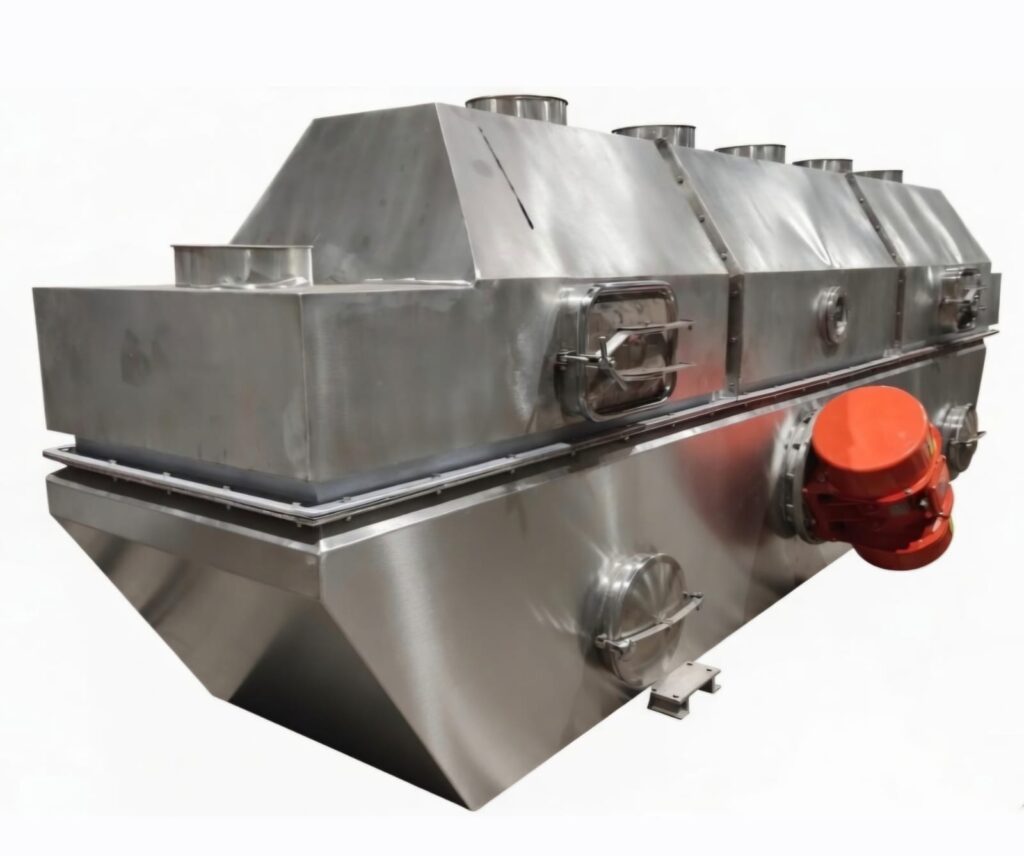
Unlike a conventional fluidized bed dryer, a VFBD combines controlled hot-air fluidization with mechanical vibration. The vibration helps move and distribute the material through the drying chamber while improving contact between the product and drying air.
For large Asian manufacturing plants, this combination can provide a practical solution where conventional static fluidization or rotary drying may not deliver the required combination of throughput, residence-time control, product handling and energy performance.
China: The Major Opportunity for High-Capacity VFBD Systems
China is a particularly important market for industrial drying equipment because of its enormous chemical, fertilizer, food-processing and advanced-materials manufacturing base.
Major Chinese applications include:
Specialty Chemicals → Fertilizers → Agrochemicals → Battery Chemicals → Food Ingredients → Starch → Sugar → MSG → Industrial Salts
Large production facilities often require dryers that can operate continuously and maintain consistent product moisture at high throughput.
For these applications, high-capacity Vibratory Fluidized Bed Dryers can be considered where the product characteristics are suitable for fluidization.
Why VFBD technology fits Chinese processing industries
A properly engineered VFBD can provide:
- Continuous material movement
- Controlled residence time
- Uniform drying
- Intensive air-to-product contact
- Reduced risk of localized overheating
- Better handling of certain difficult materials
- Automated temperature and airflow control
- Scalable drying capacity
The actual configuration should be determined from feed properties, moisture load, particle characteristics, required evaporation and final product specifications.
Where VFBDs Fit Across Asia-Pacific
The opportunity extends beyond China.
Countries across Asia-Pacific have major production clusters in:
Southeast Asia
Indonesia, Thailand, Vietnam and Malaysia
Important sectors include:
- Food processing
- Starch production
- Palm-derived products
- Fertilizers
- Agrochemicals
- Minerals
- Animal feed
- Industrial chemicals
East Asia
China, South Korea and Japan
Applications can include:
- Advanced chemicals
- Battery materials
- Electronic chemicals
- Specialty materials
- Food ingredients
- Pharmaceuticals
- Industrial salts
South Asia
India and neighboring markets
Demand is associated with:
- Pharmaceuticals
- APIs
- Fertilizers
- Agrochemicals
- Sugar
- Salt
- Food ingredients
- Agricultural processing
This creates a broad market for continuous industrial drying technologies, particularly where production volumes are high.
Key Industries Driving VFBD Demand
1. Specialty Chemical Manufacturing
Chemical manufacturers frequently handle crystalline, granular and particulate materials that require controlled moisture reduction.
VFBDs can be engineered for suitable:
- Chemical crystals
- Granules
- Inorganic salts
- Intermediates
- Specialty chemical products
- Catalytic materials
For chemical plants, important design considerations include corrosion resistance, product contamination control, temperature profile, residence time and dust collection.
2. Fertilizer & Agrochemical Processing
Fertilizer and agrochemical manufacturing is one of the strongest application areas for continuous industrial drying in Asia.
Products may include:
- Fertilizer granules
- Ammonium-based products
- Potassium salts
- Phosphate-based materials
- Agrochemical intermediates
- Granulated soil nutrients
A VFBD can provide continuous drying while maintaining controlled product movement through the drying chamber.
For high-volume fertilizer plants, dryer selection should consider:
Feed rate + moisture content + evaporation load + particle size + bulk density + final moisture + heat source
3. Lithium Salts & Battery Materials
China and Asia-Pacific have become major manufacturing centers for battery materials and related chemical processing.
Drying requirements can arise in the processing of:
- Lithium salts
- Battery chemical intermediates
- Cathode-related materials
- Specialty inorganic powders
- Precursor materials
These applications can require particularly careful control of:
- Product temperature
- Moisture
- Residence time
- Contamination
- Particle attrition
- Exhaust handling
For sensitive battery-material applications, dryer design should be based on detailed laboratory or pilot-scale process evaluation rather than simply selecting equipment based on throughput.
4. Food Ingredients, Starch & MSG
Asia-Pacific has enormous food-processing capacity, creating another significant application area for VFBD technology.
Potential applications include:
- Starch
- Modified starch
- MSG
- Food-grade salts
- Sugar products
- Granulated ingredients
- Plant-based food ingredients
For food processing, hygienic construction and controlled product temperatures become particularly important.
Depending on the application, equipment can be designed using suitable stainless-steel construction, controlled airflow, automated temperature control and appropriate dust-collection systems.
Why Choose a Vibratory Fluidized Bed Instead of a Conventional Fluidized Bed?
The defining feature of a VFBD is the combination of fluidizing air and mechanical vibration.
Conventional Fluidized Bed
Hot air provides the primary mechanism for suspending and drying particles.
Vibratory Fluidized Bed
Hot air provides fluidization while mechanical vibration assists:
Material Movement → Mixing → Residence-Time Control → Continuous Discharge
This can make VFBD technology attractive for certain products that are difficult to process efficiently in a conventional fluidized bed.
Potential advantages include:
Gentler product handling
Mechanical movement can help transport particles without relying entirely on high air velocity.
Continuous operation
Suitable for large-scale production lines.
Uniform drying
Improved product distribution can contribute to consistent moisture removal.
Controlled residence time
Vibration and deck configuration can be engineered around the required processing time.
Flexible process design
Multiple heating and airflow zones can be incorporated where required.
Potential fan-energy savings
The reduced dependence on very high airflow for material transport can potentially lower air-handling requirements in suitable applications.
Actual energy performance, however, depends on product properties, dryer configuration, airflow, heat source and operating conditions.
The Asia-Pacific Drying Challenge: High Throughput Without Sacrificing Product Quality
Large Asian manufacturing plants increasingly need to balance three requirements:
01 — Production Capacity
The dryer must process the required tonnes per hour.
02 — Product Quality
Moisture, temperature and particle characteristics must remain within specification.
03 — Operating Economics
Energy, maintenance and downtime must remain commercially viable.
This makes dryer selection a process-engineering decision rather than simply an equipment purchase.
A suitable VFBD design should therefore begin with:
Material Characterization
↓
Moisture & Evaporation Calculation
↓
Drying Temperature Selection
↓
Residence-Time Determination
↓
Airflow Calculation
↓
Heat-Duty Calculation
↓
Dryer Sizing
↓
Pilot/Process Validation
↓
Commercial-Scale VFBD
What Determines VFBD Capacity?
One of the most important questions asked by industrial buyers is:
“What size Vibratory Fluidized Bed Dryer do I need?”
Capacity cannot be determined from feed rate alone.
Key parameters include:
- Wet feed capacity
- Initial moisture
- Final moisture
- Solids concentration
- Particle size
- Bulk density
- Specific heat
- Drying temperature
- Ambient conditions
- Required residence time
- Heat-source availability
- Exhaust conditions
A preliminary moisture balance can be represented as:
Wet Feed → Dry Solids + Evaporated Water
The required evaporation rate then becomes a major input for determining the thermal duty and dryer size.
For a commercial project, GTI Dryers can evaluate these parameters to develop a preliminary equipment configuration.
Energy Efficiency: A Major VFBD Opportunity in Asia-Pacific
Energy consumption is a major consideration for high-throughput drying operations.
A modern VFBD can be engineered around several energy-efficiency strategies:
Heat Recovery
Recovering usable heat from exhaust streams where technically and economically practical.
Multi-Zone Drying
Different temperatures and airflow rates can be used across different sections of the dryer.
Airflow Optimization
Avoiding unnecessary airflow can reduce fan power and improve overall process efficiency.
Variable Frequency Drives
VFDs can regulate:
- Fans
- Feeders
- Vibratory drives
- Conveyors
- Air-handling systems
Thermal Insulation
Proper insulation can reduce heat loss from the drying chamber and associated hot-air systems.
Heat Source Integration
Depending on plant requirements, VFBD systems may be integrated with:
- Steam
- Thermal oil
- Natural gas
- LPG
- Electric heating
- Biomass heating
- Waste-heat systems
The best configuration depends on the customer’s local energy economics and plant infrastructure.
Why Indian Engineering Can Be Competitive in the Asia-Pacific Dryer Market
For an Asian buyer, purchasing industrial drying equipment from India can offer an alternative to sourcing exclusively from European, Japanese or Chinese suppliers.
The key value proposition should not simply be low price.
Instead, the opportunity lies in combining:
Process Engineering + Manufacturing Capability + Customization + Competitive Project Economics
India has a large engineering and manufacturing ecosystem covering mechanical fabrication, process equipment, automation and industrial machinery.
This can allow an Indian manufacturer to develop customized drying systems for international applications while maintaining competitive manufacturing economics.
For buyers evaluating a supplier, important considerations include:
| Buyer Requirement | GTI Dryers Approach |
| Process design | Material-specific dryer engineering |
| Construction | SS304 / SS316 / SS316L options where required |
| Automation | PLC, HMI, VFD and instrumentation |
| Heating | Steam, thermal oil, gas, electric and other configurations |
| Dust control | Cyclones, filters and suitable collection systems |
| Capacity | Customized according to evaporation requirement |
| Product handling | Designed around particle characteristics |
| Documentation | Engineering drawings and project documentation |
| Testing | Process evaluation and testing where appropriate |
| Support | Remote technical assistance and commissioning support |
The objective is to provide the customer with a drying solution rather than a standard machine.
GTI Dryers: An Indian VFBD Manufacturer for Global Applications
GTI Dryers, an Indian industrial drying technology company, can position its Vibratory Fluidized Bed Dryer systems for customers across Asia-Pacific looking for customized continuous drying solutions.
The company’s location in India can provide an important combination of:
Indian Manufacturing Economics + Process Engineering + Customized Design + International Project Capability
Depending on the application, GTI Dryers can engineer systems around:
- Required production capacity
- Initial and final moisture
- Product temperature
- Particle size
- Residence time
- Heat source
- Airflow
- Dust-collection requirements
- Automation level
- Material-of-construction requirements
Potential GTI VFBD applications include:
Chemical Drying
For suitable granular and crystalline chemical products.
Fertilizer Drying
For continuous drying of suitable fertilizer granules and salts.
Agrochemical Processing
For appropriate particulate and granular products.
Food Ingredient Drying
For suitable starches, salts, MSG and other particulate ingredients.
Battery Material Processing
For selected inorganic and chemical materials requiring controlled moisture removal.
Industrial Salt & Mineral Processing
For suitable crystalline and granular materials.
What Should an Asia-Pacific Buyer Ask Before Purchasing a VFBD?
Before requesting a quotation, manufacturers should ideally receive the following information:
Material Information
- Product name
- Feed form
- Particle size
- Bulk density
- Stickiness
- Thermal sensitivity
Moisture Information
- Initial moisture %
- Desired final moisture %
- Moisture basis
- Water evaporation requirement
Production Information
- Wet feed rate
- Operating hours/day
- Required continuous capacity
- Batch or continuous operation
Process Information
- Maximum allowable product temperature
- Required residence time
- Available heat source
- Ambient conditions
- Exhaust requirements
Construction Information
- SS304
- SS316
- SS316L
- Carbon steel
- Special corrosion-resistant construction
Providing these details allows a dryer manufacturer to prepare a significantly more accurate preliminary design.
Frequently Asked Questions About VFBDs in China & Asia-Pacific
What is a Vibratory Fluidized Bed Dryer?
A Vibratory Fluidized Bed Dryer is a continuous industrial dryer that combines heated-air fluidization with mechanical vibration to transport, mix and dry suitable granular or particulate materials.
What industries use VFBDs?
VFBDs can be used in suitable applications across chemicals, fertilizers, agrochemicals, food ingredients, minerals, salts, pharmaceuticals and advanced materials.
Why use vibration in a fluidized bed dryer?
Mechanical vibration assists product movement and can improve material distribution and residence-time control, particularly for products that may be difficult to transport using airflow alone.
Is VFBD suitable for fertilizer drying?
Yes, VFBDs can be considered for suitable fertilizer granules and salts. The final design depends on particle size, moisture, temperature sensitivity and required capacity.
Can VFBDs dry battery materials?
Potentially, yes. Selected battery chemicals and inorganic materials can be evaluated for VFBD processing, but material characterization and contamination-control requirements are particularly important.
Can GTI Dryers manufacture VFBD systems for export?
GTI Dryers is an Indian industrial dryer manufacturer capable of engineering customized drying solutions for international industrial applications, subject to project requirements and technical evaluation.
How do I select the right VFBD capacity?
Capacity depends on wet feed rate, moisture removal, final moisture, particle properties, residence time, drying temperature and heat-transfer requirements. A process-based calculation is required before final sizing.
China & Asia-Pacific: Where Continuous Drying Meets Industrial Scale
The expansion of chemical manufacturing, fertilizer production, agrochemical processing, food ingredients and battery-material manufacturing is creating a strong need for reliable continuous drying systems across Asia-Pacific.
For high-throughput particulate materials, Vibratory Fluidized Bed Dryers can provide a combination of:
Continuous Operation + Controlled Residence Time + Uniform Drying + Gentle Product Movement + Process Automation
However, the correct dryer should always be selected according to the material and process—not simply according to industry or production capacity.
Looking for a Vibratory Fluidized Bed Dryer for China or Asia-Pacific?
If your plant processes fertilizers, chemicals, agrochemicals, starch, MSG, salts, food ingredients, minerals or selected battery materials, GTI Dryers can evaluate the drying requirement and recommend a suitable VFBD configuration.
Send GTI Dryers these five details to start a preliminary evaluation:
1. Product / Material
2. Wet Feed Rate (kg/hr or TPH)
3. Initial Moisture %
4. Required Final Moisture %
5. Available Heat Source
From these parameters, the drying requirement can be evaluated in terms of water evaporation, thermal duty, airflow, residence time and preliminary VFBD sizing.
GTI Dryers — Indian Engineering for Global Industrial Drying Applications.
Talk to GTI Dryers about your VFBD requirement and develop a process-based drying solution for your China or Asia-Pacific production facility.