Vibratory Fluidized Bed Dryer Brazil: A Growing Opportunity for High-Capacity Continuous Processing
Brazil and the wider Latin American region represent some of the world’s most important markets for agricultural commodities, sugar, soy products, starch, fertilizers and mineral-based materials.
Large-scale processing plants in Brazil require drying technologies that can operate continuously, handle high production volumes and deliver consistent final moisture before products move to storage, further processing or export.
This creates an important opportunity for Vibratory Fluidized Bed Dryers (VFBDs).
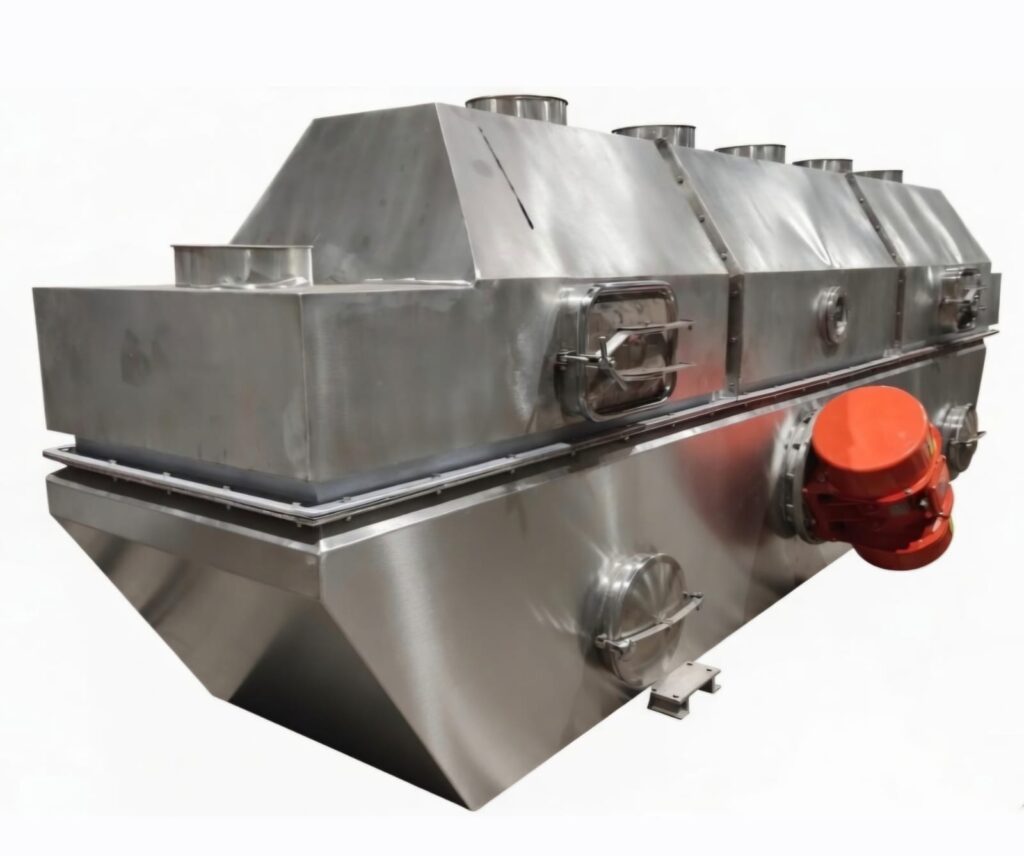
Unlike conventional static fluidized bed systems, a VFBD combines fluidized hot-air drying with controlled mechanical vibration. This combination can improve material movement, drying uniformity and handling of certain difficult or fragile granules.
For Brazilian processors, the technology can be particularly relevant where the production line involves:
High Throughput → Continuous Processing → Controlled Moisture → Product Quality → Energy Optimization → Export-Ready Product
Why Brazil Is an Important Market for Industrial VFBD Systems
Brazil’s agricultural and mineral-processing economy creates large volumes of granular, crystalline and particulate products that require reliable moisture control.
Major processing sectors include:
- Sugar and sugar derivatives
- Soy protein and soy-based ingredients
- Cassava and tapioca starch
- Corn and agricultural starches
- Fertilizer salts
- Mineral products
- Food ingredients
- Animal feed ingredients
- Biomass-derived materials
- Chemical and industrial granules
For these industries, drying is not simply a final processing step.
Moisture control affects storage stability, flowability, product quality, transportation economics and downstream processing.
A properly engineered continuous dryer can therefore become an important part of the overall production system.
Brazil’s Core VFBD Opportunity: Agricultural & Food Processing
1. Sugar & Sugar-Based Products
Brazil is a major global sugar producer and exporter, making continuous drying technology highly relevant to the sugar-processing sector.
Sugar crystals require controlled moisture removal to achieve the desired:
- Final moisture
- Crystal quality
- Flowability
- Storage stability
- Handling characteristics
A Vibratory Fluidized Bed Dryer/Cooler can be engineered for continuous movement of suitable sugar products while providing controlled air distribution.
Depending on the process configuration, the system can combine:
Drying + Cooling + Conveying
within a continuous production line.
This makes VFBD technology worth evaluating for large sugar-processing facilities where consistent product conditions are important.
2. Soy Protein & Plant-Based Ingredients
Brazil’s strong soybean industry also creates opportunities for advanced drying systems for soy-derived food ingredients and protein products.
Suitable particulate products may require controlled drying after wet processing or other upstream operations.
VFBD technology can provide:
- Continuous drying
- Controlled residence time
- Uniform air-product contact
- Adjustable vibration
- Reduced mechanical handling
- Controlled outlet moisture
For processors producing soy protein ingredients, plant-based food materials and other agricultural powders or granules, dryer selection should be based on the actual particle size, bulk density, moisture profile and thermal sensitivity.
3. Starch & Tapioca Processing
Cassava and starch processing is another important opportunity across Brazil and Latin America.
Starch-based materials can present challenges related to:
- Fine particles
- Agglomeration
- Moisture distribution
- Product temperature
- Flowability
A continuous VFBD can be evaluated where the material characteristics allow effective fluidization.
The system can be designed around:
Feed Moisture → Evaporation Load → Air Temperature → Airflow → Residence Time → Final Moisture
This process-based approach is more reliable than selecting a dryer solely according to the product name.
4. Fertilizer & Mineral Salts
Brazil’s agricultural economy also creates substantial demand for fertilizers and mineral-based agricultural inputs.
Granular fertilizers and mineral salts can require continuous drying after crystallization, washing or other processing operations.
VFBD systems are particularly interesting for suitable:
- Fertilizer granules
- Mineral salts
- Crystalline products
- Agricultural nutrients
- Chemical granules
Controlled vibration can assist product movement while hot air provides the drying medium.
For fertilizer applications, the dryer design may also need to consider:
Particle Size + Bulk Density + Abrasion + Corrosiveness + Dust Generation + Final Moisture
Material compatibility and dust-control requirements should be established during the engineering stage.
Why Vibration Matters in a Fluidized Bed Dryer
A conventional fluidized bed dryer depends primarily on airflow to suspend and move particles.
A Vibratory Fluidized Bed Dryer introduces mechanical vibration to assist material transport.
This can offer advantages for certain materials, including:
More Controlled Product Movement
Vibration can help move material progressively through the drying chamber.
Improved Drying Uniformity
Controlled product movement and airflow can support more consistent exposure to drying air.
Lower Attrition Potential
For appropriately selected products, gentler material movement can help reduce unnecessary mechanical impact compared with some conventional conveying arrangements.
Handling of Difficult Materials
Vibration can be useful when processing materials that are difficult to transport solely through airflow.
Continuous Operation
VFBD systems can be designed for continuous industrial production, making them suitable for high-volume Brazilian processing plants.
VFBD vs Conventional Fluidized Bed Dryer
| Parameter | Conventional Fluidized Bed | Vibratory Fluidized Bed |
| Material movement | Primarily airflow | Airflow + mechanical vibration |
| Continuous operation | Yes | Yes |
| Granular materials | Suitable | Highly suitable for selected materials |
| Product handling | Air-driven | Controlled vibration-assisted movement |
| Drying uniformity | Depends strongly on fluidization | Can benefit from controlled movement |
| Difficult-to-fluidize materials | May be challenging | Can provide additional conveying assistance |
| Large-volume processing | Possible | Well suited to continuous applications |
| Drying + cooling | Possible | Can be integrated |
| Application flexibility | Material dependent | Material dependent |
The correct choice depends on the product’s fluidization behavior, particle characteristics, moisture content and required production capacity.
Energy Efficiency: An Important Consideration for Brazilian Industry
Energy consumption is a major factor in industrial drying economics.
A dryer does not simply consume energy to heat a product. A significant portion of the thermal requirement is associated with evaporating water.
Therefore, efficient VFBD design should focus on reducing unnecessary thermal and airflow losses.
GTI Dryers can engineer systems around factors such as:
- Optimized airflow
- Controlled air temperature
- Proper insulation
- Variable frequency drives
- Multi-zone drying
- Heat recovery opportunities
- Efficient air circulation
- Appropriate heat-source selection
Potential heat sources can include:
Steam | Thermal Oil | Natural Gas | LPG | Electric Heating | Biomass | Waste Heat
The optimum configuration depends on the plant’s available energy infrastructure and process economics.
From Brazil to Latin America: Where Can VFBD Technology Be Used?
The opportunity extends beyond Brazil.
Latin American industries processing agricultural, chemical and mineral products can also evaluate continuous VFBD systems.
Potential markets include:
Brazil
Sugar, soy, starch, fertilizers, food ingredients and minerals.
Argentina
Soy products, agricultural ingredients, food processing and fertilizers.
Mexico
Food ingredients, chemicals, fertilizers and industrial granules.
Chile
Mineral processing, salts, chemicals and food ingredients.
Colombia
Coffee-related processing, agricultural products, food ingredients and chemicals.
Peru
Mineral processing, agricultural products and industrial chemicals.
The exact opportunity varies by country, but the common requirement is similar:
High-volume processing + moisture control + continuous operation.
What Is the Best VFBD for Brazilian Processing Plants?
There is no universal “best” Vibratory Fluidized Bed Dryer.
The correct dryer configuration depends on the process.
Before selecting a VFBD, engineers should evaluate:
Feed Characteristics
- Initial moisture
- Particle size
- Bulk density
- Shape
- Stickiness
- Flowability
- Thermal sensitivity
Production Requirements
- Feed rate
- Operating hours
- Required evaporation rate
- Final moisture
- Residence time
Plant Conditions
- Available heat source
- Ambient conditions
- Electrical infrastructure
- Available installation space
- Dust-control requirements
Product Requirements
- Final moisture
- Product temperature
- Particle integrity
- Cooling requirement
- Storage stability
This is why process engineering is more important than simply purchasing a standard dryer.
How to Calculate VFBD Capacity
A preliminary dryer capacity calculation begins with the amount of water that must be removed.
For example:
Feed Rate = 1,000 kg/h
Initial Moisture = 30%
Final Moisture = 5%
The approximate dry solids entering the system are:
1,000 × (1 − 0.30) = 700 kg/h
The final product at 5% moisture would be approximately:
700 ÷ 0.95 = 737 kg/h
Therefore, approximately:
1,000 − 737 = 263 kg/h of water
must be evaporated.
The actual dryer size, heating requirement and airflow must then be established using detailed thermal calculations and product characteristics.
This is why GTI Dryers recommends evaluating the complete drying duty rather than selecting equipment only by feed capacity.
How GTI Dryers Can Support Brazilian & Latin American Projects
For Brazilian customers, working with an overseas dryer manufacturer should be about more than equipment supply.
The important requirement is an engineering partner capable of understanding:
Product → Process → Dryer → Heat Source → Automation → Dust Collection → Installation → Commissioning
GTI Dryers, as an Indian industrial drying-system manufacturer, can develop customized drying solutions around individual process requirements.
Potential VFBD system configurations can include:
- Vibratory fluidized bed drying chamber
- Feed system
- Hot-air generation system
- Air distribution system
- Vibration drive
- Cyclone or dust-collection system
- Exhaust system
- Product cooling section
- PLC/HMI control
- VFD-based speed control
- Temperature instrumentation
- Integrated conveying
The final configuration should be engineered according to the customer’s product and plant conditions.
Why Consider an Indian VFBD Manufacturer for Brazil?
Brazilian and Latin American buyers evaluating international equipment suppliers may compare European, American, Chinese and Indian manufacturers.
India offers an increasingly relevant combination of engineering capability, manufacturing infrastructure and competitive project economics.
For GTI Dryers, the positioning should not simply be “lower-cost equipment.”
A stronger proposition is:
International Drying Technology, Engineered & Manufactured in India
Potential advantages for international buyers include:
Process Engineering
Dryer design based on moisture removal, residence time, product characteristics and thermal requirements.
Customized Manufacturing
Equipment can be configured for different capacities, materials and plant conditions.
Stainless-Steel Fabrication
SS304, SS316 and SS316L construction can be considered where required by the application.
Automation
PLC, HMI, VFD and instrumentation can be incorporated for controlled continuous operation.
Flexible Heating Integration
Steam, thermal oil, gas, electric, biomass or other suitable heat sources can be evaluated.
Complete System Engineering
GTI can work toward integrating drying with feeding, heating, dust collection, cooling and conveying requirements.
Competitive Project Economics
Indian manufacturing can provide an attractive balance between equipment specification and overall capital investment.
What Brazilian Buyers Should Ask Before Purchasing a VFBD
Before comparing quotations, ask every manufacturer:
- What is the guaranteed evaporation capacity?
- What initial and final moisture levels are considered?
- What product temperature will be maintained?
- What is the expected residence time?
- What heat source is being proposed?
- What is the estimated specific energy consumption?
- How is airflow distributed?
- How is vibration controlled?
- What dust-collection system is included?
- What materials of construction are proposed?
- What automation platform is being offered?
- Can pilot testing be conducted?
- What documentation will be supplied?
- What commissioning support is available?
- What spare-parts and after-sales support can be provided internationally?
These questions help buyers compare complete drying solutions rather than simply comparing machine prices.
Frequently Asked Questions About VFBD in Brazil
What is a Vibratory Fluidized Bed Dryer?
A Vibratory Fluidized Bed Dryer is a continuous industrial drying system that combines hot-air fluidization with mechanical vibration to move and dry suitable granular, crystalline or particulate materials.
What industries use VFBD systems in Brazil?
Potential industries include sugar processing, soy and plant-based ingredients, starch, fertilizers, mineral salts, food ingredients, chemicals and agricultural processing.
Is VFBD suitable for sugar drying?
VFBD technology can be evaluated for suitable sugar crystals where controlled drying and continuous product movement are required. Final selection should be based on crystal size, moisture, throughput and product-temperature requirements.
Can VFBD dry fertilizer granules?
Yes, suitable fertilizer granules and mineral salts can be candidates for VFBD systems. Engineers should evaluate particle characteristics, corrosiveness, abrasion, dust generation and required final moisture.
Is VFBD more energy efficient than a conventional dryer?
Energy performance depends on the material, moisture removal, heat source, airflow, dryer configuration and operating conditions. A properly engineered VFBD can optimize airflow and residence time, but energy consumption should be established through process calculations or testing rather than assumed.
Can GTI Dryers manufacture VFBD systems for Brazil?
GTI Dryers can develop customized industrial drying systems based on the customer’s feed characteristics, capacity, moisture reduction, heat source and automation requirements. International project requirements should be evaluated individually.
Brazil’s Opportunity: From Commodity Processing to Value-Added Production
Brazil’s enormous agricultural production creates a natural requirement for technologies that can improve the shelf life, stability, handling and value of processed materials.
The next opportunity is not simply producing more commodities.
It is improving the efficiency of processing.
For suitable applications, advanced continuous drying can contribute to:
Better Moisture Control
↓
Improved Storage Stability
↓
Lower Handling & Transportation Challenges
↓
Consistent Product Quality
↓
Higher-Value Processed Products
This makes Vibratory Fluidized Bed Dryers a technology worth evaluating across Brazil’s food, agricultural, fertilizer, mineral and chemical-processing industries.
GTI Dryers: Industrial VFBD Solutions for Brazil & Latin America
Brazil’s large-scale agricultural and industrial processing sectors require drying equipment capable of operating reliably under demanding production conditions.
GTI Dryers can support customers evaluating Vibratory Fluidized Bed Dryers, Fluidized Bed Dryers, Rotary Dryers, Band Dryers, Flash Dryers, Paddle Dryers and other industrial drying technologies.
Rather than recommending one dryer for every product, GTI’s approach is to evaluate:
Feed Material → Moisture → Capacity → Evaporation Load → Product Sensitivity → Heat Source → Residence Time → Final Moisture
This process-engineering approach helps determine the appropriate drying technology and system configuration.
Looking for a Vibratory Fluidized Bed Dryer for Brazil?
If your facility processes sugar, soy protein, starch, fertilizer granules, mineral salts, food ingredients or other granular materials, GTI Dryers can evaluate your application and develop a preliminary drying concept.
Share your feed rate, initial moisture, final moisture, product characteristics and available heat source with GTI Dryers to discuss a customized VFBD solution for your Brazilian or Latin American processing plant.