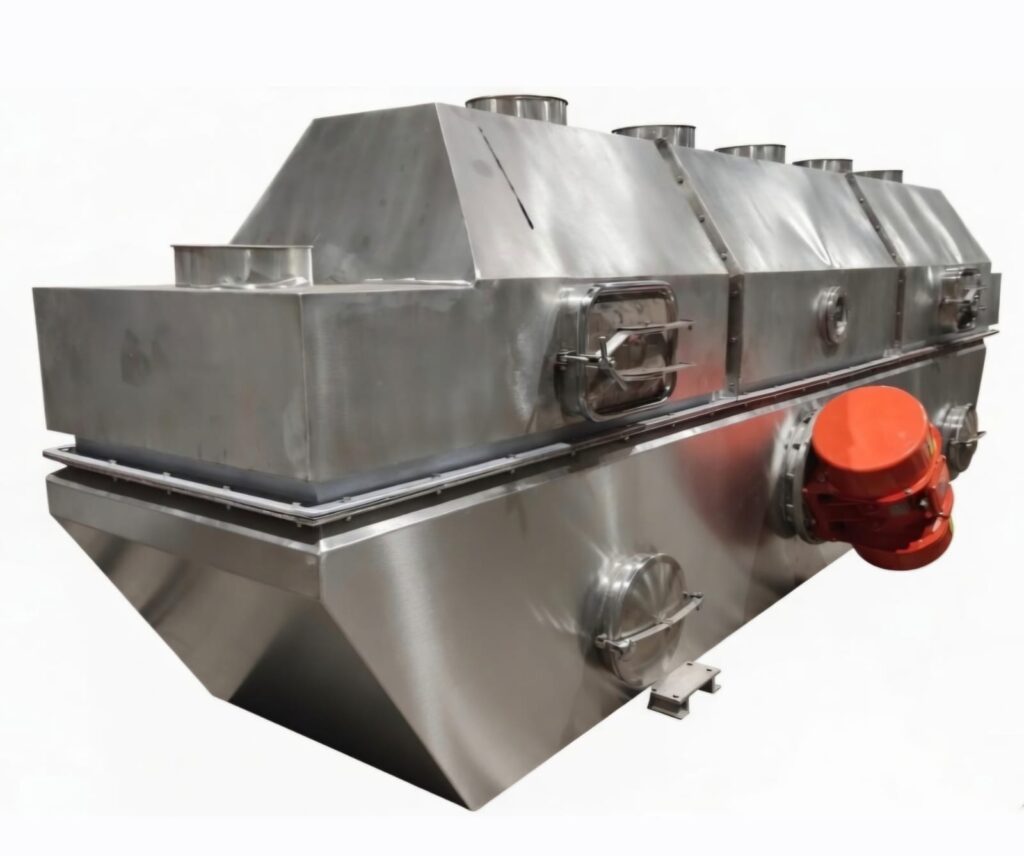
Vibratory Fluidized Bed Dryer Germany: A Continuous Drying Solution for Europe’s Energy-Conscious Process Industries
Germany and Central Europe are home to highly developed chemical, pharmaceutical, food, polymer, recycling and advanced-material industries. These sectors increasingly require drying systems capable of delivering consistent moisture removal while controlling product temperature, residence time, energy consumption and mechanical stress.
For many granular and crystalline products, a conventional fluidized bed may not provide the desired combination of product movement, gentle handling and continuous operation.
This is where a Vibratory Fluidized Bed Dryer (VFBD) becomes relevant.
A VFBD combines fluidized hot-air drying with controlled mechanical vibration. Air provides the primary heat and mass transfer mechanism, while vibration assists the movement of material through the drying chamber.
The result is a continuous drying concept that can be evaluated for:
Fragile granules + crystals + uneven particles + certain sticky materials + heat-sensitive solids + continuous production
For German and Central European manufacturers, the attraction is not simply faster drying. It is the ability to engineer a drying system around product quality, energy performance, process control and plant integration.
Why Is Germany an Important Market for Vibratory Fluidized Bed Dryers?
Germany has one of Europe’s largest and most technically advanced industrial bases, particularly in:
- Chemicals
- Specialty chemicals
- Pharmaceuticals
- Plastics and polymers
- Food processing
- Machinery
- Recycling
- Biomass and renewable-energy systems
- Advanced materials
At the same time, European manufacturers are under increasing pressure to improve energy efficiency and reduce industrial emissions.
The European Union has adopted a legally binding target to reduce net greenhouse-gas emissions by 90% by 2040 compared with 1990 levels, while maintaining the objective of climate neutrality by 2050.
Energy economics also remain an important consideration for German industry. Eurostat reported that Germany had the highest non-household electricity price in the EU in the second half of 2025, at €22.64 per 100 kWh for the reported consumption band.
That does not mean every German plant will automatically replace a rotary dryer with a VFBD. Rather, it means energy consumption, airflow optimization, heat recovery and process efficiency can become significant equipment-selection criteria.
What Is a Vibratory Fluidized Bed Dryer?
A Vibratory Fluidized Bed Dryer is a continuous industrial drying system that combines:
Hot Air + Fluidization + Mechanical Vibration + Controlled Product Movement
In a conventional fluidized bed, airflow suspends or fluidizes particles.
In a VFBD, mechanical vibration assists the movement of the material along the drying deck.
This combination can be useful when manufacturers need:
- Controlled continuous conveying
- Uniform exposure to drying air
- Gentle product handling
- Controlled residence time
- Consistent moisture removal
- Better handling of certain difficult-to-fluidize materials
The exact benefits depend on particle characteristics and process conditions.
How Does a VFBD Dryer Work?
The basic process can be represented as:
Wet Feed
↓
Controlled Feeding
↓
Fluidization + Vibration
↓
Heat & Mass Transfer
↓
Moisture Evaporation
↓
Controlled Residence Time
↓
Final Drying Zone
↓
Dried Product Discharge
Hot air passes through the product bed while the vibrating mechanism moves the material progressively through the dryer.
Depending on the application, the dryer can incorporate single or multiple drying zones, allowing temperature and airflow to be adjusted across the process.
This is particularly useful when the product requires a controlled drying profile rather than one aggressive drying condition.
Why Use Vibration in a Fluidized Bed Dryer?
Mechanical vibration can provide an additional method of moving the material through the drying chamber.
This can be beneficial for certain products that may:
- Have irregular particle sizes
- Be fragile
- Experience attrition under aggressive handling
- Be difficult to transport using airflow alone
- Show poor fluidization characteristics
- Tend to form localized accumulation
The vibration parameters can be engineered according to the material and required conveying behavior.
Potential process advantages include:
Gentle product transport
Vibration can move the product without relying entirely on high-velocity pneumatic conveying.
Controlled residence time
Dryer length, vibration characteristics and feed rate can be used to establish the required residence time.
Continuous operation
VFBD systems are designed for continuous feeding and discharge.
Uniform drying
Fluidized air provides direct contact between the drying medium and particles.
Airflow optimization
Because vibration contributes to material transport, airflow can potentially be optimized for drying rather than being responsible for all product movement.
Germany’s Key VFBD Applications
1. Fine Chemicals & Specialty Chemicals
Germany’s chemical industry represents one of the most important potential application areas for continuous drying systems.
VFBD technology can be evaluated for suitable:
- Chemical crystals
- Specialty chemical granules
- Inorganic salts
- Pigments
- Catalysts
- Chemical intermediates
- Granulated additives
For chemical applications, the dryer may require:
Corrosion-resistant construction + controlled temperature + dust containment + uniform moisture removal + automated operation
The appropriate construction material must be selected according to the chemical composition, temperature and process environment.
2. Advanced Polymer Granules
Polymer processing often requires precise control of moisture before subsequent manufacturing stages.
Potential applications include suitable:
- Polymer granules
- Plastic compounds
- Resin particles
- Additives
- Specialty polymer materials
A VFBD can be evaluated when the process requires continuous movement and controlled drying without excessive mechanical damage to the granules.
Important design parameters include:
- Particle size
- Bulk density
- Initial moisture
- Target moisture
- Product temperature
- Residence time
- Airflow
- Thermal sensitivity
3. Food Processing & Food Ingredients
Germany and Central Europe have extensive food-processing industries producing ingredients, powders, granules and specialty food products.
Potential applications for VFBD systems include suitable:
- Food granules
- Crystalline food ingredients
- Salt
- Sugar
- Starch-based materials
- Seasoning ingredients
- Nutritional ingredients
- Specialty food products
For food applications, equipment selection should consider:
Hygienic construction + cleanability + product-contact materials + controlled temperature + dust management
The correct design depends on the product and applicable plant requirements.
4. Pharmaceutical & Nutraceutical Processing
Although the primary target sectors for this Germany/Central Europe page are chemicals, polymers, food and sustainable processing, pharmaceutical applications can also be relevant.
VFBD systems may be considered for suitable:
- Pharmaceutical granules
- Excipients
- Crystalline intermediates
- Nutraceutical ingredients
- Heat-sensitive particulate materials
For pharmaceutical projects, the equipment specification must be developed around the applicable GMP, cleaning, containment, material and documentation requirements.
The dryer type alone does not establish regulatory compliance.
5. Biomass, Recycling & Circular-Economy Applications
Germany’s industrial transition toward resource efficiency and circular material flows creates opportunities for thermal processing technologies.
VFBD systems can be evaluated for suitable:
- Biomass granules
- Recovered materials
- Organic solids
- Recycling intermediates
- Process residues
- Granulated waste-derived materials
However, product-specific testing is important because recycled materials can vary considerably in:
- Moisture
- Particle size
- Density
- Composition
- Flowability
- Thermal behavior
VFBD vs Conventional Fluidized Bed Dryer
| Feature | Conventional Fluidized Bed | Vibratory Fluidized Bed |
| Drying principle | Fluidized air | Fluidized air + vibration |
| Product movement | Primarily airflow | Airflow + mechanical vibration |
| Continuous operation | Yes | Yes |
| Gentle conveying | Application-dependent | Can be advantageous for suitable products |
| Difficult particles | Depends on fluidization | Vibration can assist movement |
| Residence-time control | Airflow/process dependent | Airflow + vibration + dryer geometry |
| Energy optimization | Airflow-focused | Airflow and vibration can be optimized |
| Best application | Fluidizable particles | Granules/crystals and selected difficult materials |
The correct technology depends on the material. VFBD should not be selected simply because vibration is available; it should be selected when the combined drying and conveying mechanism fits the product.
VFBD vs Rotary Dryer: Which Is Better?
There is no universal winner.
A rotary dryer may be advantageous for:
- Very large bulk-solid throughput
- Coarser materials
- Robust products
- High-moisture feeds
- Applications where long residence time is acceptable
A VFBD may be more attractive for:
- Granules
- Crystals
- More delicate particles
- Continuous controlled drying
- Materials requiring more controlled product movement
- Applications where fluidized heat and mass transfer are beneficial
The decision should be based on:
Particle size → Moisture → Throughput → Temperature → Residence time → Product fragility → Flowability → Energy requirement
For German process engineers, this application-based approach is more useful than choosing a dryer based solely on equipment category.
Energy Efficiency: Why It Matters in Germany
Drying is fundamentally a thermal process, and a significant portion of the energy requirement is associated with evaporating water.
Therefore, reducing unnecessary heat and airflow losses can have a direct impact on operating economics.
Germany’s industrial energy environment makes this particularly relevant. Eurostat reported that EU industry consumed 8,835 PJ of energy in 2024, with electricity and natural gas together accounting for more than 65% of industrial energy use.
A modern VFBD project can therefore be evaluated for:
1. Optimized Airflow
Use only the airflow required to achieve the necessary heat and mass transfer.
2. Variable Frequency Drives
VFDs can regulate:
- Fans
- Feeders
- Conveyors
- Auxiliary equipment
3. Multi-Zone Drying
Different temperature and airflow conditions can be applied across drying zones.
4. Heat Recovery
Where technically and hygienically appropriate, exhaust heat can be recovered to reduce thermal demand.
5. Thermal Insulation
Proper insulation reduces heat loss from:
- Dryer body
- Hot-air ducts
- Process piping
- Heated surfaces
6. Efficient Heat Sources
Depending on plant infrastructure, the system can be designed around:
Steam | Thermal Oil | Natural Gas | LPG | Electricity | Hot Water | Waste Heat
The best configuration depends on the customer’s existing utilities and energy strategy.
A Practical VFBD Energy-Optimization Approach
Instead of asking:
“Which dryer consumes the least energy?”
German process engineers should ask:
“How much water must be evaporated, and how efficiently can the complete drying system deliver that evaporation?”
A preliminary evaluation should consider:
Feed Rate
Initial Moisture
Final Moisture
Water Evaporation
Product Temperature
Residence Time
Airflow
Heat Recovery
=
Overall Drying Energy Requirement
This approach provides a much more meaningful comparison between dryer technologies.
Automation & Industry 4.0 for German Drying Plants
German industrial buyers commonly place strong emphasis on automation, process visibility and integration with existing plant systems.
A customized VFBD can incorporate:
PLC → HMI → VFD → Temperature Sensors → Pressure Sensors → Airflow Monitoring → Vibration Control → Alarm Management
Potential monitored parameters include:
- Feed rate
- Inlet temperature
- Outlet temperature
- Product temperature
- Airflow
- Differential pressure
- Vibration frequency
- Residence time
- Exhaust conditions
- Final moisture
Where required, the system can be evaluated for integration with broader plant automation and SCADA architecture.
What Should a German Buyer Specify Before Requesting a VFBD Quote?
A meaningful quotation should start with technical information.
Product Information
- Product name
- Initial moisture
- Final moisture
- Particle size
- Bulk density
- Product temperature limit
- Stickiness
- Flowability
- Attrition sensitivity
Production Information
- Feed rate in kg/h or t/h
- Operating hours/day
- Continuous or batch operation
- Required availability
- Seasonal production variations
Utility Information
- Steam pressure
- Gas availability
- Electrical supply
- Cooling requirements
- Compressed air availability
Final Product Requirements
- Target moisture
- Product temperature
- Particle integrity
- Packaging requirement
- Storage requirement
The more complete the process data, the more accurately the dryer can be engineered.
How Is VFBD Capacity Calculated?
A preliminary VFBD capacity assessment begins with the moisture balance.
For example:
Wet Feed → Dry Solids + Evaporated Water
If a process receives a wet feed with a known moisture percentage and must reach a specified final moisture, the required evaporation rate can be estimated.
The basic engineering sequence is:
Feed Capacity
↓
Initial Moisture
↓
Final Moisture
↓
Water Evaporation Rate
↓
Required Heat Duty
↓
Airflow Requirement
↓
Residence Time
↓
VFBD Size
Actual equipment sizing requires additional product and thermal data, and pilot testing can be valuable for difficult materials.
What Is the Cost of a Vibratory Fluidized Bed Dryer in Germany?
There is no meaningful single “VFBD price in Germany.”
The capital cost depends on:
- Dryer capacity
- Evaporation load
- Stainless-steel grade
- Product-contact finish
- Heating system
- Air-handling system
- Dust collection
- Automation
- Instrumentation
- Vibration system
- Safety requirements
- Installation scope
- Testing and documentation
For this reason, GTI Dryers should position its commercial offering around application-specific engineering and total project economics, rather than publishing an arbitrary equipment price.
Why Consider an Indian VFBD Manufacturer for Germany and Central Europe?
Germany is known for advanced machinery and process engineering. Therefore, an Indian manufacturer should not approach the German market by competing only on price.
A stronger proposition is:
International Process Engineering at Competitive Manufacturing Economics
India has a large engineering and manufacturing ecosystem capable of combining:
Process Engineering + Mechanical Design + Fabrication + Thermal Engineering + Automation
For German and Central European buyers, this can create an alternative sourcing model where equipment is customized to the process while maintaining a competitive project cost.
However, buyers should evaluate an international supplier on:
- Engineering capability
- Material quality
- Documentation
- Testing
- Automation
- Quality control
- Export experience
- Spare-parts support
- Installation support
- Communication
- Project-management capability
The country of manufacture should be only one part of the purchasing decision.
Why GTI Dryers Can Target the German VFBD Market
GTI Dryers can position its VFBD systems as custom-engineered industrial drying solutions manufactured in India for international process industries.
The focus should be on solving the customer’s process problem.
GTI’s potential value proposition:
Application Engineering
Dryer design based on actual product characteristics rather than a generic catalogue model.
Customized Thermal Design
Heating configuration can be evaluated according to available utilities and product requirements.
Automation
PLC, HMI, VFD and process instrumentation can be integrated according to project scope.
Stainless-Steel Construction
Appropriate SS grades and product-contact materials can be specified according to the application.
Complete System Engineering
Potential integration of:
Feeding → Heating → VFBD → Dust Collection → Cooling → Conveying
International Project Support
For European projects, documentation, drawings, inspection procedures, remote technical support and commissioning assistance can be structured according to project requirements.
GTI Dryers: Vibratory Fluidized Bed Drying for Global Process Industries
For a German or Central European manufacturer, choosing a VFBD supplier should not be based solely on the machine’s technical name.
The real questions are:
Can the dryer handle my product?
Can it achieve my final moisture specification?
Can product temperature be controlled?
Can particle attrition be minimized?
Can energy consumption be optimized?
Can the equipment integrate with my existing plant?
Can the supplier provide the required engineering documentation and support?
These are the questions that determine whether a dryer becomes a reliable production asset.
Frequently Asked Questions About VFBD Dryers in Germany
What is a Vibratory Fluidized Bed Dryer?
A VFBD is a continuous dryer combining fluidized hot air with mechanical vibration to dry and transport particulate materials through the drying chamber.
What industries use VFBD dryers in Germany?
Potential sectors include fine chemicals, specialty chemicals, polymers, food ingredients, pharmaceuticals, biomass and recycling-related processing.
Is VFBD more energy-efficient than a rotary dryer?
Not universally. Energy performance depends on the product, evaporation load, airflow, heat source, residence time and complete system design. Vibration can assist material transport and allow airflow and fan operation to be optimized for suitable applications.
Can VFBD dryers handle fragile granules?
Yes, VFBD technology can be considered for fragile granules and crystals where controlled vibration and fluidized-air drying are appropriate. Product testing is recommended for critical applications.
Can a VFBD process sticky materials?
Certain sticky or difficult-to-fluidize materials may benefit from vibration, but suitability depends strongly on stickiness, moisture, particle characteristics and temperature. Testing is recommended before final equipment selection.
Can VFBD dryers be used for pharmaceutical products?
They can be evaluated for appropriate pharmaceutical and nutraceutical applications, subject to the required process, cleaning, containment, materials and applicable GMP requirements.
How do I choose between a VFBD and rotary dryer?
Compare the technologies based on particle size, moisture, throughput, fragility, temperature sensitivity, residence time, flowability and energy requirements.
Can GTI Dryers manufacture a VFBD for Germany?
GTI Dryers can evaluate customized VFBD configurations based on the customer’s material, capacity, moisture-removal requirement, heat source and automation requirements.
The Future of Continuous Drying in Germany
Germany’s industrial drying market is moving within a wider European transition toward energy efficiency, decarbonization, resource efficiency and advanced process automation.
The EU’s legally binding 2040 climate target requires a 90% reduction in net greenhouse-gas emissions from 1990 levels, reinforcing the long-term direction toward lower-carbon industrial production.
At the same time, German industry continues to operate in an energy-intensive environment, making efficient thermal processing an important engineering consideration.
This creates an opportunity for technologies that can combine:
Continuous Drying
Gentle Product Handling
Controlled Residence Time
Airflow Optimization
Heat Recovery
Automation
The VFBD is one technology that can be evaluated within this broader industrial-drying strategy.
Final Takeaway: Is VFBD Right for Your German Production Line?
A Vibratory Fluidized Bed Dryer can be an attractive solution for German and Central European manufacturers handling granular, crystalline or other particulate products that require continuous, controlled and relatively gentle drying.
The strongest applications are likely to be found where manufacturers need to balance:
Product Quality + Throughput + Energy Performance + Process Control + Equipment Reliability
For fine chemicals, polymer granules, food ingredients, selected pharmaceutical materials, biomass and recycling applications, the correct dryer should be determined through material characterization, moisture calculations and, where necessary, pilot testing.
Looking for a Vibratory Fluidized Bed Dryer for Germany or Central Europe?
GTI Dryers can evaluate your product characteristics, feed rate, initial moisture, final moisture, evaporation requirement, temperature limitations and available heat source to determine whether a VFBD is appropriate for your application.
Send your product and process data to GTI Dryers for a preliminary VFBD engineering evaluation.