Why Refractance Window Drying Is Becoming Important for Indian Food Processing
India has one of the world’s largest agricultural and food-processing ecosystems, creating enormous opportunities for technologies that can convert perishable agricultural products into stable, higher-value ingredients.(Food Tech Projects)
Fruits, vegetables, herbs, spices and other biological materials can be difficult to dry because excessive thermal exposure may negatively affect colour, flavour, aroma, nutrients and bioactive compounds.
This is where Refractance Window (RW) drying technology becomes particularly interesting.
RW drying is a thin-film drying technology designed for products such as purees, juices and other pumpable food materials. Research has reported rapid drying and good retention of quality attributes compared with conventional high-temperature drying approaches.
For Indian manufacturers looking to move from commodity agriculture toward value-added powders, ingredients, concentrates and nutraceutical products, RW drying can provide an alternative route to conventional hot-air drying and, for selected applications, more expensive low-temperature technologies.
India’s Food-Processing Opportunity: From Fresh Produce to High-Value Ingredients
The business case for advanced drying in India is closely connected with reducing agricultural losses and increasing the value obtained from processed produce.
Government data based on ICAR-CIPHET and NABCONS studies reports estimated post-harvest losses across several Indian agricultural commodities, including fruits and vegetables.
At the same time, India’s food-processing ecosystem continues to receive policy and infrastructure support. The Ministry of Food Processing Industries currently operates initiatives covering areas such as Mega Food Parks, cold-chain infrastructure, agro-processing clusters, food safety and quality assurance, and PMFME.
This creates an important opportunity:
Fresh Produce → Processing → Drying → Powder/Ingredient → Longer Shelf Life → Higher Value
Instead of selling only fresh or semi-processed agricultural commodities, processors can develop products such as:
- Fruit powders
- Vegetable powders
- Fruit leather
- Puree powders
- Herbal powders
- Nutraceutical ingredients
- Natural colour ingredients
- Functional food ingredients
- Instant beverage ingredients
- Flavour ingredients
What Is a Refractance Window Dryer?
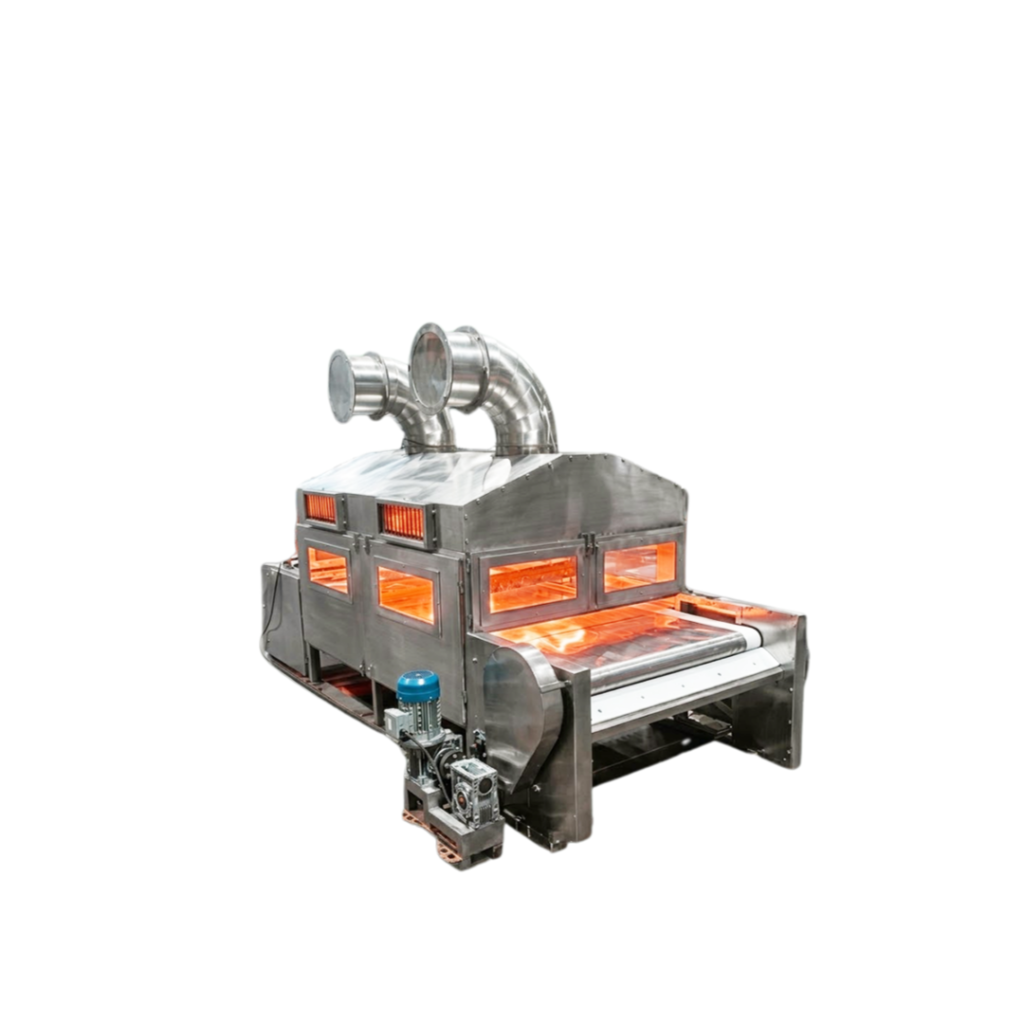
A Refractance Window Dryer uses a thin product layer placed over a temperature-controlled heat-transfer surface, commonly using a transparent polymer film.
Heat is transferred through the film while moisture evaporates from the product.
The process involves a combination of conduction, radiation and convection, with evaporative cooling helping to limit product temperature under appropriate operating conditions.
The technology is particularly relevant when the manufacturer wants to balance:
Drying Speed + Product Quality + Colour Retention + Nutrient Retention + Energy Efficiency
Recent research continues to investigate RW drying for food and biological materials, including process mechanisms, quality retention and smart process control.
Where Can RW Dryers Be Used in India?
The Indian market offers a wide range of potential applications.
1. Fruit & Fruit-Pulp Processing
India’s large fruit-processing sector creates opportunities for drying:
- Mango pulp
- Banana
- Guava
- Papaya
- Pineapple
- Strawberry
- Tomato
- Other fruit purees and concentrates
RW drying can be evaluated when the objective is to convert puree or similar feed into a stable dried product while maintaining desirable quality characteristics.
Potential products:
Fruit powder → Instant beverage ingredients → Food premixes → Functional ingredients
Indian processors can investigate RW drying for suitable vegetable purees and formulations involving:
- Tomato
- Carrot
- Pumpkin
- Spinach
- Peas
- Beetroot
- Other vegetable-based ingredients
The process parameters must be optimized according to feed thickness, solids concentration, temperature and required final moisture.
3. Herbal & Ayurvedic Ingredients
India’s extensive herbal and Ayurvedic-product ecosystem creates another potential application area.
Selected botanical materials, extracts and formulations may require controlled drying to protect valuable quality attributes.
Potential applications include:
- Herbal extracts
- Botanical ingredients
- Ayurvedic formulations
- Plant-based powders
- Functional food ingredients
However, RW drying should be selected after evaluating the actual feed material and its thermal sensitivity rather than assuming that every herbal product requires the same drying technology.
4. Nutraceutical & Functional Food Ingredients
The growth of functional foods and nutraceutical products is increasing interest in technologies capable of processing heat-sensitive ingredients.
RW drying can be evaluated for suitable:
- Fruit-based nutraceutical ingredients
- Plant extracts
- Functional food powders
- Natural antioxidant ingredients
- Botanical concentrates
- Specialty food ingredients
For high-value products, quality retention can be as important as drying capacity.
Why Indian Manufacturers Are Looking Beyond Conventional Dryers
Traditional hot-air dryers can be effective for many products, but they are not automatically the best choice for every heat-sensitive material.
For some applications, excessive thermal exposure may influence:
Colour → Aroma → Flavour → Nutrients → Bioactive Compounds → Rehydration Properties
Research on RW drying has reported advantages in product quality and retention of nutritional and sensory attributes for suitable food materials.
This makes RW technology worth evaluating when the commercial objective is not simply:
“Remove water.”
but rather:
“Remove water while preserving as much product value as practical.”
Refractance Window Dryer vs Spray Dryer vs Freeze Dryer
The correct technology depends heavily on the feed and final product.
| Requirement | Refractance Window Dryer | Spray Dryer | Freeze Dryer |
| Typical feed | Purees, juices, thin films | Liquid feeds/emulsions | Sensitive liquids/solids |
| Product form | Flakes, sheets or powders after milling | Fine powder | Highly porous dried product |
| Thermal exposure | Relatively controlled | Higher inlet air temperature | Very low product temperature |
| Continuous operation | Yes | Yes | Usually batch |
| High-value heat-sensitive food | Strong candidate | Application-dependent | Excellent but expensive |
| Capital intensity | Application-dependent | Application-dependent | Generally high |
| Best use case | Food/nutraceutical ingredients where quality and throughput matter | Powder production from liquid feed | Premium preservation applications |
This comparison is only a preliminary screening tool. Pilot testing should determine the appropriate technology for a specific product.
The Indian Applications That Can Create the Strongest Commercial Opportunity
For an Indian drying-equipment manufacturer, the opportunity extends beyond individual food products.
Maharashtra & Gujarat
Potential focus:
Food ingredients + nutraceuticals + fruit processing + specialty food manufacturing
Andhra Pradesh & Telangana
Potential focus:
Fruit processing + food ingredients + nutraceuticals + pharmaceutical-related applications
Karnataka
Potential focus:
Herbal products + nutraceuticals + specialty food ingredients + biotechnology
Tamil Nadu
Potential focus:
Food processing + coconut products + fruit and vegetable processing + functional ingredients
Kerala
Potential focus:
Coconut + spices + herbal products + nutraceutical ingredients
Punjab, Haryana & Uttar Pradesh
Potential focus:
Agro-processing + vegetable products + food ingredients + cereal-based applications
Maharashtra, Madhya Pradesh & Rajasthan
Potential focus:
Fruit processing + herbs + agricultural ingredients + food powders
This geographic targeting gives GTI an opportunity to build dedicated landing pages around searches such as:
Refractance Window Dryer Maharashtra
Refractance Window Dryer Gujarat
Refractance Window Dryer Hyderabad
Refractance Window Dryer Bangalore
Refractance Window Dryer Tamil Nadu
Refractance Window Dryer Kerala
Food Dryer Manufacturer India
Fruit Dryer Manufacturer India
What Makes an RW Dryer Project Successful?
Buying a dryer should not start with machine size.
It should start with the material.
GTI Dryers can evaluate factors such as:
Feed Characteristics
- Initial moisture
- Total soluble solids
- Viscosity
- Feed thickness
- Particle characteristics
- Solids concentration
- Stickiness
- Thermal sensitivity
Production Requirements
- Feed rate
- Required evaporation rate
- Operating hours
- Final moisture
- Required product form
- Powder or flake requirement
Product Quality
- Colour retention
- Aroma
- Nutrient retention
- Rehydration
- Water activity
- Solubility
Plant Requirements
- Available utilities
- Heating source
- Floor space
- Automation level
- Cleaning requirements
- Production scale
This engineering-first approach helps prevent the common mistake of selecting drying equipment based only on nominal capacity.
How GTI Dryers Can Support RW Dryer Projects in India
As an Indian industrial drying-system manufacturer, GTI Dryers can position its RW drying solutions around application engineering rather than simply selling a standard machine.
The project-development process can include:
Material Evaluation
↓
Laboratory/Pilot Testing
↓
Drying Parameter Development
↓
Evaporation & Energy Calculation
↓
Equipment Selection
↓
Customized Dryer Design
↓
Commercial-Scale Manufacturing
↓
Installation & Commissioning
This approach is especially valuable for products where drying conditions directly influence the commercial value of the finished ingredient.
Pilot Testing: The Most Important Step Before Buying an RW Dryer
Different food materials behave differently during drying.
A mango puree, herbal extract, tomato concentrate and nutraceutical formulation cannot automatically be processed using identical parameters.
Pilot testing can help establish:
- Drying time
- Feed-layer thickness
- Product temperature
- Final moisture
- Drying capacity
- Product quality
- Energy requirement
- Powder recovery
- Rehydration behaviour
This is particularly important when scaling from laboratory production to commercial food-processing capacity.
Can Refractance Window Drying Help Reduce Post-Harvest Losses?
Drying alone does not solve India’s post-harvest-loss challenge, but it can form part of a broader value-addition strategy.
The basic concept is:
Fresh Agricultural Produce
↓
Sorting & Processing
↓
Pulp / Puree / Extract
↓
Refractance Window Drying
↓
Stable Dried Ingredient
↓
Packaging & Storage
↓
Domestic or Export Market
This approach can convert a highly perishable raw material into a product with greater storage and processing flexibility.
Government studies continue to track post-harvest losses in Indian agricultural commodities, reinforcing the importance of improved processing and preservation infrastructure.
Is a Refractance Window Dryer Right for Your Indian Food Plant?
RW drying should be considered when the application involves:
✓ Heat-sensitive food materials
✓ Purees or liquid/semiliquid feeds
✓ Fruit and vegetable ingredients
✓ Nutraceutical ingredients
✓ Herbal or botanical materials
✓ High-value food ingredients
✓ Products where colour and nutrient retention matter
It may not be the best solution for every feed. For granular, crystalline, highly fibrous or free-flowing materials, technologies such as fluid bed, rotary, band, flash or other dryers may be more appropriate.
The correct technology should therefore be determined through material characterization and testing.
Why Choose an Indian Refractance Window Dryer Manufacturer?
Working with an Indian manufacturer can provide advantages for domestic projects, particularly where customers require application-specific engineering, communication and after-sales support.
For Indian food processors, important supplier-selection factors include:
- Application-specific dryer design
- Pilot testing
- Drying calculations
- Customized capacity
- Local technical support
- Spare-parts availability
- Installation assistance
- Commissioning support
- Process optimization
- Integration with existing food-processing lines
For GTI Dryers, the objective should be to provide a complete drying solution rather than simply supplying a piece of equipment.
Frequently Asked Questions About Refractance Window Dryers in India
What is a Refractance Window Dryer?
A Refractance Window Dryer is a thin-film drying system designed to remove moisture from suitable food and biological materials while controlling product thermal exposure.
What products can be dried using an RW Dryer?
Potential applications include fruit purees, vegetable purees, juices, herbal ingredients, nutraceutical materials and other suitable heat-sensitive food formulations.
Is Refractance Window Drying better than spray drying?
Not universally. RW drying and spray drying serve different process requirements. The best choice depends on feed properties, desired product form, capacity and quality requirements.
Is RW drying suitable for nutraceutical products?
It can be considered for suitable nutraceutical and botanical formulations, particularly where thermal sensitivity and quality retention are important. Product-specific testing is recommended.
Is Refractance Window Drying suitable for mango pulp?
Mango pulp is one of the types of puree-based materials for which RW drying can be evaluated. Actual performance depends on pulp composition, solids concentration, layer thickness and target moisture.
How much does a Refractance Window Dryer cost in India?
There is no single standard price. Cost depends on evaporation capacity, belt area, heating system, material of construction, automation, product characteristics and plant configuration. A project-specific quotation requires feed and production data.
Final Perspective: India’s Next Opportunity Is Value-Added Food Drying
India’s agricultural strength creates an enormous opportunity for value-added food processing.
The objective is increasingly moving from simply producing agricultural commodities toward manufacturing:
Powders → Extracts → Functional Ingredients → Nutraceuticals → Instant Foods → Export-Ready Ingredients
Refractance Window drying can be an important technology to evaluate for selected heat-sensitive products because research has demonstrated its potential for rapid drying and improved retention of quality attributes.
For Indian food processors, the real question is not simply:
“Which dryer should we buy?”
It is:
“Which drying technology can give us the required capacity, product quality and economics for our specific raw material?”
That is where application engineering, pilot testing and drying calculations become critical.
Looking for a Refractance Window Dryer Manufacturer in India?
GTI Dryers develops customized industrial drying solutions for food, nutraceutical, herbal and other process applications.
If you are processing fruit pulp, vegetable puree, herbal extracts, nutraceutical ingredients, functional foods or other heat-sensitive materials, share your feed characteristics and production requirement with GTI Dryers.
Our engineering team can evaluate the material, determine the appropriate drying approach and develop a preliminary RW dryer configuration, drying calculation and project recommendation for your Indian processing facility.
Contact GTI Dryers for Refractance Window Dryer India solutions, pilot testing and customized drying-system consultation.