Why India Is Becoming a High-Demand Market for Industrial Band Dryers
India’s combination of large agricultural production, expanding food processing, pharmaceutical manufacturing, chemical production and biomass utilization is creating strong opportunities for continuous industrial drying systems.
The country’s food-processing sector alone has been expanding steadily. Government data reports that food-processing GVA increased from ₹1.34 lakh crore in 2014–15 to ₹2.24 lakh crore in 2023–24, while processed-food exports have also increased significantly.
This creates a practical requirement for industrial dryers capable of handling large quantities of:
- Spices and herbs
- Fruits and vegetables
- Coconut and desiccated coconut
- Agricultural products
- Food ingredients
- Herbal materials
- Pharmaceutical granules
- Chemical products
- Biomass and agro-residues
For these applications, a band dryer, belt dryer or conveyor dryer can provide an important advantage: continuous drying with controlled temperature, airflow and residence time.
What Is a Band Dryer?
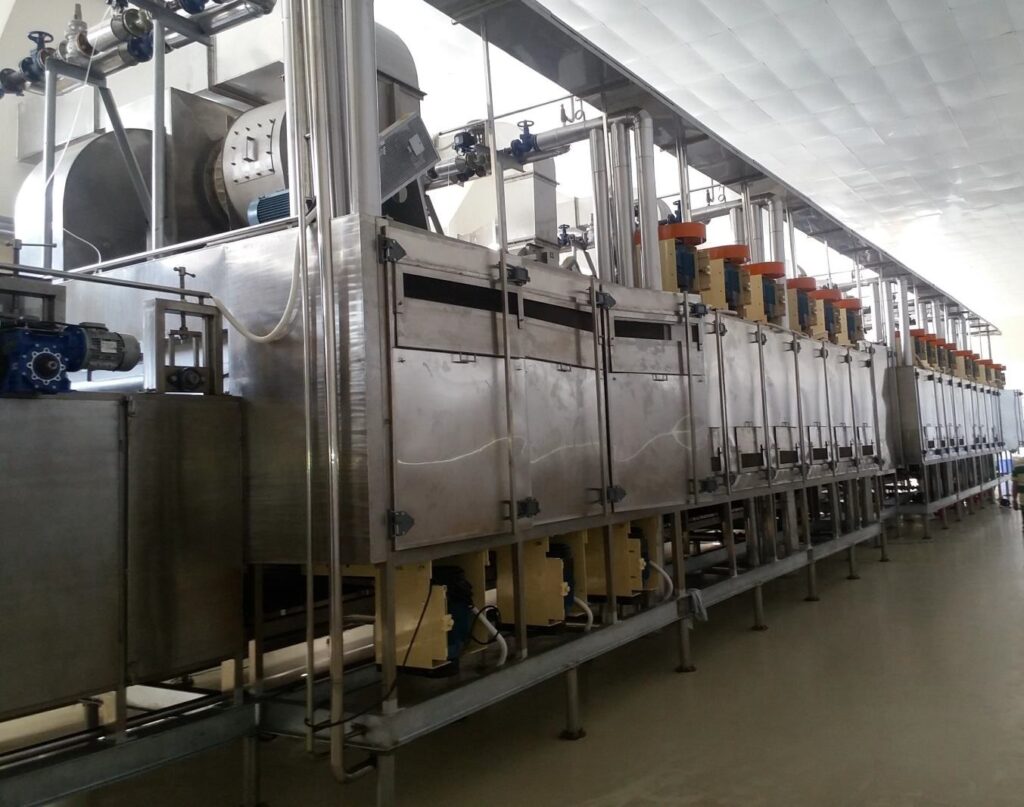
An industrial band dryer—also called a belt dryer, mesh belt dryer or conveyor dryer—is a continuous drying machine in which wet material moves through a controlled drying chamber on a perforated belt or conveyor.
Unlike a simple batch tray dryer, a continuous band dryer can be configured with multiple drying zones.
A typical process can be represented as:
Wet Feed → Feeding System → Pre-Drying → Main Drying → Final Drying → Cooling → Discharge
Each zone can be engineered with different:
- Temperature
- Airflow
- Humidity
- Residence time
- Belt speed
- Recirculation ratio
This makes band dryers particularly useful where uniform final moisture and continuous production are important.
GTI Dryers describes its band dryers as continuous systems designed for controlled moisture removal, high throughput and 24×7 industrial operation across food, chemical, pharmaceutical, biomass and other applications.
Why Band Dryers Are Important for Indian Industries
India’s processing industries often deal with seasonal agricultural materials, variable feed moisture and large production volumes.
The challenge is not simply removing moisture.
Manufacturers need to achieve:
Uniform Drying + Product Quality + Controlled Temperature + High Throughput + Lower Energy Consumption
A properly designed band dryer can address these requirements through multi-zone drying and controlled airflow.
This is particularly valuable for products where excessive temperature can affect:
- Colour
- Aroma
- Nutritional properties
- Active ingredients
- Texture
- Rehydration characteristics
- Product appearance
Where Are Band Dryers Used in India?
India is one of the world’s leading spice-producing and exporting countries. Government/industry data identifies India as the largest producer, consumer and exporter of spices, with production reaching about 11.8 million MT in FY2024.
This creates significant potential for industrial spice drying systems.
Band dryers can be evaluated for products such as:
- Chilli
- Turmeric
- Ginger
- Garlic
- Onion
- Coriander
- Cumin
- Curry leaves
- Herbs
- Botanical ingredients
For heat-sensitive spices and herbs, controlled drying can help maintain product characteristics while achieving the required final moisture.
Key Indian locations
Potential application clusters include:
Gujarat | Madhya Pradesh | Rajasthan | Andhra Pradesh | Telangana | Karnataka | Kerala | Tamil Nadu | Maharashtra
2. Coconut & Desiccated Coconut Processing
India has a major coconut-processing ecosystem, particularly across southern states.
Industrial dryers can be integrated into processing lines for:
- Desiccated coconut
- Coconut flakes
- Coconut chips
- Coconut powder
- Coconut-based ingredients
- Coconut residues
For coconut processing, the drying system must balance moisture removal, product colour, flavour and final quality.
A multi-zone band dryer can provide controlled drying rather than exposing the product to one constant high-temperature condition.
Key application regions
Kerala | Tamil Nadu | Karnataka | Andhra Pradesh | Odisha
3. Fruits & Vegetable Dehydration
India’s diverse agro-climatic conditions provide abundant raw material for fruit and vegetable processing. The Ministry of Food Processing Industries highlights India’s large agricultural base and its potential for value-added processing.
Band dryers can be considered for:
- Onion
- Garlic
- Potato
- Carrot
- Tomato
- Banana
- Mango
- Apple
- Leafy vegetables
- Dehydrated vegetable mixes
For export-oriented processors, controlled drying can help improve consistency between batches.
4. Pharmaceutical & Nutraceutical Manufacturing
India’s pharmaceutical industry is another important application area.
India ranks among the world’s largest pharmaceutical producers by volume, with more than 10,000 manufacturing units and a substantial API manufacturing base.
Depending on material characteristics and process requirements, continuous belt drying can be evaluated for:
- Pharmaceutical granules
- Herbal extracts
- Nutraceutical ingredients
- Plant-based materials
- Certain intermediates
- Crystalline products
- Specialty formulations
However, pharmaceutical applications require much stricter consideration of GMP, containment, cleaning, material compatibility and process validation than conventional food drying.
5. Chemical & Specialty Chemical Processing
India’s chemical manufacturing ecosystem creates applications for continuous drying of:
- Chemical intermediates
- Crystals
- Salts
- Pigments
- Catalysts
- Granules
- Specialty chemicals
- Industrial powders
For these applications, the dryer may be engineered around the material’s:
Moisture + Particle Size + Bulk Density + Stickiness + Thermal Sensitivity + Required Final Moisture
Depending on the material, a band dryer may be combined with other technologies such as a fluid bed, flash dryer or rotary dryer.
6. Biomass & Agro-Residue Drying
India’s large agricultural sector generates substantial quantities of biomass and agro-residues.
Potential applications include:
- Sawdust
- Wood chips
- Agricultural residues
- Biomass fibres
- Agro-processing by-products
- Organic residues
However, rotary dryers are often preferred for very high-throughput, coarse biomass applications. Band dryers become more attractive when the material requires controlled residence time, gentle handling or staged drying.
This distinction is important when selecting an industrial dryer rather than simply choosing equipment based on industry name.
Band Dryer vs Rotary Dryer: Which Is Better for India?
There is no universal “best” dryer.
| Requirement | Band Dryer | Rotary Dryer |
| Heat-sensitive products | Excellent potential | Moderate |
| Spices & herbs | Excellent | Limited depending on product |
| Fruits & vegetables | Excellent | Limited |
| Continuous processing | Excellent | Excellent |
| Fine control of residence time | Excellent | Moderate |
| Very coarse biomass | Moderate | Excellent |
| Minerals & sand | Usually not first choice | Excellent |
| Large bulk solids | Good depending on material | Excellent |
| Multi-zone drying | Excellent | Possible but different configuration |
| Gentle product handling | Excellent | Moderate |
The correct selection should be based on material characteristics and drying calculations, not simply production capacity.
What Makes GTI Dryers Different for the Indian Market?
For an Indian manufacturer, local engineering capability can be an important advantage when developing a customized drying system.
GTI Dryers can engineer industrial band drying systems around the actual requirements of the Indian processing plant, including:
Customized Drying Design
The system can be developed according to:
- Feed rate
- Initial moisture
- Final moisture
- Product temperature
- Material characteristics
- Available heat source
- Required capacity
- Factory layout
Multi-Zone Temperature Control
Different drying zones can provide staged moisture removal rather than applying identical conditions throughout the dryer.
Controlled Airflow
Air distribution is critical for achieving uniform drying across the belt width.
Energy Optimization
Potential energy-efficiency measures include:
- Hot-air recirculation
- Heat recovery
- Proper insulation
- Variable-frequency drives
- Optimized airflow
- Multi-stage drying
Actual energy savings should be established through material-specific engineering calculations and testing, rather than using a generic percentage.
Indian Manufacturing Advantage: Engineering, Testing & Support
For Indian customers, choosing an industrial band dryer manufacturer in India can simplify project development, communication, customization and after-sales support.
GTI Dryers can support projects from initial process evaluation through:
Material Analysis → Drying Calculation → Pilot Testing → Equipment Design → Manufacturing → Installation → Commissioning
This is particularly useful for processors dealing with difficult or variable materials.
Instead of asking only:
“What capacity dryer do we need?”
the better engineering questions are:
What is the feed moisture?
How much water must be evaporated per hour?
What is the target final moisture?
What temperature can the product tolerate?
Which heat source is available?
What is the required production capacity?
These parameters determine the actual dryer configuration.
How to Calculate Band Dryer Capacity
A preliminary drying calculation begins with the moisture balance.
For example:
Feed Rate → Initial Moisture → Final Moisture → Water Evaporation → Heat Duty → Airflow → Residence Time → Belt Area
Important design inputs include:
- Feed capacity, kg/h
- Initial moisture, %
- Final moisture, %
- Product bulk density
- Drying temperature
- Specific heat
- Ambient conditions
- Heat-source efficiency
- Required residence time
For commercial projects, GTI Dryers can use these parameters to develop a more detailed drying calculation and equipment sizing.
Energy Consumption of Band Dryers in India
Because industrial drying is fundamentally an evaporation process, energy efficiency becomes especially important for high-moisture materials.
A well-engineered system should consider:
Heat Input → Useful Evaporation → Exhaust Loss → Heat Recovery → Recirculation → Final Energy Consumption
Available heat sources may include:
- Steam
- Thermic fluid
- Natural gas
- LPG
- Biomass
- Electricity
- Waste heat
The optimum option depends on the plant’s location, fuel availability, utility cost and product requirements.
Why India Is a Strong Market for Continuous Drying Technology
The opportunity is not limited to one industry.
India’s food-processing sector continues to receive policy support through programs covering Mega Food Parks, cold chains, agro-processing clusters, food-safety infrastructure and value addition.
At the same time, India’s pharmaceutical and API manufacturing ecosystem provides another major market for specialized drying equipment.
This creates a broad market for industrial band dryers, belt dryers and continuous drying systems.
Looking for a Band Dryer Manufacturer in India?
If you are evaluating a band dryer, belt dryer, mesh belt dryer or continuous conveyor dryer in India, GTI Dryers can help evaluate the process based on your actual material and production requirements.
Suitable applications include:
Food Processing | Spices | Coconut | Fruits & Vegetables | Herbs | Pharmaceuticals | Nutraceuticals | Chemicals | Biomass | Agro-Residues
The right drying system can help manufacturers achieve:
Consistent Moisture → Better Product Quality → Continuous Production → Controlled Energy Use → Higher Process Efficiency
Get a Drying Recommendation From GTI Dryers
Share your:
- Material name
- Feed moisture
- Required final moisture
- Production capacity
- Product temperature limit
- Available heat source
- Application/industry
GTI Dryers can then evaluate whether a band dryer, belt dryer, fluid bed dryer, rotary dryer or another drying technology is the appropriate solution for your application.
For Indian food, spice, coconut, pharmaceutical, chemical and biomass processors, the goal is not simply to buy a dryer—it is to select the right drying process for the product, capacity and operating economics.