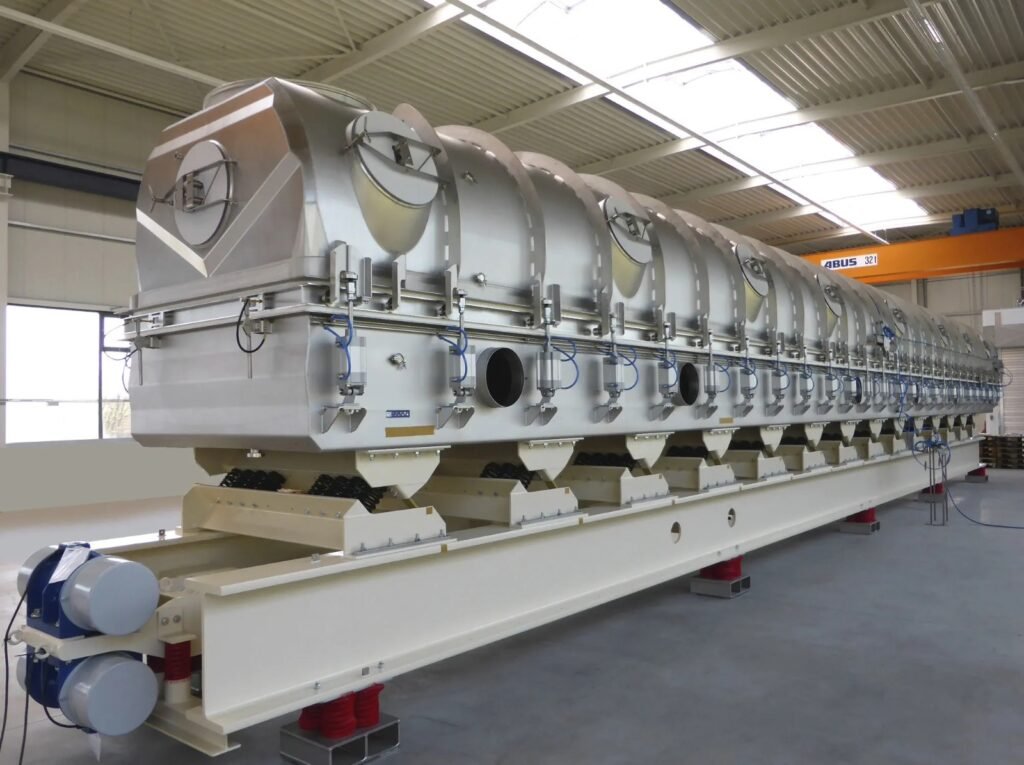
Band Dryer USA: Continuous Industrial Drying for America’s Food, Pet Food, Biomass & Chemical Industries
The United States has one of the world’s most diversified industrial processing markets, with large-scale operations spanning pet food, packaged foods, snacks, agricultural commodities, forestry products, biomass, chemicals and polymers.
Across these industries, manufacturers increasingly need drying systems that can operate continuously while maintaining consistent moisture, product quality and production capacity.
This is where industrial band dryers, belt dryers and conveyor dryers become valuable.
Unlike simple batch drying equipment, a continuous band dryer can be engineered around the specific requirements of a high-volume U.S. production line.
The objective is not simply to remove water.
It is to achieve:
Controlled Drying + Consistent Moisture + High Throughput + Product Quality + Energy Efficiency
Why Is the U.S. a Strong Market for Industrial Band Dryers?
Several characteristics of the American processing industry support demand for continuous drying systems:
- Large-scale food manufacturing
- High-volume pet food production
- Industrial snack and cereal processing
- Potato and vegetable dehydration
- Forestry and biomass processing
- Chemical and polymer manufacturing
- Automated continuous production lines
- Increasing focus on energy efficiency
- Strict food-safety and process-control requirements
For manufacturers, dryer performance directly influences production economics.
A poorly designed dryer can create:
Uneven Moisture → Product Rejects → Reprocessing → Higher Energy Consumption → Production Downtime
A properly engineered system can instead support:
Uniform Drying → Stable Product Quality → Continuous Production → Better Energy Utilization
1. Pet Food Drying: A Major U.S. Band Dryer Application
The U.S. pet food industry is one of the most important applications for industrial drying technology.
Large manufacturers produce:
- Pet food kibble
- Treats
- Snacks
- Functional pet-food products
- Meat-based pet-food products
- Grain-based formulations
- Specialty nutritional products
For suitable products, continuous belt or band drying can be incorporated into processing systems where controlled moisture reduction is required.
Why Controlled Drying Matters
Pet food manufacturers need to manage:
- Final moisture
- Product temperature
- Residence time
- Texture
- Bulk density
- Shelf stability
- Product uniformity
U.S. animal-food manufacturers also operate within FDA requirements concerning safety, sanitation, manufacturing practices and preventive controls. FDA notes that applicable animal-food facilities must follow CGMP and preventive-control requirements under the Preventive Controls for Animal Food framework.
Therefore, a pet-food drying system should be considered as part of the overall food-safety and process-control architecture, rather than as an isolated heating machine.
2. Snacks, Cereals & Dehydrated Foods
The U.S. packaged-food sector creates another major opportunity for continuous drying.
Potential applications include:
Potatoes | Vegetables | Fruits | Snacks | Cereals | Herbs | Food Ingredients
Band dryers can be configured with multiple drying zones to control the product’s moisture-removal profile.
A typical process may look like:
Wet/Prepared Product
↓
Feeding
↓
Initial Drying
↓
Main Drying
↓
Final Moisture Control
↓
Cooling / Conditioning
↓
Packaging
This is particularly useful when product quality depends on controlled moisture rather than simply achieving the fastest possible evaporation.
3. Dehydrated Potato & Vegetable Processing
Potatoes and vegetables can require carefully controlled drying to achieve the desired:
- Moisture level
- Color
- Texture
- Rehydration characteristics
- Shelf stability
A multi-zone band dryer can provide different airflow and temperature conditions across the drying chamber.
For example:
Zone 1
High-moisture removal
Zone 2
Main drying
Zone 3
Controlled final drying
Zone 4
Cooling or conditioning
The exact configuration depends on the product and production requirements.
4. Biomass & Wood Pellet Drying in the USA
The U.S. forestry and biomass industries also create demand for high-capacity industrial dryers.
Potential feedstocks include:
- Sawdust
- Wood chips
- Bark
- Forestry residues
- Agricultural biomass
- Wood-processing by-products
- Biomass fuel feedstocks
For biomass applications, however, dryer selection must be material-specific.
High-volume, free-flowing biomass may be better suited to a rotary dryer in some applications, while a band or belt dryer can be advantageous for materials requiring controlled residence time, gentle handling or specific bed-depth configurations.
The correct choice depends on:
Feed Moisture + Particle Size + Bulk Density + Throughput + Final Moisture + Available Heat Source
The U.S. specialty chemical and polymer sectors require drying systems for a wide variety of materials.
Potential applications include:
- Chemical intermediates
- Polymer products
- Resins
- Pigments
- Catalysts
- Granulated chemicals
- Industrial additives
- Agricultural chemicals
- Specialty powders
For these applications, the dryer may need precise control of:
Temperature + Airflow + Residence Time + Exhaust + Moisture + Product Handling
The material’s thermal sensitivity and physical behavior must be evaluated before selecting a belt dryer.
Why Multi-Pass Band Dryers Are Important for U.S. Plants
A multi-pass band dryer can increase the effective drying path while maintaining a relatively compact plant footprint.
Instead of requiring one extremely long drying chamber, the product can travel through multiple passes.
Example:
Pass 1 → Initial Moisture Removal
↓
Pass 2 → Main Drying
↓
Pass 3 → Final Drying
↓
Pass 4 → Cooling / Conditioning
This configuration can be particularly useful where plant space, production capacity and energy utilization all need to be considered.
How Does a Continuous Band Dryer Work?
The basic operating principle is:
Wet Feed
→
Continuous Feeding
→
Moving Mesh/Belt Conveyor
→
Controlled Heated Air
→
Moisture Evaporation
→
Multi-Zone Drying
→
Exhaust Air Management
→
Final Product
The drying conditions can be adjusted according to:
- Product thickness
- Feed moisture
- Final moisture
- Air temperature
- Air velocity
- Residence time
- Feed rate
- Product characteristics
Band Dryer vs Rotary Dryer in the USA
American manufacturers often compare band dryers and rotary dryers before investing in industrial drying equipment.
| Requirement | Band / Belt Dryer | Rotary Dryer |
| Continuous operation | Excellent | Excellent |
| Food products | Excellent for suitable materials | Good for suitable bulk products |
| Pet-food applications | Application dependent | Application dependent |
| Dehydrated vegetables | Excellent | Good |
| Biomass | Good–Excellent depending on material | Excellent for many bulk materials |
| Minerals | Application dependent | Excellent |
| Multi-zone control | Excellent | Moderate |
| Gentle drying | Strong advantage | More mechanical movement |
| Large bulk solids | Good | Excellent |
| Controlled residence time | Excellent | Good |
There is no universal winner.
For food, vegetables, snacks and products requiring controlled residence time, a band dryer may be advantageous.
For high-volume minerals, sand, rugged biomass and free-flowing bulk solids, rotary drying may be more appropriate.
How Much Does a Band Dryer Cost in the USA?
The cost of an industrial band dryer cannot be accurately determined from a generic online price because the final system depends heavily on the application.
Major cost factors include:
- Dryer capacity
- Evaporation requirement
- Number of drying zones
- Belt width
- Dryer length
- Heating source
- Material of construction
- Automation level
- Heat-recovery system
- Exhaust treatment
- Feed and discharge equipment
- Installation requirements
A small food-processing dryer and a high-capacity multi-pass industrial dryer can therefore have dramatically different project costs.
The better approach is to first determine:
Feed Rate → Moisture → Water Evaporation → Heat Duty → Dryer Size → Energy Consumption → Capital Cost
How to Calculate Band Dryer Capacity
Dryer capacity should be calculated from the actual process rather than the machine name.
Important inputs include:
Feed Capacity
How many kg/h or tonnes/h enter the dryer?
Initial Moisture
How much water is present in the feed?
Final Moisture
What moisture level must the finished product achieve?
Evaporation Load
How many kilograms of water must be removed per hour?
Residence Time
How long must the product remain inside the dryer?
Drying Conditions
What temperature and airflow are required?
A simplified engineering relationship begins with:
Water Evaporation = Water in Feed − Water Remaining in Final Product
The resulting evaporation requirement becomes a major input for dryer sizing and thermal calculations.
For an actual project, additional material and process properties must be evaluated.
Band Dryer Energy Consumption: How Can U.S. Plants Reduce Operating Costs?
Energy can represent a major portion of industrial drying operating costs.
An efficient band dryer can be designed around several strategies.
1. Heat Recovery
Recover usable heat from exhaust streams where technically and economically practical.
2. Optimized Airflow
Avoid unnecessarily high airflow and match air movement to the product.
3. Multi-Zone Temperature Control
Use different temperature profiles through the drying process rather than operating the entire dryer under one condition.
4. Variable Frequency Drives
VFDs can regulate:
- Fans
- Conveyors
- Feeders
- Exhaust systems
5. Proper Insulation
Good thermal insulation helps minimize heat losses from the drying chamber and hot-air ducts.
6. Efficient Heat Sources
Depending on the facility, systems can be engineered around:
- Natural gas
- LPG
- Steam
- Thermal oil
- Electricity
- Biomass
- Waste heat
The optimum configuration depends on local utility prices and plant infrastructure.
U.S. Regional Opportunities for Industrial Band Dryers
The American market is geographically diverse, so applications can vary significantly by region.
Midwest
Major opportunities in:
Food Processing | Pet Food | Agricultural Products | Chemicals
States such as Iowa, Illinois, Indiana, Minnesota and Wisconsin have extensive food and agricultural processing activity.
California & Western States
Potential demand includes:
Food Ingredients | Fruits & Vegetables | Agricultural Processing | Biomass
Pacific Northwest
The forestry sector creates opportunities for:
Wood Processing | Biomass | Wood Residues | Pellet-Related Processing
Southern U.S.
Industrial applications can include:
Pet Food | Chemicals | Agricultural Processing | Wood Products
Northeast
Potential applications include:
Specialty Chemicals | Food Ingredients | Pharmaceuticals | Advanced Manufacturing
This regional approach makes the page more relevant to U.S. searches such as:
“industrial band dryer USA”
“pet food belt dryer USA”
“food processing dryer manufacturer USA”
“biomass belt dryer USA”
“industrial conveyor dryer manufacturer”
What Should U.S. Buyers Check Before Purchasing a Band Dryer?
Before requesting quotations, plant engineers should prepare several important parameters.
Material Information
- Material name
- Initial moisture
- Final moisture
- Particle size
- Bulk density
- Stickiness
- Flowability
- Thermal sensitivity
Production Information
- Feed rate
- Operating hours
- Required throughput
- Continuous or batch operation
- Seasonal variations
Utility Information
- Available steam
- Natural gas
- LPG
- Electricity
- Biomass
- Waste heat
Product Requirements
- Final moisture
- Product temperature
- Color
- Texture
- Particle integrity
- Shelf stability
The more accurate the input data, the more reliable the dryer recommendation.
Pilot Testing: Reduce Risk Before Commercial Installation
For new materials or demanding applications, pilot testing can provide valuable information before purchasing full-scale equipment.
Testing can help evaluate:
- Drying rate
- Moisture reduction
- Product quality
- Residence time
- Airflow
- Temperature profile
- Energy requirement
- Commercial-scale dryer configuration
For pet food, food ingredients, biomass and chemical materials, application-specific testing can help determine whether a band dryer, rotary dryer, fluid bed dryer or another technology is more appropriate.
Why Choose GTI Dryers for U.S. Industrial Drying Projects?
GTI Dryers provides customized industrial drying solutions for applications across:
Food | Pet Food | Agriculture | Biomass | Chemicals | Pharmaceuticals | Minerals | Industrial Processing
Depending on the material, GTI Dryers can evaluate technologies including:
Band Dryers | Mesh Belt Dryers | Multi-Pass Belt Dryers | Rotary Dryers | Flash Dryers | Fluid Bed Dryers | Paddle Dryers | Spray Dryers | Vacuum Dryers
The engineering approach begins with the customer’s material rather than forcing every application into one standard machine.
GTI Dryers can support projects through:
- Material evaluation
- Drying calculations
- Pilot testing
- Dryer selection
- Customized engineering
- Process design
- Automation
- Energy optimization
- Equipment manufacturing
- Installation and commissioning support
U.S. Buyer FAQ: Band & Belt Dryers
What is a band dryer?
A band dryer is a continuous industrial drying system in which material travels through a controlled drying chamber on a moving belt while heated air removes moisture.
Is a band dryer suitable for pet food?
It can be suitable for certain pet-food products and process stages, depending on feed characteristics, moisture targets, thermal requirements and the overall process design.
U.S. pet-food facilities must also consider applicable FDA food-safety, CGMP and preventive-control requirements.
Is a band dryer better than a rotary dryer?
Not necessarily. Band dryers are often attractive for products requiring controlled residence time and multi-zone drying, while rotary dryers can be advantageous for many high-volume bulk-solid applications.
Can a band dryer dry biomass?
Yes, for suitable biomass materials. However, the feed moisture, particle size, bulk density and required capacity should be evaluated before selecting the technology.
How can band dryer energy consumption be reduced?
Heat recovery, optimized airflow, multi-zone temperature control, VFDs and proper insulation can improve energy utilization.
How is a band dryer sized?
Sizing depends on feed rate, initial moisture, target final moisture, evaporation load, product characteristics, residence time, temperature and airflow.
Should I perform pilot testing?
For unfamiliar, heat-sensitive or difficult-to-dry materials, pilot testing can significantly improve confidence in the commercial dryer design.
The U.S. Opportunity for Advanced Continuous Drying
The American market combines high-volume food production, sophisticated pet-food manufacturing, large agricultural processing, forestry resources and advanced chemical manufacturing.
That combination creates demand for drying systems capable of operating continuously while maintaining:
Capacity + Moisture Uniformity + Product Quality + Energy Efficiency
For manufacturers looking to upgrade an existing dryer or establish a new production line, the right equipment should be selected through engineering calculations rather than capacity alone.
Need a Band Dryer for a U.S. Processing Plant?
If you are evaluating an industrial band dryer, belt dryer, conveyor dryer or multi-pass drying system in the United States, GTI Dryers can assess your application based on material characteristics and production requirements.
Whether your application involves:
Pet Food | Snacks | Dehydrated Potatoes | Vegetables | Biomass | Wood Residues | Chemicals | Polymers | Food Ingredients
the starting point is simple:
Material + Feed Moisture + Final Moisture + Capacity + Heat Source
From these parameters, GTI Dryers can develop a preliminary drying calculation, technology recommendation and pilot-testing strategy for your application.
Looking for an industrial band dryer manufacturer for the USA? Contact GTI Dryers to discuss your material, capacity and drying requirements.