Japan’s Industrial Drying Market: Precision, Efficiency & Resource Recovery
Japan is one of Asia’s most technically advanced manufacturing economies, with sophisticated requirements across chemicals, electronic materials, pharmaceuticals, specialty materials, food processing and wastewater treatment.
For these industries, drying is not simply a moisture-removal step.
It can directly influence:
Product Purity → Particle Characteristics → Moisture Control → Energy Consumption → Material Recovery → Process Stability
This is particularly important for difficult materials such as chemical filter cakes, electronic-chemical intermediates, high-moisture sludge and heat-sensitive process solids.
At the same time, Japan’s limited land availability has historically encouraged thermal treatment and resource-efficient approaches to sewage sludge management. Recent research notes that almost all sewage sludge in Japan is treated through thermal routes rather than conventional landfill disposal, with drying, incineration, melting, carbonization and gasification among commercially implemented approaches.
This creates a strong technical case for evaluating indirect paddle dryers and vacuum paddle dryers in appropriate applications.
Why Paddle Dryers Are Relevant to Japan
Japanese industrial plants often require equipment capable of handling materials that are:
- Sticky
- Pasty
- Heat-sensitive
- High in moisture
- Chemically active
- Fine-particle based
- Difficult to fluidize
- Sensitive to contamination
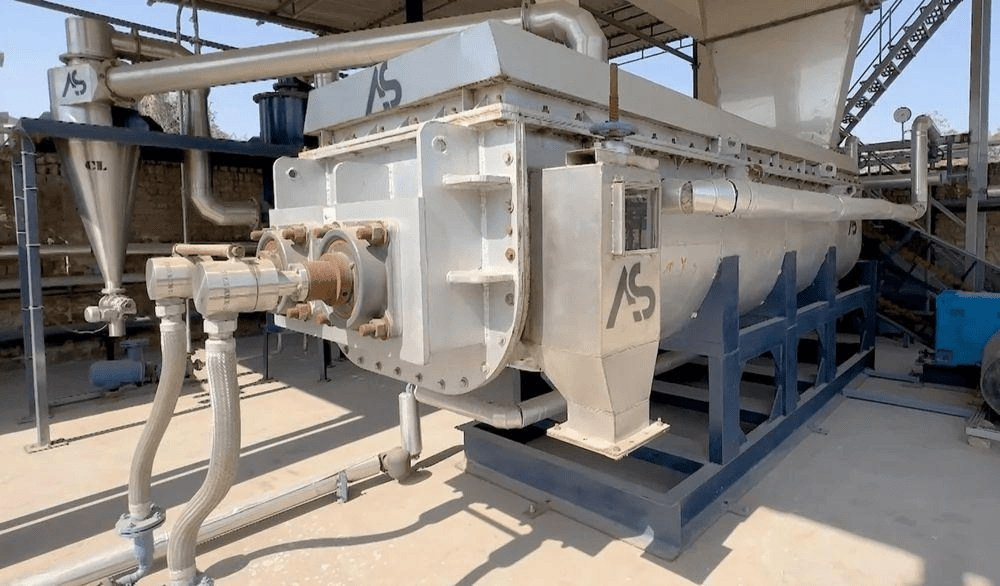
A Paddle Dryer uses indirect heat transfer through heated surfaces while mechanical paddles continuously mix and move the material.
The process can be represented as:
Wet Feed → Mixing & Conveying → Indirect Heat Transfer → Moisture Evaporation → Dry Product
For applications requiring lower drying temperatures or controlled atmospheres, a vacuum paddle dryer can be evaluated.
Japan’s Three Major Paddle Dryer Opportunities
Rather than treating the Japanese market as a single application, GTI Dryers can target three major segments.
01 — Advanced Materials & Electronic Chemicals
Japan has a highly developed ecosystem for specialty materials and electronic manufacturing.
Suitable paddle-drying applications may include:
- Specialty chemical intermediates
- Electronic chemical materials
- Fine powders
- Inorganic materials
- Catalyst-related materials
- Battery-material intermediates
- High-value process solids
These applications can place strong emphasis on:
Purity + Temperature Control + Containment + Moisture Uniformity
For such materials, dryer selection should be based on actual feed behavior, thermal sensitivity and required product specifications.
02 — Municipal & Industrial Sludge
Sludge treatment is another important opportunity.
Japan’s land constraints and established thermal treatment infrastructure have made sludge drying an important process option. Research on Japanese sludge treatment identifies drying as a means of reducing moisture, lowering transportation requirements and improving the efficiency of subsequent thermal processing.
Potential applications include:
- Municipal sewage sludge
- Industrial wastewater sludge
- ETP sludge
- Filter-press cake
- Digested sludge
- High-moisture organic residues
A paddle dryer can potentially be integrated after mechanical dewatering and before downstream thermal treatment.
03 — Chemical Recovery & Specialty Processing
Japan’s chemical sector creates demand for controlled drying of materials where direct hot-gas contact may not be desirable.
Potential applications include:
- Chemical filter cakes
- Specialty chemicals
- Fine chemicals
- Pigments
- Organic residues
- Pharmaceutical intermediates
- Crystalline solids
For certain heat-sensitive or solvent-containing materials, vacuum drying can be evaluated as part of a controlled process.
Vacuum Paddle Dryer vs Indirect Paddle Dryer
Japanese customers often require precision rather than simply maximum throughput.
| Application Requirement | Indirect Paddle Dryer | Vacuum Paddle Dryer |
| Municipal sludge | Suitable for selected applications | Possible |
| Industrial sludge | Suitable | Suitable |
| Chemical filter cake | Suitable | Suitable |
| Fine chemicals | Suitable | Strong candidate |
| Heat-sensitive materials | Application dependent | Strong candidate |
| Low-temperature drying | Application dependent | Advantage |
| Controlled atmosphere | Limited | Strong advantage |
| Solvent-containing materials | Application dependent | Potentially suitable |
| Continuous operation | Yes | Depending on design |
The correct configuration must be determined from material characteristics, evaporation requirements, thermal sensitivity and downstream process conditions.
Japan’s Sludge-to-Resource Opportunity
Japan is increasingly interested in resource recovery from wastewater.
Phosphorus is particularly relevant because Japan has historically depended heavily on imported phosphorus resources. Research on Japan’s phosphorus-recovery landscape identifies sewage sludge as a potential secondary phosphorus resource.
Recent Japanese initiatives are also expanding phosphorus recovery from sewage sludge for fertilizer production.
However, it is important to distinguish the role of the dryer:
Paddle Dryer ≠ Phosphorus Recovery System
Instead, drying can form part of a larger process:
Wastewater Treatment
↓
Sludge Generation
↓
Mechanical Dewatering
↓
Paddle Drying
↓
Thermal Treatment / Ash Processing
↓
Phosphorus Recovery / Resource Utilization
The appropriate process depends on the selected recovery technology and characteristics of the sludge.
Why Indirect Paddle Drying Fits Precision-Oriented Applications
A major advantage of indirect paddle drying is that the process can be engineered around controlled heat transfer.
Controlled Thermal Processing
Heated surfaces transfer thermal energy to the material while paddles continuously mix it.
Enclosed Material Handling
An enclosed process can be advantageous where containment and controlled vapor handling are important.
Suitable for Sticky Materials
Mechanical agitation can help process materials that are difficult to fluidize.
Lower Direct-Gas Contact
Indirect heating can be useful where direct combustion-gas/product contact is undesirable.
Integration With Heat Recovery
Where suitable, waste heat or recovered thermal energy can be incorporated into the overall drying system.
Energy Efficiency: A Major Consideration for Japanese Plants
Energy efficiency is particularly important for continuous industrial drying.
A properly engineered paddle dryer can be evaluated for:
Heat Recovery
Recovering useful energy from exhaust or downstream processes where technically practical.
Thermal Insulation
Reducing heat loss from the dryer body, ducts and process surfaces.
Optimized Residence Time
Avoiding unnecessary thermal exposure.
Controlled Feed Rate
Maintaining stable material loading and drying conditions.
Variable-Speed Drives
Controlling:
- Paddle speed
- Feed system
- Discharge system
- Auxiliary equipment
Heat-Source Optimization
Possible heating options can include:
- Steam
- Thermal oil
- Hot water
- Electricity
- Waste heat
- Other suitable plant heat sources
Actual energy performance must be established through material-specific calculations and, where appropriate, testing.
How Much Capacity Does a Paddle Dryer Need?
Japanese projects should not select a dryer solely from wet-feed capacity.
The important calculation is the water evaporation requirement.
For example:
Wet Feed = 3,000 kg/h
Initial Moisture = 75%
Water entering the dryer:
3,000 × 0.75 = 2,250 kg/h
Dry solids:
3,000 × 0.25 = 750 kg/h
If the target moisture is 10%:
Final product:
750 ÷ 0.90 ≈ 833 kg/h
Approximate water evaporated:
2,250 − 83 ≈ 2,167 kg/h
This is why an accurate drying calculation is essential before selecting the commercial paddle dryer.
Japan Paddle Dryer Projects Need Material Testing
A catalogue specification cannot accurately predict the performance of every chemical or sludge.
Before commercial-scale equipment selection, GTI Dryers can evaluate:
- Initial moisture
- Final moisture
- Feed rate
- Solids concentration
- Bulk density
- Stickiness
- Particle size
- Thermal sensitivity
- Residence time
- Heat requirement
- Product discharge behavior
Pilot testing can help determine whether an indirect paddle dryer, vacuum paddle dryer or another drying technology is appropriate.
What Industries in Japan Can Use Paddle Dryers?
Chemical Manufacturing
For specialty chemicals, filter cakes and selected process intermediates.
Electronic Chemicals
For suitable high-purity and moisture-sensitive materials.
Advanced Materials
For selected inorganic, specialty and functional-material applications.
Pharmaceuticals
For suitable API intermediates, crystalline solids and heat-sensitive materials.
Municipal Wastewater
For sludge moisture reduction before thermal treatment or other recovery routes.
Industrial Wastewater
For ETP sludge, filter cake and high-moisture process residues.
Food Ingredients
For selected pasty or high-moisture food-processing materials where indirect drying is appropriate.
How GTI Dryers Can Serve Japanese Customers
GTI Dryers is an Indian industrial dryer manufacturer developing customized drying equipment for international applications.
For Japanese projects, the approach should be based on engineering data rather than a standard machine.
Project Workflow
1. Material Data
What exactly needs to be dried?
↓
2. Moisture Analysis
How much water must be removed?
↓
3. Drying Calculation
What is the evaporation and thermal requirement?
↓
4. Technology Selection
Paddle / Vacuum Paddle / Rotary / Flash / Fluid Bed / Band
↓
5. Pilot Testing
Can the selected configuration achieve the required result?
↓
6. Customized Engineering
Equipment designed around the actual process.
↓
7. Manufacturing & International Project Support
Commercial-scale equipment and technical documentation.
What Should Japanese Buyers Ask a Paddle Dryer Manufacturer?
Before purchasing an industrial paddle dryer, evaluate:
Material Compatibility
Can the dryer handle the actual sludge, chemical or powder?
Thermal Performance
What is the calculated evaporation capacity?
Energy Consumption
What heat source and recovery options are available?
Containment
How are vapors, dust and process gases managed?
Material of Construction
Is the equipment suitable for corrosive or chemically active materials?
Automation
Can PLC, sensors, VFDs and process monitoring be integrated?
Pilot Testing
Can the manufacturer validate the process before scale-up?
International Support
Can engineering documentation and remote/onsite commissioning support be provided?
Japan-Specific Search Questions
What is a paddle dryer used for in Japan?
Industrial paddle dryers can be used for suitable sludge, chemical filter cakes, specialty materials and other wet or difficult-to-handle solids requiring controlled indirect drying.
Is a paddle dryer suitable for sewage sludge?
Yes, for suitable sludge characteristics and process configurations. Japanese research identifies thermal drying as an established sludge-treatment option, particularly for reducing moisture before subsequent utilization or thermal treatment.
Why is sludge drying important in Japan?
Japan’s limited land availability and established thermal treatment infrastructure make moisture reduction and efficient sludge processing important. Drying can reduce transport mass and improve downstream thermal-processing efficiency.
Is vacuum paddle drying suitable for electronic chemicals?
It can be considered for suitable materials where controlled temperature, atmosphere and moisture removal are important. Final equipment selection requires material-specific testing.
Can paddle dryers help phosphorus recovery?
A paddle dryer does not recover phosphorus by itself. It may serve as a drying/pre-treatment step within a larger sludge-treatment and phosphorus-recovery process.
Why GTI Dryers for the Japanese Market?
GTI Dryers can offer customized drying solutions for:
Industrial Sludge | Chemical Filter Cake | Fine Chemicals | Advanced Materials | Electronic Chemicals | Pharmaceutical Intermediates | High-Moisture Process Solids
Available technology options can include:
Indirect Paddle Dryer | Vacuum Paddle Dryer | Rotary Dryer | Flash Dryer | Fluid Bed Dryer | Band Dryer | Mesh Belt Dryer | Vacuum Dryer
The objective is not simply to sell a dryer.
The objective is to develop a system around:
Material → Moisture → Capacity → Thermal Requirement → Product Quality → Energy Efficiency → Process Integration
Japan: A Strategic Market for High-Precision Industrial Drying
Japan’s combination of advanced materials manufacturing, specialty chemicals, sophisticated wastewater treatment and strong resource-efficiency requirements makes it an attractive market for high-precision industrial drying technologies.
The wastewater segment is particularly relevant because Japan already has substantial experience with thermal sludge treatment, while newer resource-recovery initiatives are creating additional opportunities around phosphorus and other recovered materials.
For GTI Dryers, this creates an opportunity to bring Indian-engineered paddle drying technology to Japanese chemical, environmental and advanced-material processing applications.
Looking for a Paddle Dryer for Japan?
If your Japanese project involves:
Sewage Sludge | Industrial ETP Sludge | Chemical Filter Cake | Electronic Chemicals | Advanced Materials | Fine Chemicals | Pharmaceutical Intermediates | High-Moisture Solids
GTI Dryers can evaluate the material and recommend a suitable drying approach.
Share Your Process Data
Send:
- Material name
- Wet-feed capacity
- Initial moisture
- Target final moisture
- Feed temperature
- Available heat source
- Required operating hours
- Product requirements
GTI Dryers can then develop a preliminary:
Drying Calculation → Technology Recommendation → Pilot Testing Plan → Customized Paddle Dryer Proposal
GTI Dryers — Indian industrial drying engineering for global applications, including Japan.