India’s Growing Demand for Industrial Paddle Dryers
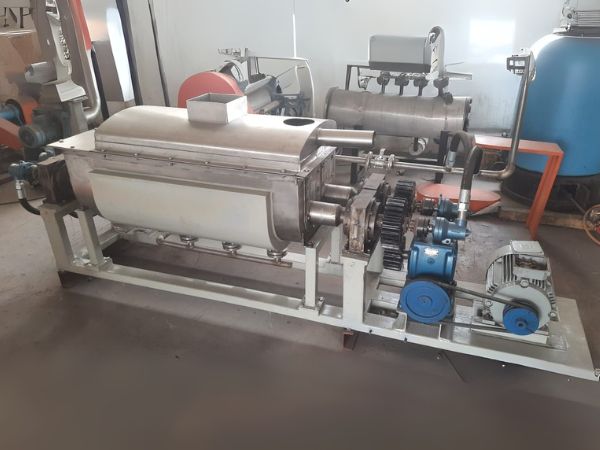
India’s pharmaceutical, chemical, agrochemical and wastewater-treatment industries are creating increasing demand for controlled, enclosed and energy-efficient industrial drying systems.
From pharmaceutical manufacturing clusters in Hyderabad, Ahmedabad, Vadodara and Mumbai to chemical and agrochemical production zones across Gujarat, Maharashtra, Telangana, Andhra Pradesh and Tamil Nadu, manufacturers increasingly require drying equipment capable of handling wet filter cakes, API intermediates, crystalline solids, pigments, dyes, chemical residues and industrial sludge.
At the same time, wastewater treatment and resource-recovery projects are generating large volumes of high-moisture sludge and filter cake that require further processing.
This is where an industrial paddle dryer can become an important part of the process.
Unlike conventional direct hot-air drying, an indirect paddle dryer transfers heat through heated surfaces, making it particularly relevant for materials where controlled temperature, enclosed processing, low exhaust volume or handling of sticky/pasty feedstocks are important considerations.
For Indian manufacturers evaluating drying equipment, the key question is therefore not simply:
“Which dryer should we buy?”
It is:
“Which drying technology provides the right combination of moisture reduction, product quality, energy performance, containment and operating economics for our material?”
Why Paddle Dryers Are Important for India’s Pharmaceutical & Chemical Industries
India is a major manufacturing base for APIs, pharmaceutical intermediates, specialty chemicals, dyes, pigments, agrochemicals and other process chemicals.
Many of these processes generate materials such as:
- Pharmaceutical filter cakes
- API intermediates
- Wet crystalline products
- Chemical filter cakes
- Pigments and dyes
- Agrochemical intermediates
- Organic and inorganic residues
- Industrial wastewater sludge
- High-moisture pasty materials
These materials can be difficult to process using conventional dryers because they may be sticky, heat-sensitive, solvent-containing, pasty or difficult to fluidize.
A properly engineered paddle dryer or vacuum paddle dryer can provide controlled indirect thermal processing for suitable applications.
The final dryer configuration, however, must be selected based on the actual material characteristics and process requirements.
Where Are Paddle Dryers in Demand Across India?
India’s industrial demand is concentrated around several major manufacturing clusters.
Gujarat – Chemicals, APIs & Agrochemicals
Industrial regions such as Ahmedabad, Vadodara, Ankleshwar, Vapi and Surat have extensive chemical, pharmaceutical and agrochemical activity.
Potential paddle-dryer applications include:
- Chemical filter cake
- API intermediates
- Dyes and pigments
- Agrochemical residues
- ETP sludge
- Specialty chemicals
Maharashtra – Pharmaceuticals & Specialty Chemicals
Mumbai, Thane, Pune and surrounding industrial areas represent important pharmaceutical, chemical and engineering markets.
Paddle dryers may be evaluated for:
- Pharmaceutical intermediates
- Chemical filter cakes
- Specialty chemicals
- Sludge
- Heat-sensitive materials
Telangana – Pharmaceutical & API Manufacturing
Hyderabad and the surrounding pharmaceutical corridor have significant API and pharmaceutical manufacturing activity.
Potential applications include:
- API wet cake
- Pharmaceutical intermediates
- Crystalline solids
- Solvent-containing materials
- Pharmaceutical wastewater residues
Andhra Pradesh – Bulk Drugs & Chemicals
Industrial clusters in Andhra Pradesh also create demand for controlled drying systems for pharmaceutical and chemical processing.
Tamil Nadu & Karnataka – Pharma, Food & Specialty Processing
Industrial facilities in Chennai, Bengaluru and other manufacturing centres can require customized drying systems for pharmaceuticals, chemicals, food ingredients and industrial residues.
This creates strong local search opportunities for terms such as:
“paddle dryer manufacturer Gujarat”
“pharmaceutical paddle dryer India”
“paddle dryer manufacturer Hyderabad”
“industrial paddle dryer Mumbai”
“paddle dryer for ETP sludge India”
Paddle Dryer for Pharmaceutical API & Filter Cake Drying
One of the most important applications for paddle drying in India is pharmaceutical and API processing.
Pharmaceutical manufacturing can generate wet cakes after filtration or centrifugation. These materials may contain significant quantities of water or organic solvents.
Depending on the application, a vacuum paddle dryer (VPD) can be considered where reduced-pressure drying, controlled temperature and enclosed processing are required.
Potential applications include:
- API filter cake
- Pharmaceutical intermediates
- Crystalline products
- Fine chemicals
- Solvent-wet materials
- Heat-sensitive pharmaceutical materials
For solvent-containing products, the system may be engineered with appropriate vacuum, condensation and solvent-recovery arrangements, subject to the material and plant requirements.
Important parameters include:
Feed moisture → Solvent content → Feed rate → Target moisture → Product temperature → Heating medium → Vacuum requirement → Residence time
This application-specific approach is much more reliable than selecting a dryer purely on nominal capacity.
Paddle Dryer for ETP Sludge, Industrial Sludge & ZLD Applications
Another important Indian market is industrial wastewater and sludge management.
Pharmaceutical, chemical, textile, food and other industrial facilities can generate sludge through wastewater treatment.
The overall process can involve:
ETP → Clarification/Treatment → Sludge Separation → Mechanical Dewatering → Wet Cake → Paddle Dryer → Dried Solids
A paddle dryer can be evaluated where indirect thermal drying is suitable for the dewatered sludge.
Potential applications include:
- ETP sludge
- Pharmaceutical sludge
- Chemical sludge
- Industrial filter cake
- Organic residues
- High-moisture process solids
However, drying requirements vary substantially depending on the sludge composition, solids concentration, stickiness, organic content and final disposal or recovery objective.
Therefore, material testing and engineering calculations are important before equipment selection.
Why Choose an Indirect Paddle Dryer?
Paddle dryers use heated surfaces to transfer thermal energy to the material.
This can provide several process advantages for suitable applications:
Controlled Heat Transfer
Indirect heating allows the process to be designed around controlled product temperatures.
Enclosed Processing
An enclosed dryer configuration can be beneficial when handling certain chemicals, pharmaceutical intermediates or odor-producing materials.
Low Process-Air Requirement
Because the primary heating mechanism is indirect, the process may require considerably less drying air than conventional direct systems, depending on the design.
Suitable for Difficult Materials
Paddle dryers can be considered for materials that are:
- Sticky
- Pastelike
- Filter-cake-like
- Sludge-like
- Heat-sensitive
- Difficult to fluidize
Flexible Heating Options
Depending on the application, heating may be provided through media such as:
- Steam
- Thermal oil
- Hot water
- Other engineered heating arrangements
Paddle Dryer vs Rotary Dryer: Which Is Better?
There is no universally “best” industrial dryer.
The appropriate technology depends on the material.
| Requirement | Paddle Dryer | Rotary Dryer |
| Sticky/pasty material | Often suitable | Application dependent |
| Wet filter cake | Suitable for many applications | Depends on feedability |
| Bulk granular solids | Suitable | Excellent |
| Minerals | Application dependent | Common choice |
| Sludge | Strong application area | Also possible |
| Indirect drying | Yes | Available in certain configurations |
| High-temperature bulk drying | Application dependent | Common |
| Vacuum drying | Vacuum paddle configurations available | Specialized designs |
| Pharmaceutical applications | Suitable for selected materials | Application dependent |
For API filter cakes, sticky chemical materials and certain sludge applications, a paddle dryer may offer advantages.
For large-volume free-flowing minerals, sand and bulk solids, a rotary dryer may often be more appropriate.
The correct choice should be based on material testing and process calculations.
How GTI Dryers Approaches Paddle Dryer Selection
At GTI Dryers, dryer selection begins with the material and process—not simply the name of the product.
A typical evaluation considers:
Material Characterization
↓
Initial Moisture
↓
Feed Rate
↓
Target Final Moisture
↓
Heat Requirement
↓
Heating Medium
↓
Residence Time
↓
Dryer Configuration
↓
Capacity & Energy Calculation
This approach helps develop a paddle dryer configuration aligned with the customer’s actual production requirement.
What Information Is Required Before Buying a Paddle Dryer?
If you are planning a paddle dryer project in India, providing the following information can significantly improve the accuracy of the initial engineering assessment:
- Material name
- Feed capacity
- Initial moisture %
- Desired final moisture %
- Solids concentration
- Feed temperature
- Bulk density
- Particle size
- Stickiness
- Organic/inorganic composition
- Solvent content
- Required operating temperature
- Heating medium available
- Steam pressure, if applicable
- Thermal-oil temperature, if applicable
- Vacuum requirement
- Operating hours per day
- Required material of construction
- Hazardous-area requirements, where applicable
Example:
A request stating:
“We need a 1 TPH paddle dryer”
does not provide enough information for accurate equipment selection.
A much better RFQ would state:
“We have 1,000 kg/hr pharmaceutical filter cake containing X% moisture and require Y% final moisture using available steam at Z bar.”
That allows the engineering team to evaluate water evaporation, heat duty, dryer capacity and configuration.
How Is Paddle Dryer Capacity Calculated?
A preliminary drying calculation begins with the amount of moisture that must be removed.
For example:
Feed = 1,000 kg/hr
Initial moisture = 50%
Final moisture = 10%
The engineer must determine the corresponding water evaporation requirement and then evaluate:
- Heat required for evaporation
- Sensible heating
- Heat losses
- Heating-medium requirement
- Residence time
- Effective heat-transfer area
- Paddle configuration
- Dryer volume
- Motor power
This is why paddle dryer capacity cannot be accurately selected using feed rate alone.
GTI Dryers can evaluate these parameters as part of the equipment-selection process.
Paddle Dryer Energy Consumption: How Can Operating Costs Be Reduced?
Energy efficiency is increasingly important for Indian chemical, pharmaceutical and environmental-processing plants.
Potential energy-optimization measures include:
Heat Recovery
Recovering usable heat from suitable process streams can reduce overall thermal demand.
Optimized Heating Surface
Correct sizing of the heat-transfer area helps avoid excessive thermal load.
Proper Insulation
Insulation reduces unnecessary heat losses from the dryer body and associated hot surfaces.
Variable-Speed Control
VFDs can regulate appropriate process equipment such as feed systems and auxiliary drives.
Vacuum Operation
For suitable materials, vacuum drying can lower the effective boiling temperature and support controlled drying.
Correct Moisture Target
Over-drying a product wastes energy. The final moisture specification should therefore be clearly defined.
The actual energy consumption depends heavily on feed moisture, evaporation load, material properties, heating medium, operating conditions and dryer design.
How GTI Dryers Helps De-Risk Paddle Dryer Projects
Industrial drying equipment represents a significant capital investment.
Before finalizing a system, customers should ideally understand:
Can the material be dried successfully?
What final moisture can be achieved?
What thermal load is required?
What dryer capacity is appropriate?
How will the material behave during drying?
What heating source should be used?
This is where pilot testing and drying calculations become valuable.
Material Testing
Where appropriate, drying trials can help evaluate:
- Moisture reduction
- Product behaviour
- Drying time
- Temperature requirements
- Product quality
- Energy requirements
Engineering Calculations
The engineering evaluation can then consider:
Feed Rate + Moisture Reduction + Water Evaporation + Heat Duty + Residence Time + Heat Transfer Area = Dryer Configuration
This provides a stronger technical basis for equipment selection.
Why Choose GTI Dryers as an Indian Paddle Dryer Manufacturer?
For Indian pharmaceutical, chemical, food and wastewater projects, working with an Indian manufacturer can provide practical advantages.
Application-Specific Engineering
GTI Dryers can develop equipment around the characteristics of the customer’s material rather than relying only on standard machine sizes.
Customized Construction
Material of construction and equipment configuration can be selected according to the process requirements.
Multiple Heating Options
Depending on the project, systems can be designed around appropriate heating media such as steam or thermal oil.
Automation
Industrial paddle dryers can incorporate process controls for parameters such as:
- Temperature
- Feed rate
- Drive speed
- Vacuum
- Pressure
- Heating conditions
Technical Support
An Indian manufacturing base can simplify technical communication, engineering coordination, commissioning and spare-parts support for domestic customers.
Export-Oriented Engineering
For customers outside India, the same engineering approach can be adapted for international projects and different industrial standards.
Paddle Dryer Applications: Beyond Pharmaceuticals
Although pharmaceutical drying is an important application, paddle dryers can also be evaluated for numerous other industries.
- Specialty chemicals
- Chemical filter cakes
- Pigments
- Dyes
- Intermediates
- Industrial residues
Agrochemical Industry
- Agrochemical intermediates
- Wet cakes
- Formulation ingredients
- Process residues
Wastewater Treatment
- ETP sludge
- Industrial sludge
- Filter cake
- Treatment residues
Selected food and biomass applications can also be evaluated where indirect drying and controlled thermal processing are appropriate.
Minerals & Industrial Materials
Certain mineral and inorganic materials may also be considered depending on their particle characteristics and drying requirements.
Frequently Asked Questions About Paddle Dryers in India
What is a paddle dryer used for?
A paddle dryer is an industrial drying system used for suitable wet, sticky, pasty, granular or filter-cake materials. It is particularly useful where controlled indirect heat transfer is required.
What is an indirect paddle dryer?
An indirect paddle dryer transfers heat to the material through heated surfaces such as paddles and/or the dryer body rather than relying primarily on direct contact with combustion gases.
Is a paddle dryer suitable for pharmaceutical APIs?
For suitable pharmaceutical materials, paddle dryers—particularly vacuum configurations—can be evaluated for API filter cakes, intermediates and crystalline products.
Can a paddle dryer dry ETP sludge?
Yes, paddle dryers can be considered for suitable ETP and industrial sludge applications. Feed solids concentration, stickiness, organic content and final moisture requirements must be evaluated.
What is a vacuum paddle dryer?
A vacuum paddle dryer operates under reduced pressure and can be useful for selected heat-sensitive or solvent-containing materials where controlled low-temperature drying is required.
What is the difference between a paddle dryer and rotary dryer?
Paddle dryers are particularly useful for certain sticky, pasty, filter-cake and sludge materials, while rotary dryers are widely used for continuous drying of free-flowing bulk solids, minerals and other granular materials.
How much does a paddle dryer cost in India?
There is no single standard price. Cost depends on capacity, material of construction, heating system, vacuum requirement, automation, solvent recovery, pressure rating and other project-specific requirements.
How do I select the correct paddle dryer capacity?
Capacity should be calculated from feed rate, initial and final moisture, water evaporation, material properties, heating conditions and required residence time—not feed rate alone.
Can GTI Dryers test my material?
GTI Dryers can evaluate drying requirements based on material characteristics and available process information, with testing where appropriate to support equipment selection.
Final Takeaway: India’s Paddle Dryer Market Is Moving Toward Application-Specific Engineering
India’s expanding pharmaceutical, chemical, agrochemical and wastewater-treatment industries are creating opportunities for advanced industrial drying systems.
For applications involving API filter cakes, pharmaceutical intermediates, chemical residues, pigments, dyes, ETP sludge, industrial sludge and other difficult-to-handle materials, paddle dryers can provide an effective indirect drying option when properly engineered.
But choosing the right dryer requires more than comparing machine prices.
The right approach is:
Material Analysis → Drying Trial → Moisture Calculation → Heat & Mass Balance → Capacity Selection → Dryer Engineering → Manufacturing → Commissioning
Looking for a Paddle Dryer Manufacturer in India?
If you are planning a pharmaceutical, API, chemical, agrochemical, ETP sludge or ZLD-related drying project, GTI Dryers can help evaluate the application and identify a suitable industrial paddle dryer, indirect paddle dryer or vacuum paddle dryer configuration.
Share your material name, feed capacity, initial moisture, required final moisture and available heating source with GTI Dryers to start a preliminary technical discussion.
GTI Dryers — Industrial Drying Solutions Engineered Around Your Material
Target locations: Gujarat | Maharashtra | Telangana | Andhra Pradesh | Tamil Nadu | Karnataka | Rajasthan | Pan-India