Industrial Paddle Dryers in China: Solving the Challenge of Sludge, Chemicals & High-Moisture Solids
China’s enormous manufacturing base, expanding wastewater-treatment infrastructure and large chemical-processing sector are creating growing requirements for efficient industrial drying technologies.
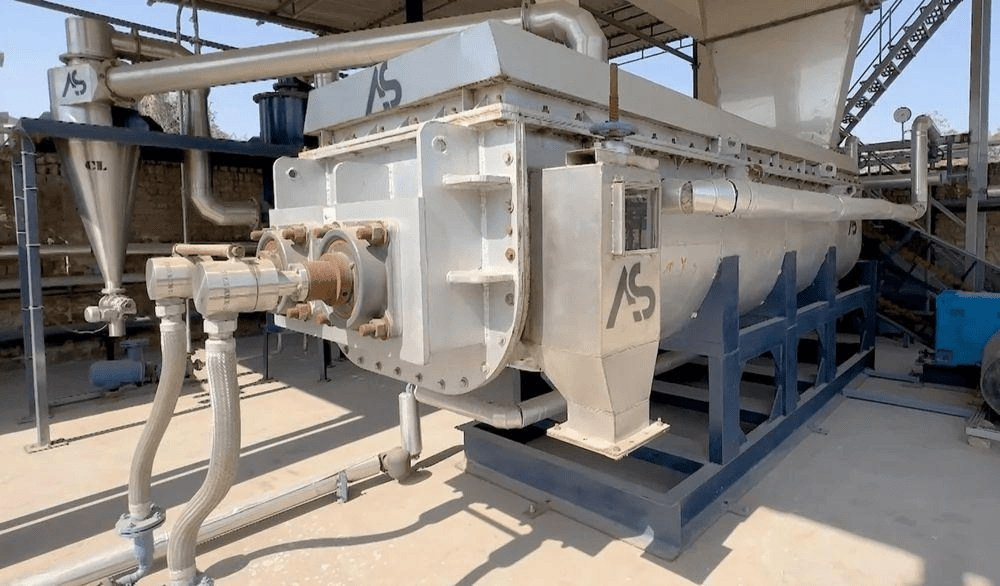
Among the technologies available for difficult-to-handle materials, industrial paddle dryers are particularly relevant when the feed is wet, pasty, sticky, sludge-like or requires indirect heating.
The application range extends across:
Municipal Wastewater → Industrial Sludge → Chemical Manufacturing → Pharmaceutical Processing → Filter Cakes → Organic Residues → High-Moisture Industrial Solids
For plant managers, EPC contractors and process engineers, the question is no longer simply “Can the material be dried?”
The more important questions are:
- How much water must be removed?
- What final moisture is required?
- How can thermal consumption be controlled?
- Can the material be handled continuously?
- What heating method is appropriate?
- Can the dried solids be recovered, reused or safely disposed of?
This is where a properly engineered indirect paddle dryer or vacuum paddle dryer can become an important part of the process.
Why China Is an Important Market for Paddle Drying Technology
China has a large and diverse industrial base covering chemicals, pharmaceuticals, food processing, minerals, manufacturing and wastewater treatment.
At the same time, wastewater treatment itself carries significant water and energy requirements. A 2026 study in Nature Communications examining more than 10,000 urban wastewater-treatment plants found that China’s wastewater-treatment water and energy footprints nearly tripled between 2009 and 2022.
This makes energy-conscious sludge and solids processing increasingly important.
China’s environmental framework also places emphasis on wastewater treatment, sludge management, industrial solid-waste control and resource recovery. The 2026 Environmental Code includes provisions concerning industrial wastewater, municipal sludge treatment and disposal, industrial solid waste and cleaner production.
As a result, drying can be considered not as an isolated operation, but as part of a broader:
Wastewater Treatment → Dewatering → Drying → Resource Recovery / Disposal
strategy.
Where Are Paddle Dryers Used in China?
1. Municipal & Wastewater Sludge Drying
One of the strongest application areas is sludge drying.
Wastewater treatment produces sludge containing substantial quantities of water. Mechanical dewatering can reduce moisture, but additional thermal drying may be required when the objective is further moisture reduction.
A paddle dryer can be evaluated for:
- Municipal sewage sludge
- Industrial wastewater sludge
- ETP sludge
- Chemical sludge
- Filter cake
- Biological sludge
- High-moisture treatment residues
China’s environmental framework specifically addresses safe sludge treatment and disposal, making downstream sludge management an important part of wastewater infrastructure.
China’s enormous chemical manufacturing ecosystem creates applications for dryers handling difficult materials such as:
- Chemical filter cakes
- Pigments
- Dyes
- Inorganic chemicals
- Organic chemicals
- Fertilizer intermediates
- Salts
- Resins
- Process residues
For materials that are sticky or unsuitable for conventional hot-air drying, indirect paddle drying can provide controlled thermal contact without relying entirely on direct contact between the product and combustion gases.
3. Pharmaceutical & Fine-Chemical Processing
Pharmaceutical manufacturing requires controlled processing conditions and consistent final moisture.
Depending on the formulation and process requirements, vacuum paddle dryers can be considered for:
- Pharmaceutical intermediates
- APIs
- Fine chemicals
- Wet powders
- Filter cakes
- Solvent-containing materials
- Heat-sensitive products
Vacuum operation can allow drying at lower product temperatures, although the appropriate system must always be determined from the material’s thermal and chemical characteristics.
For pharmaceutical applications, equipment design, material of construction, containment, cleaning requirements and applicable GMP expectations should be established during the engineering stage.
Indirect Paddle Dryer vs Vacuum Paddle Dryer
Choosing between the two depends primarily on the material and process conditions.
| Requirement | Indirect Paddle Dryer | Vacuum Paddle Dryer |
| Sludge drying | Excellent candidate | Possible for specialized applications |
| Chemical filter cake | Excellent candidate | Excellent candidate |
| Heat-sensitive material | Good | Very good |
| Atmospheric drying | Suitable | Not required |
| Low-temperature drying | Limited by heating medium | Strong advantage |
| Solvent recovery | Application dependent | Strong potential advantage |
| Continuous operation | Excellent | Application dependent |
| High-moisture pastes | Excellent | Excellent |
The final selection should be based on feed moisture, solids concentration, thermal sensitivity, residence time, required final moisture and heat source.
Why Paddle Dryers Work Well for Difficult Materials
Unlike many conventional dryers that depend primarily on high-velocity hot air, an indirect paddle dryer transfers heat through heated surfaces.
The rotating paddles continuously:
Mix → Contact → Heat → Expose → Dry → Discharge
the material.
This can make the technology attractive for materials that are:
- Sticky
- Pasty
- Sludge-like
- Cohesive
- High in moisture
- Difficult to fluidize
- Sensitive to excessive direct heating
The exact configuration depends on material rheology and process objectives.
China’s Key Industrial Paddle Dryer Applications
A China-focused paddle dryer strategy should not target only wastewater treatment.
The technology can also be relevant to:
Environmental Engineering
Municipal sludge | ETP sludge | Industrial sludge | Waste residues
Chemical Industry
Filter cake | Pigments | Dyes | Salts | Chemical intermediates
Pharmaceutical Industry
APIs | Pharmaceutical intermediates | Fine chemicals | Wet solids
Organic residues | Food-processing by-products | Biomass-derived materials
Industrial Manufacturing
High-moisture process solids | Mineral residues | Specialty materials
Paddle Dryer Capacity: What Determines the Size?
There is no universal paddle dryer size based only on the name of the material.
The most important engineering inputs include:
Feed Rate
kg/h or tonnes/h
↓
Initial Moisture
%
↓
Target Moisture
%
↓
Water Evaporation
kg/h
↓
Required Heat Duty
kW or kcal/h
↓
Residence Time
↓
Paddle Dryer Capacity
For example, a feed containing a high percentage of water may require substantially more thermal capacity than a partially dewatered filter cake, even if both plants process the same tonnes per hour.
This is why material-specific drying calculations are essential before selecting a commercial machine.
How to Reduce Paddle Dryer Energy Consumption
For high-moisture sludge and industrial solids, evaporation duty can become a major operating expense.
A properly engineered system can therefore consider:
Heat Recovery
Recovering useful heat from exhaust streams where technically feasible.
Optimized Heating Surface
Designing the heating area according to actual evaporation requirements.
Feed Pre-Dewatering
Mechanical dewatering before thermal drying can significantly reduce the amount of water entering the dryer.
Insulation
Reducing heat losses from the dryer body, piping and process equipment.
Variable-Speed Drives
Controlling paddle speed, feed systems and auxiliary equipment according to operating requirements.
Heat Source Optimization
Depending on the plant, the system may be designed around:
Steam | Thermal Oil | Hot Water | Electricity | Waste Heat
The most economical configuration depends on local energy costs and available utilities.
Why China-Based Plants Need Material-Specific Testing
A major challenge with sludge and chemical drying is material variability.
Two sludge samples can behave very differently depending on:
- Solids concentration
- Organic content
- Particle size
- Oil content
- Stickiness
- Ash content
- Inorganic composition
- Initial moisture
- Required final moisture
Therefore, simply specifying “paddle dryer for sludge” is not enough to finalize a commercial design.
A better engineering approach is:
Material Sample → Laboratory/Pilot Test → Drying Calculation → Heat & Mass Balance → Equipment Design → Commercial System
GTI Dryers: Industrial Paddle Drying Solutions for International Projects
GTI Dryers provides industrial drying solutions for different process industries and material characteristics.
Depending on the application, the technology portfolio can include:
Indirect Paddle Dryers | Vacuum Paddle Dryers | Rotary Dryers | Flash Dryers | Fluid Bed Dryers | Band Dryers | Mesh Belt Dryers | Spray Dryers
For a Chinese project, the appropriate technology should be selected according to the actual material rather than using a one-size-fits-all approach.
GTI Dryers can evaluate parameters such as:
- Feed capacity
- Initial moisture
- Final moisture
- Solids concentration
- Material temperature limitations
- Heating medium
- Residence time
- Product characteristics
- Energy availability
- Required automation
Pilot Testing: Reduce Risk Before Buying a Paddle Dryer
For sludge, chemical filter cakes and pharmaceutical materials, pilot testing can be extremely valuable.
A pilot test can help evaluate:
- Drying performance
- Moisture reduction
- Product behavior
- Residence time
- Thermal requirements
- Discharge characteristics
- Potential sticking
- Energy consumption
Instead of selecting equipment purely from theoretical assumptions, test results can provide practical engineering information for commercial-scale design.
Drying Calculations for Chinese Industrial Projects
Before requesting a quotation for an industrial paddle dryer in China, prepare:
Feed Rate + Initial Moisture + Final Moisture + Material Temperature + Heating Source + Operating Hours
These parameters allow engineers to estimate:
Water Evaporation → Heat Duty → Heating Surface → Dryer Size → Auxiliary Equipment → Operating Cost
GTI Dryers can use these inputs to develop a preliminary drying recommendation and help evaluate the most suitable technology.
High-Intent Searches for Paddle Dryers in China
This page can target commercial and informational searches such as:
Commercial Keywords
- Industrial paddle dryer China
- Paddle dryer manufacturer China
- Paddle dryer supplier China
- Industrial sludge dryer China
- Sludge drying equipment China
- Indirect paddle dryer China
- Vacuum paddle dryer China
Application Keywords
- Paddle dryer for wastewater sludge
- Paddle dryer for chemical sludge
- Paddle dryer for filter cake
- Industrial sludge drying system
- Chemical paddle dryer
- Pharmaceutical paddle dryer
Buyer-Research Keywords
- Paddle dryer capacity calculation
- Paddle dryer energy consumption
- Paddle dryer operating cost
- Paddle dryer for high moisture materials
- Paddle dryer vs rotary dryer
- How to select a paddle dryer
Why GTI Dryers for Paddle Dryer Projects?
When evaluating an international drying supplier, buyers should look beyond machine specifications.
Important criteria include:
- Material-specific engineering
- Drying calculations
- Pilot testing
- Heat and mass balance
- Energy-efficiency analysis
- Appropriate material of construction
- Process automation
- Safety and containment considerations
- Installation and commissioning support
- After-sales technical assistance
For difficult sludge and chemical applications, process engineering is often as important as the dryer itself.
Frequently Asked Questions
What is a paddle dryer used for?
Paddle dryers are commonly considered for drying sludge, filter cakes, pastes, chemicals, pharmaceutical intermediates and other difficult-to-handle wet solids.
What is an indirect paddle dryer?
An indirect paddle dryer transfers heat to the material through heated surfaces rather than relying primarily on direct contact with combustion gases.
Can a paddle dryer dry wastewater sludge?
Yes, paddle dryers can be evaluated for municipal and industrial wastewater sludge, particularly when the material has been mechanically dewatered first.
Is a vacuum paddle dryer suitable for pharmaceuticals?
It can be suitable for certain pharmaceutical and fine-chemical materials where controlled, lower-temperature drying or solvent handling is required. The final design depends on the specific product and process.
How is paddle dryer capacity calculated?
Capacity depends on feed rate, initial moisture, final moisture, evaporation load, material properties, residence time and available heat transfer area. A material-specific drying calculation is recommended.
Can GTI Dryers test my material?
Yes. Material-specific pilot testing can help determine drying behavior and provide engineering data before commercial-scale equipment selection.
Looking for an Industrial Paddle Dryer in China?
China’s combination of chemical manufacturing, wastewater treatment, pharmaceutical production and industrial processing creates a strong application environment for advanced paddle drying systems.
For plants handling municipal sludge, ETP sludge, chemical filter cake, pharmaceutical intermediates or other high-moisture industrial solids, the right drying technology can improve moisture control, handling, storage and downstream processing.
If you are evaluating an industrial paddle dryer in China, don’t select equipment based only on tonnes per hour.
Start with the material.
Feed Moisture → Solids Content → Water Evaporation → Heat Requirement → Dryer Selection → Pilot Testing → Commercial Design
Get a Paddle Dryer Evaluation from GTI Dryers
Submit your material type, feed rate, initial moisture, target moisture and available heat source to GTI Dryers for a preliminary drying assessment.
GTI Dryers — Industrial Paddle Dryers, Vacuum Dryers & Customized Drying Systems for Chemical, Pharmaceutical, Environmental and Process Industries.