Industrial Dryers USA: Advanced Drying Solutions for Pharmaceuticals, APIs, Excipients, Food & Beverage Powders
The United States is one of the world’s most demanding markets for high-performance industrial drying equipment, particularly in pharmaceutical manufacturing, API production, excipient processing, nutraceuticals, food ingredients and beverage powders.
For American manufacturers, a dryer is not simply a piece of thermal equipment. It is an important part of the production process that can influence moisture control, product quality, particle characteristics, energy consumption, sanitation, process consistency and operating cost.
This is especially important for pharmaceutical manufacturers working within the FDA regulatory framework. FDA identifies 21 CFR Parts 210 and 211 as key CGMP regulations covering drug manufacturing, processing, packing and holding, with Part 211 specifically addressing finished pharmaceuticals.
For food manufacturers, FDA’s Current Good Manufacturing Practice, Hazard Analysis, and Risk-Based Preventive Controls for Human Food framework also places importance on equipment, sanitation, process controls, monitoring and verification.
This creates strong demand for hygienic, controllable and application-specific industrial drying systems.
Why the USA Is a High-Value Market for Industrial Dryers
US manufacturers increasingly look beyond basic dryer capacity.
They want systems that can deliver:
- Consistent final moisture
- Controlled product temperature
- Repeatable drying performance
- Energy-efficient operation
- Hygienic construction
- Reliable continuous production
- Automated process control
- Easy cleaning and maintenance
- Scalable production capacity
- Documentation appropriate to the project
For pharmaceutical and food applications, dryer selection must also consider the facility’s applicable quality and regulatory requirements.
This is where custom industrial dryer engineering becomes more valuable than purchasing a standard machine.
Pharmaceutical Dryers for APIs, Excipients & Drug Manufacturing
The US pharmaceutical industry creates particularly strong demand for controlled drying technologies.
API Drying
Active pharmaceutical ingredients may require drying after processes such as:
- Filtration
- Crystallization
- Washing
- Solvent exchange
- Wet processing
Depending on the API’s thermal sensitivity, particle characteristics and moisture specification, manufacturers may evaluate:
Vacuum Dryers • Paddle Dryers • Tray Dryers • Fluid Bed Dryers • Specialty Drying Systems
FDA’s Q7A guidance specifically addresses GMP for API manufacturing and emphasizes systems for managing API quality and purity.
Excipient Drying
Pharmaceutical excipients can also require carefully controlled moisture removal before downstream processing.
Potential applications include:
- Pharmaceutical granules
- Powdered excipients
- Crystalline materials
- Nutraceutical ingredients
- Functional ingredients
A fluid bed dryer can be particularly suitable for appropriate free-flowing particulate materials because it provides efficient gas-solid contact and relatively uniform drying.
Pharmaceutical Spray Dryers in the USA
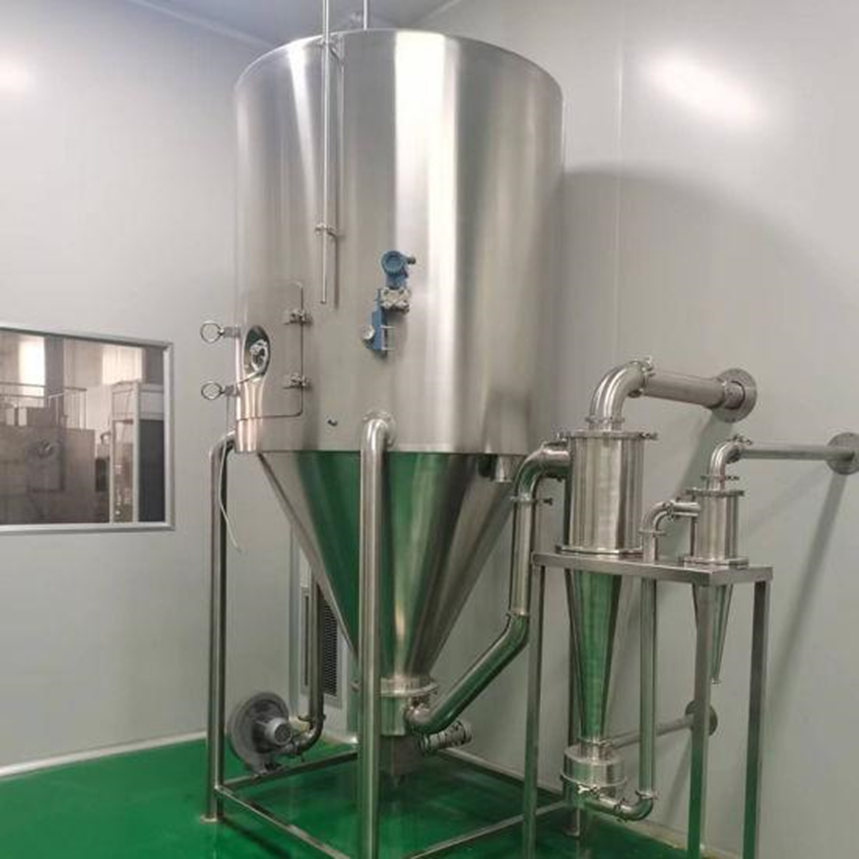
Spray drying is one of the most important technologies for converting liquid feeds, solutions, emulsions and slurries into powders.
Potential US applications include:
- Pharmaceutical formulations
- API-related solutions
- Nutraceutical ingredients
- Dairy powders
- Food ingredients
- Flavors
- Beverage powders
- Specialty chemicals
A properly designed spray drying system can control:
Feed Rate → Atomization → Drying Air → Residence Time → Moisture Removal → Powder Collection
The final configuration depends heavily on the feed properties and required powder characteristics.
Fluid Bed Dryers for Pharmaceutical & Food Processing
Fluid bed dryers are suitable for many free-flowing granular and particulate products.
Applications may include:
- Pharmaceutical granules
- Excipients
- Nutraceuticals
- Food granules
- Crystalline products
- Chemical products
Key advantages can include:
- Efficient heat transfer
- Controlled moisture reduction
- Uniform drying
- Continuous or batch operation
- Integration with upstream and downstream processes
For US pharmaceutical projects, equipment design should be evaluated against the customer’s applicable CGMP, quality, validation and documentation requirements, rather than simply marketing a dryer as “FDA approved.”
Food & Beverage Powder Dryers USA
The opportunity extends well beyond pharmaceuticals.
American food and beverage manufacturers require drying systems for products such as:
- Milk powder
- Whey powder
- Coffee extracts
- Tea extracts
- Fruit powders
- Vegetable powders
- Protein ingredients
- Nutraceutical powders
- Flavor ingredients
- Beverage premixes
FDA’s food CGMP framework covers areas including plant and equipment design, sanitation, production and process controls.
For facilities subject to the FDA’s preventive-control requirements, hazard analysis and risk-based preventive controls are also important components of the food safety system.
Therefore, food powder drying equipment should be considered as part of the overall hygienic processing system, not as an isolated machine.
Which Industrial Dryer Is Best for the USA Market?
There is no single “best industrial dryer.” The correct technology depends on the material and process.
| Application | Dryer Technology to Evaluate |
| API wet cake | Vacuum / Paddle / Tray Dryer |
| Pharmaceutical granules | Fluid Bed Dryer |
| Liquid pharmaceutical feed | Spray Dryer |
| Excipients | Fluid Bed / Vacuum / Spray |
| Heat-sensitive API | Vacuum / Indirect Dryer |
| Sticky pharmaceutical intermediate | Paddle / Vacuum Dryer |
| Dairy powder | Spray Dryer |
| Beverage powder | Spray Dryer |
| Nutraceutical ingredients | Spray / Fluid Bed Dryer |
| Food extracts | Spray / Specialty Dryer |
The final selection should be based on drying calculations, product testing and process requirements.
cGMP-Focused Industrial Dryer Design for US Pharmaceutical Plants
For pharmaceutical projects, the phrase “cGMP-compliant dryer” should be used carefully.
FDA’s CGMP regulations establish requirements for drug manufacturing, and equipment forms part of the broader manufacturing system.
A pharmaceutical dryer project may therefore need to consider:
Hygienic Construction
Material of construction and surface finish appropriate to the product and cleaning strategy.
Cleanability
Design that minimizes product accumulation and supports effective cleaning.
Process Control
Monitoring and control of parameters such as temperature, airflow, pressure and drying time.
Containment
Appropriate containment strategy for potent APIs, powders or hazardous materials.
Documentation
Engineering and manufacturing documentation appropriate to the customer’s quality and qualification requirements.
Automation
PLC/SCADA-based monitoring can provide better process repeatability and data visibility.
How Much Does an Industrial Dryer Cost in the USA?
Searching for industrial dryer price USA is common, but there is no reliable single price for a pharmaceutical or industrial dryer.
Total project cost depends on:
- Dryer technology
- Capacity
- Water evaporation
- Material of construction
- Heating system
- Automation
- Dust collection
- Feed and discharge systems
- Hygienic requirements
- Containment
- Installation
- Qualification/documentation requirements
Therefore, US buyers should compare total cost of ownership, not only equipment purchase price.
A lower-priced dryer that consumes more energy or produces inconsistent moisture can become more expensive over its operating life.
How to Calculate Industrial Dryer Capacity
A preliminary capacity calculation starts with the amount of water that must be removed.
Basic principle:
Water Evaporation = Water in Feed − Water Remaining in Dried Product
Actual equipment sizing requires additional information including:
- Feed rate
- Initial moisture
- Final moisture
- Material properties
- Product temperature limit
- Particle size
- Heat source
- Drying temperature
- Residence time
- Required operating hours
GTI Dryers can use these parameters to develop a preliminary drying calculation and dryer selection for a specific US application.
Industrial Dryer Energy Efficiency in the USA
Energy consumption can be a major component of the operating cost of industrial drying.
GTI’s engineering approach can evaluate:
- Heat recovery
- Airflow optimization
- Dryer insulation
- Heat-transfer efficiency
- Variable-frequency drives
- Exhaust-air optimization
- Multi-stage drying
- Heat-source selection
Potential heat sources may include:
Natural Gas • LPG • Steam • Thermal Oil • Electricity • Biomass • Waste Heat
The objective is not simply to reduce temperature. It is to achieve the required final moisture with the lowest practical energy consumption while maintaining product quality.
Capture US Buyers Before They Contact a Manufacturer
How Much Does a Pharmaceutical Dryer Cost in the USA?
Explain the factors affecting pharmaceutical dryer investment and total cost of ownership.
How to Calculate Industrial Dryer Capacity
Target engineers and project managers calculating evaporation load and dryer capacity.
Industrial Dryer Energy Consumption: How to Reduce Operating Costs
Capture users researching operating costs before purchasing equipment.
Spray Dryer vs Fluid Bed Dryer for Pharmaceutical Products
Target pharmaceutical engineers comparing drying technologies.
What Is the Best Dryer for APIs?
Explain when vacuum, paddle, tray, fluid bed or spray drying may be appropriate.
What Is a cGMP Pharmaceutical Dryer?
Explain hygienic design, process control, cleanability and documentation without making unsupported regulatory claims.
Food Powder Dryer vs Spray Dryer: Which Is Better?
Target food and beverage manufacturers searching for powder-production solutions.
Industrial Dryer Maintenance Checklist
Capture maintenance-related searches and create opportunities for replacement or modernization projects.
Major US Industrial & Pharmaceutical Hubs
For Generative Engine Optimization (GEO) and local search visibility, don’t target only “industrial dryer USA.”
Build supporting location-based content around major manufacturing clusters.
New Jersey & Pennsylvania
Target pharmaceutical, specialty chemical and food-processing applications.
Keywords:
- Pharmaceutical dryer New Jersey
- API dryer Pennsylvania
- Industrial dryer manufacturer Northeast USA
North Carolina
Target pharmaceutical, biotechnology and advanced manufacturing.
Keywords:
- Pharmaceutical dryer North Carolina
- API drying equipment USA
- Industrial drying systems North Carolina
California
Target pharmaceutical, nutraceutical, food and specialty ingredient production.
Keywords:
- Pharmaceutical dryer California
- Food powder dryer California
- Spray dryer manufacturer USA
Texas
Target chemicals, pharmaceuticals, food processing and industrial manufacturing.
Keywords:
- Industrial dryer Texas
- Chemical dryer Texas
- Pharmaceutical dryer Texas
Illinois, Ohio & Midwest
Target food ingredients, chemicals, pharmaceuticals and industrial processing.
Keywords:
- Industrial dryer Midwest USA
- Food powder dryer Illinois
- Pharmaceutical dryer Ohio
This country → state → industry → dryer type structure gives GTI a much stronger GEO architecture than publishing multiple pages that simply repeat “industrial dryer USA.”
Why US Manufacturers Should Choose GTI Dryers
GTI Dryers can position itself around engineering the drying process, rather than simply supplying equipment.
The project approach can follow:
Material Analysis → Pilot Testing → Drying Calculation → Dryer Selection → Thermal Design → Equipment Manufacturing → Testing → Installation & Commissioning
Depending on the application, GTI can evaluate:
- Spray Dryers
- Fluid Bed Dryers
- Vibratory Fluid Bed Dryers
- Vacuum Dryers
- Paddle Dryers
- Tray Dryers
- Flash Dryers
- Rotary Dryers
- Band/Belt Dryers
- Specialty Drying Systems
Pilot Testing: Reduce Risk Before Investing in a US Industrial Dryer
For high-value pharmaceutical and food products, pilot testing can provide valuable information before commercial-scale equipment is finalized.
Testing can help evaluate:
- Drying rate
- Final moisture
- Product temperature
- Energy requirement
- Powder characteristics
- Residence time
- Product recovery
- Dryer configuration
This is particularly useful for new APIs, excipients, nutraceuticals, food extracts and beverage powders.
Drying Calculations for US Pharmaceutical & Food Processing Plants
Before recommending equipment, GTI can evaluate:
Feed Rate + Initial Moisture + Final Moisture + Product Properties + Temperature Limit + Heat Source
The engineering output can help determine:
Water Evaporation → Thermal Duty → Dryer Capacity → Air Requirement → Heat Requirement → Dryer Configuration
This gives a US project team a clearer technical and economic basis for equipment selection.
Ready for the US Industrial Dryer Market?
If your facility in New Jersey, Pennsylvania, North Carolina, California, Texas, Illinois, Ohio, or elsewhere in the United States requires drying equipment for APIs, excipients, pharmaceuticals, nutraceuticals, food ingredients or beverage powders, GTI Dryers can evaluate the process and recommend a suitable drying technology.
Send GTI Your Process Data:
Material Name + Feed Rate + Initial Moisture + Final Moisture + Temperature Limit + Batch/Continuous Requirement
GTI Dryers can then evaluate:
Water Evaporation → Dryer Capacity → Thermal Requirement → Dryer Type → Energy Requirement → Equipment Configuration
Request an Industrial Dryer Evaluation
GTI Dryers provides customized industrial drying solutions for pharmaceutical, API, excipient, nutraceutical, food and beverage powder applications.
Request a preliminary drying calculation and discuss your US industrial dryer project with GTI Dryers.