Rotary Dryer Brazil for High-Capacity Industrial Processing
Brazil is one of the world’s major agricultural, mining, forestry and industrial-processing markets, creating strong opportunities for industrial rotary dryers and rotary drum drying systems.
From São Paulo, Minas Gerais and Paraná to Mato Grosso, Goiás and Bahia, Brazilian industries process large volumes of biomass, agricultural products, minerals, fertilizers, chemicals and other bulk solids.
For these applications, industrial drying is not simply about removing moisture. The right dryer must deliver:
- Consistent final moisture
- High evaporation capacity
- Reliable continuous operation
- Efficient heat utilization
- Low operating cost
- Controlled product temperature
- Easy maintenance
- Integration with existing production lines
GTI Dryers provides customized rotary drum dryer solutions for Brazil, with equipment selection based on the material, throughput, moisture load, heat source and required final product quality.
Why Rotary Dryers Are Important for Brazil
Brazil’s large-scale industries frequently handle high-moisture bulk materials that require continuous drying before storage, transportation, pelletizing, grinding or further processing.
Typical applications include:
- Sugar and sugar-processing by-products
- Biomass and wood residues
- Sawdust and wood chips
- Agricultural products
- Fertilizers
- Minerals and ores
- Sand
- Industrial chemicals
- Sludge
- Bulk solids
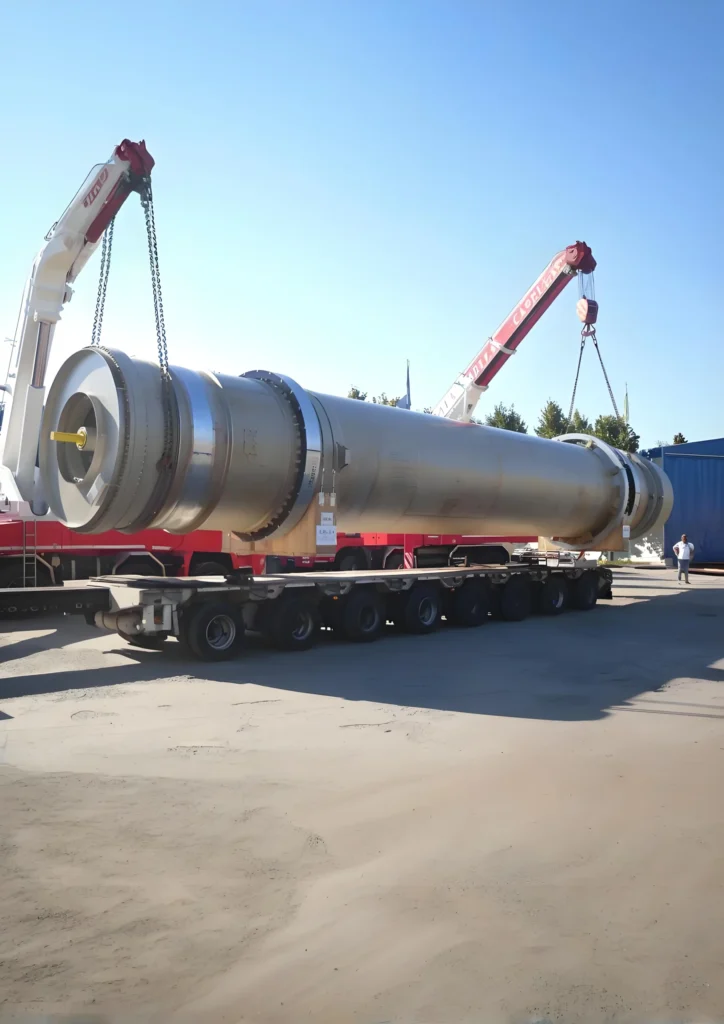
A Rotary Drum Dryer is particularly suitable for applications requiring high throughput and robust continuous operation.
However, the best dryer depends on the material.
For example, a biomass project may favor a direct-fired rotary dryer, while a sensitive or contamination-controlled application may require an indirect configuration or another drying technology.
Key Brazilian Markets for Rotary Drum Dryers
1. Biomass, Wood & Agro-Residues
Brazil has a substantial biomass and agricultural-processing ecosystem, generating materials such as:
- Wood chips
- Sawdust
- Bagasse
- Agricultural residues
- Biomass pellets
- Coffee-processing residues
- Other plant-based materials
A biomass rotary dryer Brazil solution can provide continuous high-capacity drying before pelletizing, briquetting, combustion or further processing.
Depending on the material and process, GTI can evaluate single-pass, multi-pass or customized rotary dryer configurations.
2. Sugar & Sugarcane Processing
Brazil is a global leader in sugarcane production, making sugar and sugarcane-derived products important potential applications for industrial drying.
Rotary drying can be considered for suitable:
- Sugar-processing materials
- Bagasse-related applications
- Agricultural by-products
- Biomass fuels
- Bulk solid intermediates
Dryer selection depends on moisture content, particle characteristics, temperature sensitivity and the downstream process.
Brazil’s mining sector creates significant demand for robust bulk-material processing equipment.
Potential rotary-dryer applications include:
- Iron-bearing materials
- Mineral concentrates
- Sand
- Limestone
- Clay
- Industrial minerals
- Mineral by-products
A mineral rotary dryer Brazil system can be engineered for high-throughput operation with appropriate drum construction, flights, wear protection and dust-collection equipment.
For abrasive materials, mechanical durability becomes just as important as thermal efficiency.
4. Fertilizers & Chemicals
Brazil’s agricultural economy creates significant demand for fertilizers and agricultural inputs.
Rotary dryers can be used for suitable:
- Fertilizer granules
- Mineral-based fertilizers
- Chemical solids
- Industrial salts
- Bulk chemical materials
Depending on particle characteristics, a rotary dryer, fluid bed dryer or vibratory fluid bed dryer may be evaluated.
The objective is to achieve the required final moisture without damaging granules or unnecessarily increasing energy consumption.
Direct vs Indirect Rotary Dryer in Brazil
The choice between direct and indirect heating should be based on the application rather than geography alone.
| Requirement | Direct Rotary Dryer | Indirect Rotary Dryer |
| Biomass | Excellent starting option | Possible |
| Wood chips/sawdust | Excellent | Possible |
| Minerals | Excellent | Possible |
| Sand | Excellent | Possible |
| Fertilizers | Application dependent | Application dependent |
| Heat-sensitive materials | Limited | Better suited |
| Product/combustion-gas separation | No | Yes |
| Very high throughput | Excellent | Application dependent |
For biomass and minerals, direct rotary drying is often a strong starting configuration because of its high heat-transfer capability.
For materials where combustion-gas contact is undesirable, an indirect rotary dryer may be considered.
How Much Does a Rotary Dryer Cost in Brazil?
There is no single price for an industrial rotary dryer.
The investment depends on:
- Capacity
- Feed moisture
- Required evaporation
- Final moisture
- Drum size
- Direct or indirect heating
- Heat source
- Construction material
- Dust collection
- Automation
- Feeding/discharge systems
- Safety requirements
A small agricultural dryer and a high-capacity mineral rotary dryer Brazil project can have completely different equipment configurations.
Therefore, buyers should compare total cost of ownership, not only the initial equipment price.
How to Calculate Rotary Dryer Capacity
A basic starting point is the amount of water that must be removed.
Water Evaporation = Water Entering with Feed − Water Remaining in Product
Actual dryer sizing then considers:
- Feed rate
- Initial moisture
- Final moisture
- Particle size
- Bulk density
- Specific heat
- Drying temperature
- Residence time
- Airflow
- Heat-transfer coefficient
- Available heat source
GTI Dryers can use these parameters to develop a preliminary rotary dryer capacity and evaporation calculation before equipment selection.
Rotary Dryer Energy Consumption: How to Reduce Operating Costs
For large Brazilian plants operating continuously, energy efficiency can significantly influence production economics.
GTI Dryers can evaluate:
Heat Recovery
Recovering usable energy from exhaust gases where technically feasible.
Optimized Airflow
Maintaining effective drying while minimizing unnecessary exhaust losses.
Flight Design
Improving material lifting, cascading and gas-solid contact.
Insulation
Reducing heat loss from hot surfaces.
Heat-Source Integration
Evaluating natural gas, biomass, steam, thermal oil, electricity or available waste heat.
For Brazilian biomass and sugar-processing industries, integration with available biomass residues or process heat can be particularly attractive when technically and environmentally appropriate.
Rotary Dryer vs Belt Dryer for Biomass
Both technologies can be suitable for biomass, but they solve different process requirements.
| Requirement | Rotary Dryer | Belt Dryer |
| High-volume biomass | Excellent | Good |
| Sawdust | Excellent | Good |
| Wood chips | Excellent | Good |
| Robust bulk drying | Excellent | Good |
| Gentle drying | Moderate | Excellent |
| Multi-zone temperature control | Possible | Excellent |
| Very high throughput | Excellent | Application dependent |
For large quantities of sawdust, wood chips and robust biomass, a rotary dryer is often a strong starting point.
For heat-sensitive materials requiring gentle, low-temperature and multi-zone drying, a belt dryer may be preferable.
What Is the Best Rotary Dryer for Wet Minerals?
There is no universal best rotary dryer.
For Brazilian mineral-processing applications, the design should consider:
- Mineral type
- Abrasiveness
- Feed moisture
- Target moisture
- Particle size
- Bulk density
- Throughput
- Product temperature
- Residence time
- Dust generation
For highly abrasive materials, GTI can evaluate wear-resistant components, heavy-duty drum construction and customized flights.
Rotary Dryer Maintenance Checklist
Regular maintenance is critical for continuous industrial operation.
Daily
- Check bearings
- Monitor vibration
- Inspect temperatures
- Check burner operation
- Monitor product moisture
- Inspect dust-collection performance
Weekly
- Inspect rollers and tyres
- Check drive system
- Inspect seals
- Check flights
- Lubricate required components
Periodically
- Check drum alignment
- Inspect shell condition
- Check flight wear
- Inspect gearbox
- Service burner system
- Calibrate instrumentation
- Inspect insulation
Preventive maintenance can help reduce unplanned downtime and extend equipment service life.
Brazilian Locations & Industrial Search Opportunities
São Paulo
Industrial manufacturing, food processing, chemicals and agricultural processing.
Minas Gerais
Mining, minerals, metallurgy and industrial materials.
Paraná
Agriculture, biomass, food processing and manufacturing.
Mato Grosso & Goiás
Agricultural processing, biomass and grain-related industries.
Bahia
Mining, chemicals, agriculture and industrial processing.
This supports long-tail searches such as:
- Rotary dryer São Paulo
- Rotary dryer Minas Gerais
- Rotary dryer Paraná
- Biomass rotary dryer Brazil
- Sugar dryer Brazil
- Mineral dryer Brazil
- Rotary drum dryer Brazil
- Industrial dryer manufacturer Brazil
- Rotary dryer supplier Brazil
- Fertilizer dryer Brazil
Why Choose GTI Dryers for Rotary Dryer Projects in Brazil?
GTI Dryers approaches rotary-dryer projects from the process requirement first, rather than selling a standard machine.
The engineering process can include:
Material Analysis → Drying Calculation → Capacity Calculation → Dryer Selection → Thermal Design → Equipment Configuration → Automation → Installation & Commissioning
Depending on the application, GTI can evaluate:
- Direct rotary dryers
- Indirect rotary dryers
- Rotary drum dryers
- Multi-pass rotary dryers
- Biomass drying systems
- Mineral drying systems
- Fluid bed dryers
- Belt/band dryers
- Flash dryers
- Complete drying systems
Get a Rotary Dryer Solution Designed for Your Brazilian Plant
Whether you are processing biomass in Paraná, minerals in Minas Gerais, sugarcane by-products in São Paulo, fertilizers in agricultural regions, or chemicals and bulk solids elsewhere in Brazil, selecting the right dryer configuration is essential for controlling moisture, energy consumption and production costs.
Send GTI Dryers Your Process Data
Provide:
Material + Feed Capacity + Initial Moisture + Target Moisture + Particle Size + Available Heat Source + Operating Hours
GTI Dryers can then evaluate:
Evaporation Load → Dryer Capacity → Heat Requirement → Rotary Configuration → Energy Requirement → Equipment Proposal
Looking for a Rotary Dryer Manufacturer in Brazil?
GTI Dryers provides customized industrial rotary drum dryers for biomass, minerals, sugar, fertilizers, chemicals, agricultural products and other bulk solids.
Contact GTI Dryers for a preliminary drying calculation and discuss your Brazil rotary dryer project.