Rotary Dryer Manufacturer USA: High-Performance Industrial Rotary Drum Drying Systems
Industries across the United States rely on efficient moisture removal for minerals, biomass, fertilizers, chemicals, food ingredients, agricultural products, sludge and other bulk solids.
For high-throughput applications, a rotary dryer can provide continuous processing, robust material handling and controlled moisture reduction.
GTI Dryers designs and manufactures custom rotary drum drying systems based on the material characteristics, initial and final moisture, required evaporation rate, production capacity, heat source and desired operating conditions.
Rather than treating every material the same, GTI’s approach is to engineer the dryer around the actual drying requirement.
This is particularly important for U.S. manufacturers looking to improve:
- Production capacity
- Moisture consistency
- Thermal efficiency
- Product quality
- Operating costs
- Automation
- Long-term equipment reliability
What Is an Industrial Rotary Dryer?
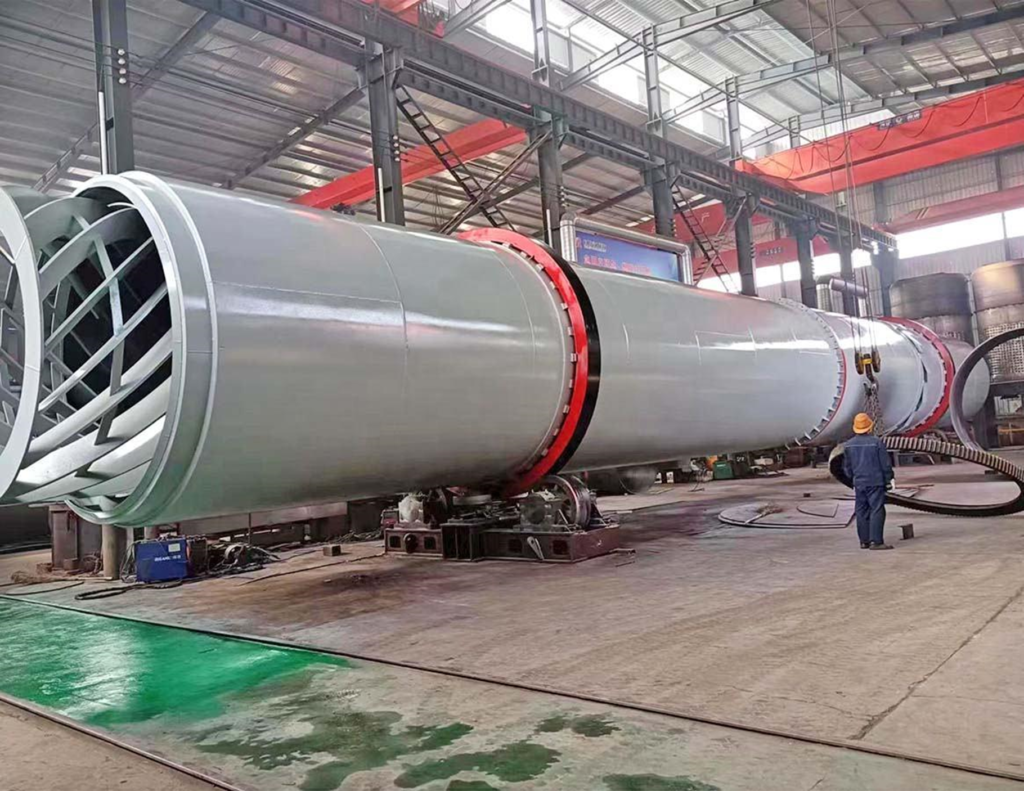
A rotary dryer is a continuous industrial drying machine consisting primarily of a rotating cylindrical drum.
Wet material enters the drum and moves through the drying chamber while controlled hot air transfers heat to the material and evaporates moisture.
Internal lifting flights repeatedly lift and cascade the material through the airflow, improving contact between the product and drying air.
The result is continuous moisture reduction suitable for many free-flowing, granular, fibrous and bulk materials.
GTI Dryers can engineer rotary systems with configurations such as:
- Direct-heated rotary dryers
- Indirect-heated rotary dryers
- Single-pass rotary dryers
- Multi-pass rotary dryers
- Co-current rotary dryers
- Counter-current rotary dryers
- Biomass rotary dryers
- Mineral rotary dryers
- Sand rotary dryers
- Fertilizer rotary dryers
- Chemical rotary dryers
- Sludge rotary dryers
The final configuration depends on the material and process requirements rather than simply the desired dryer capacity.
Rotary Dryer Applications in the USA
The U.S. market covers a wide range of industries where industrial drying is required.
Rotary drum dryers can be used for moisture reduction in materials such as:
- Silica sand
- Foundry sand
- Limestone
- Gypsum
- Clay
- Kaolin
- Bentonite
- Mineral concentrates
- Iron ore
- Other bulk minerals
For mineral processors, controlling moisture can improve handling, storage, transportation and downstream processing.
Biomass drying is another important application.
GTI rotary dryers can be evaluated for:
- Wood chips
- Sawdust
- Wood shavings
- Rice husk
- Bagasse
- Agricultural residues
- Biomass fuels
- RDF
- Biomass feedstocks
Reducing excess moisture can improve the usable energy value and handling characteristics of biomass.
3. Fertilizers
Industrial rotary dryers can be integrated into fertilizer processing lines for suitable products such as:
- Organic fertilizers
- Compost
- NPK materials
- Granulated fertilizers
- Agricultural nutrient products
Controlled drying helps achieve the required final moisture before storage, packaging or further processing.
4. Food & Agricultural Products
For suitable bulk food and agricultural materials, rotary drying can provide continuous high-throughput processing.
Applications may include:
- Grains
- Corn
- Rice
- Pulses
- Coffee-related materials
- Animal feed ingredients
- Agricultural by-products
For heat-sensitive food products, however, alternative technologies such as band dryers, belt dryers or specialized low-temperature systems may be more appropriate.
5. Chemical & Industrial Materials
Rotary dryers can also be engineered for suitable:
- Chemical powders
- Industrial salts
- Fertilizer chemicals
- Mineral chemicals
- Granules
- Process intermediates
- Bulk industrial solids
The material’s thermal sensitivity, particle characteristics and required final moisture should be evaluated before selecting the dryer.
Rotary drying systems can also be considered for selected:
- Industrial sludge
- ETP sludge
- Municipal sludge
- Paper sludge
- Filter cakes
- Waste-derived materials
The appropriate configuration depends heavily on feed moisture, stickiness, odor control and environmental requirements.
Why Choose a Custom Rotary Dryer Instead of a Standard Machine?
A rotary dryer is not simply a rotating drum.
Drum diameter, drum length, flight design, airflow, residence time, heating method and material loading all influence drying performance.
GTI Dryers designs systems around factors such as:
Feed moisture → Target moisture → Throughput → Water evaporation → Heat requirement → Airflow → Residence time → Dryer configuration
This engineering approach can help U.S. manufacturers avoid selecting a dryer based only on nominal capacity.
Energy-Efficient Rotary Drying for U.S. Industrial Plants
Energy consumption is one of the most important operating considerations when evaluating an industrial dryer.
GTI systems can incorporate engineering strategies such as:
- Optimized airflow
- Heat recovery
- Thermal insulation
- Variable-frequency drives
- Controlled residence time
- Efficient burner systems
- Direct or indirect heating selection
- Automated temperature monitoring
- Dust collection and exhaust optimization
Potential heat sources can include:
Natural Gas | LPG | Biomass | Steam | Thermal Oil | Electricity | Waste Heat
Actual energy consumption and potential savings should be calculated according to the material, moisture removal, capacity and operating conditions.
How to Select a Rotary Dryer for a U.S. Plant
Before purchasing a rotary drum dryer in the USA, manufacturers should evaluate:
Material
What exactly are you drying?
Initial Moisture
How much water enters the dryer?
Final Moisture
What moisture specification must the product achieve?
Capacity
How many kg/hour or tons/hour need to be processed?
Heat Sensitivity
Can the product tolerate direct hot air?
Heating Source
What utilities are available at the plant?
Operating Hours
Is the dryer required for batch operation or continuous 24/7 production?
Environmental Requirements
Will the system require cyclone, bag filter, scrubber or other exhaust treatment?
These parameters determine the appropriate rotary dryer size and configuration.
Pilot Testing & Drying Calculations Before Equipment Selection
A major advantage for industrial buyers is being able to evaluate the drying process before committing to full-scale equipment.
Pilot Testing
GTI Dryers can conduct material-specific testing to evaluate:
- Drying behavior
- Final moisture
- Product temperature
- Residence time
- Capacity
- Energy requirement
- Product quality
Drying Calculations
The engineering assessment can consider:
- Feed rate
- Initial moisture
- Final moisture
- Water evaporation
- Heat requirement
- Available energy source
- Airflow
- Dryer dimensions
- Residence time
This creates a technical basis for dryer sizing, operating-cost estimation and project evaluation.
Rotary Dryer Manufacturer USA: Why GTI Dryers?
GTI Dryers combines industrial drying technology with application-specific engineering.
Our rotary drying solutions can be customized for:
- Minerals
- Biomass
- Fertilizers
- Chemicals
- Food
- Agriculture
- Animal feed
- Sludge
- Waste-derived materials
The system can also be integrated with supporting equipment such as:
Hot Air Generator → Feeding System → Rotary Dryer → Cyclone/Bag Filter → Exhaust System → Product Discharge → Control System
This allows the dryer to become part of a complete industrial process rather than functioning as an isolated machine.
Frequently Asked Questions
What is a rotary dryer used for?
A rotary dryer is primarily used for continuous moisture removal from bulk solids, granular materials, minerals, biomass, fertilizers, chemicals, agricultural products and other suitable materials.
Who supplies rotary drum dryers for the USA?
GTI Dryers designs and manufactures industrial rotary drum drying systems for international applications, including projects serving U.S. industrial requirements.
What materials can be dried in a rotary dryer?
Depending on the process design, rotary dryers can handle materials such as sand, minerals, biomass, fertilizers, agricultural products, chemicals, sludge and bulk solids.
Is a rotary dryer suitable for biomass?
Yes. Rotary dryers are widely considered for high-throughput biomass materials such as sawdust, wood chips, agricultural residues and other suitable biomass feedstocks.
How is rotary dryer capacity calculated?
Capacity depends on the feed rate, initial moisture, target moisture, water evaporation, material properties, thermal conditions, airflow and residence time.
Can GTI Dryers customize a rotary dryer?
Yes. Rotary dryer design can be customized according to material characteristics, production capacity, moisture requirements, heating source and process conditions.
Get a Rotary Dryer Designed for Your U.S. Application
If your U.S. processing facility requires a rotary dryer, rotary drum dryer or complete industrial drying system, GTI Dryers can evaluate your material and process requirements before recommending a configuration.
Whether you are processing minerals, sand, biomass, fertilizers, chemicals, food ingredients, agricultural products or industrial sludge, the right rotary drying system can help you achieve consistent moisture control and efficient continuous production.
Send GTI Dryers Your Process Details
Material + Feed Moisture + Required Final Moisture + Production Capacity + Available Heat Source
Our engineering team can use these details to prepare a preliminary drying calculation and rotary dryer recommendation.
GTI Dryers — Custom Industrial Rotary Drying Systems for Global Processing Industries.