Best Industrial Drying Machines for Philippine Industries in 2026
The Philippines is one of Southeast Asia’s important markets for food processing, coconut products, seaweed and carrageenan, agriculture, mining, chemicals, pharmaceuticals, biomass and industrial manufacturing.
As manufacturers expand production and focus on export-quality products, the demand for reliable industrial drying machines in the Philippines continues to grow.
Moisture control is a critical part of many industrial processes. Products such as coconut, copra, seaweed, cassava starch, dried fruits, spices, minerals, chemicals, pharmaceutical granules and biomass require controlled moisture removal before further processing, packaging, storage or export.
Traditional drying methods can be affected by changing weather, high humidity, contamination and inconsistent drying conditions. Modern industrial dryers provide controlled temperature, airflow, residence time and final moisture, allowing manufacturers to achieve more repeatable production results.
Genex Tech Industries develops customized industrial drying solutions for different Philippine applications, including rotary dryers, spray dryers, flash dryers, belt dryers, band dryers, mesh belt dryers, fluid bed dryers, paddle dryers and vacuum drying systems.
Why Philippine Industries Need Industrial Drying Systems
The Philippines has a tropical maritime climate characterized by high humidity and significant rainfall. For commercial-scale processing, depending entirely on natural or open-air drying can create operational challenges.
Common problems include:
- Inconsistent final moisture
- Longer drying periods
- Dependence on weather conditions
- Risk of contamination
- Mold and microbial growth
- Product quality variation
- Higher manual labor requirements
- Large drying-area requirements
- Difficulty maintaining export specifications
An engineered industrial drying machine allows manufacturers to control important process parameters according to the product and production requirement.
Key Drying Parameters
Drying Temperature → Air Velocity → Residence Time → Heat Transfer → Final Moisture
The objective is not simply to remove as much moisture as possible. The objective is to achieve the required final moisture while maintaining product quality and process efficiency.
Industrial Dryer Manufacturer for the Philippines
Genex Tech Industries provides customized industrial drying equipment for applications across food processing, agriculture, coconut processing, seaweed processing, mining, chemicals, pharmaceuticals and biomass.
The source material identifies support across major Philippine industrial regions including Luzon, Visayas and Mindanao, with local representatives supporting technical and commercial requirements.
Depending on the project, industrial drying solutions can be evaluated according to:
- Product characteristics
- Initial moisture
- Required final moisture
- Production capacity
- Heat sensitivity
- Particle size
- Material flowability
- Required residence time
- Heating source
- Hygiene requirements
- Plant configuration
Industrial Dryer Philippines: Which Dryer Is Best for Your Industry?
There is no universal industrial dryer suitable for every product.
The appropriate drying technology depends on whether the feed material is a liquid, slurry, wet cake, powder, granule, agricultural product, bulk solid or heat-sensitive material.
The major industrial dryer technologies include:
| Industrial Dryer | Typical Feed | Major Applications |
| Rotary Dryer | Bulk solids | Mining, minerals, biomass, fertilizers |
| Spray Dryer | Liquids & slurries | Coconut milk, food, chemicals, pharma |
| Flash Dryer | Fine wet solids | Starch, powders, chemicals |
| Belt / Mesh Belt Dryer | Sliced & particulate products | Food, coconut, seaweed, spices |
| Apron Band Dryer | Heavy, coarse & robust materials | Biomass, agro-materials, industrial solids |
| Fluid Bed Dryer | Granules & particles | Pharma, food ingredients, chemicals |
| Paddle Dryer | Sludge, paste & sticky materials | ETP sludge, oleochemicals, by-products |
1. Rotary Dryer Philippines – High-Capacity Bulk Drying
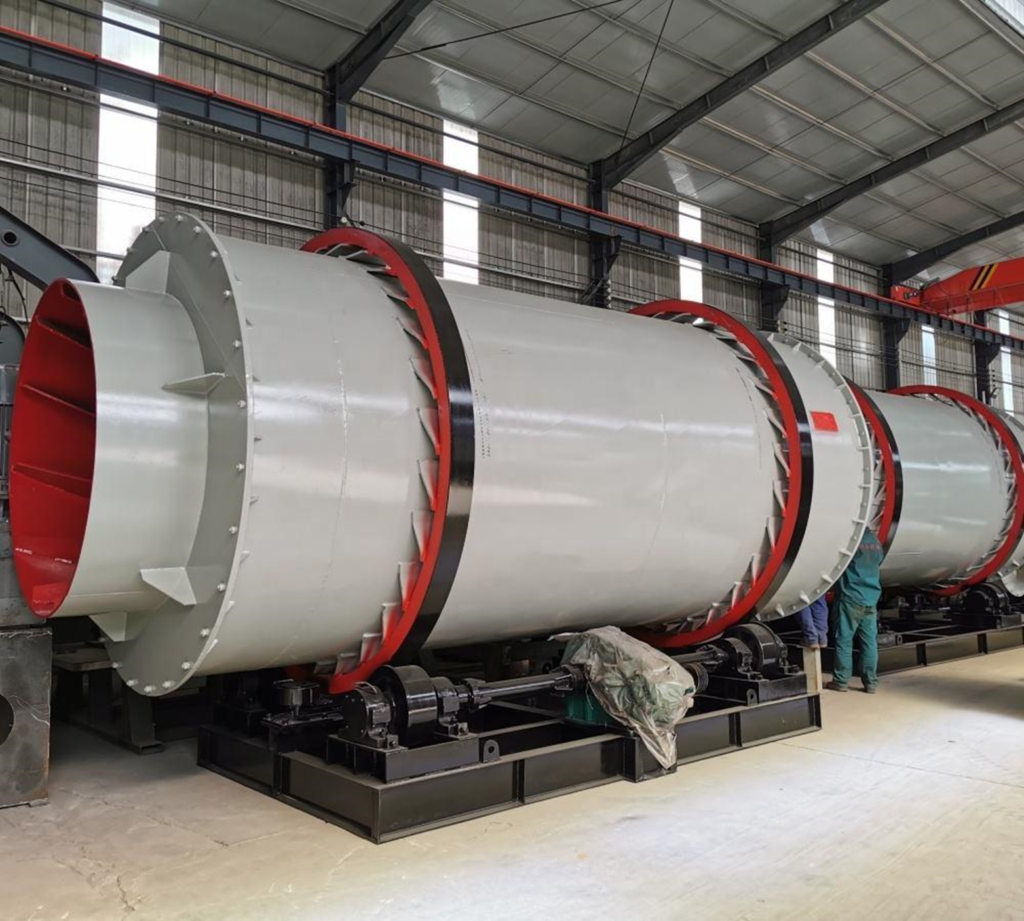
A rotary dryer is a continuous industrial drying system designed for high-volume bulk materials.
The dryer generally consists of a rotating cylindrical drum equipped with internal flights or lifters. As the drum rotates, the wet material is lifted and cascaded through the drying zone, increasing contact between the material and the drying medium.
Rotary Dryer Applications in the Philippines
Rotary dryers can be considered for:
Mining & Minerals
- Nickel ore
- Copper-containing materials
- Chromite
- Silica sand
- Limestone
- Mineral concentrates
- Industrial mineral residues
Biomass & Agricultural Residues
- Coconut shell
- Coconut husk
- Coir
- Wood chips
- Sawdust
- Bagasse
- Rice husk
Fertilizers & Chemicals
- Fertilizer products
- Organic fertilizer
- Industrial salts
- Chemical solids
Animal Feed & Agro-Processing
- Fish meal
- Feed ingredients
- Grain residues
- Spent grains
Advantages of Rotary Dryers
- High processing capacity
- Continuous operation
- Robust construction
- Suitable for bulk solids
- Flexible heating configurations
- Suitable for demanding industrial environments
Rotary dryers can be designed around different heat sources, depending on the process and plant infrastructure.
2. Spray Dryer Philippines – Liquid-to-Powder Drying
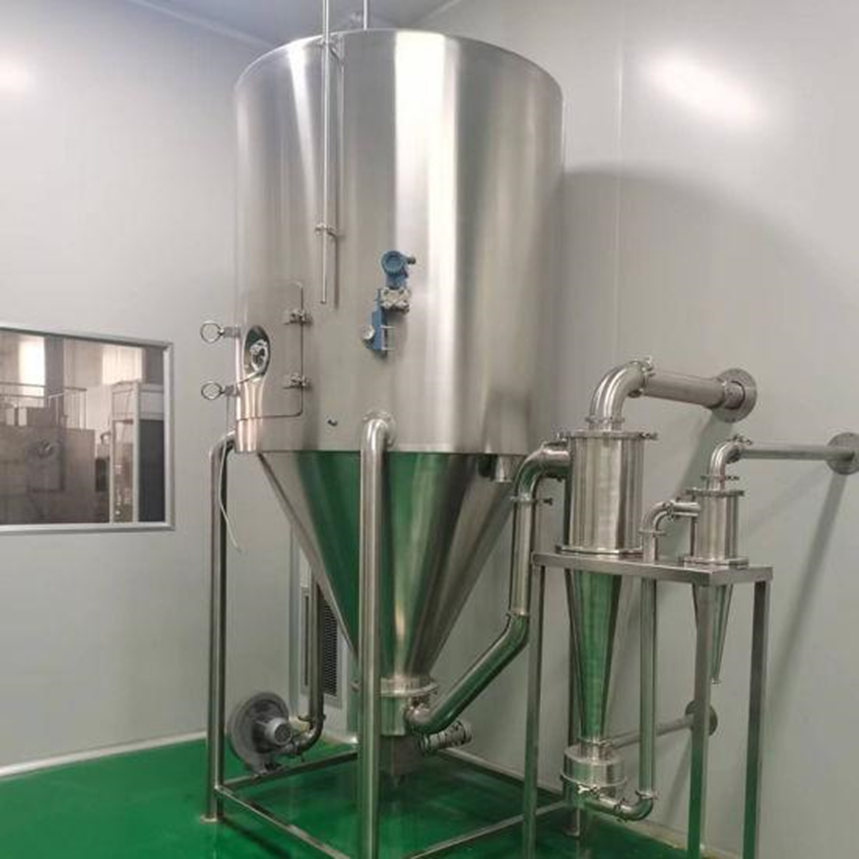
A spray dryer converts liquid feed materials such as solutions, emulsions, suspensions and slurries into powders.
The liquid is atomized into fine droplets inside a drying chamber. Hot drying air rapidly removes moisture from the droplets, producing a dried powder.
Spray Dryer Applications in the Philippines
Coconut Industry
Spray drying can be considered for:
- Coconut milk powder
- Coconut cream powder
- Coconut water powder
Food Processing
- Fruit-based liquids
- Flavoring ingredients
- Yeast
- Maltodextrin
- Milk solids
- Soluble beverage ingredients
Seaweed & Carrageenan
- Carrageenan-related liquid products
- Algal extracts
- Other seaweed-derived liquid feeds
Herbal & Nutraceutical Products
- Botanical extracts
- Herbal extracts
- Plant-based liquid concentrates
Chemical & Pharmaceutical Processing
- Specialty chemical products
- Pharmaceutical intermediates
- Selected APIs
- Pigments
- Ceramic-related powders
Why Choose a Spray Dryer?
Spray dryers offer:
- Continuous liquid-to-powder processing
- Rapid moisture removal
- Controlled powder characteristics
- High automation potential
- Consistent powder production
For heat-sensitive materials, the drying temperature and residence time must be carefully engineered around the specific feed material.
3. Flash Dryer Philippines – Rapid Powder & Starch Drying
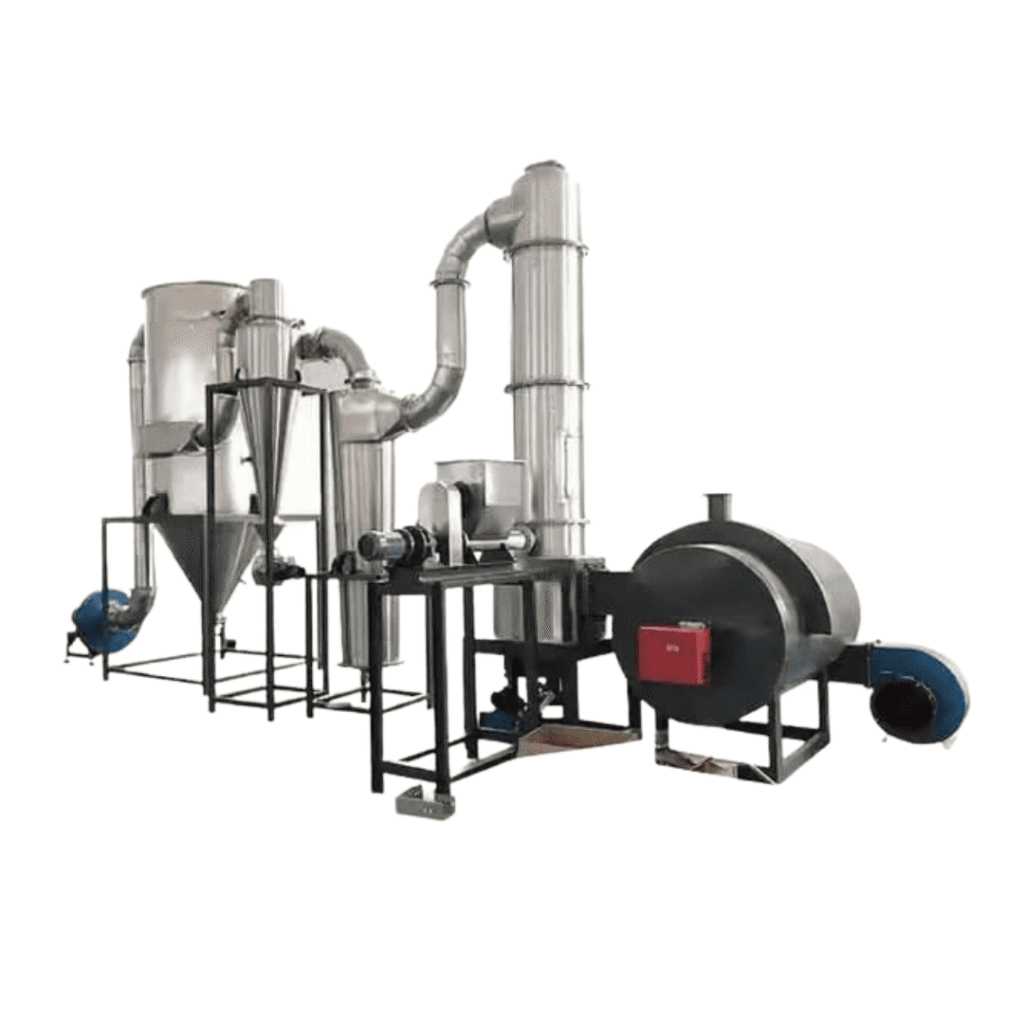
A flash dryer, also called a pneumatic dryer in suitable configurations, is designed for rapid moisture removal from finely divided wet materials.
Wet material is dispersed into a high-velocity stream of heated air. The resulting high heat and mass transfer rate allows rapid drying.
Flash Dryer Applications
Flash dryers can be evaluated for:
- Cassava starch
- Tapioca flour
- Modified starch
- Native starch
- Fine chemical products
- Precipitated silica
- Calcium carbonate
- Pigments
- Dye intermediates
- Inorganic salts
- Fine mineral materials
Flash Dryer Benefits
- Rapid drying
- Compact footprint
- Continuous operation
- Fast thermal response
- Suitable for fine materials
- High heat and mass transfer
For products requiring rapid drying, flash drying can provide an effective alternative to longer-residence-time drying technologies.
4. Belt Dryer Philippines – Continuous & Gentle Food Drying
A belt dryer, also called a band dryer or mesh belt dryer, is one of the most versatile technologies for continuous dehydration of food, agricultural and other solid materials.
The wet product is distributed over a perforated belt and transported through controlled drying zones.
Air can pass through or across the product depending on the dryer configuration.
Belt Dryer Applications in the Philippines
Coconut Products
- Desiccated coconut
- Coconut flakes
- Coconut chips
- Processed coconut products
Tropical Fruits
- Dried mango
- Banana chips
- Pineapple
- Papaya
- Jackfruit
- Other sliced fruits
Seaweed
- Kappaphycus
- Eucheuma
- Seaweed flakes
- Seaweed feedstock before further processing
Spices & Herbs
- Garlic
- Onion
- Ginger
- Chili
- Pepper
- Herbs
Biomass
- Agricultural residues
- Biomass particles
- Wood products
- Pellet-related materials
Advantages of Belt Dryers
- Continuous drying
- Gentle material handling
- Multi-zone temperature control
- Adjustable residence time
- Large drying area
- Suitable for automated processing
- Stainless-steel construction options for food applications
Multi-tier belt dryer designs can increase drying capacity within a relatively compact plant footprint.
5. Fluid Bed Dryer Philippines – Food, Chemical & Pharmaceutical Granules
A Fluid Bed Dryer (FBD) uses upward-flowing hot air to suspend and fluidize solid particles.
This creates excellent contact between the drying air and individual particles, supporting efficient heat and mass transfer.
Fluid Bed Dryer Applications
Pharmaceutical Industry
- Pharmaceutical granules
- Tablet granules
- Capsule-related materials
- Powder drying
- Selected coating processes
Food Industry
- Sugar
- Salt
- MSG
- Cereal ingredients
- Instant food powders
- Granulated ingredients
Chemical Industry
- Polymer granules
- Plastic resins
- Crystalline chemical products
- Other particulate materials
Benefits of Fluid Bed Dryers
- High heat and mass transfer
- Uniform drying
- Controlled residence time
- Suitable for granules
- Continuous and batch configurations
- Precise process control
For pharmaceutical applications, equipment design and material-contact surfaces should be specified according to the applicable GMP and plant requirements.
6. Apron Band Dryer Philippines – Heavy-Duty Continuous Drying
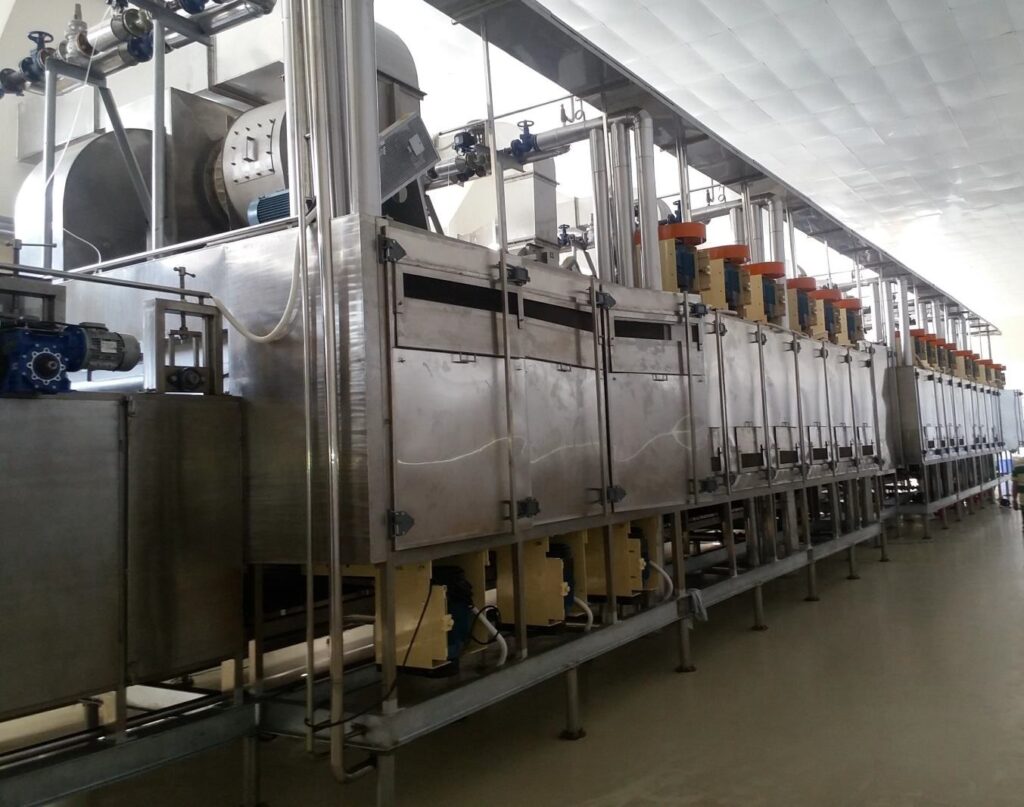
An Apron Band Dryer, also known as an Apron Dryer or Heavy-Duty Band Dryer, is a continuous industrial drying system designed for materials that require robust conveying and controlled thermal drying.
Unlike conventional lightweight mesh belt systems, an apron band dryer uses a heavy-duty moving belt or overlapping apron plates to transport the material through controlled drying zones.
This makes the technology suitable for coarse, heavy, irregular, sticky or mechanically demanding materials where conventional conveyor or mesh belt dryers may not be the preferred configuration.
How Does an Apron Band Dryer Work?
Wet material is continuously fed onto the moving apron belt. The material travels through one or more temperature-controlled drying zones while heated air is circulated across or through the product layer.
A typical process can be represented as:
Wet Feed → Product Distribution → Controlled Heating Zones → Moisture Evaporation → Final Drying → Dried Product Discharge
The dryer can be configured with multiple drying zones, allowing temperature, airflow and residence time to be adjusted according to the product characteristics.
Apron Band Dryer Applications in the Philippines
An apron band dryer can be considered for a range of industrial and agro-processing materials, including:
Coconut & Agro-Processing
- Coconut products
- Coconut residues
- Agricultural by-products
- Coarse agro-materials
- Biomass feedstocks
Food Processing
- Coarse food ingredients
- Food-processing residues
- Selected vegetable and agricultural products
- Heavy or irregular food materials
Biomass & Renewable Energy
- Biomass residues
- Wood-related materials
- Agricultural waste
- Coarse biomass feedstock
- Pre-drying before pelletizing or further processing
Chemical & Industrial Materials
- Coarse chemical solids
- Industrial residues
- Filtered solids
- Materials requiring controlled continuous drying
The exact application should be confirmed through product characteristics and drying trials.
Key Advantages of Apron Band Dryers
1. Heavy-Duty Material Handling
The robust apron conveying system is suitable for materials that may be too heavy, coarse or abrasive for lightweight conveyor configurations.
2. Continuous Operation
The dryer can operate continuously, making it suitable for industrial plants requiring consistent production.
3. Multi-Zone Drying
Independent drying zones can be configured to provide different temperature and airflow conditions during the drying process.
4. Controlled Residence Time
The belt speed can be adjusted to provide the required residence time according to the material and target moisture.
5. Suitable for Difficult Materials
Apron band dryers can be considered for materials that are:
- Coarse
- Heavy
- Irregular
- Sticky
- Difficult to convey
- Mechanically demanding
6. Industrial-Scale Configuration
The system can be engineered according to the required:
- Feed rate
- Moisture evaporation
- Final moisture
- Drying temperature
- Heating source
- Residence time
- Belt loading
- Plant layout
7. Paddle Dryer Philippines – Sludge, Sticky Materials & By-Products
A Paddle Dryer is an indirect drying system suitable for challenging materials such as sludge, pastes, sticky solids and certain industrial by-products.
The heating medium circulates through hollow paddles and/or the dryer jacket while mechanical agitation promotes material movement and heat transfer.
Paddle Dryer Applications
Wastewater & Sludge
- ETP sludge
- STP sludge
- Industrial wastewater sludge
- Sludge volume reduction
Oleochemical Processing
- Coconut processing residues
- Fatty-acid-related residues
- Industrial sludges
Food & Industrial By-Products
- Sticky by-products
- High-moisture residues
- Process slurries
Paddle dryers can be particularly useful where indirect heating and controlled mechanical agitation are required.
8. Vacuum Dryer Philippines – Heat-Sensitive Products
Vacuum drying is used when reducing the boiling temperature of moisture is important for processing heat-sensitive materials.
Operating under reduced pressure can allow moisture removal at lower product temperatures compared with conventional atmospheric drying, depending on the system and process conditions.
Potential Applications
- Pharmaceutical materials
- Heat-sensitive active ingredients
- Specialty chemicals
- High-value products
- Materials requiring controlled low-temperature drying
Vacuum drying parameters should be established based on product characteristics and process requirements.
Industrial Dryers for the Philippine Coconut Industry
The coconut industry is one of the most important application areas for industrial drying technology in the Philippines.
Different coconut products require different drying approaches.
Copra Drying
Industrial drying can provide controlled moisture removal from copra while reducing dependence on weather conditions.
The source material specifically identifies copra drying as an important application and highlights the objective of producing consistent, higher-quality dried copra.
Desiccated Coconut Drying
For desiccated coconut, continuous belt or multi-pass drying systems can be considered where uniform moisture distribution and controlled drying conditions are required.
Coconut Shell & Biomass
Rotary drying systems can be evaluated for pre-drying coconut shell and other biomass materials before downstream processing.
Industrial Seaweed & Carrageenan Dryers in the Philippines
The Philippines has an important seaweed-processing industry, particularly involving Kappaphycus and Eucheuma.
Industrial drying can be used to reduce moisture in harvested seaweed before transportation, storage or further processing.
Potential Drying Systems
Depending on the feed characteristics and production requirements:
- Mesh belt dryers
- Belt dryers
- Multi-tier band dryers
- Rotary dryers
- Other customized continuous drying systems
For seaweed applications, dryer selection should consider the material’s moisture content, bulk density, stickiness, salt content, desired final moisture and required throughput.
Industrial Dryers for Philippine Food Processing
The Philippine food-processing sector includes a wide variety of products requiring controlled dehydration.
Potential applications include:
Fruits
- Mango
- Banana
- Pineapple
- Papaya
- Jackfruit
Vegetables
- Onion
- Garlic
- Vegetable slices
Spices
- Ginger
- Turmeric
- Chili
- Pepper
Food Ingredients
- Starches
- Granules
- Food powders
- Seasonings
Seafood & Animal Products
- Fish
- Seafood ingredients
- Feed materials
For each product, the dryer should be selected based on feed condition, moisture level, temperature sensitivity, required capacity and target final moisture.
Industrial Dryers for Mining & Minerals in the Philippines
The Philippines has significant mining and mineral-processing activity, creating demand for high-capacity thermal processing equipment.
Rotary dryers are often considered for bulk mineral materials because of their robust mechanical design and continuous operation.
Potential applications include:
- Nickel-containing materials
- Copper-related materials
- Chromite
- Silica sand
- Limestone
- Mineral concentrates
- Industrial residues
The final dryer design should account for material abrasiveness, particle size, bulk density, initial moisture and required throughput.
Industrial Chemical Dryers in the Philippines
Chemical manufacturers require drying systems capable of achieving controlled moisture levels while maintaining product specifications.
Depending on the material form, suitable technologies can include:
- Rotary dryers
- Flash dryers
- Paddle dryers
- Fluid bed dryers
- Spray dryers
- Vacuum dryers
Applications can include:
- Chemical salts
- Pigments
- Polymers
- Crystalline chemicals
- Specialty chemicals
- Chemical intermediates
The correct technology depends heavily on the physical properties of the chemical feed.
Pharmaceutical Dryers for Philippine Manufacturing
Pharmaceutical manufacturing requires highly controlled drying conditions.
Potential pharmaceutical drying technologies include:
Fluid Bed Dryers
Suitable for many pharmaceutical granules and particulate materials.
Vacuum Dryers
Useful when low-temperature processing is required for heat-sensitive materials.
Spray Dryers
Suitable for converting certain pharmaceutical or biological liquid feeds into powders.
Hygienic Design Considerations
Pharmaceutical drying systems may require:
- Appropriate stainless-steel construction
- Controlled airflow
- Cleanable surfaces
- Validatable process parameters
- Appropriate filtration
- GMP-oriented design
- Batch traceability and process control
Final equipment specifications should be established according to the pharmaceutical product and applicable regulatory requirements.
How to Choose the Right Industrial Dryer in the Philippines
Selecting an industrial dryer should begin with the material, not the machine.
Before purchasing a dryer, manufacturers should define:
1. What is the material?
Is it:
- Liquid?
- Slurry?
- Wet cake?
- Powder?
- Granule?
- Bulk solid?
- Sliced food?
- Sticky sludge?
2. What is the initial moisture?
The starting moisture determines the total evaporation load.
3. What is the target final moisture?
The required final moisture influences dryer size, residence time and energy requirement.
4. What is the production capacity?
Specify:
- kg/hour
- tons/hour
- tons/day
5. Is the product heat-sensitive?
Heat-sensitive materials may require:
- Low-temperature drying
- Heat pump drying
- Vacuum drying
- Indirect drying
- Carefully controlled residence time
6. What heating source is available?
Possible options include:
- Steam
- Thermal oil
- Hot water
- Gas
- LPG
- LNG
- Biomass
- Electric heating
- Waste heat
7. What are the hygiene requirements?
Food and pharmaceutical applications may require specialized sanitary construction and cleaning arrangements.
Industrial Dryer Selection Guide
| Material / Application | Dryer to Consider | Main Reason |
| Coconut shell | Rotary Dryer | High-capacity bulk drying |
| Copra | Belt / Continuous Dryer | Controlled continuous drying |
| Desiccated coconut | Belt Dryer | Gentle, uniform drying |
| Seaweed | Belt / Mesh Belt Dryer | Continuous moisture reduction |
| Coconut milk | Spray Dryer | Liquid-to-powder conversion |
| Cassava starch | Flash Dryer | Rapid moisture removal |
| Dried fruits | Belt Dryer | Gentle continuous dehydration |
| Spices | Belt Dryer | Controlled temperature drying |
| Minerals | Rotary Dryer | Heavy-duty bulk processing |
| Pharmaceutical granules | Fluid Bed Dryer | Efficient particle drying |
| Sticky sludge | Paddle Dryer | Indirect drying |
| Heat-sensitive pharma | Vacuum Dryer | Controlled low-temperature drying |
Why Choose a Customized Industrial Dryer?
Every industrial drying project has different process conditions.
A standard machine may not provide the required performance when the product has unusual characteristics such as:
- High initial moisture
- High stickiness
- Heat sensitivity
- Irregular particle size
- Abrasiveness
- High bulk density
- Low flowability
- Strict final moisture specifications
A customized dryer can be engineered around the actual material and plant requirements.
Typical Project Evaluation
Product → Moisture → Capacity → Drying Temperature → Heating Source → Residence Time → Final Moisture → Dryer Configuration
This process helps engineers identify a more suitable drying technology for the application.
Industrial Dryer Manufacturer & Supplier for the Philippines
Genex Tech Industries provides industrial drying technologies for diverse processing requirements.
The company’s dryer portfolio includes:
- Rotary Dryers
- Spray Dryers
- Flash Dryers
- Belt Dryers
- Apron Band Dryers
- Mesh Belt Dryers
- Fluid Bed Dryers
- Paddle Dryers
- Vacuum Dryers
- Customized Thermal Processing Systems
The source material positions Genex Tech as a provider of customized thermal drying equipment for Philippine industries and identifies local technical support through representatives.
Frequently Asked Questions About Industrial Dryers in the Philippines
Which industrial dryer is best for coconut?
The best dryer depends on the coconut product. Belt or mesh belt dryers can be considered for desiccated coconut and coconut flakes, while rotary drying may be suitable for bulk coconut shell or biomass applications. Spray drying can be considered when converting coconut-based liquids into powders.
Which dryer is used for seaweed in the Philippines?
Continuous belt or mesh belt dryers can be considered for seaweed drying because they provide controlled continuous moisture removal and can be designed for large processing capacities.
Which dryer is suitable for cassava starch?
A flash dryer is commonly considered when rapid moisture removal from fine starch materials is required.
Which industrial dryer is used for minerals?
Rotary dryers are suitable for many bulk mineral-drying applications because of their robust construction and continuous high-capacity operation.
What is the difference between a belt dryer and a rotary dryer?
A belt dryer transports material continuously on a perforated belt through controlled drying zones and is often suitable for products requiring gentle handling. A rotary dryer tumbles bulk material inside a rotating drum and is generally suited to robust bulk solids and high-throughput applications.
Which dryer is suitable for pharmaceutical granules?
Fluid Bed Dryers are widely considered for pharmaceutical granules and particulate materials because they provide effective contact between heated air and individual particles.
What information is required to select an industrial dryer?
Important information includes product name, initial moisture, target final moisture, production capacity, feed condition, particle size, heat sensitivity, available heating source and required operating hours.
Does Genex Tech provide customized industrial dryers for Philippine industries?
Yes. The source material positions Genex Tech as providing customized industrial drying solutions for Philippine applications across food, agriculture, coconut, seaweed, mining, chemicals, pharmaceuticals and related industries.
Get the Right Industrial Dryer for Your Philippine Plant
Whether you are processing coconut, copra, seaweed, carrageenan, cassava starch, dried fruits, spices, minerals, chemicals, pharmaceutical granules, sludge or biomass, selecting the correct industrial dryer is essential for achieving consistent moisture control and reliable production.
Genex Tech Industries can evaluate your product and process requirements and recommend a suitable drying technology based on:
- Initial moisture
- Final moisture
- Production capacity
- Product characteristics
- Heat sensitivity
- Heating source
- Residence time
- Plant conditions
Looking for an industrial dryer in the Philippines? Share your product name, initial moisture, required final moisture and production capacity to discuss a customized industrial drying solution.
CONTACT US:
+91 9330077417
www.foodtechprojects.com
www.coconutprojects.com
www.gtidryers.com
10 / C Middleton Row, 700071, India