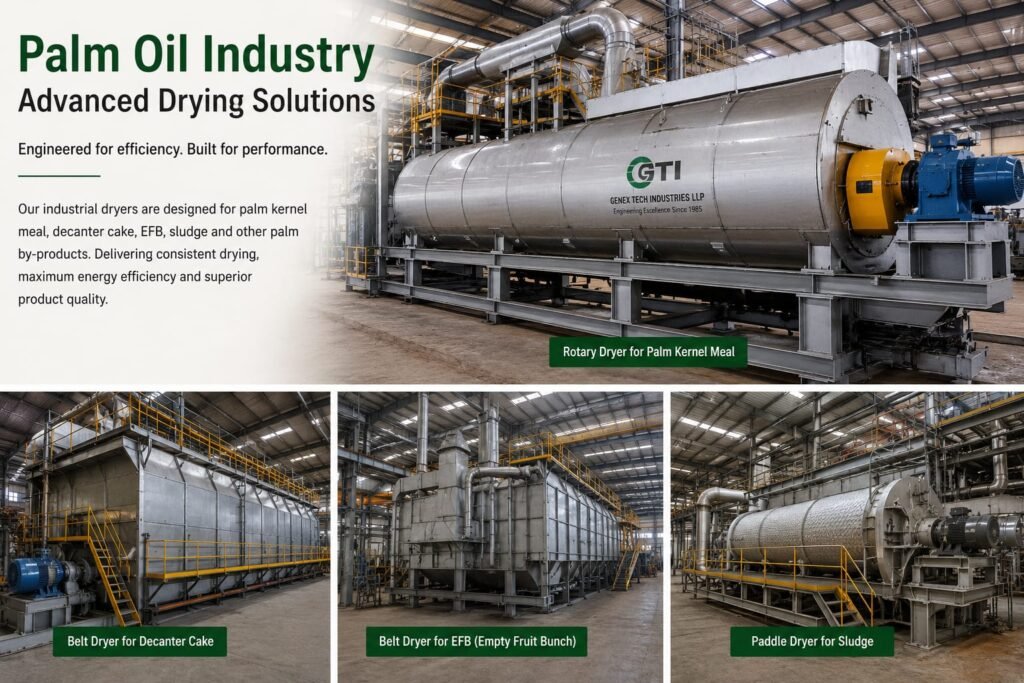
The palm oil industry in Southeast Asia faces an unprecedented imperative: converting high-moisture organic processing waste into high-value biomass energy, animal feed, and sustainable bio-products. Operating efficiently requires advanced thermal drying engineering capable of handling challenging feedstocks like Empty Fruit Bunches (EFB), Palm Pressed Fibre (PPF), Palm Kernel Shells (PKS), Decanter Cake, and Palm Oil Mill Effluent (POME) sludge.
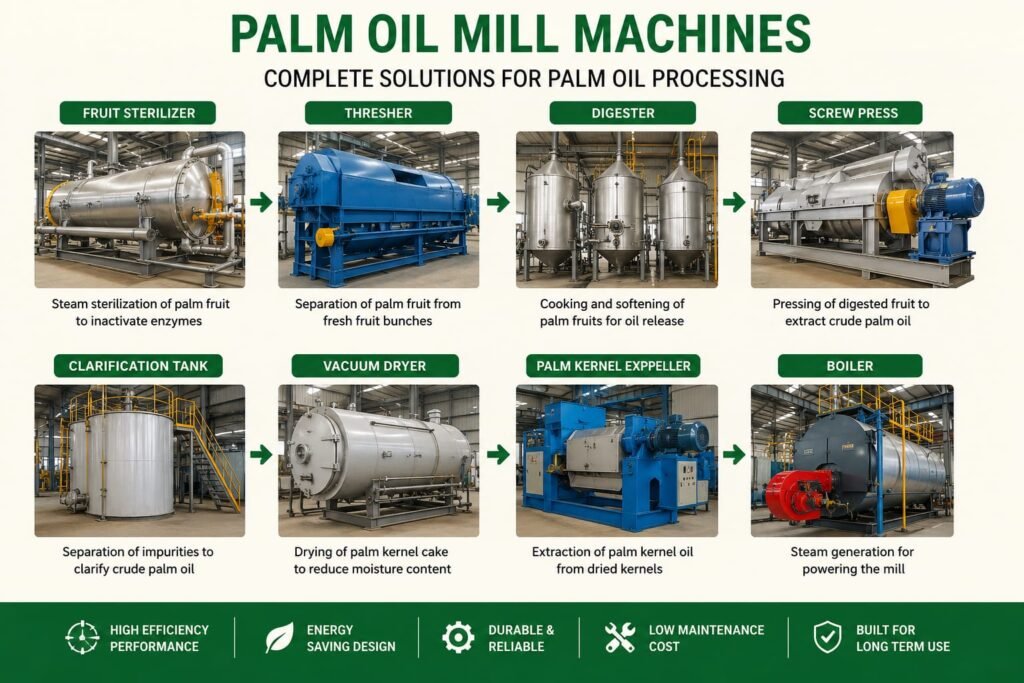
As industry stakeholders gather for PALMEX Thailand 2026 from 6th to 7th August 2026 at the CO-OP Exhibition Centre in Surat Thani, Thailand, Genex Tech Industries LLP (GTI) will be attending the event.
Important Visitor Announcement: Genex Tech Industries LLP (GTI) is attending PALMEX Thailand 2026 as a visitor only and is not an exhibitor. GTI’s engineering delegation will be present on-site across both days (August 6–7, 2026) to meet directly with palm oil mill owners, biomass processors, EPC contractors, project consultants, and technology partners. To explore advanced custom drying solutions or pre-book a B2B technical discussion during the event, visit the official GTI Palm Drying Systems platform.
Part 1: PALMEX Thailand 2026 & Modern Palm Biomass Engineering
PALMEX Thailand 2026: Event Overview & Strategic Context
PALMEX Thailand 2026 stands as Thailand’s premier specialized trade event dedicated to the palm oil, oleochemical, and biomass industries. Held in Surat Thani—the heartbeat of Thailand’s palm oil production sector—the 15th edition brings together upstream mill operators, downstream processors, equipment manufacturers, and green energy technology developers.
| Event Parameter | Details |
|---|---|
| Event Name | PALMEX Thailand 2026 (15th Edition) |
| Dates | 6th – 7th August 2026 |
| Venue | CO-OP Exhibition Centre, Surat Thani, Thailand |
| Industry Focus | Upstream & Downstream Palm Oil Technology, Biomass Processing, Effluent Treatment |
| GTI Participation Status | Visitor Only (GTI is not an exhibitor; no exhibition booth) |
| GTI Core Expertise | Heavy-duty industrial thermal dryers, biomass processing equipment, waste heat recovery systems |
Surat Thani serves as the ideal hub for this gathering, as southern Thailand accounts for the vast majority of the nation’s crude palm oil (CPO) output. Thailand ranks third globally in palm oil production, making its processing sector a key market for modernization, energy efficiency upgrades, and waste-to-wealth technologies.
The Southeast Asia Palm Oil Industry Landscape
Across Southeast Asia—primarily Indonesia, Malaysia, and Thailand—palm oil extraction yields vast quantities of organic solid and liquid by-products. For every ton of Fresh Fruit Bunches (FFB) processed, a mill generates:
- Empty Fruit Bunches (EFB): ~22–23%
- Palm Pressed Fibre (PPF): ~12–15%
- Palm Kernel Shells (PKS): ~5–7%
- Decanter Cake: ~3–5%
- Palm Oil Mill Effluent (POME) Sludge: ~60–65% (volumetric liquid effluent yield generating significant solid sludge upon treatment)
Raw biomass off the press or centrifuge contains moisture levels ranging from 50% to over 85%. Burning wet biomass directly in boilers leads to incomplete combustion, low thermal efficiency, high particulate emissions, and accelerated equipment corrosion. High-moisture biomass drying solves these operational challenges by stabilizing materials for combustion, gasification, pelletization, and organic fertilizer production.
GTI Overview: Genex Tech Industries LLP
Genex Tech Industries LLP (GTI) is an engineering and manufacturing firm specializing in industrial drying systems, thermal equipment, and process engineering solutions. GTI engineers and fabricates heavy-duty rotary dryers, paddle dryers, conveyor band dryers, and fluid bed drying systems tailored for tough, abrasive, sticky, and fibrous materials.
GTI’s thermal engineering portfolio addresses high-moisture agricultural waste and industrial by-products. By engineering equipment that utilizes waste thermal energy—such as boiler flue gas or turbine exhaust steam—GTI helps palm oil processing plants achieve lower operating costs (OPEX), reduced fuel consumption, and higher process throughput.
Why Connect with GTI Delegates at PALMEX Thailand 2026?
Because GTI is attending PALMEX Thailand 2026 as a visitor only (not an exhibitor), GTI delegates offer flexible, direct, on-site networking opportunities throughout the venue. Meeting with GTI’s visiting technical representatives in Surat Thani provides palm oil processors and plant builders several strategic advantages:
- Unbiased Technical Consultations: Discuss operational bottlenecks, sticky material handling, and moisture targets with industrial thermal engineers.
- Custom Retrofit & Heat Recovery Integration: Learn how to tap unused waste heat from existing mill boilers to dry EFB, decanter cake, or POME sludge without increasing total plant energy consumption.
- Turnkey Sizing & Process Modeling: Receive preliminary capital expenditure (CAPEX) and operating expenditure (OPEX) evaluations for integrating custom drying loops into new or expanding palm oil mills.
- Partnership & Distribution Opportunities: Regional EPC contractors, equipment distributors, and project consultants can establish strategic technical ties with GTI for regional project execution across Thailand, Malaysia, Indonesia, and beyond.
Palm Drying Systems Overview
Industrial palm biomass drying requires equipment engineered specifically for non-uniform, sticky, fibrous, or abrasive materials. Standard generic dryers often fail in palm oil applications due to material clogging, uneven drying, thermal degradation, or fire hazards caused by residual palm oil volatile organic compounds (VOCs).
GTI’s specialized Palm Drying Systems are designed around structural durability, precise temperature management, optimized residence times, and automated air recirculation to ensure safe, energy-efficient moisture reduction.
[Raw Wet Palm Biomass] ──► [De-watering / Shredding] ──► [GTI High-Efficiency Dryer] ──► [Cyclones / Scrubbers]
 (50% - 85% Moisture)                                     ▲ (Flue Gas / Steam Heat)          │
                                                          └──────────────────────────────────┘
                                                                 [Dried Stable Product]
                                                                  (< 10% - 15% Moisture)
Featured Snippets: Core Drying Technology Summary
What is the ideal moisture content for palm biomass combustion and pelletization?
Raw EFB and palm fibre exit palm oil press stations at 50%–65% moisture. For efficient boiler co-firing or high-density pellet production, moisture must be reduced to 10%–12%. This moisture drop increases the Gross Calorific Value (GCV) of palm biomass from ~2,000 kcal/kg up to ~4,200–4,500 kcal/kg.
Which industrial dryer type is best for Empty Fruit Bunches (EFB) and Palm Pressed Fibre (PPF)?
Heavy-duty Triple-Pass Rotary Drum Dryers and continuous Multi-Tier Conveyor Band Dryers are the most reliable industrial solutions. Rotary dryers handle high-volume shredded EFB with constant tumbling action, while conveyor band dryers provide controlled gentle drying using low-temperature waste heat.
Primary Applications of Palm Biomass Thermal Processing
                      ┌──► Boiler Fuel (Enhanced GCV Power Generation)
                      ├──► High-Density Biomass Pellets & Briquettes
Wet Palm Biomass ─────┼──► Pyrolysis & Biochar Production
 (EFB, PPF, PKS,      ├──► Organic Bio-Fertilizers & Soil Conditioners
  POME Sludge)        └──► Animal Feed Supplements (Decanter Cake)
Part 2: Biomass & By-Product Thermal Processing Equipment
                      ┌──► Rotary Drum Dryers (High volume, heavy tumbling)
                      ├──► Paddle Dryers (Indirect heat, sticky sludge/cakes)
GTI Dryer Portfolio ──┼──► Continuous Band Dryers (Low-temp, delicate solids)
                      └──► Vibratory Fluid Bed Dryers (Granular kernels/shells)
Palm Fibre Dryers
Palm Pressed Fibre (PPF) is squeezed out during crude oil extraction. Containing residual oil (~5–8%) and moisture (~45–55%), un-dried PPF burns inefficiently in mill boilers, producing smoke and clinker formation.
GTI palm fibre dryers reduce moisture levels to under 12%. By drying PPF, mills convert fibrous biomass into an immediate high-calorific fuel source. GTI systems incorporate spark detection, flame-proof discharge locks, and dynamic air speed controls to safely process fibrous materials with residual oil content.
EFB Dryers (Empty Fruit Bunch Thermal Processing)
Empty Fruit Bunches represent one of the largest biomass streams in palm oil milling. Raw EFB leaves the sterilizer and thresher with a moisture content of 60%–68% and a tough, fibrous structure.
[Raw Wet EFB Bunches] ──► [Hydraulic EFB Press / Shredder] ──► [GTI EFB Rotary / Band Dryer] ──► [Pelletizer / Boiler]
  (Moisture: 65%)             (Shredded Fibres: 50% H2O)           (Output Moisture: < 12%)
GTI EFB Dryers utilize heavy-duty shredding interface systems coupled with multi-pass rotary or belt drying chambers. Processing EFB into dried biomass yields a valuable raw material for:
- EFB Biomass Pellets: High-density export fuel replacing coal in industrial boilers.
- Molded Pulp & Packaging: Sustainable biodegradable paper packaging products.
- Power Generation: High-efficiency direct-firing in biomass power plants.
Palm Kernel Dryers
Palm kernels require precise thermal treatment to weaken the internal kernel-to-shell bond, facilitate clean cracking in rippler machines, and prevent kernel rancidity caused by fungal growth during storage.
GTI Palm Kernel Dryers employ low-temperature indirect hot-air circulation or fluidizing bed techniques. Maintaining uniform drying temperatures below 60°C–70°C preserves Free Fatty Acid (FFA) quality in extracted Palm Kernel Oil (PKO) while ensuring the outer shell cracks cleanly without damaging the kernel inside.
Palm Shell Dryers (Palm Kernel Shell – PKS)
Palm Kernel Shells (PKS) are a premium bio-energy feedstock valued for high fixed carbon content and naturally low ash yield. Fresh PKS off the hydrocyclone or clay bath separator contains surface moisture around 20%–30%.
GTI PKS Dryers use rotary or vibratory fluid bed thermal systems to strip surface and capillary moisture down to <10%. Dried PKS delivers a heating value exceeding 4,500 kcal/kg, making it an ideal fuel for industrial boilers, cement kilns, and gasification plants across Japan, South Korea, and Europe.
Industrial Dryer Architecture Comparison
+-----------------------------------------------------------------------------------+
|                            GTI DRYER SELECTION MATRIX                             |
+--------------------------+-----------------------+--------------------------------+
| Dryer Type               | Key Material Fit      | Primary Thermal Source         |
+--------------------------+-----------------------+--------------------------------+
| Rotary Drum Dryer        | Shredded EFB, PPF     | Boiler Flue Gas / Direct Fire  |
| Paddle Dryer             | POME Sludge, Cake     | Steam / Thermal Oil (Indirect) |
| Multi-Pass Band Dryer    | Long EFB Fibre        | Waste Heat / Hot Water         |
| Vibratory Fluid Bed      | Palm Kernels, PKS     | Air Heat Exchanger             |
+--------------------------+-----------------------+--------------------------------+
1. Industrial Rotary Dryers
GTI Rotary Dryers feature heavy-duty welded steel shells mounted on forged riding rings and trunnion assemblies. Internal flight designs actively lift and shower palm biomass through a hot gas stream, maximizing heat transfer rates.
                  ┌─────────────────────────────────────────────────┐
  Wet Biomass ──► │  (S)  Flight Lifts Material  (S)  (S)           │ ──► Exhaust Air to Cyclone
  Hot Gas In  ──► │  ======= Rotating Drum Shell =======            │ ──► Dried Product Out
                  └─────────────────────────────────────────────────┘
- Best For: Large-scale EFB processing, Palm Pressed Fibre, high-tonnage biomass plants.
- Key Feature: High mechanical reliability, handling up to 50+ metric tons per hour (MTPH) with heavy bulk density variability.
2. Paddle Dryers (Indirect Thermal Processing)
GTI Hollow-Paddle Dryers deliver high-efficiency indirect heat transfer for sticky, pastelike, or ultra-fine materials. Dual parallel shafts with intermeshing wedge-shaped hollow paddles rotate inside a jacketed trough, heating material through direct contact with steam or thermal oil.
- Best For: Dewatered POME sludge, centrifuge decanter cake, oily mill slurries.
- Key Feature: Zero direct airflow required through the drying chamber, virtually eliminating dust emissions, nitrogen gas sweep requirements, and carrier gas cleanup costs.
3. Continuous Band / Conveyor Belt Dryers
GTI Continuous Multi-Pass Band Dryers convey wet biomass along perforated stainless steel belt layers inside an insulated drying enclosure. Heated air flows vertically upward or downward through the material bed.
- Best For: Long-strand EFB fibres, fragile bio-compounds, heat-sensitive materials.
- Key Feature: Low operational air velocities prevent dust entrainment; ideal for low-temperature waste heat utilization (e.g., hot water loops or low-pressure waste steam).
4. Vibratory Fluid Bed Dryers (VFBD)
GTI Vibratory Fluid Bed Dryers combine mechanical vibration with hot air forced through a perforated distribution plate. This fluidizes free-flowing solid particles, surrounding each particle with hot gas.
- Best For: Uniform granular solids like Palm Kernel Shells (PKS) and graded palm kernels.
- Key Feature: Precise control over residence time, high heat transfer efficiency (W/m2K), and plug-flow material transport preventing thermal degradation.
Part 3: Effluent Management, Biomass Energy & Engineering Principles
POME Sludge Dryers
Palm Oil Mill Effluent (POME) is one of the most environmentally hazardous liquid wastes generated by palm oil mills due to high Biochemical Oxygen Demand (BOD) and Chemical Oxygen Demand (COD). When treated in anaerobic digestion ponds or aerobic systems, substantial volumes of concentrated organic sludge accumulate.
GTI POME Sludge Dryers accept dewatered sludge cake (~80% moisture) and evaporate internal moisture to under 10%–12%. This turns an offensive environmental liability into a stabilized, nutrient-rich organic bio-fertilizer containing nitrogen, phosphorus, potassium, and trace minerals ideal for plantation soil enrichment.
Raw POME Liquid ──► Anaerobic Digester ──► Decanter / Belt Press ──► GTI Sludge Dryer ──► Bio-Fertilizer
 (High BOD/COD)                              (80% Moisture)           (10% Moisture)     (Pelletized / Granular)
Decanter Cake Dryers
3-Phase Decanters used in modern palm oil extraction yield a semi-solid material known as decanter cake. Containing 70%–75% moisture, un-dried decanter cake degrades quickly, emits odor, and presents handling challenges.
GTI Decanter Cake Dryers evaporate moisture rapidly using indirect steam or flue-gas heating. Dried decanter cake offers excellent nutritional value as a high-protein ruminant feed ingredient or high-grade organic fertilizer binder.
Biomass & Digestate Drying Infrastructure
Integrating high-capacity digestate and biomass drying systems into modern palm oil complexes enables complete circular energy recovery:
                  ┌──► Biogas Generation (Anaerobic Digestion) ──► Boiler Fuel / Power
Palm Oil Waste ───┤
                  └──► Solid Digestate ──► GTI Dryer ──► Solid Biomass Pellets
Heat Recovery & Energy Efficiency Integration
Thermal drying operations require substantial energy input to supply the latent heat of vaporization (≈2,260 kJ/kg of evaporated water). GTI designs custom heat recovery loops that draw thermal energy directly from existing palm oil mill waste sources:
[Palm Mill Boiler Flue Gas] ──┐
[Turbine Exhaust Steam]    ──┼──► [GTI Waste Heat Exchanger] ──► [Zero-Fuel-Cost Drying Energy]
[Condenser Hot Water]      ──┘
By tapping waste energy streams, GTI palm drying systems can reduce net operational fuel costs to near zero, substantially lowering the payback period of the installation.
Thermal & Thermodynamic Engineering Principles
Industrial dryer design relies on fundamental heat and mass transfer principles. Evaporation rate inside a continuous dryer is defined by the thermal energy balance equation:
Q=mw⋅λ+mp⋅Cp⋅(Tout−Tin)+Qloss
Where:
- Q = Total thermal energy required (kJ/h or kW)
- mw = Mass flow rate of evaporated water (kg/h)
- λ = Latent heat of vaporization of water (≈2,260 kJ/kg)
- mp = Mass flow rate of dry bone biomass product (kg/h)
- Cp = Specific heat capacity of dry biomass (≈1.5–1.8 kJ/kg⋅∘C)
- Tin,Tout = Inlet and outlet product temperatures (∘C)
- Qloss = Convective and radiation enclosure losses (kJ/h)
Mass Balance Equations
To calculate required dryer capacity, the water removal rate is derived from wet feed moisture (Min) and targeted product moisture (Mout):
mw=mfeed⋅(100−MoutMin−Mout)
Example Calculation: Processing 10,000 kg/h of raw shredded EFB at 60% inlet moisture down to 10% final moisture:
mw=10,000⋅(100−1060−10)=10,000⋅(9050)≈5,555.5 kg/h of H2O evaporated
This process yields approximately 4,444.5 kg/h of dried EFB fuel product.
+-----------------------------------------------------------------------------------+
|               PALM BIOMASS MOISTURE & MASS BALANCE SPECIFICATIONS                 |
+-------------------+-----------------+-------------------+-------------------------+
| Biomass Feed      | Raw Moisture %  | Output Moisture % | Water Evaporation/Ton   |
+-------------------+-----------------+-------------------+-------------------------+
| Empty Fruit Bunch | 60% – 68%       | 10% – 12%         | 550 – 640 kg            |
| Palm Fibre (PPF)  | 45% – 55%       | 10% – 12%         | 390 – 480 kg            |
| Palm Shell (PKS)  | 20% – 30%       | 8% – 10%          | 130 – 220 kg            |
| Decanter Cake     | 70% – 75%       | 10% – 12%         | 660 – 710 kg            |
| POME Sludge Cake  | 80% – 85%       | 10% – 12%         | 770 – 830 kg            |
+-------------------+-----------------+-------------------+-------------------------+
Automation & Smart Process Control
GTI Palm Drying Systems incorporate programmable logic control (PLC) and SCADA systems with closed-loop feedback:
- Automated Variable Feed Controls: Adjusts input feed rate according to exhaust air temperature and real-time moisture sensor data.
- Multi-Point Spark Detection & Extinction: Instantly detects airborne embers or hotspots in dry biomass conveyance channels, triggering automatic high-pressure water mist suppression within milliseconds.
- Exhaust Gas Recirculation (EGR): Recirculates up to 50% of unsaturated exhaust gases to retain thermal energy while maintaining dynamic oxygen concentration below safety thresholds.
Part 4: Integrated Turnkey Solutions, Global Reach & FAQs
Turnkey Palm Oil Processing Solutions
GTI provides end-to-end process engineering, equipment fabrication, installation supervision, and commissioning support for complete biomass conditioning lines:
[Raw Waste Receiving Hoppers] ──► [De-watering Press / Shredders] ──► [GTI Drying System]
                                                                            │
[Pellet Cooling / Packaging]  ◄── [Biomass Pelletization Mill] ◄───────────┘
Key Industries & Value-Added Applications
GTI drying technologies serve diverse industrial operations:
- Palm Oil Mills & Refineries: In-house energy balance optimization and waste-to-wealth conversion.
- Biomass Pellet & Briquette Manufacturers: Commercial export pellet production for power plant co-firing.
- Biogas & Wastewater Treatment Plants: Sludge volume reduction and bio-fertilizer production.
- Co-generation & Power Utilities: Moisture conditioning to maintain stable boiler combustion temperatures.
Global Market Capability & Regional Commitment
Genex Tech Industries LLP (GTI) manufactures industrial equipment meeting international quality standards. GTI serves major agricultural and industrial markets across:
- Southeast Asia: Thailand, Malaysia, Indonesia, Vietnam, Philippines.
- Latin America: Colombia, Guatemala, Costa Rica, Honduras, Ecuador.
- Africa: Nigeria, Côte d’Ivoire, Ghana, Cameroon.
- South Asia: India, Sri Lanka.
GTI Global Delivery ──► Southeast Asia | Latin America | Africa | South Asia
Why Choose Genex Tech Industries LLP (GTI)?
- Heavy-Duty Structural Engineering: Built with thick abrasion-resistant plate alloys designed for continuous operation (24/7/365).
- Thermal Efficiency Focus: Advanced internal air distribution and heat recovery options yield low overall energy usage per kilogram of water evaporated.
- Safety-First Operational Design: Complete integration of inert gas blanketing options, spark suppression, explosion relief panels, and thermal monitoring.
- Custom-Tailored Systems: Sized to match precise client footprints, moisture targets, and available plant utilities.
Frequently Asked Questions (FAQs)
1. Will GTI have an exhibition booth at PALMEX Thailand 2026?
No. Genex Tech Industries LLP (GTI) is attending PALMEX Thailand 2026 as a visitor only. GTI delegates will be present throughout the venue on August 6th and 7th, 2026, to conduct B2B meetings, discuss engineering projects, and consult with industry partners.
2. How do I arrange a meeting with GTI representatives at PALMEX Thailand 2026 in Surat Thani?
You can coordinate directly with GTI delegates prior to or during the event by submitting an inquiry at the official GTI Palm Drying Systems contact hub. Meetings can be scheduled at the exhibition facility or nearby venues in Surat Thani.
3. What is the impact of drying EFB on boiler performance?
Drying EFB from 60% down to 15% moisture doubles its Gross Calorific Value (GCV) from ~2,000 kcal/kg to over 4,000 kcal/kg. This improves furnace temperatures, eliminates flue gas condensation, reduces particulate emissions, and prevents boiler tube corrosion caused by incomplete combustion products.
4. Can GTI drying systems run on boiler flue gas waste heat?
Yes. GTI rotary and band dryers can be engineered to draw thermal energy directly from boiler exhaust flue gas via direct contact or high-efficiency air-to-air heat exchangers, minimizing supplemental fuel consumption.
5. What dryer type is best suited for sticky POME sludge or decanter cake?
Indirect Hollow-Paddle Dryers are ideal for sticky, high-moisture sludges and decanter cakes. Direct mechanical contact with heated rotating paddles drives off moisture efficiently without clogging air ducts or requiring high carrier gas volumes.
6. How does GTI prevent fire hazards when drying fibrous, oily palm materials?
GTI integrates closed-loop thermal monitoring, low-oxygen gas recirculation, dynamic air velocity control, and automated high-pressure spark detection and misting suppression systems into all biomass drying units.
International Keywords & Terminology Index
| Market Sector | Key Search Terms & Technical Concepts |
|---|---|
| English (Global) | Palm biomass dryer, EFB dryer, Palm Pressed Fibre drying, PKS dryer, Decanter cake thermal dryer, POME sludge dryer, Palm oil waste heat recovery, PALMEX Thailand 2026 visitor. |
| Thai (ไทย) | เครื่องอบกากปาล์ม, เครื่องอบทะลายปาล์ม (EFB), เครื่องอบกะลาปาล์ม, งาน PALMEX Thailand 2026 สุราษฎร์ธานี, ระบบอบแห้งชีวมวล. |
| Bahasa (ID/MY) | Mesin pengering kelapa sawit, pengering janjang kosong (EFB), pengering ampas kelapa sawit, pengering lumpur POME, teknologi pengeringan biomasa sawit. |
| Spanish (LatAm) | Secador de biomasa de palma, secado de raquis / tuco (EFB), secador de cisco de palmiste, secado de lodos POME, planta de secado de fibra de palma. |
Connect with GTI at PALMEX Thailand 2026
Are you attending PALMEX Thailand 2026 at the CO-OP Exhibition Centre in Surat Thani, Thailand on 6th & 7th August 2026?
Whether you are a palm oil mill operator seeking to modernize biomass fuel processing, an EPC contractor delivering turnkey green energy projects, or a regional distributor looking for industrial drying machinery, Genex Tech Industries LLP (GTI) invites you to connect during the event.
Reminder: GTI representatives are attending PALMEX Thailand 2026 as visitors only and will not be operating an exhibition booth. Direct B2B discussions can be scheduled on-site throughout the event.
Plan Your Consultation:
- Explore Technical Systems: GTI Palm Drying Systems
- Pre-Book a Meeting in Surat Thani: Submit your request via the website contact form to secure an in-person session with visiting thermal drying engineers during PALMEX Thailand 2026.
- Request a Custom Engineering Sizing Report: Provide your raw material moisture, target output, and available heat source details for a preliminary system specification.