
Vibratory Fluidised Bed Dryer
GTI Dryers is a leading Vibratory Fluidised Bed Dryer manufacturer in India, designing and manufacturing industrial VFBD drying systems for controlled, energy-efficient drying of powders, granules, crystals, pellets, and particulate materials.
Vibratory Fluidised Bed Dryers are widely used in food processing, dairy, pharmaceuticals, chemicals, nutraceuticals, fertilizers, minerals, and specialty process industries where uniform drying and precise moisture control are essential.
Our VFBD dryers are engineered to provide:
uniform drying across the product bed
controlled final moisture levels
high drying efficiency with low energy consumption
gentle product handling
reliable continuous industrial operation
GTI VFBD systems are designed for consistent drying performance, high throughput, and long-term operational reliability across a wide range of industrial applications.
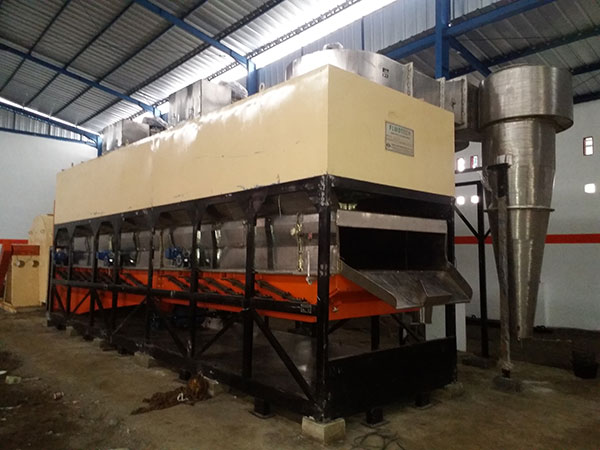
What is Vibratory Fluidised Bed Drying?
Vibratory Fluidised Bed Drying is a highly efficient thermal drying process used for removing moisture from powders, granules, crystals, and particulate materials.
In this system, a perforated vibrating bed supports the product while heated air is passed upward through the bed, causing the particles to become fluidised. The addition of controlled vibration helps move the product gradually across the bed while preventing agglomeration or channeling.
The combination of fluidisation and mechanical vibration provides:
uniform heat distribution
improved air-particle contact
consistent moisture removal
stable product movement
This technology is particularly effective for materials that require gentle handling, controlled residence time, and uniform drying conditions.
Working Principle of a Vibratory Fluidised Bed Dryer
At the core of a Vibratory Fluidised Bed Dryer is the process of fluidisation combined with controlled vibration, where heated air passes through a perforated bed to suspend and dry the product particles.
Wet material is evenly fed onto the vibrating bed. As the bed vibrates, the product spreads uniformly across the perforated plate and gradually moves toward the discharge end.
Simultaneously, heated air is introduced from below the perforated bed. The upward airflow lifts the particles slightly, creating a fluidised state where particles behave like a flowing fluid.
This fluidisation dramatically increases heat and mass transfer efficiency, allowing moisture to evaporate quickly from the product surface.
The vibration ensures continuous product movement and prevents material accumulation or clumping. As the particles travel through the dryer, moisture is progressively removed until the required moisture level is achieved.
The dried product is then discharged continuously, while the moisture-laden air exits through the exhaust and dust collection system.
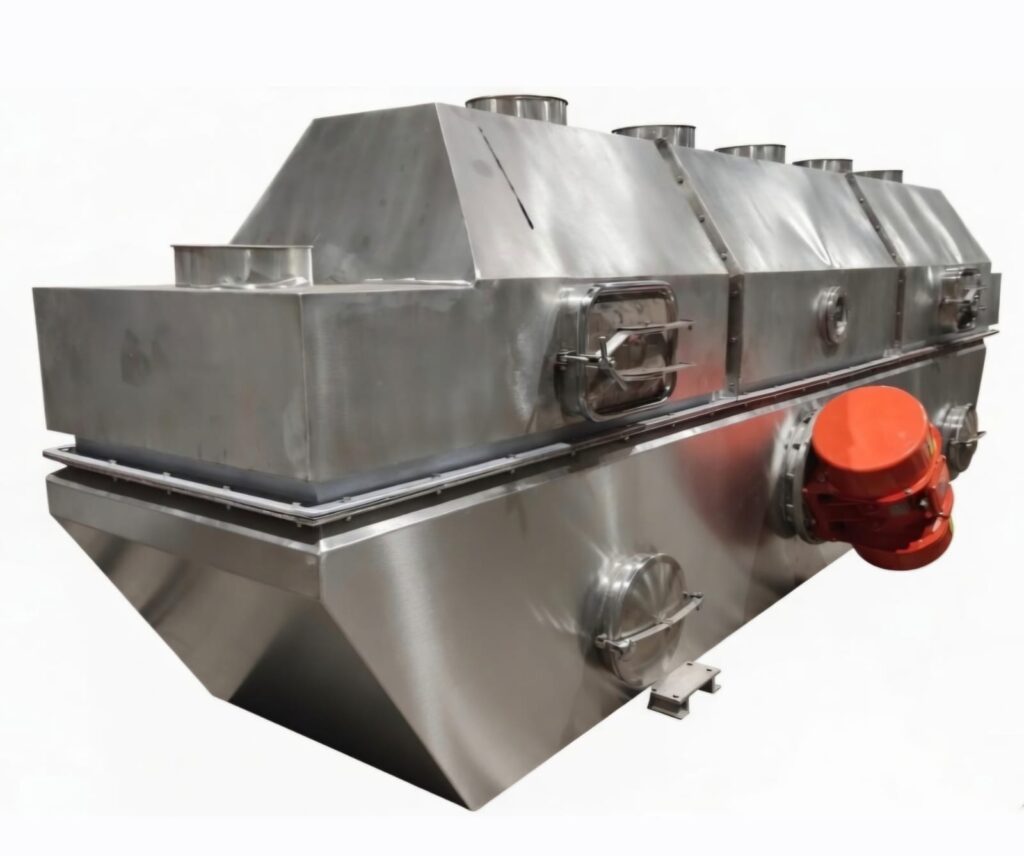
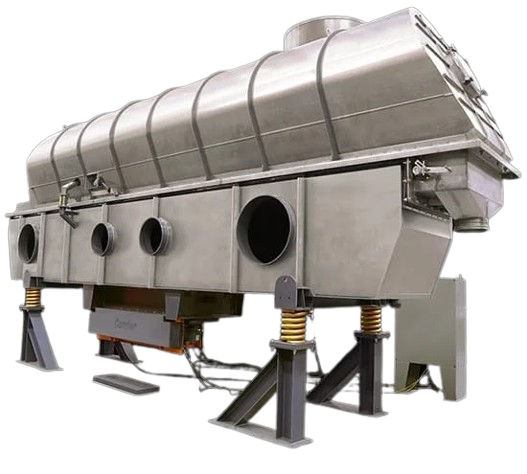
Advantages of Vibratory Fluidised Bed Dryer Technology
Industrial Vibratory Fluidised Bed Dryers provide efficient drying performance for powders and granular materials requiring uniform heat transfer and precise moisture control.
Key Benefits
Uniform drying performance due to excellent air-particle contact in the fluidised state
High heat transfer efficiency resulting in faster drying and reduced energy consumption
Gentle product handling suitable for fragile or heat-sensitive materials
Controlled residence time through adjustable vibration speed and airflow
Reduced product agglomeration because vibration prevents particle clumping
Consistent final moisture levels with uniform airflow distribution
Minimal dust carryover due to controlled fluidisation velocity
Flexible operation available in batch or continuous configurations
Energy efficient drying compared to many conventional drying systems
Compact equipment footprint with high throughput capability
Vibratory Fluidised Bed Dryer Applications
Vibratory Fluidised Bed Dryers are widely used for drying powders, granules, and crystalline materials across many industries.
Food & Dairy Industry
starch and modified starch
sugar and salt
seasoning blends and tea
dehydrated vegetable granules
coconut powder and specialty food powders
Pharmaceutical & Nutraceutical
pharmaceutical granules
herbal powders
Ayurvedic formulations
nutritional and protein ingredients
Chemical Industry
specialty chemical granules
pigments and dyes
salts and crystals
industrial chemical powders
Fertilizer & Mineral Processing
fertilizer granules
mineral powders
metallurgical materials
Other Process Industries
plastic granules
industrial pellets
feed materials and biomass particles
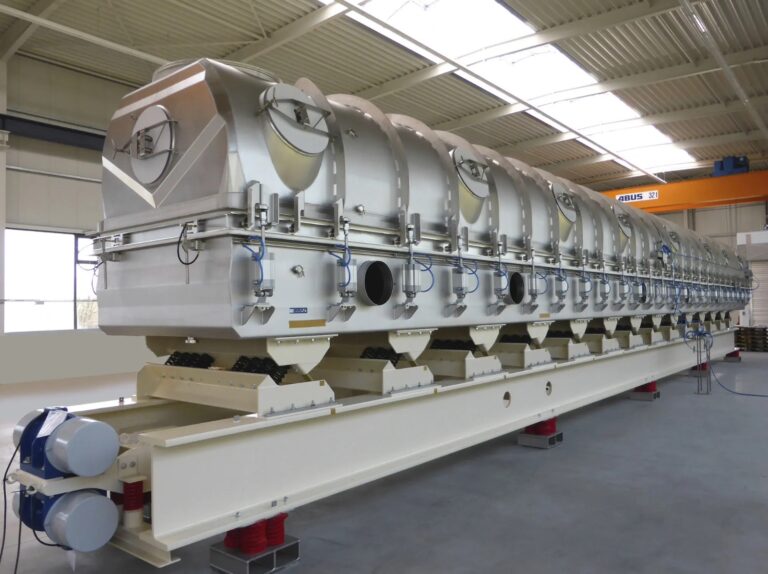
Main Components of a Vibratory Fluidised Bed Dryer System
Vibrating fluidised bed with perforated plate
Vibration drive system with motor and springs
Hot air generation and heating system
Air distribution plenum chamber
Product feed system
Exhaust air ducting and fan
Dust collection system (cyclone or bag filter)
Control panel with airflow and temperature control
Each component plays a critical role in achieving efficient drying, stable product movement, and consistent moisture removal.
Efficient VFBD operation depends on controlling several important process variables.
Air Velocity
Airflow must be carefully controlled to maintain proper fluidisation without excessive particle entrainment.
Inlet Air Temperature
The drying air temperature determines the rate of moisture evaporation.
Bed Depth
Proper bed depth ensures uniform airflow distribution and efficient drying.
Vibration Intensity
Adjustable vibration controls product residence time and material movement.
Residence Time
The time material remains in the dryer determines the final moisture content.
Feed Moisture Content
Higher moisture levels require longer residence time and greater heat input.
Drying processes influence the final physical properties of powders and granular materials.
Important considerations include:
maintaining particle integrity during drying
preventing agglomeration or lump formation
controlling product density and flowability
preserving functional product characteristics
Vibratory fluidised bed drying enables uniform moisture removal while maintaining consistent particle structure and quality.
GTI VFBD dryers can be engineered to suit different product properties, plant layouts, and capacity requirements.
Operation Mode
batch operation
continuous drying
Heating Systems
steam heating
hot air generator
thermic fluid heating
electric heating
Construction Materials
mild steel
stainless steel (SS304 / SS316)
Process Control Options
multi-zone temperature control
adjustable vibration speed
airflow control systems
Automation
manual control
PLC automation
SCADA integration
GTI Dryers specialises in the design and manufacturing of industrial drying equipment for demanding process applications.
Extensive Engineering Experience
Over 40 years of engineering expertise in industrial drying technology.
Custom-Engineered Solutions
Each VFBD dryer is designed based on product characteristics, moisture content, and production capacity.
Industrial-Grade Construction
Heavy-duty equipment designed for long service life and continuous operation.
Energy Efficient Design
Optimised airflow distribution and heat transfer systems reduce energy consumption per kg of product.
Reliable After-Sales Support
Complete assistance for installation, commissioning, and spare parts availability.
If you are planning a Vibratory Fluidised Bed Drying system for powders, granules, or crystalline materials, our engineering team can assist with selecting the most suitable equipment configuration.
We provide:
product drying evaluation
capacity planning
equipment selection
technical specifications and quotation
For more information about industrial Vibratory Fluidised Bed Dryers, contact our engineering team.
📩 Email: mktg@foodtechprojects.com
Our team can assist with:
product drying trials
dryer sizing and design
process optimisation
turnkey drying plant solutions