
Selecting the right industrial drying technology is an important decision for any manufacturing plant. The wrong dryer can increase energy consumption, affect product quality, create production bottlenecks and raise long-term operating costs.
Among the available industrial drying technologies, continuous belt dryers, rotary dryers, spray dryers, flash dryers, paddle dryers and fluid bed dryers serve different processing requirements. Although all these systems remove moisture, their working principles, material compatibility, drying efficiency and operating characteristics are significantly different.
So, which industrial dryer is best for your application?
A continuous belt dryer is particularly suitable for large-scale, continuous drying of solid materials that require controlled temperatures, uniform moisture reduction and gentle handling. However, rotary dryers may be more appropriate for certain bulk materials, spray dryers for liquid feeds, flash dryers for fine powders and fluid bed dryers for materials requiring effective particle fluidisation.
This guide compares the major industrial drying technologies to help manufacturers, engineers and procurement professionals identify the most suitable system based on material characteristics, production capacity, energy requirements, product quality and overall operating economics.
1. What Is a Continuous Belt Dryer and How Does It Work?
A continuous belt dryer is an industrial drying system that removes moisture from materials while transporting them through a heated drying chamber on a continuously moving conveyor belt.
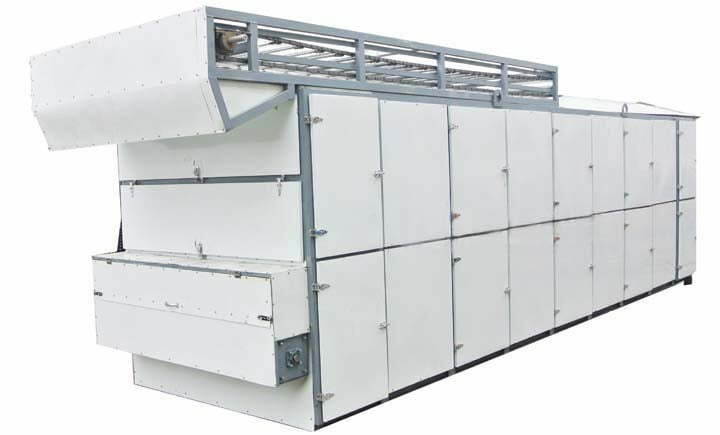
Hot air or another suitable drying medium passes through or across the material layer, transferring heat and evaporating moisture. Depending on the product, the system can use single-pass or multi-pass belt arrangements, adjustable airflow, temperature zones and controlled residence time.
Unlike batch drying systems, continuous belt dryers allow uninterrupted material feeding and discharge, making them suitable for manufacturing facilities with consistent production requirements.
Working Principle of a Continuous Belt Dryer
The drying process generally involves five stages:
- Material Feeding: Wet material is evenly distributed onto the moving conveyor belt.
- Heat Transfer: Heated air circulates through or across the material layer to provide the required drying energy.
- Moisture Evaporation: Moisture evaporates as the material moves through controlled temperature and airflow zones.
- Moisture Exhaust: Moisture-laden air is removed, with optional exhaust-air recirculation and heat recovery depending on system design.
- Product Discharge: Dried material is collected at the discharge end and transferred for further processing, packaging or storage.
The drying temperature, airflow velocity, belt speed, material bed depth and residence time can be adjusted according to the product’s physical and thermal properties.
Key Advantages of Continuous Belt Dryers
- Continuous operation for large-scale industrial production.
- Controlled drying conditions for temperature-sensitive materials.
- Uniform moisture reduction with appropriate material distribution and airflow design.
- Adjustable residence time and drying temperature.
- Suitable for a wide range of food, agricultural, biomass and industrial materials.
- Multi-zone drying configurations for different moisture-removal requirements.
- Potential for exhaust-air recirculation and heat recovery to improve energy performance.
- Reduced manual material handling compared with conventional batch drying systems.
2. Comparison of Continuous Belt Dryer vs. Other Industrial Drying Technologies
Not every industrial dryer works equally well for every material. Understanding the differences is essential before investing in a drying system.
A. Continuous Belt Dryer vs. Rotary Dryer
A rotary dryer uses a rotating cylindrical drum to move and dry bulk materials. Heat is transferred through direct contact with hot gases, indirectly through the drum wall, or through a suitable combination depending on its configuration.
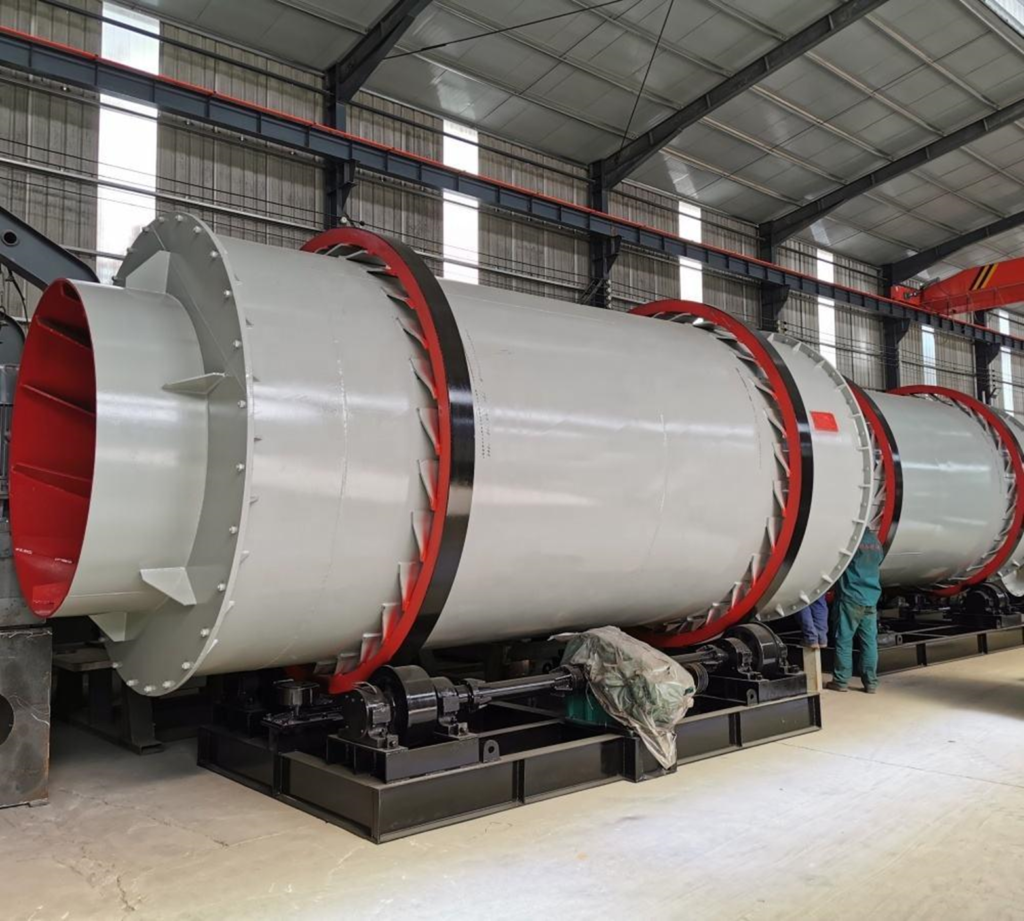
A continuous belt dryer transports material on a conveyor belt and uses controlled airflow to remove moisture.
Key Differences:
| Comparison Parameter | Continuous Belt Dryer | Rotary Dryer |
|---|---|---|
| Working Principle | Conveyor-based hot-air drying | Rotating drum drying |
| Material Handling | Controlled movement on a belt | Tumbling and cascading |
| Product Handling | Generally gentler | More mechanical agitation |
| Temperature Control | Can use multiple controlled zones | Depends on drum and gas configuration |
| Material Suitability | Solids, slices, granules and structured materials | Bulk solids, granules and certain coarse materials |
| Typical Applications | Food, biomass, agricultural products | Minerals, biomass, chemicals and bulk materials |
Which One Should You Choose?
Choose a continuous belt dryer when the product requires controlled airflow, relatively gentle handling and uniform drying conditions. A rotary dryer may be preferable for bulk materials that can tolerate tumbling and require a robust processing arrangement.
B. Continuous Belt Dryer vs. Spray Dryer
A spray dryer converts liquid feed into dry powder by atomising the liquid into fine droplets inside a heated drying chamber.
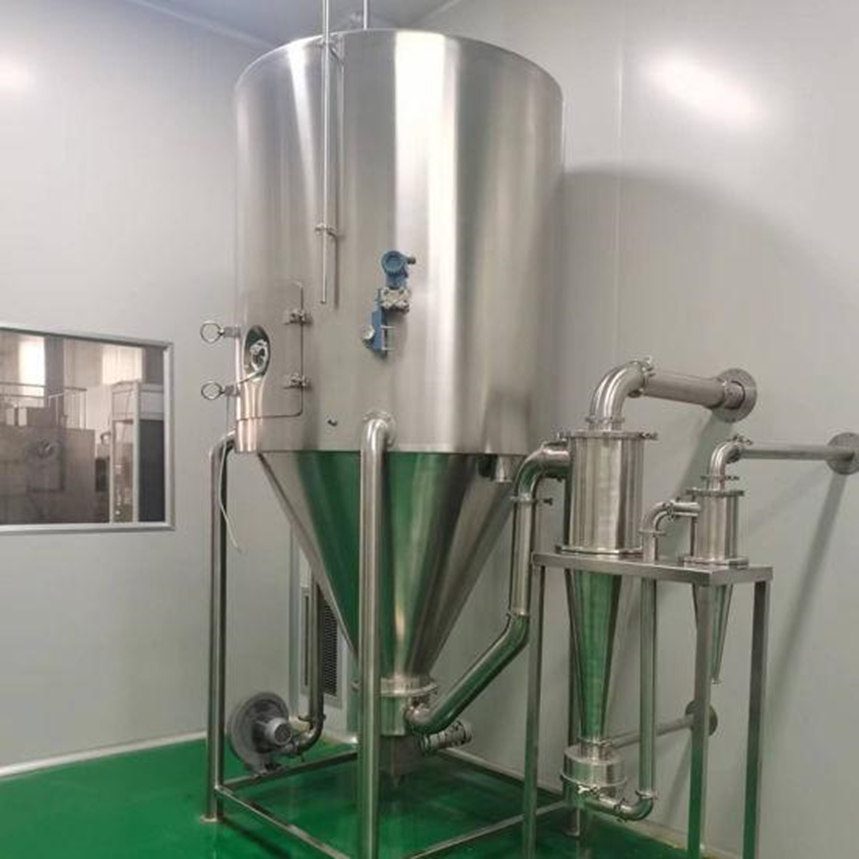
A continuous belt dryer is primarily designed for solid materials distributed over a conveyor belt.
Key Differences:
| Comparison Parameter | Continuous Belt Dryer | Spray Dryer |
|---|---|---|
| Feed Material | Wet solids and semi-solid materials | Liquid solutions, emulsions and slurries |
| Working Principle | Hot-air drying on a moving belt | Atomisation and rapid droplet drying |
| Final Product | Dried solids, flakes, granules or pieces | Powder |
| Product Handling | Conveyor-based | Droplet-based |
| Typical Applications | Fruits, vegetables, biomass and food ingredients | Milk powder, coffee powder and chemical powders |
Which One Should You Choose?
A spray dryer is generally the appropriate choice when a liquid feed must be converted directly into powder. A belt dryer is more suitable when the material is already in solid or semi-solid form and requires controlled moisture reduction.
C. Continuous Belt Dryer vs. Flash Dryer
A flash dryer uses high-velocity hot air to rapidly dry fine, wet or dispersed materials. Moisture evaporates during the short period in which particles are suspended and transported through the drying system.
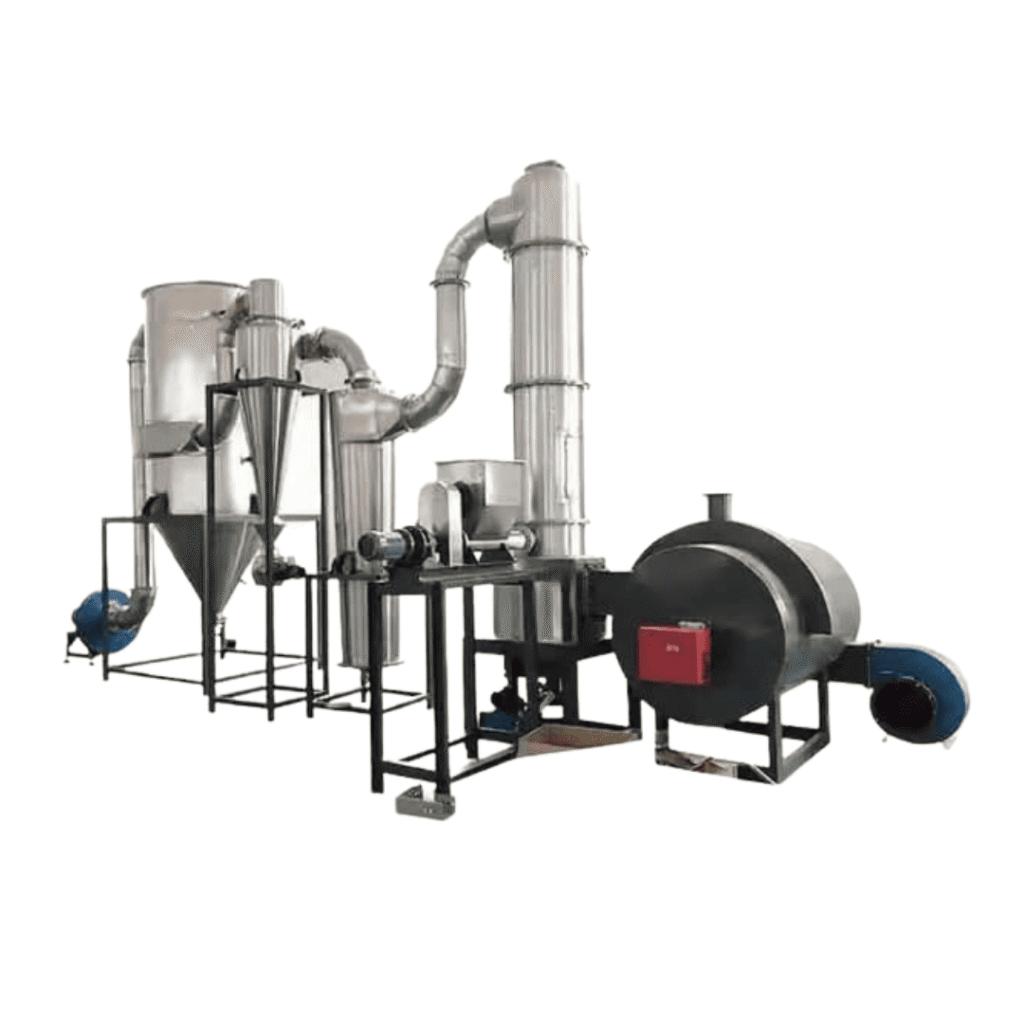
A belt dryer uses a moving conveyor and controlled residence time for drying.
Key Differences:
| Comparison Parameter | Continuous Belt Dryer | Flash Dryer |
|---|---|---|
| Feed Material | Solid, sliced, granular and semi-solid materials | Fine, wet and dispersible materials |
| Drying Method | Conveyor-based drying | Pneumatic drying |
| Residence Time | Generally longer and adjustable | Generally very short |
| Material Movement | Conveyor belt | High-velocity air |
| Product Suitability | Materials requiring controlled drying | Materials suitable for rapid pneumatic drying |
| Typical Applications | Food, biomass and agricultural products | Starch, chemicals, powders and certain minerals |
Which One Should You Choose?
A belt dryer is suitable when materials require controlled drying over a longer residence time. A flash dryer is more appropriate for materials that can be dispersed and dried rapidly through a hot-air stream.
D. Continuous Belt Dryer vs. Fluid Bed Dryer
A fluid bed dryer works by passing heated air upward through a perforated distribution plate, suspending suitable particles and creating a fluid-like movement.
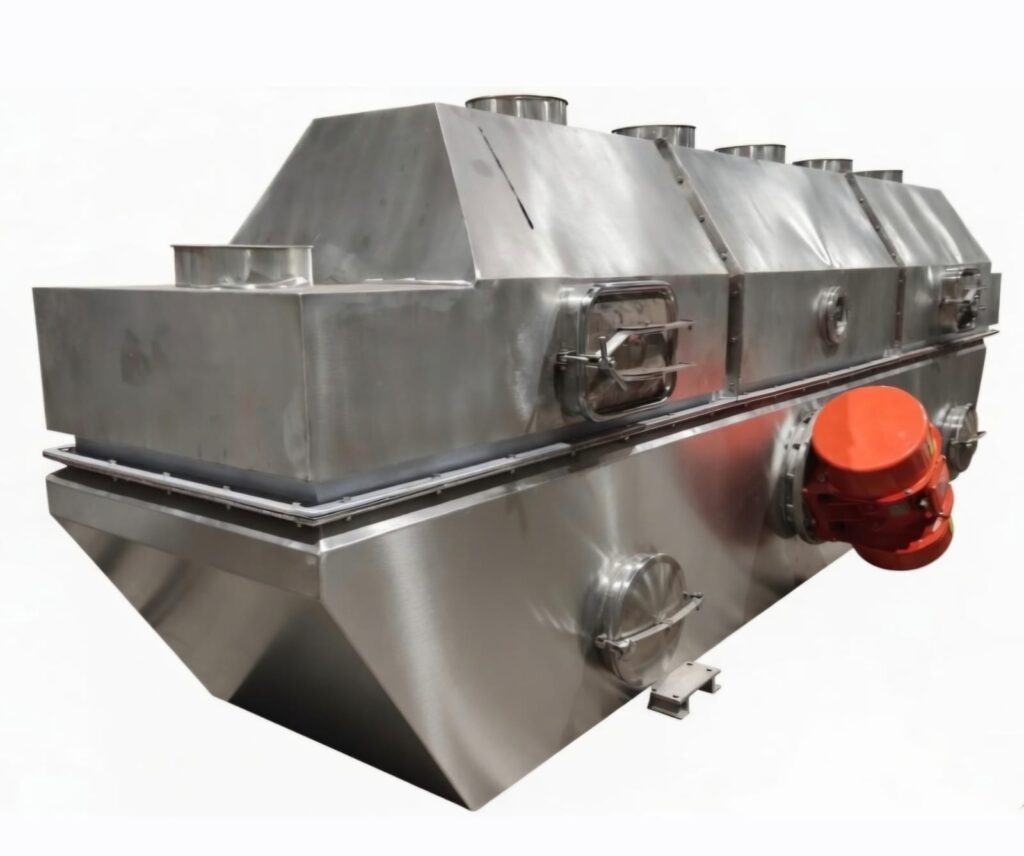
A belt dryer maintains the material on a moving conveyor while hot air passes through or across the product layer.
Key Differences:
| Comparison Parameter | Continuous Belt Dryer | Fluid Bed Dryer |
|---|---|---|
| Material Movement | Conveyor-based | Air-fluidised particles |
| Drying Method | Controlled hot-air circulation | Direct contact with fluidising air |
| Material Suitability | Slices, granules, flakes and structured solids | Free-flowing particles and granules |
| Product Handling | Relatively gentle conveyor movement | Particle movement and agitation |
| Drying Control | Belt speed, airflow and temperature | Air velocity, temperature and residence time |
| Typical Applications | Food, biomass and agricultural products | Chemicals, pharmaceuticals, food granules and powders |
Which One Should You Choose?
A belt dryer is often preferable for larger pieces, slices and materials that should remain relatively undisturbed. A fluid bed dryer is suitable for free-flowing particles requiring effective air-solid contact and rapid moisture removal.
E. Continuous Belt Dryer vs. Paddle Dryer
A paddle dryer is an indirect-contact drying system that uses heated rotating paddles to transfer heat to wet materials inside a processing chamber.
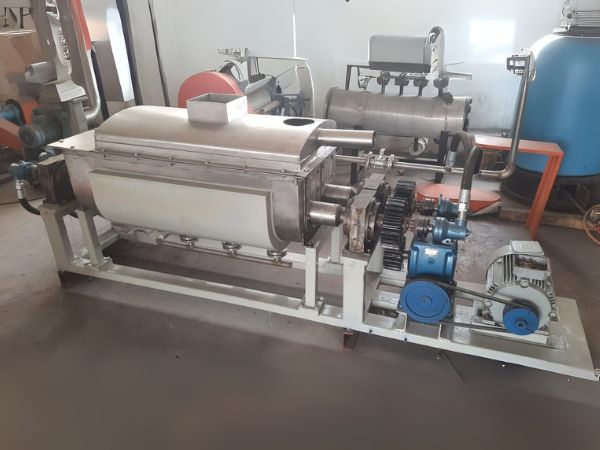
A belt dryer primarily uses controlled hot-air circulation to remove moisture from materials moving along a conveyor.
Key Differences:
| Comparison Parameter | Continuous Belt Dryer | Paddle Dryer |
|---|---|---|
| Heat Transfer | Primarily hot-air convection | Primarily indirect heat transfer |
| Material Movement | Conveyor belt | Rotating heated paddles |
| Material Suitability | Solids, granules and structured products | Wet pastes, sludge, cakes and certain bulk solids |
| Product Handling | Relatively gentle | Mechanical mixing and agitation |
| Typical Applications | Food, biomass and agricultural products | Industrial sludge, chemicals and process residues |
Which One Should You Choose?
A belt dryer is suitable for materials that can be spread and transported across a conveyor. A paddle dryer is often more suitable for sticky, viscous or sludge-like materials that require mechanical mixing and indirect heating.
3. Industrial Dryer Comparison: Which Technology Is Best?
The following table provides a quick selection guide for industrial buyers.
| Dryer Technology | Best Suited For | Main Drying Advantage | Important Consideration |
|---|---|---|---|
| Continuous Belt Dryer | Solid and semi-solid materials | Controlled continuous drying | Requires suitable material distribution |
| Rotary Dryer | Bulk solids and granules | Robust bulk material processing | Mechanical movement may affect fragile products |
| Spray Dryer | Liquids and slurries | Direct powder production | Atomisation and energy requirements |
| Flash Dryer | Fine wet powders | Rapid moisture removal | Requires suitable particle characteristics |
| Fluid Bed Dryer | Free-flowing particles | Effective air-solid contact | Material must be fluidisable |
| Paddle Dryer | Sludge, pastes and wet cakes | Indirect heating and mechanical mixing | Requires suitable mechanical handling |
Important: No single dryer is universally the most energy-efficient or cost-effective. Actual performance depends on feed moisture, final moisture requirement, material properties, operating temperature, exhaust conditions, heat recovery and plant configuration.
4. Energy Efficiency: Which Industrial Dryer Consumes Less Energy?
Energy consumption is one of the most important considerations when selecting an industrial drying system.
However, comparing dryers only by their installed motor power or heating capacity can be misleading. A more useful performance indicator is:
Specific Energy Consumption (SEC):
Specific energy consumption measures the energy required to evaporate a given quantity of water.
It can be expressed as:
SEC = Total Energy Consumed (kWh) ÷ Water Evaporated (kg)
For example, if a dryer consumes 500 kWh of energy to evaporate 1,000 kg of water:
SEC = 500 ÷ 1,000 = 0.5 kWh/kg of water evaporated.
Actual SEC should be calculated using consistent system boundaries and operating conditions.
Factors That Influence Dryer Energy Consumption
- Initial and final moisture content.
- Material composition and moisture-binding characteristics.
- Drying temperature and airflow requirements.
- Ambient temperature and humidity.
- Exhaust-air moisture and heat losses.
- Heat recovery and air recirculation arrangements.
- Insulation and equipment design.
- Production loading and operating efficiency.
Why Consider a Continuous Belt Dryer?
A properly designed belt dryer can improve energy utilisation through controlled airflow, multiple temperature zones, exhaust-air recirculation and heat recovery options. Its suitability depends on the product’s moisture characteristics and the required production conditions.
5. Industrial Dryer Cost: Initial Investment vs. Operating Cost
The purchase price of an industrial dryer should not be the only factor influencing a buying decision.
A system with a lower initial investment may have higher energy, labour and maintenance costs over its operating life.
Industrial buyers should evaluate the total cost of ownership (TCO).
Major Cost Components
- Initial Equipment Cost: Dryer structure, heating system, conveyor, fans, controls and accessories.
- Energy Consumption: Fuel, electricity, steam or other heating utilities.
- Maintenance Cost: Belts, bearings, motors, seals, filters and other components.
- Labour Requirements: Material feeding, unloading, cleaning and operational supervision.
- Production Losses: Downtime, rejected products and inconsistent moisture levels.
- Installation Cost: Civil work, electrical connections, ducting and commissioning.
Which Dryer Offers Better Cost Efficiency?
- Continuous Belt Dryer: Can offer operational advantages in continuous, large-scale production with suitable material handling.
- Rotary Dryer: Can be economical for high-volume bulk material processing.
- Spray Dryer: Appropriate when direct conversion of liquid feed into powder is required.
- Flash Dryer: Can offer compact and rapid processing for suitable fine materials.
- Fluid Bed Dryer: Suitable for efficient particle drying where fluidisation is possible.
- Paddle Dryer: Can be attractive for applications requiring indirect drying of wet pastes and sludge.
The best investment is the system that meets the required product quality and throughput at an acceptable lifecycle cost.
6. How to Choose the Right Industrial Dryer for Your Industry
Before selecting a dryer, manufacturers should evaluate the following technical and operational requirements.
| Selection Factor | What Buyers Should Evaluate |
|---|---|
| Material Type | Powder, granules, slices, sludge, paste or liquid |
| Initial Moisture | Moisture percentage before drying |
| Final Moisture | Required moisture content after drying |
| Production Capacity | Required kg/hr or MT/day |
| Temperature Sensitivity | Maximum acceptable product temperature |
| Product Characteristics | Particle size, stickiness, density and fragility |
| Energy Availability | Electricity, steam, gas, biomass or thermal oil |
| Space Availability | Equipment footprint and plant layout |
| Product Quality | Colour, texture, structure and moisture uniformity |
| Future Expansion | Scope for increased production capacity |
Which Dryer Is Best for Different Industries?
Food Processing Industry
Continuous belt dryers are suitable for drying fruits, vegetables, herbs, spices, food ingredients and other solid food products. Spray dryers are more appropriate for liquid food feeds, while fluid bed dryers can process suitable granules.
Biomass and Agricultural Industry
Belt dryers and rotary dryers are used for different biomass and agricultural drying requirements. The choice depends on particle size, material handling characteristics, moisture content and production capacity.
Rotary, paddle, flash, fluid bed and belt dryers may all be suitable depending on the chemical’s physical properties, thermal sensitivity and required final product form.
Fluid bed, spray and other specialised drying systems are selected according to product characteristics, process requirements and applicable quality and validation standards.
Wastewater and Sludge Processing
Paddle dryers and other specialised sludge drying systems are commonly considered for wet sludge and dewatered cake. Belt-based systems may also be suitable for specific sludge characteristics and process configurations.
7. Why Continuous Belt Dryers Are Preferred for Certain Industrial Applications
Continuous belt dryers offer several advantages for manufacturers who need controlled and uninterrupted drying of solid materials.
Their major benefits include:
- Continuous Production: Supports consistent material feeding and discharge.
- Controlled Drying: Adjustable temperature, airflow and residence time.
- Product Quality: Helps maintain consistent drying conditions when properly designed.
- Flexible Configuration: Single-belt and multi-belt arrangements can be designed for different applications.
- Material Compatibility: Suitable for various food, agricultural and biomass products.
- Energy Management: Recirculation and heat recovery can be incorporated where technically appropriate.
- Industrial Scalability: Can be configured according to required throughput and material characteristics.
The actual benefits depend on the dryer configuration, feed preparation, process design and operating conditions.
8. Why Choose GTI Dryers for Industrial Drying Solutions?
Choosing the right industrial dryer requires more than selecting a machine based on its name or advertised capacity. It requires an understanding of material characteristics, moisture-removal requirements, production targets and operating economics.
GTI Dryers (Genex Tech Industries) provides industrial drying solutions designed around different material and processing requirements.
When evaluating a drying system, manufacturers should consider:
- Application-specific dryer selection.
- Required evaporation capacity and throughput.
- Suitable heating and airflow arrangements.
- Material handling and feeding requirements.
- Temperature and moisture control.
- Energy utilisation and heat recovery possibilities.
- Equipment configuration and plant integration.
- Installation, commissioning and technical support requirements.
Whether your application involves food processing, biomass drying, chemical manufacturing, agricultural products or industrial sludge, selecting the correct technology is essential for reliable production.
Looking for the Right Industrial Drying Solution?
Share your material details, initial and final moisture content, required production capacity and available heating source with the GTI Dryers team.
Our technical team can help evaluate the suitable drying technology and identify an appropriate industrial drying configuration for your application.
9. Frequently Asked Questions (FAQs)
1. What is the difference between a continuous belt dryer and a rotary dryer?
A continuous belt dryer uses a moving conveyor to transport materials through a controlled hot-air drying chamber. A rotary dryer uses a rotating drum to tumble and dry bulk materials. Belt dryers are suitable for controlled drying of many solid products, while rotary dryers are commonly used for bulk materials that can tolerate mechanical movement.
2. Which is better: a belt dryer or a spray dryer?
Neither is universally better. A belt dryer is suitable for wet solid materials, whereas a spray dryer is designed to convert liquid feeds, solutions and slurries into dry powder.
3. Which industrial dryer is most energy-efficient?
Energy efficiency depends on material properties, moisture removal requirements, operating conditions and heat recovery. No single drying technology is the most energy-efficient for every application. Specific energy consumption should be evaluated under comparable operating conditions.
4. What materials can be processed in a continuous belt dryer?
Continuous belt dryers can process various solid and semi-solid materials, including fruits, vegetables, spices, herbs, biomass, agricultural products, food ingredients and selected industrial materials.
5. Is a continuous belt dryer suitable for large-scale production?
Yes. Continuous belt dryers can be designed for industrial-scale production with appropriate belt width, drying length, number of passes, airflow and material loading arrangements.
6. What factors determine the cost of an industrial dryer?
The cost depends on processing capacity, moisture evaporation requirements, material characteristics, construction material, heating system, automation, accessories, installation and plant integration.
7. What is the difference between a belt dryer and a fluid bed dryer?
A belt dryer transports materials on a conveyor while heated air removes moisture. A fluid bed dryer suspends suitable particles using upward-moving air. Belt dryers are suitable for slices and larger solid pieces, while fluid bed dryers are generally suited to free-flowing particles and granules.
8. How do I calculate the required industrial dryer capacity?
Capacity depends on wet feed rate, initial moisture, target final moisture and operating time.
For moisture percentages expressed on a wet basis:
Water Evaporation Rate = Wet Feed Rate × (Initial Moisture − Final Moisture) ÷ (100 − Final Moisture)
For example, drying 1,000 kg/hr of material from 60% moisture to 10% moisture requires the removal of approximately 555.6 kg/hr of water, assuming no loss of dry solids.
9. Can a continuous belt dryer handle heat-sensitive materials?
Yes, suitable belt dryer configurations can process many heat-sensitive materials through controlled temperature zones, airflow and residence time. However, the maximum allowable product temperature and product quality requirements must be established before equipment selection.
10. How do I select the right industrial dryer for my factory?
Start by identifying the feed material, initial moisture, target final moisture, production capacity, temperature sensitivity, available utilities and required product quality. A technical evaluation or material drying trial may be necessary for accurate equipment selection.
Conclusion: Select the Right Drying Technology for Better Industrial Performance
Selecting between a continuous belt dryer, rotary dryer, spray dryer, flash dryer, fluid bed dryer or paddle dryer depends on the material being processed and the production objectives.
A continuous belt dryer is a strong option for manufacturers requiring controlled, continuous drying of solid materials. Rotary dryers are suitable for many bulk solids, spray dryers for liquid-to-powder conversion, flash dryers for suitable fine wet materials, fluid bed dryers for free-flowing particles and paddle dryers for certain wet pastes and sludge applications.
The right selection can improve product consistency, optimise energy consumption, reduce operating costs and support long-term production efficiency.
Need help selecting the right industrial dryer?
Contact GTI Dryers – Genex Tech Industries to discuss your material, moisture-removal requirements and production capacity. Find a suitable industrial drying solution based on your actual process requirements rather than choosing equipment by capacity alone.
Contact the GTI Technical Team:
Website: gtidryers.com
Email: mktg@gtidryers.com
Phone / WhatsApp: +91 9330077417